
March is the third month of the year and a period of noticeable seasonal change. It has 31 days and falls between February and April. In the Northern Hemisphere, March usually marks the arrival of spring, while in the Southern Hemisphere it brings the beginning of autumn. Because weather patterns are shifting, the month can include sunshine, rain, strong winds, late snow, and sudden changes in temperature.
March takes its name from Mars, the Roman god of war. In the earliest Roman calendar, it was the first month of the year because it arrived when winter was ending and military campaigns and agricultural work could begin again. January and February were later placed at the beginning of the calendar, making March the third month while preserving its original name.
One of the month’s most important natural events is the equinox, which usually occurs around March 20. At this time, day and night are approximately equal in length across much of the world. In the Northern Hemisphere, the March equinox begins astronomical spring, while in the Southern Hemisphere it signals the start of autumn. Afterward, northern days continue growing longer as southern nights gradually increase.
Nature becomes especially active during March in many northern regions. Trees begin producing buds, early flowers such as daffodils and crocuses appear, and birds return from seasonal migrations. Gardeners prepare soil, plant seeds, and clean outdoor spaces. Rainfall helps new plants grow, although cold mornings and occasional frost may continue.
March also includes several well-known celebrations and observances. Saint Patrick’s Day is celebrated on March 17 with green clothing, parades, music, and traditions connected with Ireland. Women’s History Month recognizes the achievements and contributions of women, while International Women’s Day takes place on March 8. Depending on the year, religious observances such as Lent, Easter, Ramadan, or Passover may also fall partly within the month.
Sports, school activities, spring cleaning, outdoor walks, and preparations for warmer weather give March an energetic atmosphere. It often feels unpredictable, but it also represents renewal, movement, and the promise of a new season.
Welcome the changing weather and fresh energy of the season with this printable March word search puzzle, featuring 24 carefully selected words inspired by spring flowers, rain, wind, celebrations, longer days, outdoor activities, and the gradual return of warmer weather.
Related Word Searches:
St. Patrick’s Day | Spring | February | April | Easter | Pi Day
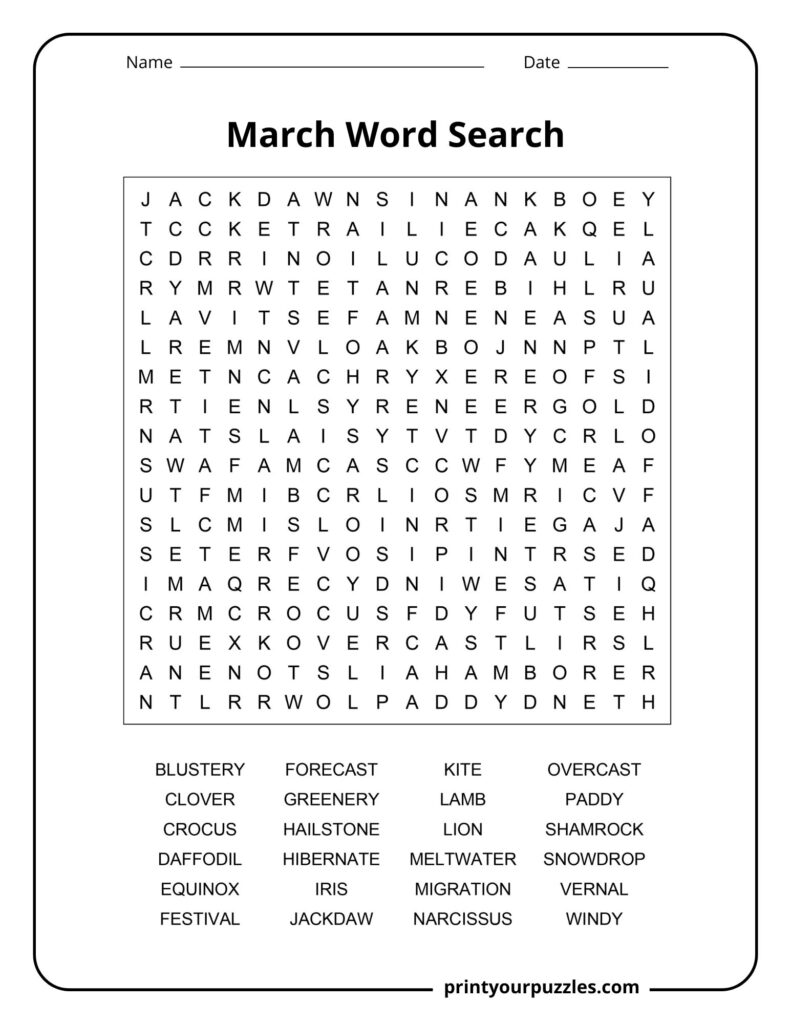
BLUSTERY, CLOVER, CROCUS, DAFFODIL, EQUINOX, FESTIVAL, FORECAST, GREENERY, HAILSTONE, HIBERNATE, IRIS, JACKDAW, KITE, LAMB, LION, MELTWATER, MIGRATION, NARCISSUS, OVERCAST, PADDY, SHAMROCK, SNOWDROP, VERNAL, WINDY
BLUSTERY – Describes wild, gusty weather with strong winds that blow in unpredictable bursts, often bringing heavy rain or clouds, typical of March’s stormy and unsettled atmospheric conditions.
CLOVER – A low-growing plant with three rounded leaflets commonly found in meadows and lawns, associated with good luck and Irish culture, and one of the first plants to green up in early spring.
CROCUS – A small, cup-shaped flower that pushes through frozen or cold soil in late winter and early spring, appearing in purple, yellow, or white, and signalling the imminent arrival of warmer weather.
DAFFODIL – A bright yellow trumpet-shaped flower that blooms in early spring, widely regarded as one of the most cheerful seasonal symbols, and the national flower of Wales, celebrated each March.
EQUINOX – The moment in March when day and night are of approximately equal length worldwide, marking the official astronomical start of spring in the Northern Hemisphere around the 20th or 21st.
FESTIVAL – A public celebration or organized event bringing communities together around a shared theme, cultural tradition, or seasonal occasion, with many spring festivals taking place throughout March globally.
FORECAST – A prediction of upcoming weather conditions based on meteorological data and atmospheric analysis, particularly important in unpredictable March when sunshine, rain, and frost can all occur within a single day.
GREENERY – The fresh, vibrant growth of leaves, grass, and plants that begins to emerge as temperatures rise in spring, transforming bare winter landscapes into lush, colourful scenes full of renewed life.
HAILSTONE – A small pellet of ice formed inside storm clouds and falling rapidly to earth during heavy spring showers, capable of damaging plants and property, and common during March’s volatile weather patterns.
HIBERNATE – To enter a prolonged state of deep sleep and reduced metabolism during winter, as many animals do, emerging in March when rising temperatures and lengthening days signal that spring has arrived.
IRIS – A flowering plant with elegant, sword-shaped leaves and distinctive blooms in shades of purple, blue, and yellow, often among the first spring flowers to appear in gardens during March and April.
JACKDAW – A small, intelligent member of the crow family with glossy black plumage and pale grey markings, highly active in early spring when it begins nesting, foraging, and forming large, noisy social flocks.
KITE – A lightweight frame covered in fabric or plastic flown on a string in open spaces, a popular outdoor activity enjoyed during March’s breezy days when strong spring winds provide ideal flying conditions.
LAMB – A newborn or young sheep, born in large numbers during late winter and early spring, whose playful presence in green fields is one of the most iconic and endearing symbols of the season.
LION – Referenced in the traditional saying “March comes in like a lion,” describing the month’s fierce, stormy start, before it reportedly calms into gentler, lamb-like conditions as the season progresses toward April.
MELTWATER – Water produced by the thawing of snow and ice as temperatures climb in early spring, flowing into rivers and streams, replenishing reservoirs, and sometimes causing localized flooding across low-lying areas in March.
MIGRATION – The seasonal movement of birds and other animals travelling from warmer winter regions back to their summer breeding grounds, with millions of species returning northward throughout March as daylight hours increase.
NARCISSUS – The botanical genus encompassing daffodils and jonquils, celebrated for their fragrant, elegant blooms in white and yellow, blooming prolifically in gardens and wild meadows during the cool, bright days of early spring.
OVERCAST – A sky completely covered by thick grey cloud, blocking direct sunlight and creating dull, flat light conditions, frequently experienced during March when weather systems bring prolonged spells of cloud and dampness.
PADDY – An informal name for Saint Patrick, the patron saint of Ireland, whose feast day on 17 March is celebrated worldwide with parades, green attire, traditional music, and festivities honoring Irish heritage and culture.
SHAMROCK – A small three-leafed clover plant adopted as the national emblem of Ireland, famously used by Saint Patrick to illustrate the Christian Trinity, and universally worn on Saint Patrick’s Day each 17 March.
SNOWDROP – One of the earliest flowers of the year, producing delicate white drooping blooms on slender green stems, often pushing through snow or frozen ground in late winter as a hopeful herald of approaching spring.
VERNAL – An adjective meaning of, relating to, or occurring in spring, most commonly used in the phrase “vernal equinox,” which marks the point in March when the sun crosses the celestial equator heading northward.
WINDY – Characterized by strong, persistent air movement, a defining feature of March weather in many regions, where pressure changes and temperature contrasts between seasons create powerful gusts across open landscapes and coastal areas.
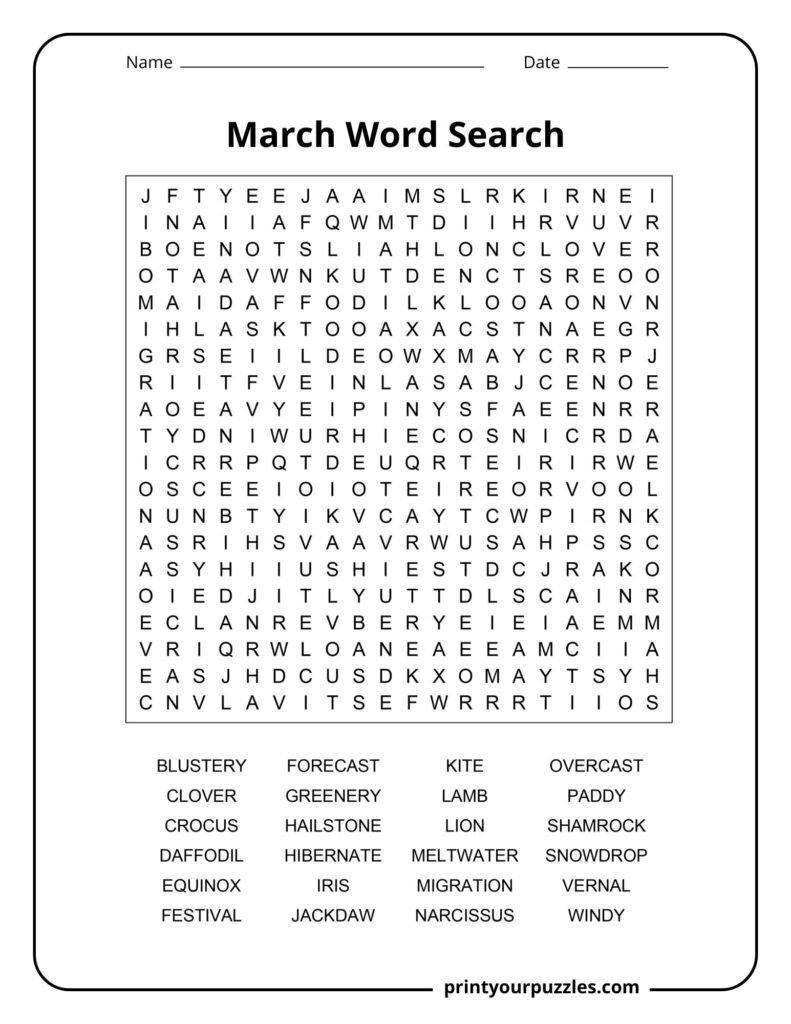
BLUSTERY, CLOVER, CROCUS, DAFFODIL, EQUINOX, FESTIVAL, FORECAST, GREENERY, HAILSTONE, HIBERNATE, IRIS, JACKDAW, KITE, LAMB, LION, MELTWATER, MIGRATION, NARCISSUS, OVERCAST, PADDY, SHAMROCK, SNOWDROP, VERNAL, WINDY
March hosts the vernal equinox, around the 20th or 21st, when day and night are equal, marking the official astronomical beginning of spring in the Northern Hemisphere.
It describes March’s typical weather pattern: stormy, fierce conditions at the month’s start gradually giving way to calmer, milder, and more pleasant weather by the end.
17 March marks the traditional death date of Saint Patrick, the patron saint of Ireland, who is credited with bringing Christianity to the island during the fifth century.
Newborn lambs, returning migratory birds, and emerging hibernating mammals are strongly linked to March, as rising temperatures and longer days trigger new life and seasonal movement across the natural world.
Snowdrops, crocuses, daffodils, and narcissus are the most common March bloomers, thriving in cool soil and brightening gardens with early colour after the long, bare months of winter.
Something is shifting. The light changes, the earth stirs, and after months of stillness there is an almost unbearable sense of possibility. These three books share March’s restless energy — the feeling that something, at last, is about to begin.
The Secret Garden – Frances Hodgson Burnett. A neglected garden slowly comes back to life, mirroring the world outside your window as winter finally loosens its grip.
Their Eyes Were Watching God – Zora Neale Hurston. A woman steps into her own life with the force of spring itself. Lush, powerful, and bursting with new beginnings.
Germinal – Émile Zola. Miners rise up from the dark earth with fury and hope. Raw, unstoppable energy — like the ground itself breaking open in March.
In the ancient Roman calendar, March was the year’s opening month, named after Mars, the god of war, until January and February were added around 713 BC.
March’s full moon is traditionally called the Worm Moon, named by
Native Americans after earthworms that begin surfacing as the ground thaws and spring soil softens.
Due to the mathematical structure of the calendar, March 1st and November 1st always fall on the exact same day of the week, in any given year.
New York City’s annual parade draws over two million spectators, making it significantly larger than any celebration held in Dublin or elsewhere across Ireland itself.
Romans believed March, being sacred to the war god Mars, was an inauspicious time for weddings, preferring calmer months like June for celebrations of love and union.