Introduction to the Election Day Word Search
Election Day is an important part of civic life in the United States, giving eligible citizens the opportunity to choose their representatives and help shape public policy. Federal elections are held on the Tuesday after the first Monday in November. Depending on the year, voters may select a president, members of Congress, governors, state legislators, judges, mayors, school board members, and other public officials.
Presidential elections take place every four years, while congressional, state, and local elections follow different schedules. The House of Representatives is elected every two years, and senators serve six-year terms, with only some Senate seats contested during each election cycle. Local elections may also be held at other times of the year, depending on the rules of each state or community.
Before casting a ballot, voters usually register and confirm where and how they can vote. Election procedures vary across the country. Some people vote in person at a polling place on Election Day, while others use early voting or submit an absentee or mail-in ballot. At polling locations, trained election workers check voter information, provide instructions, and help ensure that ballots are handled correctly.
A ballot may include candidates from different political parties, independent candidates, proposed laws, constitutional amendments, bonds, or local measures. Voters can learn about these choices by reading official guides, watching debates, attending community meetings, and comparing candidates’ positions. Reliable information is especially important because campaign advertisements and social media messages may present incomplete or misleading claims.
Several familiar symbols are connected with Election Day, including voting booths, ballot boxes, campaign signs, stickers, and the red, white, and blue colors of the American flag. Many voters proudly wear an “I Voted” sticker after participating. Schools, libraries, and civic organizations may also organize lessons and activities explaining elections, government, and citizenship.
After the polls close, election officials count and verify the ballots. Some results become clear quickly, while close contests or large numbers of mail-in ballots may require additional time. Certification and recount procedures help confirm the official outcome.
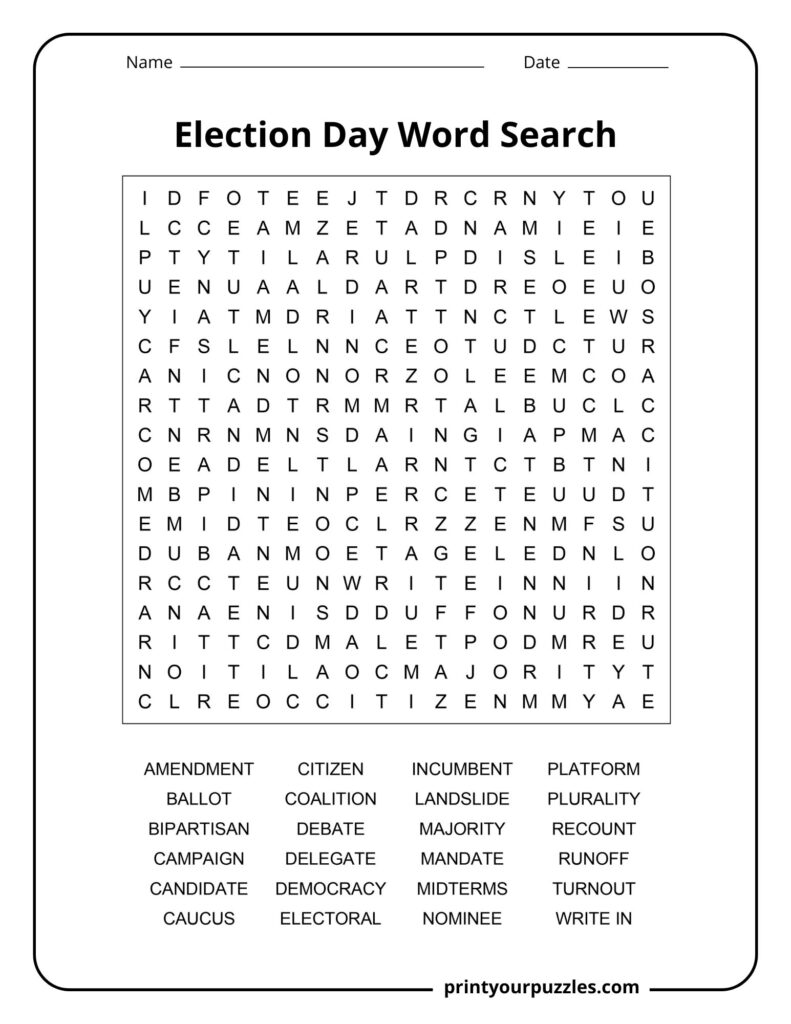
Explore voting, ballots, candidates, campaigns, government, and civic responsibility with this Election Day word search, featuring 24 carefully selected words inspired by polling places, public office, political participation, and the democratic process.
Related Word Searches:
November | Constitution Day | Presidents’ Day | 4th of July | Veterans Day
Medium Difficulty Word Search
Words to Find
AMENDMENT, BALLOT, BIPARTISAN, CAMPAIGN, CANDIDATE, CAUCUS, CITIZEN, COALITION, DEBATE, DELEGATE, DEMOCRACY, ELECTORAL, INCUMBENT, LANDSLIDE, MAJORITY, MANDATE, MIDTERMS, NOMINEE, PLATFORM, PLURALITY, RECOUNT, RUNOFF, TURNOUT, WRITE IN
All Words Defined
AMENDMENT – A formal change or addition made to a constitution, law, or official document, often proposed and voted on by elected representatives or directly by citizens during an election.
BALLOT – The official paper or digital form used by voters to record their choices during an election, listing candidates and measures for each office or issue being decided.
BIPARTISAN – Involving cooperation and agreement between two major political parties, often resulting in legislation or decisions that reflect shared priorities beyond strict party lines.
CAMPAIGN – An organized effort by a candidate or political party to win public support, involving speeches, advertising, fundraising, and outreach activities leading up to Election Day.
CANDIDATE – A person who officially declares their intention to run for a public office and seeks to earn enough votes from citizens to win an elected position.
CAUCUS – A gathering of members of a political party at the local level to discuss policies, select delegates, or determine which candidate the group will support in an upcoming election.
CITIZEN – A legally recognized member of a country who holds certain rights and responsibilities, including the fundamental democratic right to vote in local, regional, and national elections.
COALITION – An alliance formed between different political parties, groups, or individuals who temporarily unite around shared goals in order to gain enough support to win or govern effectively.
DEBATE – A structured public event where candidates present and defend their positions on key issues, respond to opponents’ arguments, and attempt to persuade undecided voters before an election.
DELEGATE – A representative chosen by voters or party members to attend a convention or larger assembly and cast votes on behalf of a specific candidate or political position.
DEMOCRACY – A system of government in which power belongs to the people, who exercise it directly or through freely elected representatives chosen in regular, fair, and competitive elections.
ELECTORAL – Relating to elections or the process of electing officials, often used to describe the system, college, or procedures through which votes are counted and winners are determined.
INCUMBENT – The current holder of an elected office who is seeking to be re-elected, generally considered to have an advantage due to name recognition and access to existing resources.
LANDSLIDE – An overwhelming electoral victory in which one candidate wins by a very large margin of votes, clearly dominating the opponent across most or all voting districts and demographics.
MAJORITY – More than half of the total votes cast in an election, often required for a candidate or measure to win, ensuring that the winning choice has broad popular support.
MANDATE – The authority given to an elected official or party by voters to carry out specific policies or a particular agenda, interpreted from the size or decisiveness of their electoral victory.
MIDTERMS – Elections held approximately halfway through a president’s term, during which voters elect members of Congress and various state officials, often seen as a referendum on the current administration.
NOMINEE – The officially selected candidate of a political party who will represent that party in a general election, chosen through primaries, caucuses, or a formal party convention process.
PLATFORM – The official set of goals, values, and policy positions adopted by a political party or candidate, intended to communicate their priorities and vision to voters before an election.
PLURALITY – The highest number of votes received by any single candidate in a race where no one earns an outright majority, which in many electoral systems is still enough to win.
RECOUNT – A second official tallying of votes conducted when results are extremely close or disputed, ensuring accuracy and fairness in the final outcome of a competitive election.
RUNOFF – A follow-up election held between the top two candidates when no one received the required number or percentage of votes to win outright during the initial election round.
TURNOUT – The percentage or total number of eligible voters who actually cast their ballots in a given election, often used as a measure of public engagement and democratic participation.
WRITE IN – A vote cast for a candidate whose name does not appear on the official ballot, requiring the voter to manually write in the person’s name in a designated space.
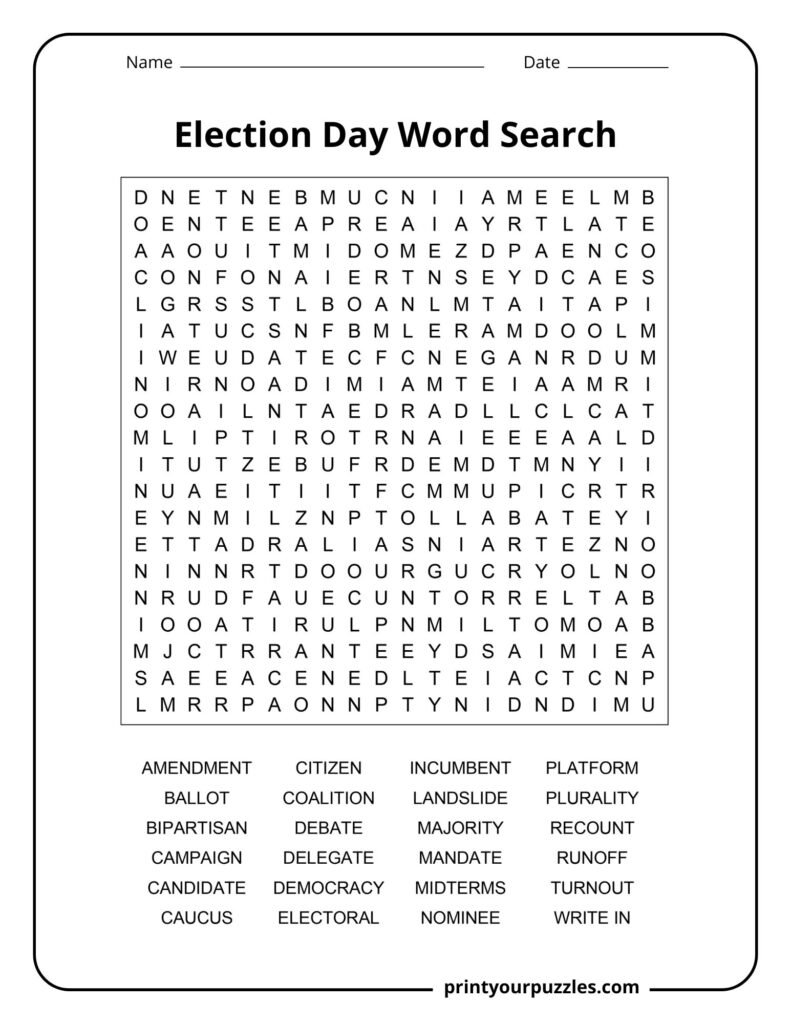
Hard Difficulty Word Search
Words to Find
AMENDMENT, BALLOT, BIPARTISAN, CAMPAIGN, CANDIDATE, CAUCUS, CITIZEN, COALITION, DEBATE, DELEGATE, DEMOCRACY, ELECTORAL, INCUMBENT, LANDSLIDE, MAJORITY, MANDATE, MIDTERMS, NOMINEE, PLATFORM, PLURALITY, RECOUNT, RUNOFF, TURNOUT, WRITE IN
5 Key FAQs About Election Day
5 Curious "Did You Know?" Facts About Election Day