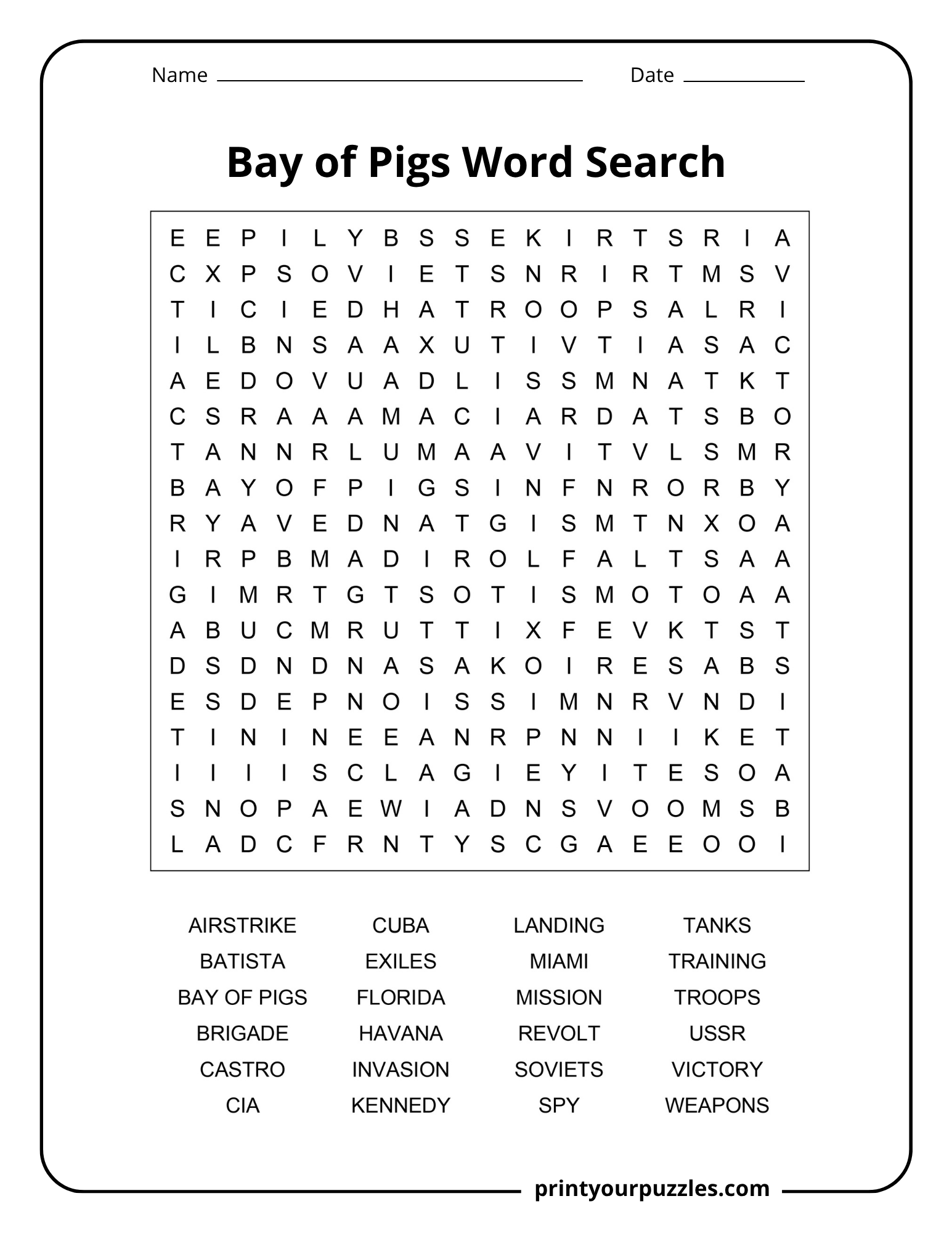
Introduction to the Bay of Pigs Word Search
The Bay of Pigs invasion was a failed attempt to overthrow Cuban leader Fidel Castro in April 1961. The operation was organized with support from the United States and carried out mainly by Cuban exiles who opposed Castro’s government. Although the invasion lasted only a few days, it became an important event in the Cold War and increased tensions between the United States, Cuba, and the Soviet Union.
Fidel Castro had taken control of Cuba in 1959 after overthrowing the government of Fulgencio Batista. Castro introduced major political and economic changes, including the nationalization of businesses and property. His government also developed closer relations with the Soviet Union. Because Cuba is located only about 90 miles from Florida, U.S. leaders became increasingly concerned about having a Soviet-aligned government so close to the United States.
The plan to remove Castro began during President Dwight D. Eisenhower’s administration and was later approved by President John F. Kennedy. The Central Intelligence Agency, or CIA, trained and supported a force of around 1,400 Cuban exiles known as Brigade 2506. The plan was for the force to land on Cuba’s southern coast at the Bay of Pigs, establish a position, and encourage Cubans to rise against Castro.
On April 17, 1961, the invasion began. However, the operation quickly encountered serious problems. Castro’s forces were prepared to respond, expected air support was limited, and the invading troops became trapped along the coast. Within about three days, most of the invading force had been captured or defeated.
The failure of the Bay of Pigs invasion was a major embarrassment for the Kennedy administration and strengthened Castro’s position in Cuba. It also pushed Cuba closer to the Soviet Union, helping create the conditions that led to the Cuban Missile Crisis in 1962.
This Bay of Pigs word search offers a fun way to review the people, places, events, and Cold War ideas connected with this important episode in U.S. and Cuban history.
Related US History Word Searches:
Cuban Missile Crisis | Cold War | John F. Kennedy | Vietnam War | Space Race | Truman Doctrine
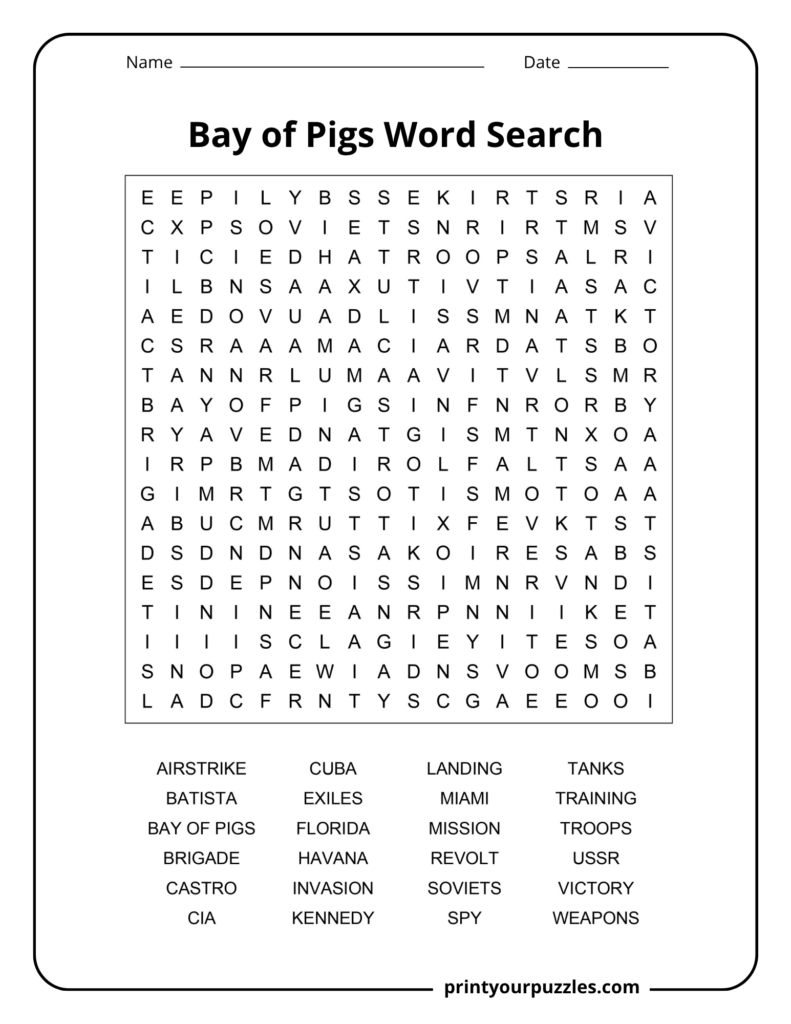
Medium Difficulty Word Search
Words to Find
AIRSTRIKE, BATISTA, BAY OF PIGS, BRIGADE, CASTRO, CIA, CUBA, EXILES, FLORIDA, HAVANA, INVASION, KENNEDY, LANDING, MIAMI, MISSION, REVOLT, SOVIETS, SPY, TANKS, TRAINING, TROOPS, USSR, VICTORY, WEAPONS
All Words Defined
AIRSTRIKE – An attack carried out by military aircraft. Airstrikes were part of the Bay of Pigs planning, but limited U.S. air support weakened the invasion force.
BATISTA – Fulgencio Batista was Cuba’s former leader, overthrown by Fidel Castro in 1959. His authoritarian government had maintained close political and economic ties with the United States.
BAY OF PIGS – A coastal area in southern Cuba where Cuban exiles landed in April 1961 during the unsuccessful U.S.-supported attempt to overthrow Fidel Castro.
BRIGADE – Brigade 2506 was the military force of Cuban exiles trained and supported by the CIA to participate in the Bay of Pigs invasion.
CASTRO – Fidel Castro was Cuba’s revolutionary leader who came to power in 1959 and successfully resisted the Bay of Pigs invasion launched against his government.
CIA – The Central Intelligence Agency organized, trained, and supported Cuban exiles for the invasion, hoping they could help remove Fidel Castro from power in Cuba.
CUBA – Caribbean island nation located south of Florida. Cuba became a major Cold War focus after Fidel Castro established a government closely aligned with the Soviet Union.
EXILES – Cubans who had left their homeland after Castro came to power. Many opposed his government, and some joined the U.S.-supported force that invaded Cuba.
FLORIDA – U.S. state located about 90 miles from Cuba. Its proximity made political and military developments in Cuba especially important to American leaders during the Cold War.
HAVANA – Capital and largest city of Cuba. Havana became the political center of Fidel Castro’s government after the Cuban Revolution brought him to power in 1959.
INVASION – A military operation in which forces enter another territory. The Bay of Pigs invasion attempted to land Cuban exiles in Cuba and overthrow Castro.
KENNEDY – John F. Kennedy was U.S. president during the Bay of Pigs invasion. He approved the operation but limited direct American military involvement during the attack.
LANDING – The arrival of troops on a shoreline during a military operation. Cuban exile forces landed near the Bay of Pigs on April 17, 1961.
MIAMI – Florida city with a large Cuban exile community. Miami became an important center for Cubans who opposed Castro and supported efforts against his government.
MISSION – A planned military or political operation designed to achieve a specific objective. The Bay of Pigs mission aimed to weaken and ultimately remove Castro’s government.
REVOLT – An organized uprising against a government or authority. Invasion planners hoped the Bay of Pigs operation would encourage Cubans inside the country to rebel against Castro.
SOVIETS – People or forces associated with the Soviet Union. After the Bay of Pigs invasion, Cuba developed even closer political and military ties with Soviet leaders.
SPY – A person who secretly gathers information for a government or organization. Intelligence gathering played an important role in planning Cold War operations involving Cuba.
TANKS – Armored military vehicles used in ground combat. Cuban government forces used tanks and other weapons while responding to the invading exile troops at Bay of Pigs.
TRAINING – Preparation designed to teach people specific skills. The CIA provided military training to Cuban exiles before they took part in the Bay of Pigs invasion.
TROOPS – Soldiers organized for military service or combat. Cuban exile troops landed at the Bay of Pigs but were quickly confronted by Castro’s armed forces.
USSR – Abbreviation for the Union of Soviet Socialist Republics, the Soviet Union. Cuba’s growing relationship with the USSR increased American fears during the Cold War.
VICTORY – Success in a conflict or competition. Castro’s forces achieved victory at the Bay of Pigs, strengthening his government and damaging the Kennedy administration’s reputation.
WEAPONS – Tools used in combat, including rifles, artillery, tanks, and aircraft. Both the invading exiles and Cuban government forces used weapons during the Bay of Pigs conflict.
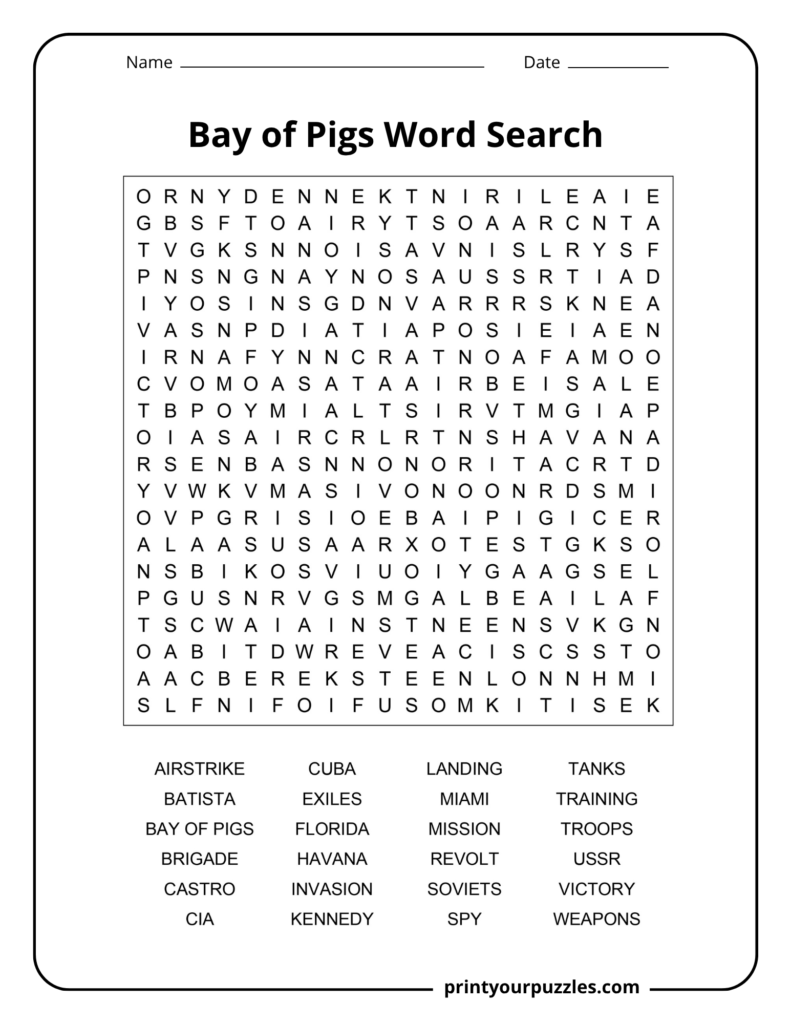
Hard Difficulty Word Search
Words to Find
AIRSTRIKE, BATISTA, BAY OF PIGS, BRIGADE, CASTRO, CIA, CUBA, EXILES, FLORIDA, HAVANA, INVASION, KENNEDY, LANDING, MIAMI, MISSION, REVOLT, SOVIETS, SPY, TANKS, TRAINING, TROOPS, USSR, VICTORY, WEAPONS
5 Key FAQs About the Bay of Pigs
5 Curious "Did You Know?" Facts About the Bay of Pigs