
The Digestive System is responsible for breaking food down into nutrients that the body can absorb and use. These nutrients provide energy, support growth, repair tissues, and help organs work properly. Digestion begins before food even reaches the stomach, and it continues through a long pathway made up of several connected organs.
The process starts in the mouth. Teeth cut and crush food into smaller pieces, while saliva begins breaking down certain carbohydrates. The tongue helps mix the food and move it toward the throat. After swallowing, food travels through the esophagus, a muscular tube that carries it to the stomach. Waves of muscle contractions, called peristalsis, push the food forward.
Inside the stomach, food is mixed with acids and digestive enzymes. These substances help break proteins and turn the meal into a thick liquid. The food then enters the small intestine, where most digestion and nutrient absorption take place. The liver produces bile to help digest fats, while the pancreas releases enzymes that break down carbohydrates, proteins, and fats.
Tiny structures called villi cover the inner surface of the small intestine. They increase the area available for absorbing nutrients. Once nutrients pass into the bloodstream, the Circulatory System transports them to cells throughout the body. Materials that cannot be digested move into the large intestine, where water and minerals are absorbed. The remaining waste is stored in the rectum before leaving the body.
Like other Body Systems, the Digestive System works closely with several partners. The Muscular System moves food through the digestive tract. The Nervous System helps control swallowing, hunger, and digestive activity. The Endocrine System releases hormones that influence appetite, blood sugar, and the production of digestive juices. Even the Skeletal System contributes by providing teeth for chewing and protecting organs in the abdominal area.
Completing a digestive system word search can help students recognize terms such as stomach, intestine, liver, pancreas, enzyme, nutrient, and saliva. Learning this vocabulary makes the digestive process easier to understand. From the first bite of food to the removal of waste, digestion is a carefully coordinated process that helps keep the body nourished, energized, and healthy.
Related Word Searches:
Body Systems | Biology | Cell | Circulatory System | Cellular Respiration | Endocrine System
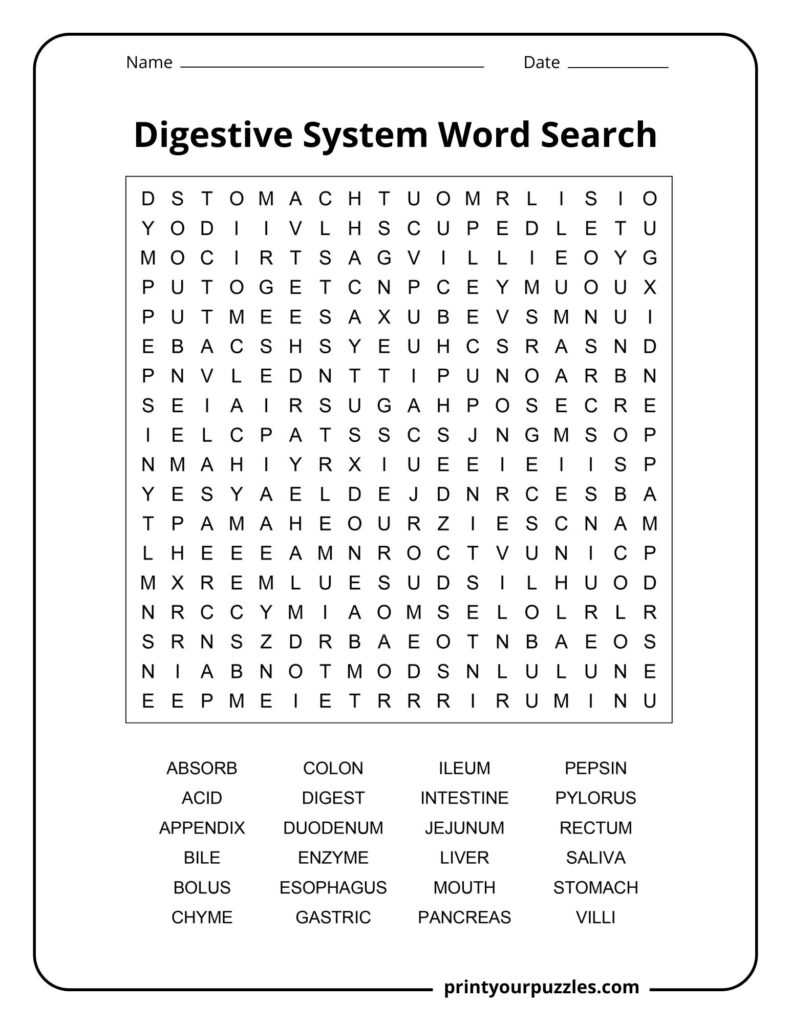
ABSORB, ACID, APPENDIX, BILE, BOLUS, CHYME, COLON, DIGEST, DUODENUM, ENZYME, ESOPHAGUS, GASTRIC, ILEUM, INTESTINE, JEJUNUM, LIVER, MOUTH, PANCREAS, PEPSIN, PYLORUS, RECTUM, SALIVA, STOMACH, VILLI
ABSORB – The process by which nutrients, water, and other substances pass through the intestinal wall into the bloodstream to be distributed throughout the body for cellular use.
ACID – A chemical substance, particularly hydrochloric acid in the stomach, that breaks down food particles, kills harmful bacteria, and activates digestive enzymes for proper nutrient processing.
APPENDIX – A small, finger-shaped pouch attached to the cecum at the beginning of the large intestine, with no essential digestive function but may support immune system health.
BILE – A greenish-brown fluid produced by the liver and stored in the gallbladder that emulsifies fats, breaking them into smaller droplets for easier digestion and absorption.
BOLUS – A soft, rounded mass of chewed food mixed with saliva that forms in the mouth and travels down the esophagus to the stomach during swallowing.
CHYME – A semi-fluid mixture of partially digested food and gastric juices that moves from the stomach into the small intestine for further digestion and nutrient absorption.
COLON – The main part of the large intestine where water, electrolytes, and vitamins are absorbed from undigested food, forming solid waste for elimination from the body.
DIGEST – The process of breaking down food into smaller molecules through mechanical and chemical means, allowing nutrients to be absorbed and utilized by the body’s cells.
DUODENUM – The first section of the small intestine, receiving partially digested food from the stomach and mixing it with bile and pancreatic enzymes for continued digestion.
ENZYME – A specialized protein that speeds up chemical reactions in digestion, breaking down complex molecules like carbohydrates, proteins, and fats into simpler, absorbable nutrients.
ESOPHAGUS – A muscular tube connecting the throat to the stomach that transports food and liquids through wavelike contractions called peristalsis during the swallowing process.
GASTRIC – Relating to the stomach, particularly describing
substances like gastric acid and gastric juices that aid in digestion, or conditions affecting the stomach lining and function.
ILEUM – The final and longest section of the small intestine where vitamin B12, bile salts, and remaining nutrients are absorbed before contents enter the large intestine.
INTESTINE – A long, tubular organ divided into small and large
sections that completes digestion, absorbs nutrients and water, and eliminates waste from the digestive system.
JEJUNUM – The middle section of the small intestine between the duodenum and ileum, where most nutrient absorption occurs through fingerlike projections called villi.
LIVER – The largest internal organ that produces bile for fat digestion, processes absorbed nutrients, detoxifies harmful substances, and stores vitamins and glycogen for energy.
MOUTH – The opening where digestion begins, containing teeth for chewing, tongue for mixing food, and salivary glands that produce enzymes to start breaking down carbohydrates.
PANCREAS – A gland behind the stomach producing digestive enzymes that break down proteins, fats, and carbohydrates, plus hormones like insulin that regulate blood sugar levels.
PEPSIN – A digestive enzyme produced in the stomach that breaks down protein molecules into smaller peptides, working most effectively in the highly acidic stomach environment.
PYLORUS – The lower section of the stomach with a muscular valve controlling the release of partially digested food into the duodenum at appropriate intervals for digestion.
RECTUM – The final section of the large intestine where feces are stored before elimination, containing nerve endings that signal when bowel movements are necessary.
SALIVA – A watery fluid secreted by glands in the mouth containing enzymes like amylase that begin carbohydrate digestion while moistening food for easier swallowing.
STOMACH – A muscular, J-shaped organ that stores food temporarily, mixes it with acidic gastric juices, and churns it into chyme before releasing into the small intestine.
VILLI – Tiny, fingerlike projections lining the small intestine that increase surface area dramatically, allowing efficient absorption of nutrients into the bloodstream for body use.
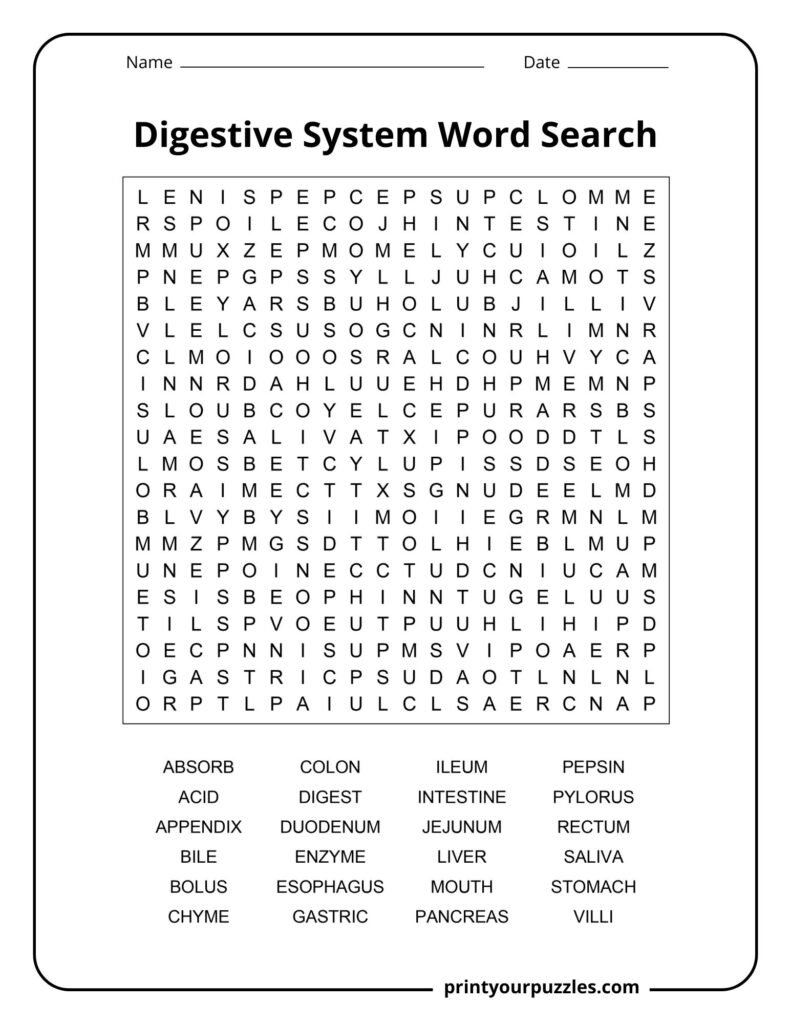
ABSORB, ACID, APPENDIX, BILE, BOLUS, CHYME, COLON, DIGEST, DUODENUM, ENZYME, ESOPHAGUS, GASTRIC, ILEUM, INTESTINE, JEJUNUM, LIVER, MOUTH, PANCREAS, PEPSIN, PYLORUS, RECTUM, SALIVA, STOMACH, VILLI
Digestion typically takes 24 to 72 hours from eating to elimination. Food spends approximately 6-8 hours in the stomach and small intestine, with remaining time in the large intestine.
The digestive system breaks down food into nutrients, absorbs them into the bloodstream for energy and growth, and eliminates waste products that the body cannot use.
Major organs include the mouth, esophagus, stomach, small intestine, large intestine, rectum, and anus. Accessory organs are the liver, pancreas, and gallbladder, which aid digestion.
Most nutrient absorption occurs in the small intestine, particularly the jejunum section, where millions of tiny villi increase surface area for efficient nutrient uptake into blood.
Beneficial bacteria in the large intestine help break down undigested food, produce certain vitamins like vitamin K, support immune function, and protect against harmful pathogens.
Despite its name, the small intestine measures approximately 20 feet long in adults. If unfolded and flattened, its internal surface area equals roughly a tennis court’s size!
The stomach replaces its mucus lining every 3-5 days to protect itself from its own powerful digestive acids, which are strong enough to dissolve metal and bone.
Your salivary glands produce enough saliva each day to fill approximately four cups. Over a lifetime, that equals roughly 25,000 liters or enough to fill two swimming pools!
The human digestive tract houses trillions of microorganisms, collectively weighing 2-5 pounds. These beneficial bacteria outnumber human cells and are essential for health and immunity.
Those rumbling sounds, called borborygmi, occur when gas and fluids move through your intestines. This happens during digestion whether your stomach is full or empty!