Earth may look like one solid planet beneath our feet, but its interior is divided into several distinct layers. Each layer has different temperatures, materials, pressures, and physical properties. Together, these hidden sections help explain earthquakes, volcanoes, mountain formation, continental movement, and many other processes that shape the surface of our world.
The four main layers of Earth are the crust, mantle, outer core, and inner core. The crust is the thin, solid outer layer where people, animals, and plants live. It includes both continental crust, which forms the land, and oceanic crust, which lies beneath the oceans. Although the crust seems enormous to us, it is extremely thin compared with the rest of the planet.
Below the crust is the mantle, the thickest of Earth’s layers. It is made mostly of hot rock that can slowly move and flow over long periods. Heat rising from deeper inside the planet creates movement within the mantle. This movement helps push and pull the tectonic plates that form Earth’s surface. When these plates collide, separate, or slide past one another, they can produce earthquakes, volcanoes, ocean trenches, and mountain ranges.
Deeper still is the outer core, a layer composed mainly of liquid iron and nickel. The movement of these molten metals helps generate Earth’s magnetic field. This magnetic field surrounds the planet and helps protect it from harmful particles arriving from the Sun.
At the very center of Earth is the inner core. It is also made mainly of iron and nickel, but enormous pressure keeps it solid despite its extremely high temperature. Scientists cannot travel directly to these deep layers, so they study earthquake waves, magnetic activity, laboratory experiments, and other evidence to understand what exists below the surface.
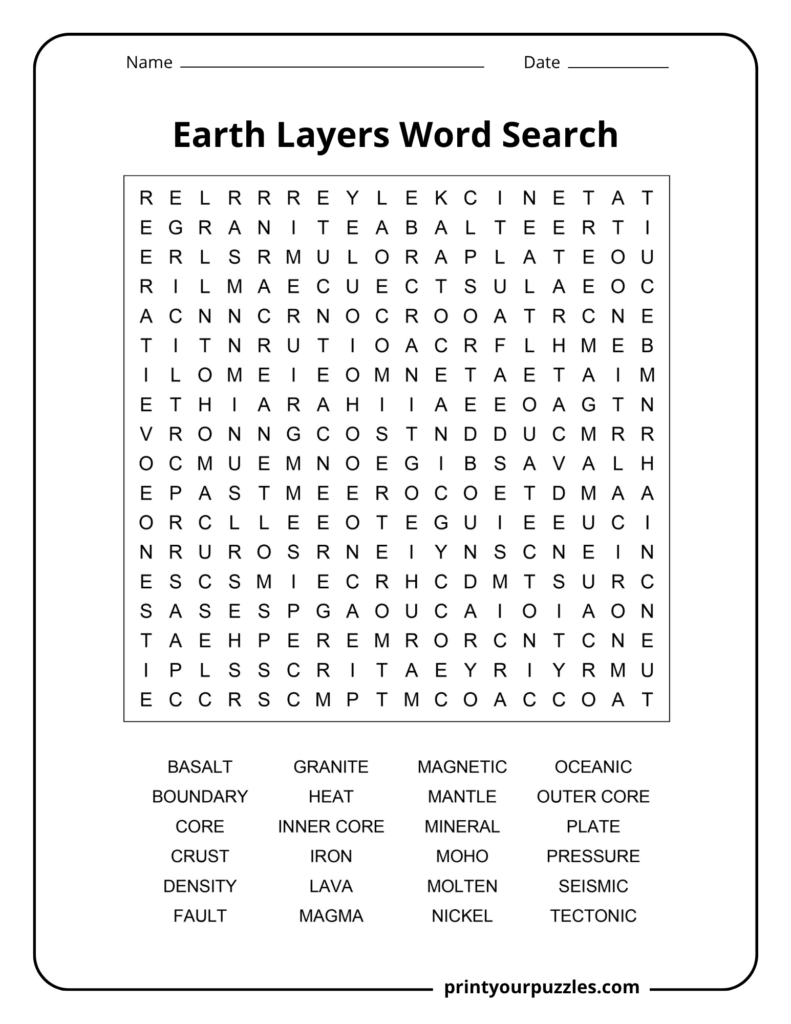
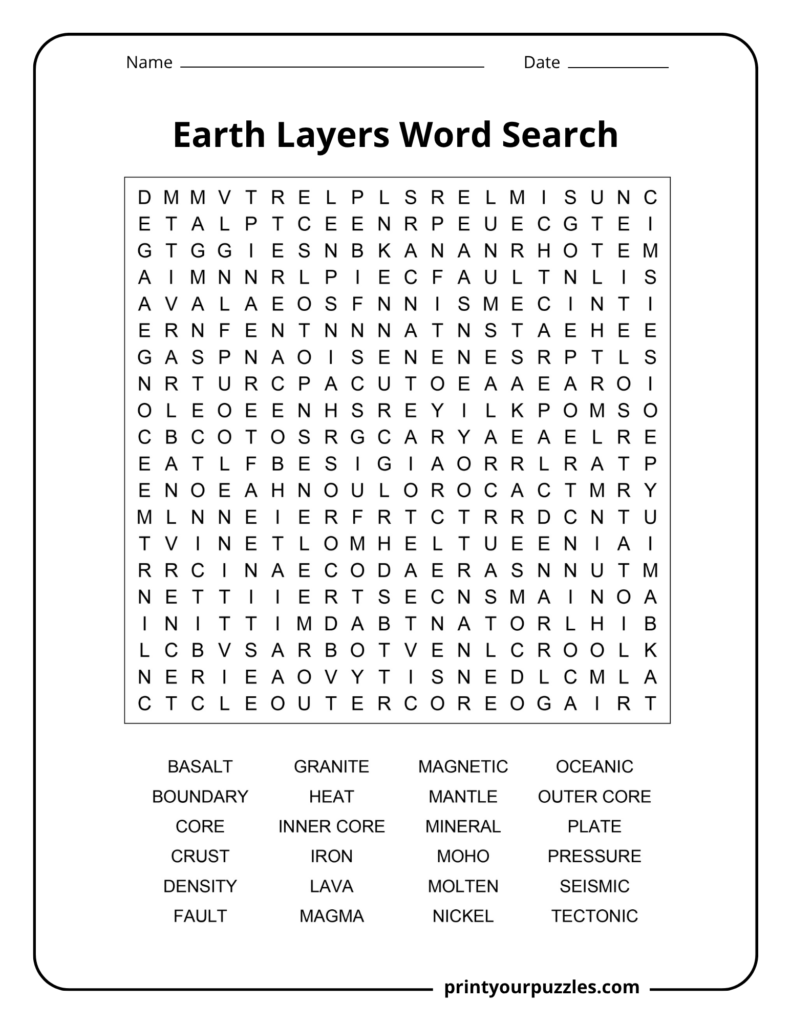
Learning about Earth’s internal structure reveals that our planet is active and constantly changing. An earth layers word search offers an enjoyable way to review important terms while exploring the crust, mantle, cores, tectonic plates, heat, pressure, and forces that continue to shape Earth from the inside out.
Related Word Searches:
Plate Tectonics | Volcano | Rock Cycle | Matter | States of Matter | Physics
BASALT – A dark, fine-grained volcanic rock that forms much of the oceanic crust when lava cools quickly at or near Earth’s surface after a volcanic eruption.
BOUNDARY – A zone where two tectonic plates meet, separate, collide, or slide past each other, often producing earthquakes, volcanoes, ocean trenches, mountain ranges, or deep faults.
CORE – Earth’s central region, composed mainly of iron and nickel, divided into a liquid outer core and a solid, extremely hot inner core beneath the mantle.
CRUST – Earth’s thin, rigid outer layer, made of continental and oceanic rock, where landforms, oceans, ecosystems, and human life are found above the deeper rocky mantle.
DENSITY – The amount of mass contained within a given volume, influencing how materials inside Earth separate, sink, rise, and form different internal layers under enormous pressure.
FAULT – A fracture in Earth’s crust where blocks of rock move, releasing stored energy that can produce earthquakes and gradually reshape the surrounding landscape over time.
GRANITE – A coarse-grained igneous rock rich in quartz and feldspar, common in continental crust and formed when magma cools slowly beneath Earth’s surface over long periods.
HEAT – Thermal energy inside Earth, produced mainly by radioactive decay and leftover planetary formation, driving mantle movement, volcanism, plate tectonics, and changes within the rocky crust.
INNER CORE – Earth’s solid central layer, composed mainly of iron and nickel, kept solid by immense pressure despite temperatures comparable to the Sun’s surface at its center.
IRON – A dense metallic element abundant in Earth’s core, helping create the planet’s internal structure and contributing strongly to the generation of its protective magnetic field.
LAVA – Molten rock that reaches Earth’s surface during volcanic activity, where it cools and solidifies into new rock, often basalt or another type of volcanic material.
MAGMA – Hot molten or partly molten rock beneath Earth’s surface, containing minerals and gases that may rise, cool underground, form crystals, or eventually erupt as lava.
MAGNETIC – Related to Earth’s magnetic field, generated by moving liquid iron in the outer core and important for protecting the planet from dangerous charged solar particles.
MANTLE – Earth’s thickest layer, located between the crust and core, composed of hot rock that slowly flows and helps drive tectonic plate movement at the surface.
MINERAL – A naturally occurring solid with a specific chemical composition and crystal structure, forming rocks throughout Earth’s crust, mantle, and deeper internal regions under varying conditions.
MOHO – The boundary between Earth’s crust and mantle, named after scientist Andrija Mohorovičić. Scientists identified it by observing changes in the speed of seismic waves.
MOLTEN – A term describing rock or metal changed into liquid by intense heat, such as magma in the mantle or iron within Earth’s moving outer core.
NICKEL – A strong metallic element found with iron in Earth’s core, contributing to its density, composition, strength, and the physical properties of the planet’s deep interior.
OCEANIC – Relating to the thin, dense crust beneath oceans, composed mainly of basalt and continually created or recycled through seafloor spreading, subduction, and tectonic plate movement.
OUTER CORE – A liquid layer of iron and nickel surrounding the inner core, whose flowing metals generate Earth’s magnetic field through continuous movement, planetary rotation, and convection.
PLATE – A large, rigid section of Earth’s lithosphere that moves slowly over the softer mantle, interacting with other plates at boundaries and causing major geological activity.
PRESSURE – The force exerted on materials inside Earth by overlying rock, increasing with depth and affecting density, melting points, mineral structure, and whether matter remains solid.
SEISMIC – Related to vibrations and waves traveling through Earth, especially those caused by earthquakes and used by scientists to study the planet’s hidden layers and internal structure.
TECTONIC – Related to the movement and deformation of Earth’s crustal plates, responsible for earthquakes, mountain building, volcanic activity, ocean basins, continental drift, and constantly changing landscapes.