
Matter is everything around us that has mass and occupies space. The air we breathe, the water we drink, the food we eat, and the objects we use every day are all forms of matter. Even things that cannot be seen easily, such as gases, are made of matter because they contain particles and take up space. Understanding matter is one of the first steps in learning how the physical world works.
All matter is made of extremely small particles called atoms. Atoms can join together to form molecules, which create the different substances found in nature. For example, a water molecule is formed when two hydrogen atoms combine with one oxygen atom. Different arrangements of atoms produce materials with different properties, including color, texture, hardness, density, and the ability to conduct heat or electricity.
Matter commonly exists in three main states: solid, liquid, and gas. A solid has a fixed shape and volume because its particles are packed closely together. A liquid has a fixed volume but changes shape to fit its container. In a gas, particles move freely and spread out, so the gas has no fixed shape or volume. Matter can also exist as plasma, a high-energy state found in stars, lightning, and some types of lighting.
Matter can change from one state to another when heat is added or removed. Melting changes a solid into a liquid, while freezing changes a liquid into a solid. Evaporation and boiling turn liquids into gases, and condensation changes gases back into liquids. These are physical changes because the substance remains chemically the same. In contrast, a chemical change creates one or more new substances, as happens when metal rusts or wood burns.
Scientists also classify matter as elements, compounds, and mixtures. Elements contain only one type of atom, while compounds contain different elements chemically joined together. Mixtures combine substances without chemically bonding them, allowing their components to remain separate.
A matter word search offers an engaging way to become familiar with terms such as atom, molecule, solid, liquid, gas, mass, volume, element, and mixture. Learning this vocabulary helps students describe materials, understand changes in substances, and explore the basic structure of everything in the universe.
Related Word Searches:
States of Matter | Atom | Molecule | Chemistry | Chemical Elements | Energy
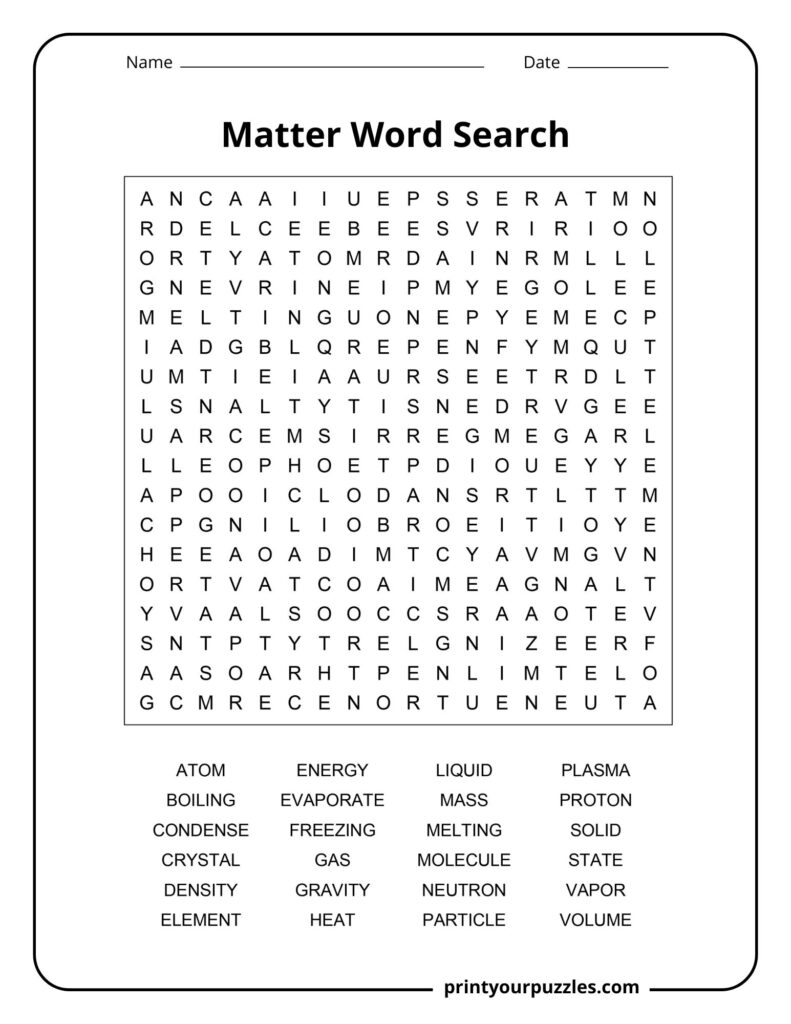
ATOM, BOILING, CONDENSE, CRYSTAL, DENSITY, ELEMENT, ENERGY, EVAPORATE, FREEZING, GAS, GRAVITY, HEAT, LIQUID, MASS, MELTING, MOLECULE, NEUTRON, PARTICLE, PLASMA, PROTON, SOLID, STATE, VAPOR, VOLUME
ATOM – The smallest unit of a chemical element that retains its properties, consisting of a nucleus containing protons and neutrons, surrounded by electrons in orbital shells.
BOILING – The rapid phase transition from liquid to gas throughout the entire liquid when it reaches a specific temperature called the boiling point, creating bubbles of vapor.
CONDENSE – The process where gas transforms into liquid when cooled or compressed, releasing heat energy as molecules slow down and come closer together, like water droplets forming.
CRYSTAL – A solid material whose atoms or molecules are arranged in a highly ordered, repeating three-dimensional pattern, creating distinctive geometric shapes with flat surfaces and sharp edges.
DENSITY – The measurement of how much mass is contained in a given volume of matter, calculated by dividing mass by volume, determining whether objects float or sink.
ELEMENT – A pure substance consisting of only one type of atom that cannot be broken down into simpler substances by chemical means, like oxygen, gold, or carbon.
ENERGY – The capacity to do work or cause change in matter, existing in various forms including thermal, kinetic, potential, chemical, and electrical, never created or destroyed.
EVAPORATE – The gradual phase change from liquid to gas occurring at the surface of a liquid at temperatures below boiling point, as faster molecules escape into the air.
FREEZING – The phase transition where liquid transforms into solid when temperature drops to the freezing point, as molecules lose energy and arrange into fixed, organized crystalline structures.
GAS – A state of matter with no definite shape or volume, where molecules move freely and rapidly, spreading to fill any container completely, like air or steam.
GRAVITY – The natural force of attraction between objects with mass, pulling them toward each other, giving weight to physical objects and keeping planets orbiting around stars consistently.
HEAT – Thermal energy transferred between objects or systems due to temperature difference, flowing from warmer to cooler areas until equilibrium is reached, measured in joules or calories.
LIQUID – A state of matter with definite volume but no fixed shape, flowing freely to conform to its container’s shape while molecules move past each other.
MASS – The amount of matter contained in an object, measuring its resistance to acceleration and gravitational attraction, remaining constant regardless of location, measured in kilograms or grams.
MELTING – The phase transition from solid to liquid state when matter is heated to its melting point, as molecular bonds weaken and particles gain freedom to move.
MOLECULE – The smallest particle of a substance retaining its chemical properties, formed when two or more atoms bond together chemically, like water containing hydrogen and oxygen.
NEUTRON – A subatomic particle located in the atom’s nucleus with no electrical charge, having approximately the same mass as a proton, contributing to atomic mass and stability.
PARTICLE – An extremely small piece or portion of matter, ranging from subatomic particles like electrons to microscopic fragments, representing the basic components of all physical substances.
PLASMA – The fourth state of matter consisting of ionized gas with free electrons and ions, found in stars, lightning, and fluorescent lights, conducting electricity and responding to magnetism.
PROTON – A positively charged subatomic particle found in the atom’s nucleus, determining the element’s identity through its atomic number, approximately equal in mass to neutrons.
SOLID – A state of matter with definite shape and volume, where particles are tightly packed in fixed positions, vibrating but not moving freely, maintaining rigid structure.
STATE – The distinct physical form in which matter exists, primarily solid, liquid, gas, or plasma, determined by temperature, pressure, and the arrangement of molecules and energy.
VAPOR – The gaseous form of a substance that is normally liquid or solid at room temperature, like water vapor or steam, floating freely in air.
VOLUME – The amount of three-dimensional space occupied by matter or enclosed within a container, measured in cubic units like liters, milliliters, or cubic centimeters typically.
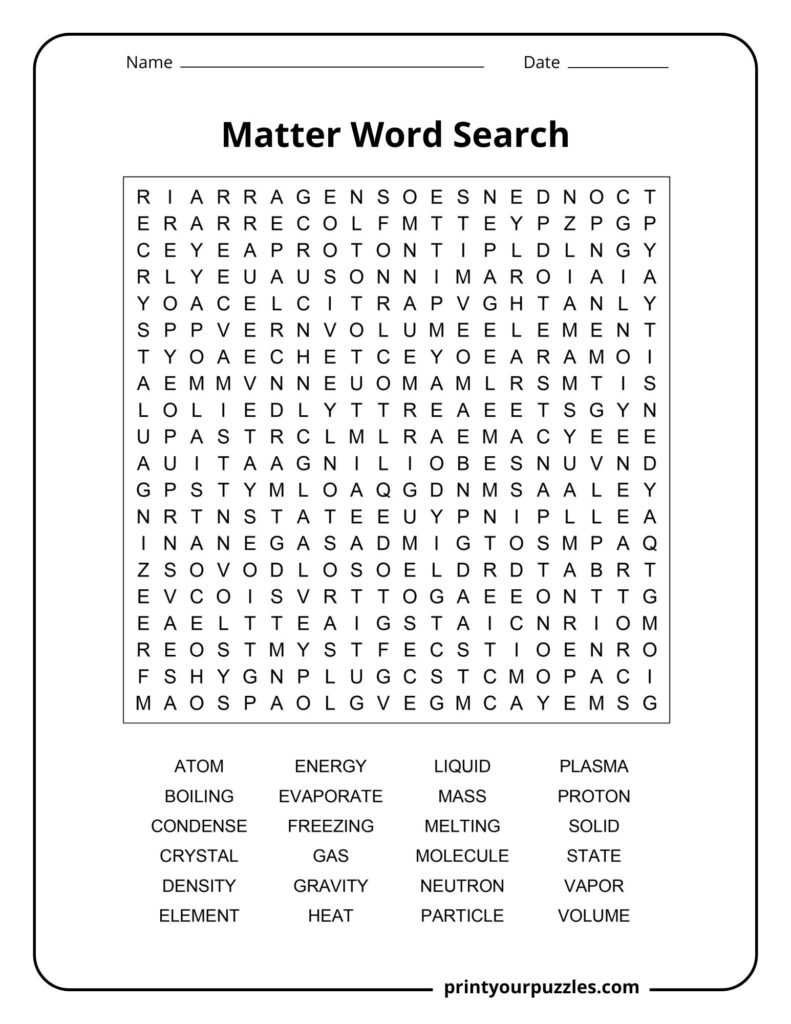
ATOM, BOILING, CONDENSE, CRYSTAL, DENSITY, ELEMENT, ENERGY, EVAPORATE, FREEZING, GAS, GRAVITY, HEAT, LIQUID, MASS, MELTING, MOLECULE, NEUTRON, PARTICLE, PLASMA, PROTON, SOLID, STATE, VAPOR, VOLUME
Matter is anything that has mass and occupies space. It includes all physical substances in the universe, from tiny atoms to massive stars, existing in various states and forms.
The four primary states of matter are solid, liquid, gas, and plasma. Each state has distinct properties based on how particles are arranged and how much energy they contain.
Matter is composed of atoms, which are the smallest units of elements. Atoms contain protons, neutrons, and electrons, and combine to form molecules that make up everything around us.
Matter changes states through heating or cooling. Adding energy causes melting, evaporation, and sublimation, while removing energy causes freezing, condensation, and deposition through temperature changes.
According to the law of conservation of mass, matter cannot be created or destroyed in chemical reactions, only transformed or rearranged into different forms while maintaining total mass.
Although rare on Earth, plasma makes up over 99% of visible matter in the universe, found in stars, nebulae, and interstellar space, glowing brightly with energy.
Most materials become denser when solidifying, but ice is less dense than liquid water, which is why ice cubes float and frozen lakes freeze from the top down.
Beyond solid, liquid, gas, and plasma, scientists have discovered exotic states including Bose-Einstein condensates, supercritical fluids, and quark-gluon plasma under extreme conditions in laboratories.
This bizarre solid is 99.8% air, so light it almost floats, yet strong enough to support weight. It feels like frozen smoke and is an excellent insulator.
Without changing temperature, applying enough pressure forces gas molecules together until they condense into liquid, a process used in creating liquid oxygen and nitrogen for industrial applications.