
Magnetism is a natural force that causes certain materials to attract or repel one another. It is especially noticeable in magnets, which can pull objects made from metals such as iron, nickel, and cobalt. Although magnetism may seem invisible, its effects can be observed in many everyday objects, from refrigerator magnets and speakers to electric motors and compasses.
Every magnet has two ends called poles: a north pole and a south pole. Opposite poles attract each other, while matching poles repel each other. For example, the north pole of one magnet will be pulled toward the south pole of another. However, two north poles or two south poles will push apart. This attraction and repulsion happen because magnets create an invisible area around themselves known as a magnetic field.
Magnetic fields are often represented with curved lines that travel from the north pole to the south pole. The field is usually strongest near the poles, where the magnetic force is most powerful. The Earth also has its own magnetic field, which acts as though a giant magnet were located inside the planet. A compass works by allowing its needle to align with this field, helping people identify north and navigate from one place to another.
Magnetism is closely connected to electricity. When an electric current flows through a wire, it produces a magnetic field. This principle is used to create electromagnets, which can be switched on and off by controlling the flow of electricity. Electromagnets are found in devices such as doorbells, cranes, generators, medical equipment, and many household appliances.
Scientists study magnetism to understand how materials, electricity, and forces interact. Some objects can become temporarily magnetized, while others, known as permanent magnets, keep their magnetic properties for a long time. Temperature, distance, and the type of material can all affect magnetic strength.
A printable magnetism word search puzzle can help students become familiar with important terms such as pole, field, force, attract, repel, compass, current, and electromagnet. Learning this vocabulary makes it easier to understand how magnetic forces work and how magnetism plays an important role in science, technology, transportation, and everyday life.
Related Word Searches:
Electricity | Physics | Energy | Atom | Matter | Earth Layers
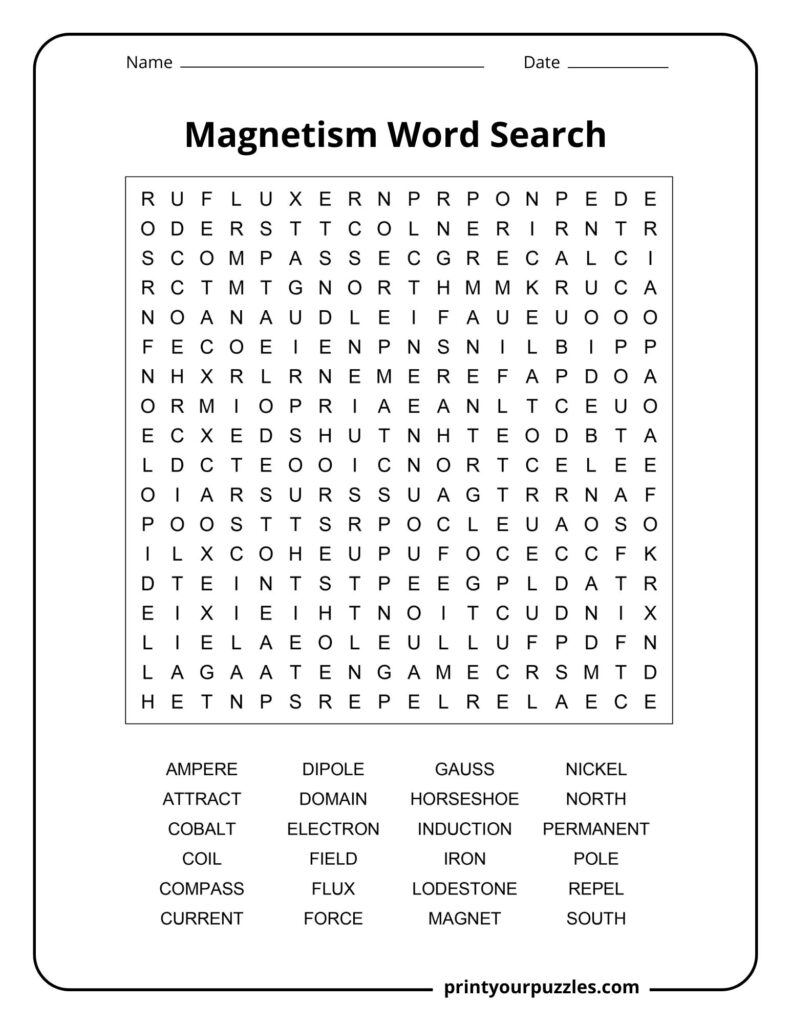
AMPERE, ATTRACT, COBALT, COIL, COMPASS, CURRENT, DIPOLE, DOMAIN, ELECTRON, FIELD, FLUX, FORCE, GAUSS, HORSESHOE, INDUCTION, IRON, LODESTONE, MAGNET, NICKEL, NORTH, PERMANENT, POLE, REPEL, SOUTH
AMPERE – The standard unit of electric current measurement in the International System of Units, named after French physicist André-Marie Ampère, representing the flow of electric charge through a conductor.
ATTRACT – The force that draws magnetic materials or opposite magnetic poles toward each other, causing them to move closer together due to magnetic field interactions between objects.
COBALT – A ferromagnetic metallic element that can be permanently magnetized, often used in strong permanent magnets and magnetic alloys alongside iron and nickel in various industrial applications.
COIL – Wire wound in a spiral or helical shape that generates a magnetic field when electric current flows through it, commonly used in electromagnets, motors, and transformers.
COMPASS – A navigation instrument containing a magnetized needle that aligns with Earth’s magnetic field, pointing toward magnetic north, enabling travelers to determine directional orientation and navigate accurately.
CURRENT – The flow of electric charge through a conductor, measured in amperes, which creates magnetic fields around the conductor and is essential for producing electromagnetic effects.
DIPOLE – A magnetic configuration with two opposite poles, north and south, separated by a distance, representing the simplest magnetic structure found in magnets and magnetic materials.
DOMAIN – A microscopic region within magnetic materials where atomic magnetic moments align in the same direction, creating a uniformly magnetized area that contributes to overall magnetic properties.
ELECTRON – A negatively charged subatomic particle whose spin and orbital motion create magnetic moments, making it fundamental to magnetism and electromagnetic interactions in atoms and materials.
FIELD – The invisible region surrounding a magnet or current-carrying conductor where magnetic forces can be detected and exerted on other magnetic materials or moving charges.
FLUX – The measure of total magnetic field passing through a given area, quantifying the strength and distribution of magnetic field lines in a specific region or surface.
FORCE – The push or pull exerted between magnetic poles or on
magnetic materials, causing attraction or repulsion, and enabling magnets to do work or affect motion.
GAUSS – A unit of magnetic field strength or magnetic flux density in the centimeter-gram-second system, named after German mathematician and physicist Carl Friedrich Gauss.
HORSESHOE – A U-shaped magnet design where poles are positioned close together at the ends, creating a stronger concentrated magnetic field in the gap between the poles.
INDUCTION – The process by which a changing magnetic field generates an electric current in a conductor, or magnetizes a material, fundamental to transformers, generators, and motors.
IRON – A ferromagnetic metal that is easily magnetized and is the most common magnetic material, widely used in electromagnets, permanent magnets, and magnetic cores.
LODESTONE – A naturally occurring magnetized piece of the mineral magnetite that attracts iron, historically used as an early compass and in the discovery of magnetic properties.
MAGNET – An object or material that produces a magnetic field, attracting ferromagnetic materials like iron and exerting forces on other magnets through attraction or repulsion interactions.
NICKEL – A ferromagnetic metallic element that exhibits magnetic properties at room temperature, commonly alloyed with iron and cobalt to create strong permanent magnets for applications.
NORTH – One of two magnetic poles, designated as the north-seeking pole, which points toward Earth’s magnetic north and repels other north poles while attracting south poles.
PERMANENT – Describing magnets that retain their magnetic properties indefinitely without requiring external power or current, made from hard magnetic materials like neodymium, alnico, or ferrite.
POLE – One of two points on a magnet where magnetic field lines converge and the magnetic force is strongest, designated as either north or south.
REPEL – The force that pushes like magnetic poles away from each other, causing them to move apart due to the interaction of their magnetic fields in opposition.
SOUTH – One of two magnetic poles, designated as the south-seeking pole, which points toward Earth’s magnetic south and repels other south poles while attracting north poles.
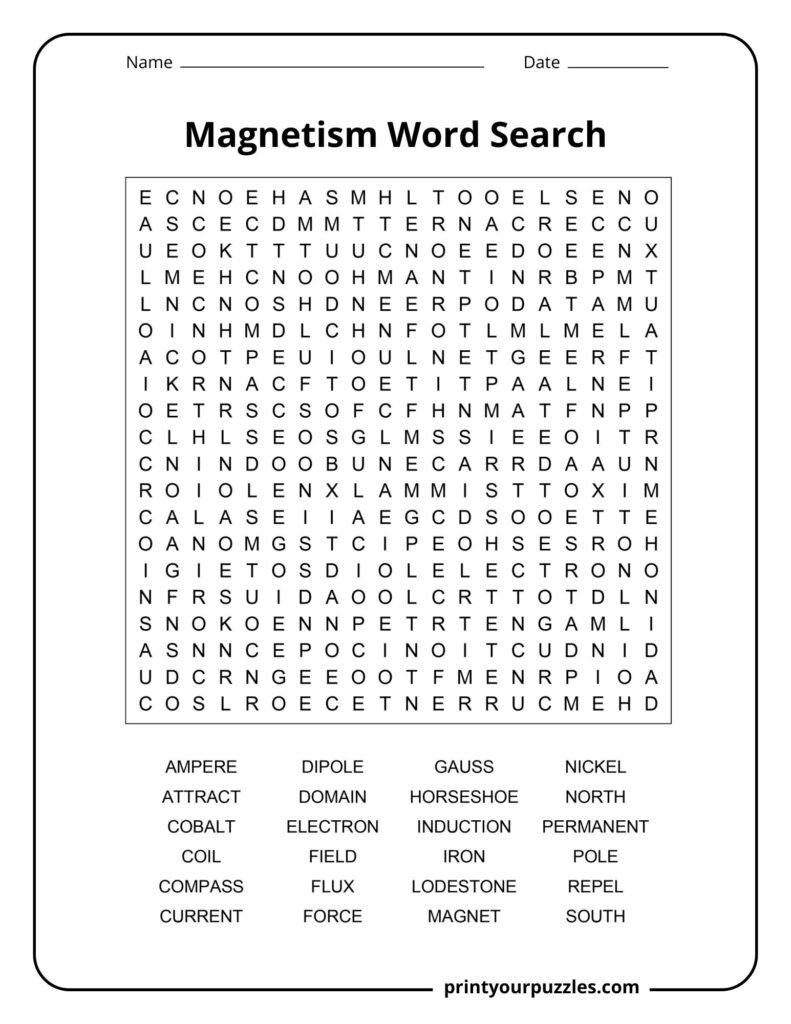
AMPERE, ATTRACT, COBALT, COIL, COMPASS, CURRENT, DIPOLE, DOMAIN, ELECTRON, FIELD, FLUX, FORCE, GAUSS, HORSESHOE, INDUCTION, IRON, LODESTONE, MAGNET, NICKEL, NORTH, PERMANENT, POLE, REPEL, SOUTH
Magnetism is a fundamental physical force produced by moving electric charges, causing certain materials to attract or repel each other through invisible magnetic fields that exert push-pull forces.
Magnets work through aligned atomic magnetic domains where electrons spin in the same direction, creating a collective magnetic field that extends beyond the material and interacts with other objects.
Ferromagnetic materials including iron, nickel, cobalt, and their alloys are strongly attracted to magnets. Most other materials, like wood, plastic, aluminum, and copper, show no magnetic attraction.
Permanent magnets retain magnetization indefinitely without external power, made from hard magnetic materials. Temporary magnets, like electromagnets, only exhibit magnetism when electric current flows through them.
Magnetic field lines must form complete loops, entering at one pole and exiting at another. This dipole nature means magnets always have two opposite poles that cannot exist independently.
Earth’s magnetic north and south poles have reversed hundreds of times throughout history, with the last reversal occurring approximately 780,000 years ago, and scientists predict another flip is overdue.
Birds, sea turtles, sharks, and even some bacteria possess magnetoreception, allowing them to detect Earth’s magnetic field for navigation during migration, finding food, and orientation purposes.
If you cut a magnet in half, you don’t get separate north and south poles. Instead, each piece becomes a complete magnet with its own north and south poles.
Electromagnets powered by superconducting materials can generate magnetic fields over 100,000 times stronger than Earth’s magnetic field, far exceeding any permanent magnet’s strength in laboratory settings.
When ferromagnetic materials are heated above their Curie temperature, thermal energy disrupts aligned magnetic domains, causing permanent magnets to lose their magnetization completely until cooled and remagnetized.