
Entropy is a scientific concept that helps explain why natural processes tend to move in a particular direction. It is commonly associated with disorder, randomness, and the spreading of energy, although its full meaning is more precise. Entropy plays an important role in physics, chemistry, biology, information theory, and many other fields.
In thermodynamics, entropy measures how widely energy is distributed within a system. When energy becomes more spread out and less available to perform useful work, entropy increases. For example, imagine placing an ice cube in a glass of warm water. Heat naturally moves from the warmer water into the colder ice, causing the ice to melt. The energy becomes more evenly distributed, and the total entropy of the system rises.
This idea is connected to the Second Law of Thermodynamics, which states that the entropy of an isolated system usually increases over time. In simple terms, organized systems naturally tend to become less organized unless energy is used to maintain or restore order. A tidy room may gradually become messy, but it will not clean itself without someone putting in effort.
Entropy does not mean that everything instantly becomes chaotic. Local order can still increase when energy is supplied. Living organisms, for instance, build complex structures and maintain organized systems by using energy from food or sunlight. However, these processes release heat and waste into the environment, increasing the overall entropy around them.
The concept also helps explain why some processes are irreversible. A broken glass does not naturally rebuild itself, and spilled milk does not return to its container. These events are theoretically possible at the level of individual particles, but they are so unlikely that they are never observed in ordinary life.
Learning about entropy introduces useful ideas such as energy transfer, equilibrium, probability, heat, and the direction of time. An entropy word search can make these scientific terms easier to recognize while providing an engaging way to review the subject. By understanding entropy, students can better appreciate how energy changes, why natural processes occur, and how the universe continues to evolve.
Related Word Searches:
Thermodynamics | Energy | Physics | Matter | Chemical Reaction | States of Matter
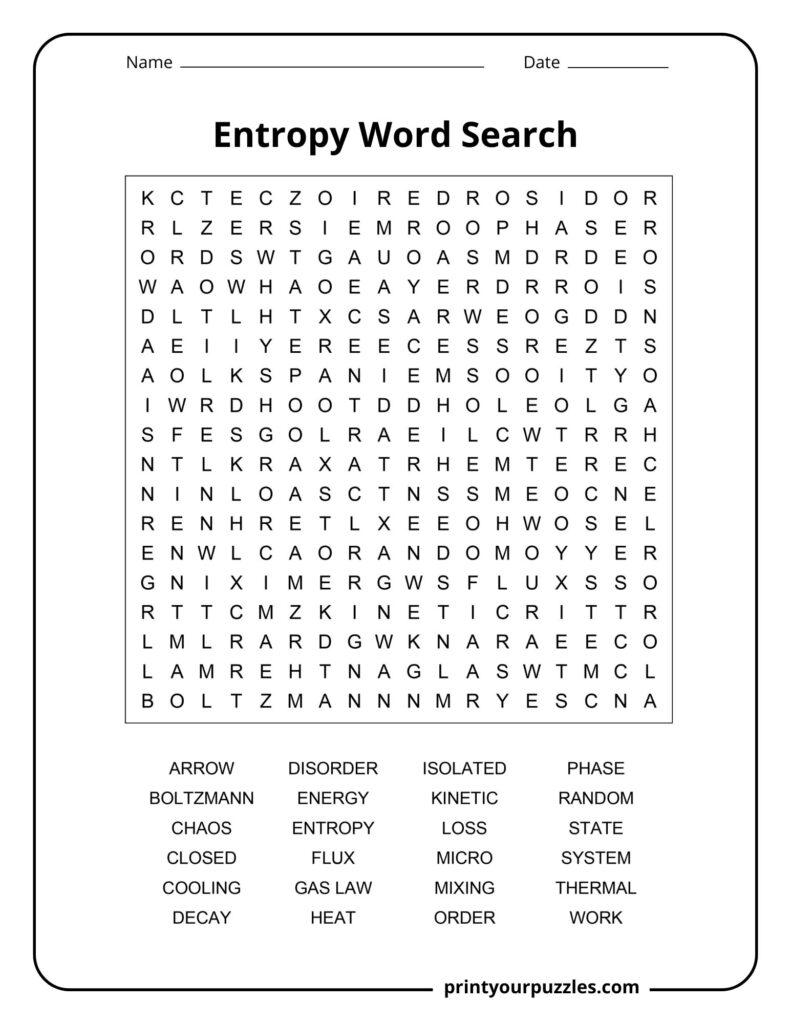
ARROW, BOLTZMANN, CHAOS, CLOSED, COOLING, DECAY, DISORDER, ENERGY, ENTROPY, FLUX, GAS LAW, HEAT, ISOLATED, KINETIC, LOSS, MICRO, MIXING, ORDER, PHASE, RANDOM, STATE, SYSTEM, THERMAL, WORK
ARROW — Refers to the “arrow of time,” a concept indicating that time flows in one direction, from past to future, driven by increasing entropy in the universe.
BOLTZMANN — Ludwig Boltzmann, Austrian physicist who formulated the statistical definition of entropy, linking microscopic particle arrangements to macroscopic thermodynamic properties through his famous equation S equals k log W.
CHAOS — A state of complete disorder and unpredictability closely associated with entropy. As entropy increases in a system, organized structures break down into increasingly chaotic arrangements.
CLOSED — A closed system exchanges energy but not matter with its surroundings. Entropy in closed systems tends to increase over time according to the second law of thermodynamics.
COOLING — The process of heat loss from a body. As objects cool, energy disperses into the environment, increasing overall entropy even though local temperature decreases and order may temporarily emerge.
DECAY — The gradual deterioration or breakdown of organized matter and energy into less ordered forms. Radioactive decay and material degradation are natural examples of entropy increasing over time.
DISORDER — A fundamental concept tied to entropy, representing the number of possible microscopic configurations of a system. Higher disorder means higher entropy, reflecting greater randomness in particle arrangements.
ENERGY — The capacity to perform work. Entropy describes how energy disperses and becomes less available for useful work, spreading from concentrated forms into diffuse, unusable heat.
ENTROPY — A thermodynamic quantity measuring the degree of disorder or randomness in a system. It quantifies energy unavailable for work and always tends to increase in isolated systems.
FLUX — The rate of flow of energy or matter through a surface. Entropy flux measures how much entropy is transported across system boundaries through heat transfer or mass exchange processes.
GAS LAW — Mathematical relationships describing gas behavior, connecting pressure, volume, and temperature. These laws help calculate entropy changes when gases expand, compress, or undergo thermal processes.
HEAT — Thermal energy transferred between bodies at different temperatures. Heat transfer is a primary mechanism driving entropy increase, as energy flows spontaneously from hot regions to cold ones.
ISOLATED — A system that exchanges neither energy nor matter with its surroundings. The second law states that entropy in an isolated system never decreases, always reaching maximum at equilibrium.
KINETIC — Relating to the motion of particles. Kinetic energy of molecules contributes to entropy, as faster-moving particles create more possible microscopic states and greater disorder within a system.
LOSS — In thermodynamic processes, useful energy is inevitably lost as waste heat due to entropy. No real engine achieves perfect efficiency because some energy always degrades irreversibly.
MICRO — Short for microstate, referring to a specific arrangement of particles in a system. Entropy is calculated by counting the number of microstates corresponding to a given macroscopic condition.
MIXING — The spontaneous blending of different substances, like gases or liquids. Mixing increases entropy because combined molecules have far more possible arrangements than when kept separately.
ORDER — A structured, organized arrangement of components in a system. Entropy measures the tendency of systems to move from ordered states toward disordered ones, requiring energy input to maintain order.
PHASE — A distinct state of matter such as solid, liquid, or gas. Phase transitions involve significant entropy changes; for example, melting and evaporation increase entropy as molecules gain freedom.
RANDOM — Lacking pattern or predictability. Entropy quantifies randomness in a system; maximum entropy corresponds to the most random possible configuration where no discernible structure or pattern remains.
STATE — The complete description of a system’s thermodynamic properties including temperature, pressure, and volume. Entropy is a state function, meaning it depends only on current conditions, not history.
SYSTEM — A defined portion of the universe under study, separated from its surroundings by boundaries. Entropy analysis examines how disorder changes within the system and its surrounding environment together.
THERMAL — Relating to heat and temperature. Thermal equilibrium represents maximum entropy for interacting bodies, where no further spontaneous heat flow occurs because temperature differences have vanished completely.
WORK — Energy transferred by a force acting over a distance. Entropy limits the conversion of heat into work; the Carnot cycle defines the maximum theoretical efficiency any heat engine can achieve.
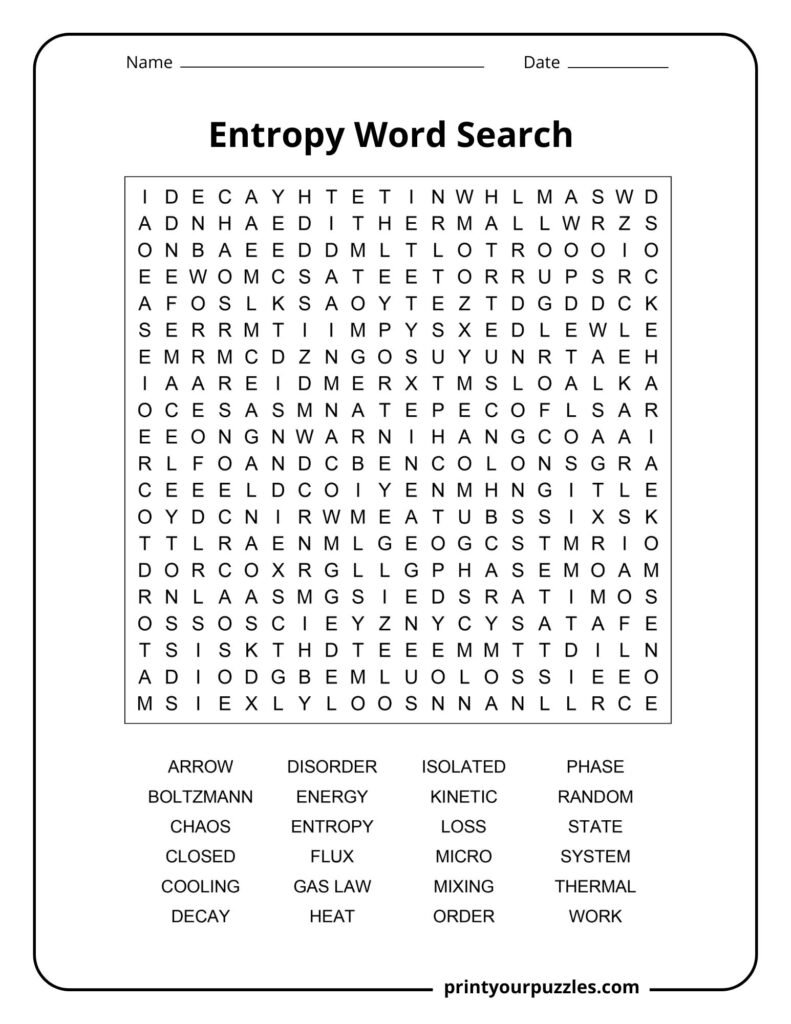
ARROW, BOLTZMANN, CHAOS, CLOSED, COOLING, DECAY, DISORDER, ENERGY, ENTROPY, FLUX, GAS LAW, HEAT, ISOLATED, KINETIC, LOSS, MICRO, MIXING, ORDER, PHASE, RANDOM, STATE, SYSTEM, THERMAL, WORK
Entropy is a thermodynamic measure of disorder or randomness within a system. It quantifies how much energy becomes unavailable for doing useful work, always tending to increase naturally.
The second law of thermodynamics states that isolated systems evolve toward maximum disorder. There are vastly more disordered states than ordered ones, making increasing entropy statistically inevitable.
Yes, entropy can decrease locally when energy is applied, like freezing water. However, the total entropy of the system plus its surroundings always increases overall.
Entropy explains why ice melts, rooms become messy, and machines lose efficiency. Every natural process generates waste heat and disorder, reflecting entropy’s constant increase around us.
Rudolf Clausius introduced the term entropy in 1865 to describe irreversible energy transformations. Later, Ludwig Boltzmann gave it a statistical interpretation connecting microscopic particle arrangements to macroscopic behavior.
Until the End of Time by Brian Greene. Brian Greene masterfully bridges the gap between complex physics and human wonder. This book provides a scientifically precise yet lyrical exploration of entropy and the cosmos, making the daunting “arrow of time” accessible to any curious mind.
Once an egg is scrambled, its molecules reach a highly disordered state. Reversing this process would require decreasing entropy, which nature simply doesn’t allow spontaneously.
Scientists predict a “heat death” where entropy reaches maximum. All energy will be evenly distributed, no temperature differences will exist, and absolutely nothing meaningful can happen anymore.
Living organisms maintain remarkable internal order by consuming food and expelling waste heat. Life is essentially a temporary, beautiful rebellion against the universe’s relentless march toward disorder.
The arrow of time exists because entropy always increases. We remember the past because it had lower entropy, and the future always holds greater disorder ahead.
Physicist Jacob Bekenstein and Stephen Hawking discovered that black hole entropy is proportional to their surface area, not volume, making them the most disordered objects known to exist.