Introduction to the Algebra Word Search
Algebra is a branch of mathematics that uses numbers, letters, and symbols to describe relationships and solve problems. While ordinary arithmetic works mainly with known numbers, algebra introduces variables—letters such as x, y, or n—that represent unknown or changing values. This makes it possible to explore patterns and find answers even when some information is missing.
A simple algebraic expression might be x + 5. The letter x stands for a number, while 5 is a constant because its value does not change. Expressions can also contain coefficients, which are numbers placed before variables. For example, in 3x, the number 3 is the coefficient and means that x is multiplied by three.
An equation states that two expressions have the same value. In*x + 5 = 12, the goal is to discover the value of x. By subtracting 5 from both sides, we find that x equals 7. Whatever operation is performed on one side of an equation must also be performed on the other side. This keeps the equation balanced, much like a scale.
Algebra also involves learning how to simplify expressions. Terms containing the same variable and exponent are called like terms and can be combined. For example, 4x + 2x simplifies to 6x. Other important skills include using the distributive property, working with negative numbers, understanding exponents, solving inequalities, and graphing equations on coordinate planes.
Students may wonder why algebra is useful outside the classroom. In everyday life, it can help people calculate discounts, compare prices, plan budgets, measure distances, adjust recipes, and determine travel times. Scientists, engineers, architects, computer programmers, economists, and many other professionals regularly use algebra to analyze information and solve practical problems.
Learning algebra becomes easier when each problem is handled step by step. Students should first identify the known and unknown information, choose the correct operation, and check whether their answer makes sense. Regular practice also helps mathematical symbols and vocabulary become more familiar.
An Algebra word search can provide an enjoyable way to review terms such as variable, equation, coefficient, expression, exponent, formula, and solution. Recognizing this vocabulary gives students a stronger foundation for understanding algebraic rules, communicating mathematical ideas, and approaching more advanced topics with confidence.
Related Word Searches:
Math | Geometry | Coding | Physics | Gravity | Weather
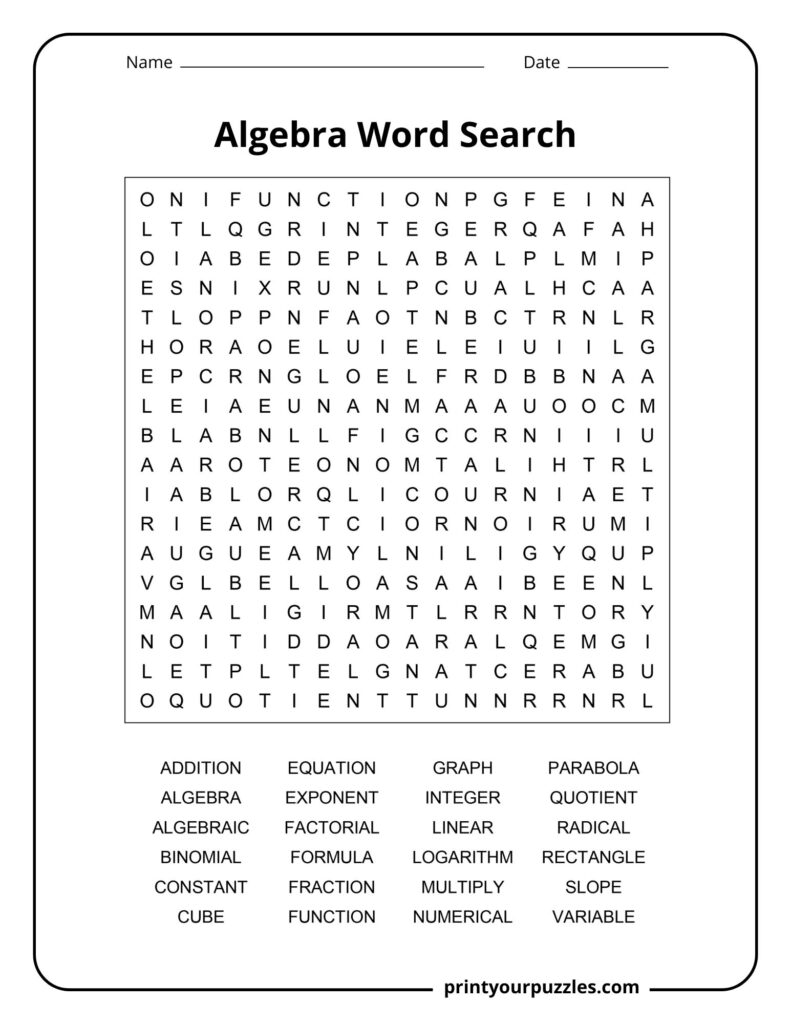
Medium Difficulty Word Search
Words to Find
ADDITION, ALGEBRA, ALGEBRAIC, BINOMIAL, CONSTANT, CUBE, EQUATION, EXPONENT, FACTORIAL, FORMULA, FRACTION, FUNCTION, GRAPH, INTEGER, LINEAR, LOGARITHM, MULTIPLY, NUMERICAL, PARABOLA, QUOTIENT, RADICAL, RECTANGLE, SLOPE, VARIABLE
All Words Defined
ADDITION – The mathematical operation of combining two or more numbers to find their sum or total value, represented by the plus sign.
ALGEBRA – A branch of mathematics using letters and symbols to represent numbers and quantities in formulas and equations to solve problems systematically.
ALGEBRAIC – Relating to or involving algebra, characterized by the use of symbols, variables, and mathematical operations to express relationships and solve equations.
BINOMIAL – An algebraic expression containing exactly two terms separated by a plus or minus sign, such as x plus y or a minus b.
CONSTANT – A fixed value that does not change within a mathematical expression or equation, often represented by a specific number or letter.
CUBE – The result of multiplying a number by itself three times, or a three-dimensional geometric shape with six equal square faces.
EQUATION – A mathematical statement showing that two expressions are equal, connected by an equals sign, often requiring solving to find unknown values.
EXPONENT – A number indicating how many times a base number is multiplied by itself, written as a superscript to the right of the base.
FACTORIAL – The product of all positive integers less than or equal to a given number, denoted by an exclamation mark, used in permutations and combinations.
FORMULA – A mathematical rule or relationship expressed using symbols and variables, providing a method to calculate a specific value or solve a problem.
FRACTION – A numerical quantity representing a part of a whole, expressed as one number divided by another, with a numerator and denominator.
FUNCTION – A mathematical relationship where each input value corresponds to exactly one output value, often expressed as an equation or rule.
GRAPH – A visual representation of mathematical data or functions using coordinate axes, showing relationships between variables through points, lines, or curves.
INTEGER – A whole number that can be positive, negative, or zero, with no fractional or decimal parts, used in counting and ordering.
LINEAR – Relating to or resembling a straight line, or describing equations and relationships where variables have exponents of one, producing straight-line graphs.
LOGARITHM – The power to which a base number must be raised to produce a given number, serving as the inverse operation of exponentiation.
MULTIPLY – To perform the mathematical operation of combining equal groups or repeated addition, finding the product of two or more numbers together.
NUMERICAL – Relating to or expressed in numbers, involving calculations or measurements rather than theoretical or symbolic representations, emphasizing quantitative aspects of mathematics.
PARABOLA – A symmetrical U-shaped curve formed by graphing a quadratic equation, where every point is equidistant from a focus and directrix line.
QUOTIENT – The result obtained when one number is divided by another, representing how many times the divisor fits into the dividend completely.
RADICAL – A mathematical symbol indicating a root operation, most commonly the square root, used to find numbers that when multiplied produce given values.
RECTANGLE – A four-sided polygon with opposite sides equal and parallel, containing four right angles, commonly used in geometry and area calculations.
SLOPE – A measure of the steepness or incline of a line on a graph, calculated by dividing the vertical rise by the horizontal run between any two points on the line.
VARIABLE – A symbol, typically a letter, representing an unknown or changing value in mathematical expressions, equations, or functions that can vary.
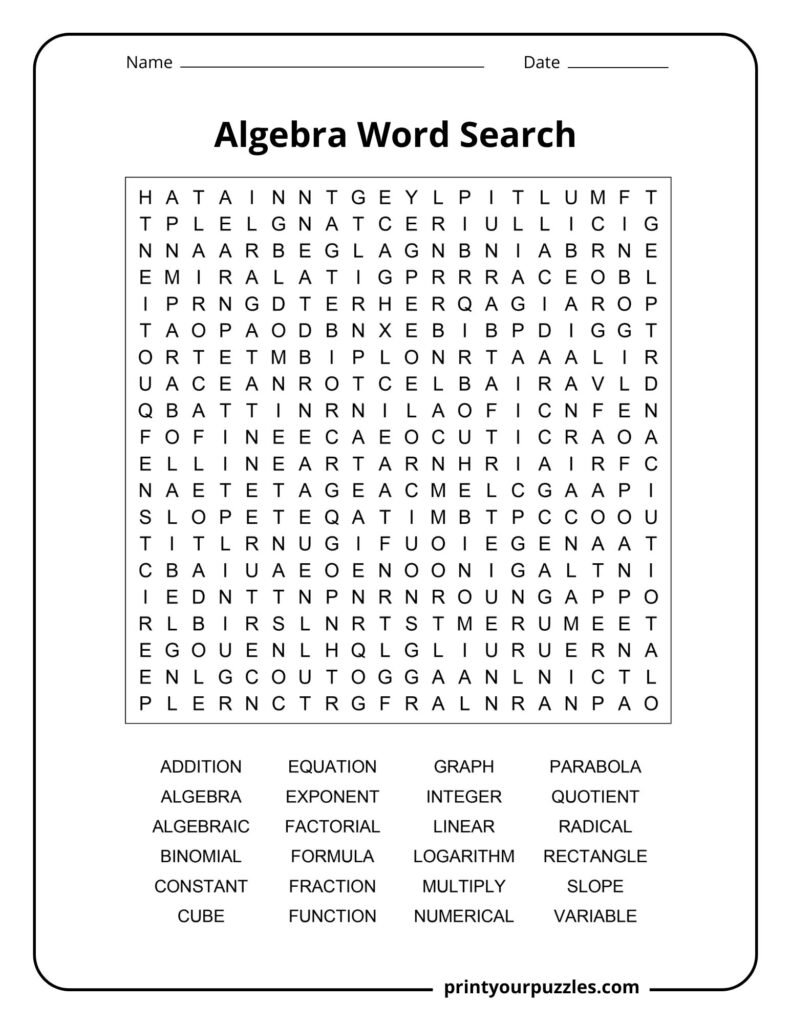
Hard Difficulty Word Search
Words to Find
ADDITION, ALGEBRA, ALGEBRAIC, BINOMIAL, CONSTANT, CUBE, EQUATION, EXPONENT, FACTORIAL, FORMULA, FRACTION, FUNCTION, GRAPH, INTEGER, LINEAR, LOGARITHM, MULTIPLY, NUMERICAL, PARABOLA, QUOTIENT, RADICAL, RECTANGLE, SLOPE, VARIABLE
5 Key FAQs About Algebra
5 Curious "Did You Know?" Facts About Algebra