
Fossils are preserved remains, impressions, or traces of living organisms from the distant past. They provide valuable evidence about plants, animals, and environments that existed millions of years before humans began recording history. By studying fossils, scientists can learn how life on Earth has changed, how species adapted, and why some organisms eventually disappeared.
Most fossils form when an organism is quickly buried by mud, sand, volcanic ash, or another type of sediment. Over time, additional layers build up, creating pressure that gradually turns the sediment into rock. Hard parts such as bones, teeth, shells, and wood are more likely to survive this process than soft tissues. Minerals may replace the original material, producing a stone-like copy that preserves the organism’s shape and structure.
Not every fossil is part of an animal or plant. Trace fossils record evidence of an organism’s activity rather than its body. Footprints, burrows, nests, bite marks, and fossilized waste can reveal how ancient creatures moved, lived, hunted, or cared for their young. Impressions of leaves, feathers, and skin can also preserve remarkable details that help researchers reconstruct prehistoric life.
Fossils are found in many places, including cliffs, deserts, riverbanks, caves, mines, and exposed layers of sedimentary rock. Paleontologists carefully excavate these discoveries using brushes, small tools, and protective materials. Each fossil’s location is recorded because the surrounding rock can provide important clues about its age and original environment.
Scientists estimate the age of fossils in several ways. Relative dating compares the positions of rock layers, since deeper layers are usually older than those above them. Radiometric dating examines the natural decay of certain elements in rocks, allowing researchers to calculate more precise ages.
The fossil record is incomplete because fossilization requires special conditions, and many organisms decay without leaving evidence. Even so, fossils have revealed extinct dinosaurs, ancient marine reptiles, early mammals, giant plants, and microscopic life forms. They also show that oceans once covered areas that are now dry land and that climates have changed dramatically over time.
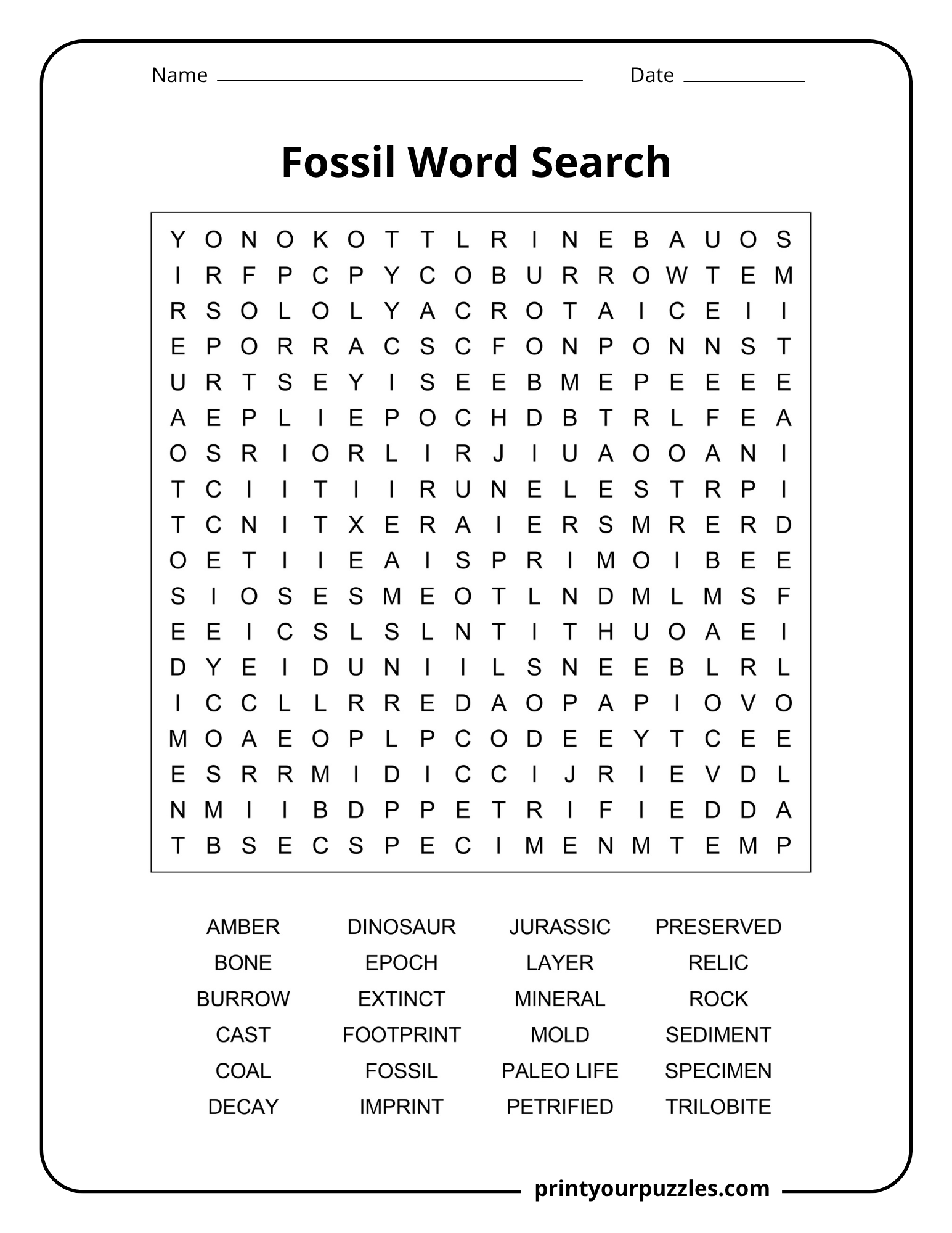
A fossil word search offers an enjoyable way to review important vocabulary while exploring paleontology, prehistoric organisms, rock layers, and the processes that preserve evidence of Earth’s ancient past.
Related Word Searches:
Rock Cycle | Erosion | Earth Layers | Plate Tectonics | Biology | Biodiversity
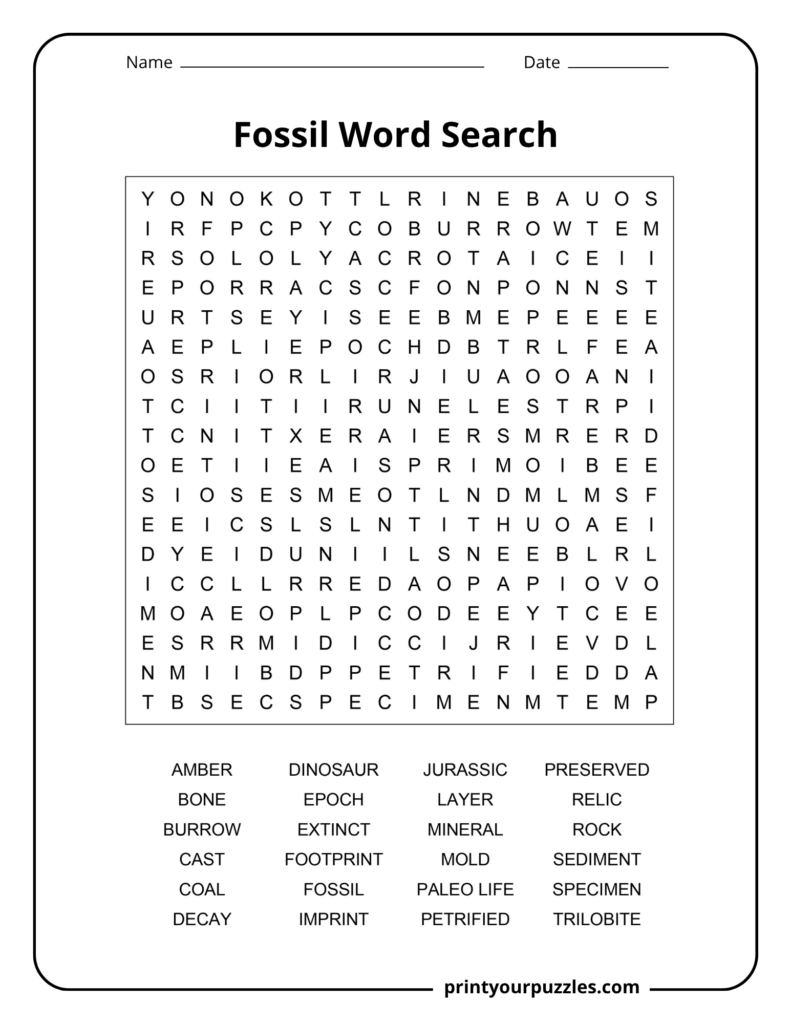
AMBER, BONE, BURROW, CAST, COAL, DECAY, DINOSAUR, EPOCH, EXTINCT, FOOTPRINT, FOSSIL, IMPRINT, JURASSIC, LAYER, MINERAL, MOLD, PALEO LIFE, PETRIFIED, PRESERVED, RELIC, ROCK, SEDIMENT, SPECIMEN, TRILOBITE
AMBER – Hardened tree resin that sometimes preserves insects, leaves, pollen, or other tiny organisms, offering unusually detailed evidence of ancient life from millions of years ago.
BONE – A hard body structure that can become fossilized after burial, especially when minerals gradually replace its original material while preserving its overall shape and internal details.
BURROW – A tunnel or shelter made by an ancient animal, preserved as a trace fossil that reveals behavior, movement, habitat, feeding patterns, and interaction with its environment.
CAST – A three-dimensional fossil formed when minerals or sediment fill a mold, creating a solid copy of the original organism’s external shape, texture, and surface details.
COAL – A dark sedimentary rock formed mainly from compressed ancient plant material, providing evidence of swampy environments, dense vegetation, and climatic conditions that existed millions of years ago.
DECAY – The natural breakdown of dead organisms by bacteria, fungi, chemicals, and environmental conditions, a process that usually occurs before fossilization can successfully preserve recognizable remains.
DINOSAUR – A member of a diverse group of prehistoric reptiles whose fossilized bones, teeth, footprints, and eggs provide important evidence about ancient terrestrial ecosystems and evolutionary change.
EPOCH – A division of geological time shorter than a period, used by scientists to organize Earth’s history and describe major environmental, climatic, biological, and evolutionary changes.
EXTINCT – Describes a species with no living members remaining, known through fossils, historical records, or scientific evidence showing that its entire population permanently disappeared from Earth.
FOOTPRINT – A preserved impression left by an animal’s foot in soft sediment, revealing information about its size, movement, speed, ancient behavior, direction, and possible social groups.
FOSSIL – The preserved remains, impression, or trace of an ancient organism, usually found in rock and studied to understand Earth’s biological, environmental, geological, and evolutionary history.
IMPRINT – A flat impression of a plant, animal, shell, feather, or other organism left in sediment that later hardened and preserved its visible outline and surface features.
JURASSIC – A geological period approximately 201 to 145 million years ago, famous for large dinosaurs, early birds, marine reptiles, widespread forests, changing continental landscapes, and ecosystems.
LAYER – A section of sediment or rock deposited during a particular time, helping scientists determine relative ages and reconstruct changes in ancient environments, climates, and ecosystems.
MINERAL – A naturally occurring inorganic substance that may replace or fill an organism’s remains during fossilization, helping preserve its structure, shape, composition, and fine anatomical details.
MOLD – A hollow impression formed when buried remains dissolve or decay after surrounding sediment hardens, leaving the organism’s shape and external features preserved within the rock.
PALEO LIFE – Ancient organisms and ecosystems known through fossils, including prehistoric plants, animals, and microorganisms that reveal how life evolved, diversified, and adapted across geological time periods.
PETRIFIED – Describes organic material transformed into stone when minerals replace its original tissues, often preserving detailed structures such as wood grain, cells, internal patterns, or growth rings.
PRESERVED – Kept from complete decay or destruction through burial, freezing, drying, mineral replacement, or resin, allowing ancient biological evidence to survive for later scientific study and comparison.
RELIC – A surviving object, remain, or trace from the distant past that provides evidence about ancient organisms, human cultures, environments, geological processes, or important historical events.
ROCK – A natural solid material composed of minerals, often containing fossils that were buried and preserved as sediment accumulated, compressed, and hardened over extremely long periods.
SEDIMENT – Loose particles of sand, mud, clay, or organic material that settle in layers and may bury organisms, creating favorable conditions for fossil formation and preservation.
SPECIMEN – An individual fossil or collected sample examined by scientists to identify an organism, compare features, determine age, and study its ancient environment and biological relationships.
TRILOBITE – An extinct marine arthropod with a segmented body and hard shell, commonly fossilized and widely used to study ancient oceans, evolution, biodiversity, and geological time.
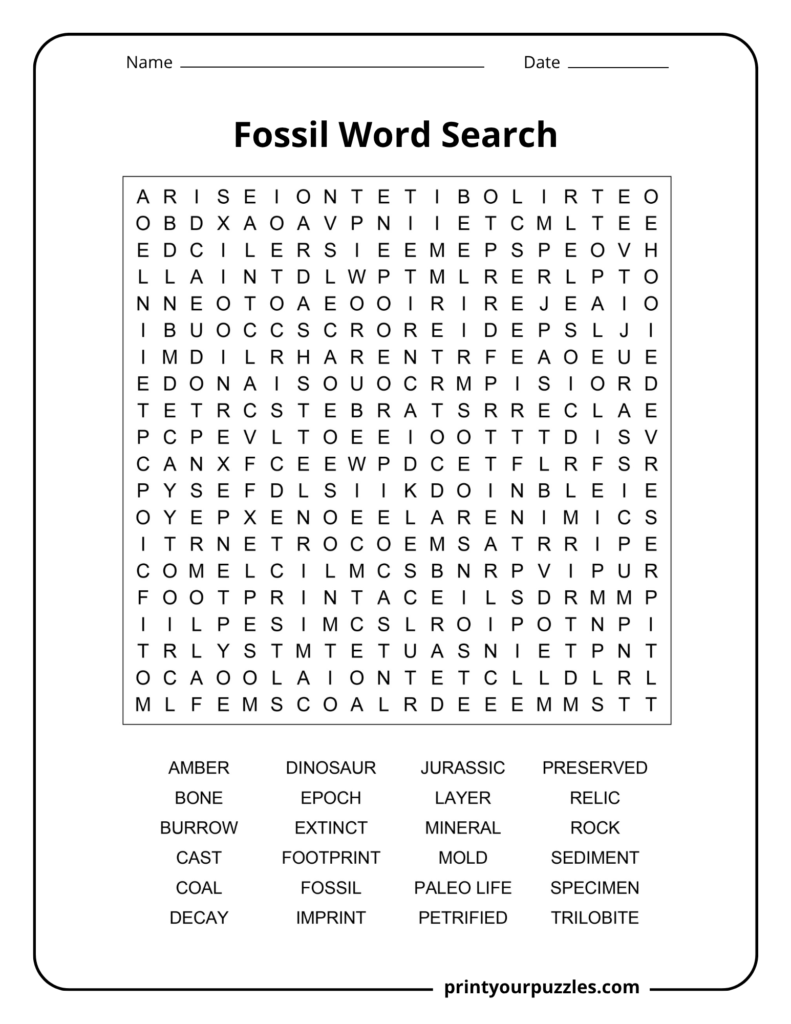
AMBER, BONE, BURROW, CAST, COAL, DECAY, DINOSAUR, EPOCH, EXTINCT, FOOTPRINT, FOSSIL, IMPRINT, JURASSIC, LAYER, MINERAL, MOLD, PALEO LIFE, PETRIFIED, PRESERVED, RELIC, ROCK, SEDIMENT, SPECIMEN, TRILOBITE
A fossil is the preserved remain, impression, or trace of an ancient organism, usually found in rock and studied for evidence about past life.
Fossils often form when organisms are quickly buried by sediment, protected from decay, and gradually preserved through mineral replacement, compression, or other geological processes.
Fossils are commonly found in sedimentary rocks, cliffs, deserts, riverbanks, caves, and quarries where erosion exposes layers containing preserved ancient remains or traces.
Fossils help scientists understand extinct species, evolution, ancient climates, changing environments, and the geological history of Earth across millions of years.
A body fossil preserves part of an organism, while a trace fossil records activity, such as footprints, burrows, nests, or fossilized waste.
Trace fossils, including footprints, burrows, nests, and bite marks, preserve evidence of an organism’s behavior rather than its physical remains.
Sticky tree resin sometimes trapped insects, pollen, leaves, and other small organisms before hardening, preserving remarkably fine details for millions of years.
Scientists study footprint size, spacing, depth, and direction to estimate an ancient animal’s speed, posture, body size, and possible group behavior.
Fossilization requires unusual conditions, such as rapid burial and limited decay, so only a tiny percentage of ancient organisms entered the fossil record.
Marine fossils discovered far inland or high in mountains demonstrate that geological forces and changing sea levels transformed Earth’s surface over time.