Biodiversity describes the remarkable variety of life found on Earth. It includes every living organism, from plants, animals, fungi, and bacteria to the ecosystems where they live. Tropical rainforests, coral reefs, deserts, rivers, grasslands, and even city parks all support different forms of life. Together, these living communities create complex natural systems in which each species has a role.
Scientists usually study biodiversity at three main levels. Genetic diversity refers to the differences among individuals within the same species. Species diversity describes the number and variety of species living in a particular place. Ecosystem diversity includes the many habitats and natural environments found across the planet. These levels are closely connected, and damage to one can affect the others.
Biodiversity is essential for healthy ecosystems and human well-being. Plants produce oxygen, insects pollinate crops, wetlands help control floods, and forests absorb carbon dioxide. Nature also provides food, medicines, building materials, and clean water. Many industries, including agriculture, fishing, tourism, and medicine, depend directly on biological resources. A rich variety of species can also make ecosystems stronger and better able to recover from fires, storms, diseases, and environmental changes.
However, biodiversity is declining in many parts of the world. Habitat destruction, pollution, climate change, overfishing, hunting, invasive species, and the excessive use of natural resources can threaten plants and animals. When a species disappears, its loss may affect predators, prey, plants, and other organisms connected through the food web. Extinction is permanent, which makes protecting endangered species and their habitats especially important.
Conservation efforts include creating national parks, restoring damaged habitats, reducing pollution, controlling invasive species, and using resources more sustainably. Individuals can also help by planting native flowers, reducing waste, avoiding products linked to habitat destruction, and supporting responsible conservation organizations.
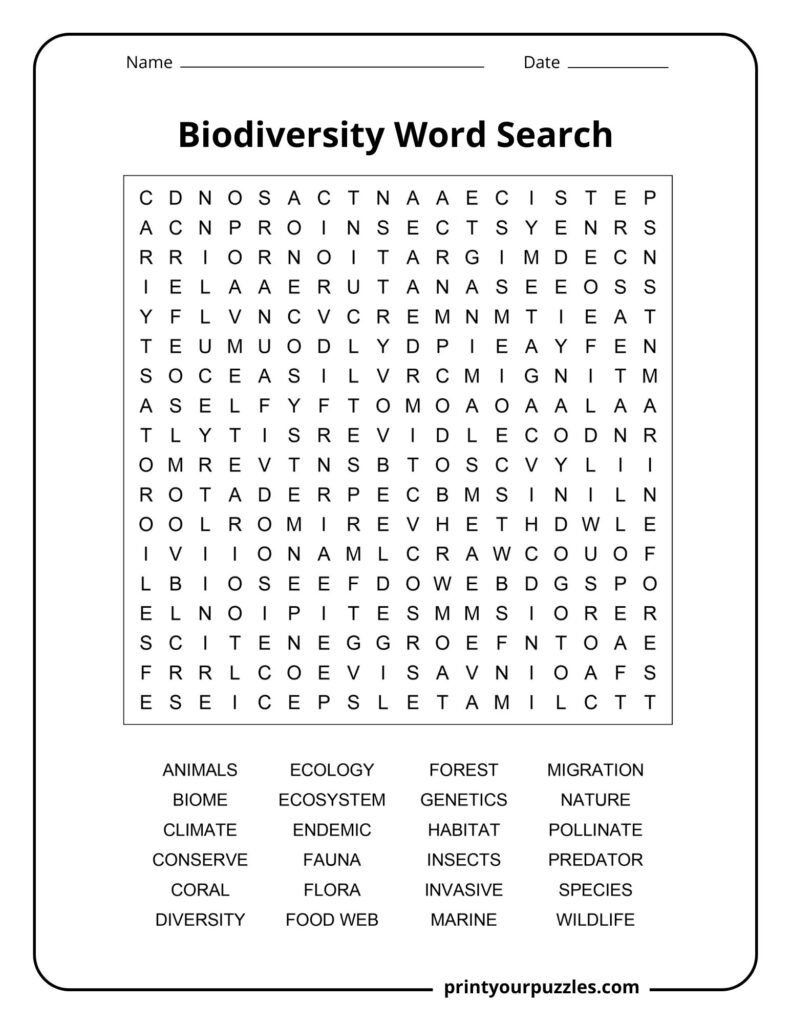
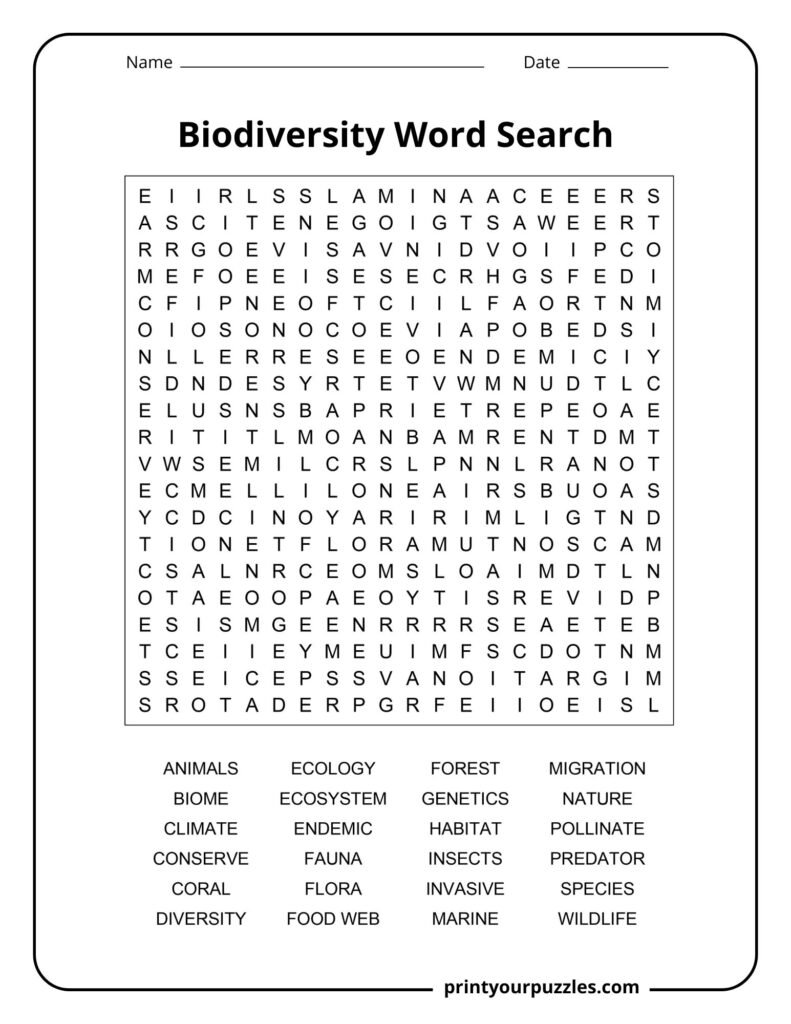
This biodiversity word search introduces vocabulary connected with species, habitats, ecosystems, conservation, and environmental threats. As you find each hidden term, you can explore how living things depend on one another and why protecting nature’s variety is essential for the future of our planet.
Related Word Searches:
Ecosystem | Ecology | Biology | Food Chain | Genetics | Botany
ANIMALS – Living organisms that usually move, consume food, respond to their surroundings, and play important roles as predators, prey, pollinators, grazers, and ecosystem engineers.
BIOME – A large natural region defined by its climate, vegetation, wildlife, and environmental conditions, such as a desert, rainforest, grassland, tundra, or freshwater biome.
CLIMATE – The long-term pattern of temperature, rainfall, wind, and other weather conditions that influences habitats, species distribution, migration, reproduction, and the survival of ecosystems.
CONSERVE – To protect species, habitats, and natural resources through careful management, sustainable practices, restoration projects, protected areas, education, and actions that reduce environmental damage.
CORAL – A small marine animal that lives in colonies and creates reefs, providing food, shelter, breeding grounds, and protection for numerous ocean species.
DIVERSITY – The variety of genes, species, habitats, and ecosystems within an area, helping natural communities remain productive, adaptable, balanced, and resilient when environmental conditions change.
ECOLOGY – The scientific study of relationships among living organisms and between organisms and their environments, including interactions involving food, shelter, competition, reproduction, energy, and nutrients.
ECOSYSTEM – A community of organisms interacting with each other and with nonliving elements, such as water, soil, sunlight, air, temperature, and minerals, within one environment.
ENDEMIC – Describes a species naturally found only in one particular geographic area, making it especially vulnerable to habitat loss, invasive organisms, disease, and environmental change.
FAUNA – The animals naturally living in a particular region, habitat, ecosystem, or period, including mammals, birds, reptiles, amphibians, fish, insects, and other animal groups.
FLORA – The plants naturally growing in a particular region or habitat, including trees, flowers, grasses, shrubs, mosses, and other vegetation supporting wildlife and ecosystem processes.
FOOD WEB – A network showing how plants, animals, fungi, and microorganisms are connected through feeding relationships, demonstrating how energy and nutrients move throughout an ecosystem.
FOREST – An ecosystem dominated by trees and other vegetation that provides habitat, stores carbon, protects soil, regulates water, produces oxygen, and supports countless living organisms.
GENETICS – The study of genes and inherited characteristics, explaining variation within species and helping scientists understand adaptation, breeding, evolution, disease resistance, and biological diversity.
HABITAT – The natural place where an organism lives and finds the food, water, shelter, space, climate, and conditions necessary for survival and successful reproduction.
INSECTS – Small animals with six legs and three main body sections, playing essential ecological roles as pollinators, decomposers, predators, prey, seed spreaders, and soil builders.
INVASIVE – Describes a nonnative species that spreads rapidly and harms local ecosystems by competing with native organisms, changing habitats, introducing diseases, or disrupting food webs.
MARINE – Related to oceans and seas, including saltwater habitats and organisms such as coral reefs, whales, fish, seaweed, plankton, shellfish, and marine mammals.
MIGRATION – The regular movement of animals from one place to another, often to find food, reproduce, avoid harsh weather, or reach safer seasonal habitats.
NATURE – The living and nonliving world not created by humans, including plants, animals, landscapes, oceans, rivers, weather, geological features, and the processes connecting them.
POLLINATE – To transfer pollen between flowers, allowing plants to produce seeds and fruit, a process performed by insects, birds, bats, wind, water, and other animals.
PREDATOR – An animal that hunts, captures, and eats other organisms, helping regulate prey populations, maintain ecological balance, remove weak individuals, and influence animal behavior.
SPECIES – A group of similar organisms capable of reproducing with one another and producing fertile offspring, sharing inherited traits while remaining distinct from other biological groups.
WILDLIFE – Wild animals, plants, fungi, and other organisms living naturally without domestication, forming essential parts of ecosystems and contributing to ecological balance and biodiversity.