

Botany is the scientific study of plants, from the smallest mosses and algae to towering trees and flowering crops. It explores how plants grow, reproduce, obtain energy, adapt to their surroundings, and interact with other living organisms. Because plants are essential to nearly every ecosystem, botany helps us understand both the natural world and many parts of everyday life.
Plants produce oxygen through photosynthesis, provide food for people and animals, and create habitats for countless species. They also supply materials used to make medicines, clothing, paper, furniture, fuels, and building products. Botanists study these valuable organisms by examining their cells, tissues, roots, stems, leaves, flowers, fruits, and seeds. They may also investigate how plants respond to sunlight, water, temperature, soil conditions, pests, and diseases.
One important area of botany is plant classification. Scientists organize plants into groups according to shared characteristics and evolutionary relationships. This system makes it easier to identify species and understand how different plants are connected. Other branches focus on plant anatomy, genetics, ecology, physiology, and the study of ancient plant remains. Some botanists work outdoors in forests, deserts, wetlands, farms, or botanical gardens, while others conduct experiments in laboratories.
Botany also plays an important role in agriculture and environmental protection. Plant scientists help develop stronger crops, improve food production, control plant diseases, and discover varieties that can survive drought, heat, or poor soil. Their research supports conservation efforts by identifying endangered plants, protecting habitats, and studying the effects of pollution and climate change.
Learning about plants encourages people to look more closely at the living world around them. A simple leaf, flower, or seed contains structures and processes that demonstrate how remarkably complex plants can be. Even plants that appear ordinary may have unusual adaptations, traditional uses, or important ecological functions.
This botany word search introduces vocabulary connected with plant science, including terms related to plant parts, growth, reproduction, classification, and habitats. As you search for each word, you can review important botanical ideas and discover how plants support ecosystems, human communities, and life across the planet.
Related Word Searches:
Photosynthesis | Biology | Cell | Ecology | Biodiversity | Genetics
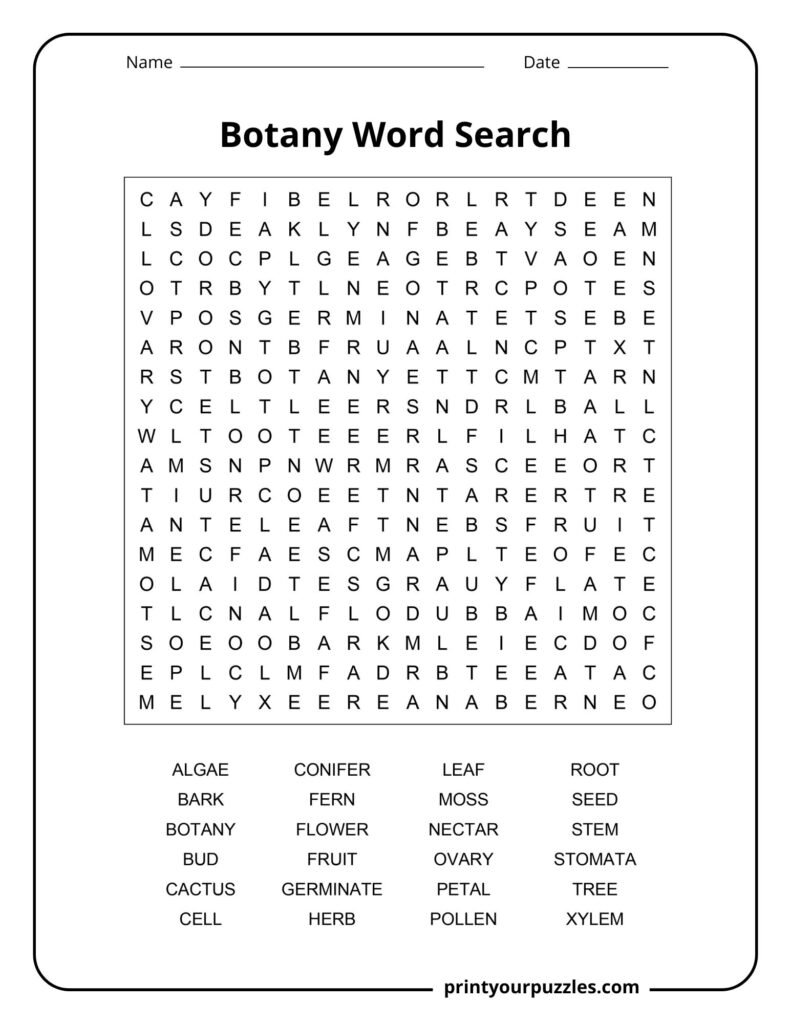
ALGAE, BARK, BOTANY, BUD, CACTUS, CELL, CONIFER, FERN, FLOWER, FRUIT, GERMINATE, HERB, LEAF, MOSS, NECTAR, OVARY, PETAL, POLLEN, ROOT, SEED, STEM, STOMATA, TREE, XYLEM
ALGAE – Simple plant-like organisms, usually found in water or damp places, that produce energy through photosynthesis and range from microscopic forms to large seaweeds.
BARK – The protective outer covering of woody stems and roots, helping defend plants against injury, pests, diseases, temperature changes, fire, and excessive water loss.
BOTANY – The scientific study of plants, including their structure, growth, reproduction, classification, evolution, ecology, diseases, uses, and importance within natural ecosystems.
BUD – A small undeveloped growth on a plant that may develop into a leaf, flower, branch, or new shoot when environmental conditions become suitable.
CACTUS – A plant adapted to dry environments, usually with thick water-storing stems, reduced leaves or spines, and specialized roots that absorb moisture very quickly.
CELL – The smallest structural and functional unit of a plant, containing specialized parts that perform essential processes such as growth, photosynthesis, respiration, reproduction, and storage.
CONIFER – A cone-bearing tree or shrub, usually evergreen, with needle-like or scale-like leaves, including pines, firs, spruces, cedars, redwoods, and related plants.
FERN – A nonflowering vascular plant that reproduces through spores and typically has divided leaves called fronds, often growing in moist, shaded, or woodland environments.
FLOWER – The reproductive structure of many plants, containing organs that produce pollen and ovules while often attracting pollinators through color, shape, scent, or nectar.
FRUIT – The mature ovary of a flowering plant, usually containing seeds and helping protect or distribute them through animals, wind, water, gravity, or other methods.
GERMINATE – To begin growing from a seed or spore after suitable moisture, temperature, oxygen, and other environmental conditions activate the development of a new plant.
HERB – A plant with soft, nonwoody stems, often valued for culinary, medicinal, aromatic, decorative, or ornamental uses, and sometimes completing its life cycle quickly.
LEAF – A usually flat plant organ that captures sunlight for photosynthesis, exchanges gases through stomata, and helps regulate water loss through the process of transpiration.
MOSS – A small nonvascular plant that grows in moist or shaded places, absorbs water directly, and reproduces through spores rather than flowers, fruits, or seeds.
NECTAR – A sweet liquid produced by flowers or other plant structures to attract pollinators such as bees, butterflies, moths, birds, bats, and certain insects.
OVARY – The part of a flower that contains ovules and, after successful fertilization, usually develops into a fruit while the ovules gradually become seeds.
PETAL – A modified leaf forming part of a flower, often brightly colored or scented to attract pollinators and help protect the inner reproductive structures.
POLLEN – A fine powder produced by the male parts of seed plants, containing reproductive cells needed to fertilize ovules and begin the development of seeds.
ROOT – A plant organ that anchors the plant, absorbs water and minerals from soil, stores nutrients, and sometimes supports spreading, survival, or vegetative reproduction.
SEED – A plant reproductive structure containing an embryo, stored food, and a protective coat, capable of developing into a new plant under suitable environmental conditions.
STEM – The plant structure that supports leaves, flowers, and fruits while transporting water, minerals, nutrients, and sugars between roots and all other plant parts.
STOMATA – Tiny pores mainly found on leaf surfaces that open and close to control gas exchange, carbon dioxide intake, oxygen release, and water loss.
TREE – A tall, long-lived woody plant with a main trunk, branches, and leaves, providing habitats, oxygen, shade, food, fuel, and many valuable materials.
XYLEM – Plant vascular tissue that carries water and dissolved minerals upward from roots while also providing structural support through strong, elongated, specialized cells.
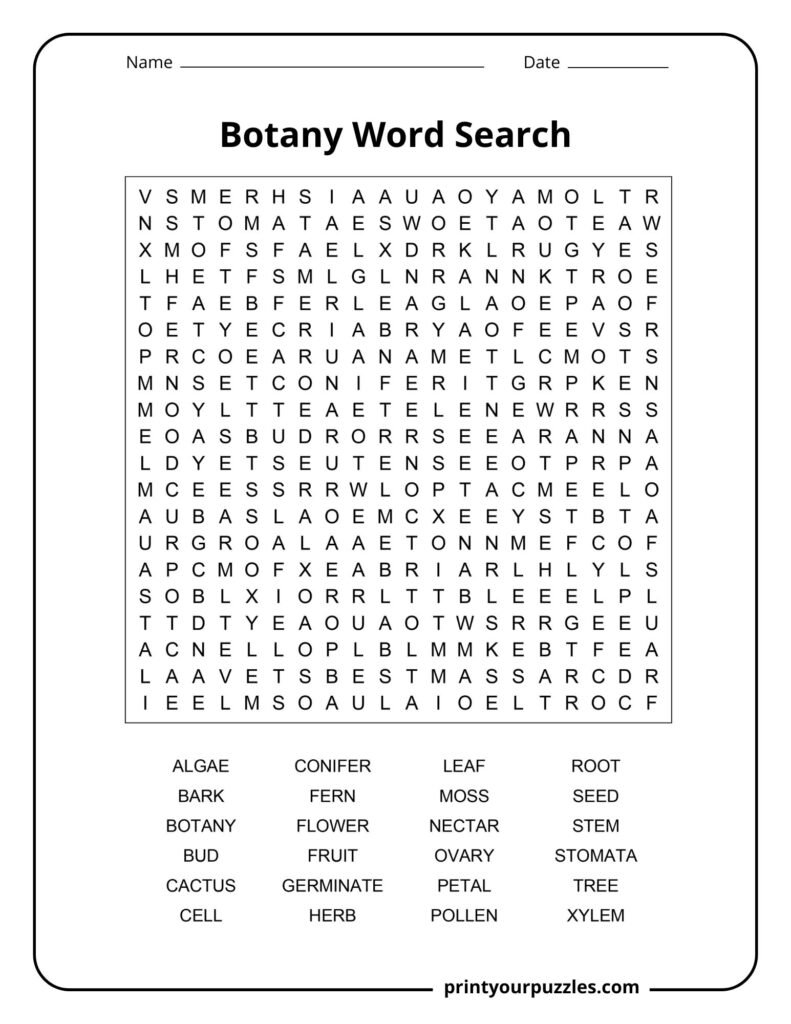
ALGAE, BARK, BOTANY, BUD, CACTUS, CELL, CONIFER, FERN, FLOWER, FRUIT, GERMINATE, HERB, LEAF, MOSS, NECTAR, OVARY, PETAL, POLLEN, ROOT, SEED, STEM, STOMATA, TREE, XYLEM
Botany is the scientific study of plants, including their structure, growth, reproduction, classification, evolution, uses, and relationships with surrounding environments.
Botany helps scientists improve crops, develop medicines, protect endangered species, understand ecosystems, manage forests, and study how plants respond to environmental change.
Botanists study plant cells, roots, stems, leaves, flowers, seeds, genetics, diseases, habitats, and the many ways plants interact with other organisms.
Plants use photosynthesis to combine sunlight, water, and carbon dioxide, producing sugars for energy while releasing oxygen into the surrounding atmosphere.
Botanists may work in laboratories, universities, farms, forests, botanical gardens, museums, conservation organizations, government agencies, or companies developing agricultural and medicinal products.
Plants can release chemical signals through the air or soil, warning nearby plants about insects, diseases, or other environmental threats.
Giant sequoias and coastal redwoods can grow to enormous sizes, with some living for thousands of years and reaching extraordinary heights.
Flowering plants evolved millions of years after mosses, ferns, and conifers, eventually becoming the most diverse and widespread plant group on Earth.
Certain seeds survive long periods without growing, waiting until moisture, temperature, light, and soil conditions become suitable for germination.
Using hydroponics, plants receive water and dissolved nutrients directly, allowing them to grow successfully without traditional soil under controlled conditions.