
The Circulatory System is the body’s transportation network. It moves blood throughout the body, delivering oxygen, nutrients, hormones, and other essential substances to cells. At the same time, it collects carbon dioxide and waste products so they can be removed. Without this continuous movement of blood, the organs and tissues would not receive what they need to function.
The heart is the central organ of the Circulatory System. This powerful muscle is divided into four chambers: two atria and two ventricles. The right side of the heart receives blood that is low in oxygen and pumps it toward the lungs. The left side receives oxygen-rich blood from the lungs and sends it to the rest of the body. The heart beats thousands of times each day, keeping blood moving through a vast network of blood vessels.
There are three main types of blood vessels. Arteries carry blood away from the heart, while veins return blood to it. Tiny vessels called capillaries connect arteries and veins. Their thin walls allow oxygen, nutrients, and waste products to pass between the blood and nearby cells.
Blood itself has several important parts. Red blood cells transport oxygen, white blood cells help defend the body against infection, and platelets help stop bleeding by forming clots. Plasma is the liquid part of blood that carries these cells along with nutrients, hormones, proteins, and waste materials.
Like other Body Systems, circulation does not work alone. The Respiratory System supplies oxygen to the blood and removes carbon dioxide. The Digestive System breaks food into nutrients that enter the bloodstream and travel to cells. The Endocrine System releases hormones that are transported through the blood to specific organs. The Nervous System helps regulate heart rate, while the Muscular System supports circulation through body movement and includes the heart itself, which is made of cardiac muscle.
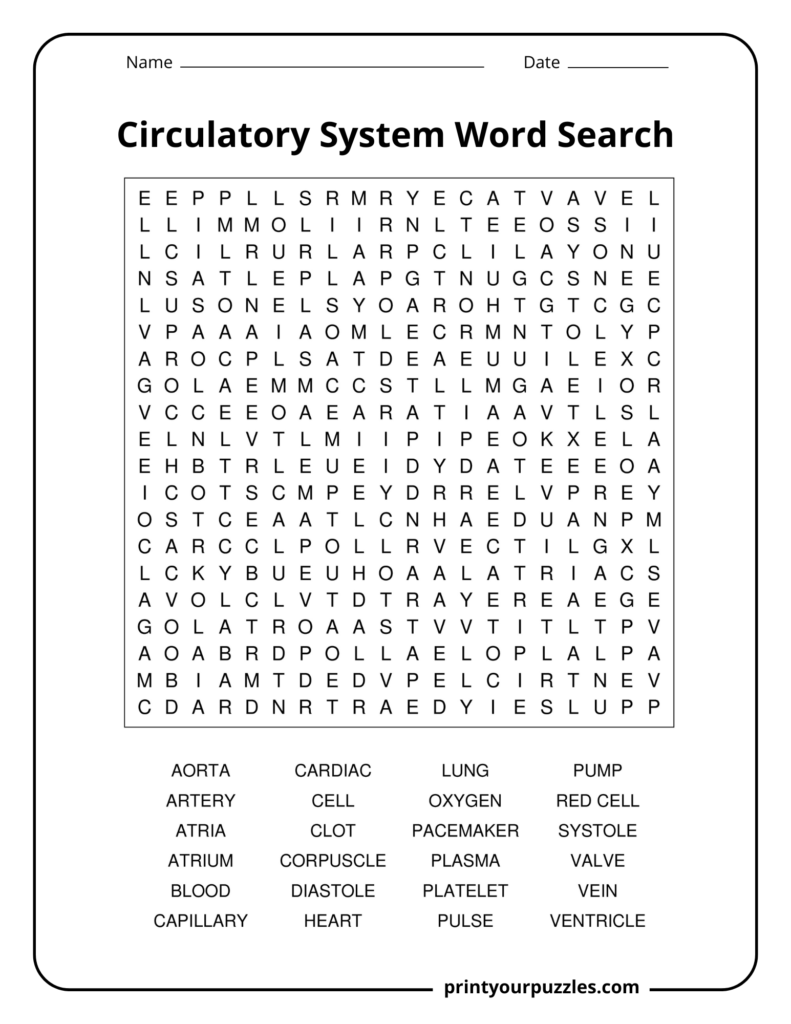
A circulatory system word search can help students become familiar with important vocabulary such as heart, blood, artery, vein, capillary, oxygen, plasma, and pulse. Learning these terms makes it easier to understand how the circulatory system connects different organs and keeps the body supplied, protected, and balanced. Every heartbeat is part of a carefully organized process that supports life from moment to moment.
Related Word Searches:
Body Systems | Cell | Cellular Respiration | Biology | Neuron | Genetics
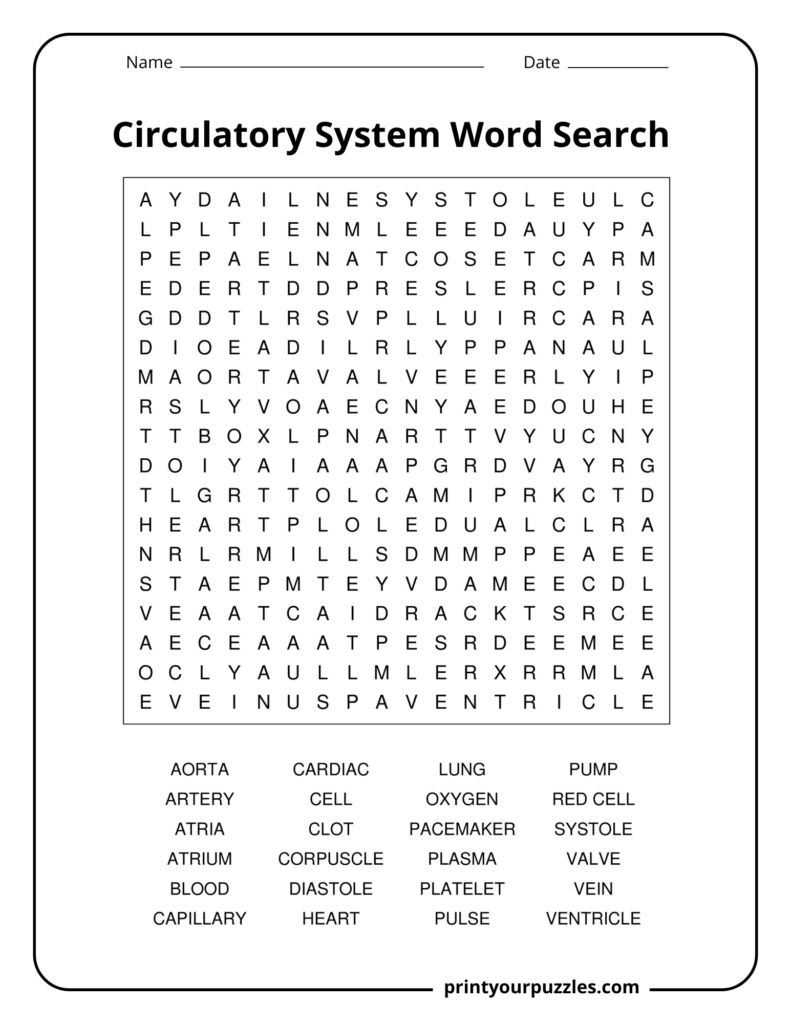
AORTA – The largest artery in the body that carries oxygen-rich blood from the heart’s left ventricle to all other arteries, distributing blood throughout the entire body system.
ARTERY – A blood vessel with thick, elastic walls that carries oxygenated blood away from the heart to various tissues and organs throughout the body under high pressure conditions.
ATRIA – The two upper chambers of the heart that receive blood from veins and pump it into the ventricles below, serving as collecting chambers for circulation.
ATRIUM – A single upper chamber of the heart; the right atrium receives deoxygenated blood from the body, while the left atrium receives oxygenated blood from lungs.
BLOOD – The red fluid circulating through vessels that transports oxygen, nutrients, hormones, and waste products while also providing immune protection and maintaining body temperature regulation throughout.
CAPILLARY – The smallest and thinnest blood vessels where oxygen, nutrients, and waste products are exchanged between blood and body tissues through their permeable single-cell-thick walls.
CARDIAC – Relating to or involving the heart and its functions, including the heart muscle tissue, rhythm, output, and overall cardiovascular health and medical conditions.
CELL – The basic structural and functional unit of blood, including red blood cells carrying oxygen, white blood cells fighting infection, and platelets enabling clotting processes.
CLOT – A thickened mass of blood that forms to stop bleeding from damaged vessels, created when platelets and fibrin proteins combine to seal wounds effectively.
CORPUSCLE – A small cellular component of blood, typically referring to red or white blood cells that perform essential functions like oxygen transport and immune system defense.
DIASTOLE – The relaxation phase of the heartbeat when the heart chambers fill with blood, represented by the lower number in blood pressure readings, allowing cardiac muscle rest.
HEART – The muscular organ that pumps blood throughout the body via rhythmic contractions, containing four chambers that work together to maintain continuous circulation and oxygen delivery.
LUNG – The respiratory organ where blood receives oxygen and releases carbon dioxide through gas exchange, working closely with the heart to oxygenate blood for circulation.
OXYGEN – A vital gas transported by red blood cells from lungs to body tissues, essential for cellular respiration and energy production, carried bound to hemoglobin molecules.
PACEMAKER – The heart’s natural electrical node, or an artificial device, that regulates heartbeat rhythm by generating electrical impulses to control the rate and timing of contractions.
PLASMA – The liquid component of blood, comprising about fifty-five percent of total volume, that transports cells, nutrients, hormones, proteins, and waste products throughout the body.
PLATELET – Small cell fragments in blood that clump together at injury sites to form clots, preventing excessive bleeding and initiating the healing process for damaged vessels.
PULSE – The rhythmic expansion and contraction of arteries caused by heartbeats, felt at various body points, indicating heart rate and providing information about cardiovascular health.
PUMP – The heart’s primary mechanical function of forcing blood through vessels by contracting and relaxing, creating pressure that maintains continuous circulation throughout the entire body.
RED CELL – A disc-shaped blood cell containing hemoglobin that transports oxygen from lungs to tissues and returns carbon dioxide, making up most blood cells by volume.
SYSTOLE – The contraction phase of the heartbeat when chambers pump blood out, represented by the higher number in blood pressure readings, forcing blood through circulatory vessels.
VALVE – A flap-like structure in the heart and veins that prevents blood from flowing backward, ensuring one-directional circulation and maintaining efficient pumping action throughout vessels.
VEIN – A blood vessel with thinner walls that carries deoxygenated blood back to the heart from body tissues, often containing valves to prevent backward flow against gravity.
VENTRICLE – One of two lower heart chambers with thick muscular walls that pump blood forcefully; the right sends blood to lungs, the left to the body.