Introduction to Cellular Respiration Word Search
Cellular respiration is the process cells use to convert energy stored in food into a form they can use. Every living organism needs energy to grow, repair tissues, reproduce, move, and carry out essential life functions. Although plants create glucose through photosynthesis, both plants and animals rely on cellular respiration to release the usable energy contained within that glucose.
The main energy-carrying molecule produced during cellular respiration is adenosine triphosphate, commonly called ATP. ATP works like a rechargeable energy source inside cells. When a cell needs to perform an activity, such as building proteins or transporting substances across its membrane, it uses energy stored in ATP.
In most organisms, cellular respiration begins with glycolysis, a series of chemical reactions that takes place in the cytoplasm. During glycolysis, one glucose molecule is divided into two smaller molecules called pyruvate. This first stage produces a small amount of ATP and does not require oxygen.
When oxygen is available, pyruvate enters the mitochondria, structures often described as the powerhouses of the cell. Inside the mitochondria, the process continues through the Krebs cycle and the electron transport chain. The Krebs cycle breaks down molecules further and releases high-energy electrons. These electrons then move through proteins in the inner mitochondrial membrane, helping create the conditions needed to produce a much larger amount of ATP.
Oxygen plays an important role at the end of the electron transport chain. It accepts electrons and combines with hydrogen to form water. Carbon dioxide is also produced during cellular respiration and is released as a waste product. In humans and many other animals, carbon dioxide travels through the bloodstream to the lungs, where it is removed during exhalation.
When oxygen is unavailable, some cells can obtain limited energy through fermentation. For example, muscle cells may produce lactic acid during intense exercise when oxygen cannot reach them quickly enough. Yeast cells use fermentation to produce alcohol and carbon dioxide.
A cellular respiration word search offers an entertaining way to review important terms connected with glucose, oxygen, mitochondria, ATP, glycolysis, fermentation, and energy production. Understanding this process helps explain how food supports life, why organisms breathe, and how cells receive the energy required to remain active and healthy.
Related Word Searches:
Cell | Energy | Biology | Molecule | Chemical Reaction | Photosynthesis
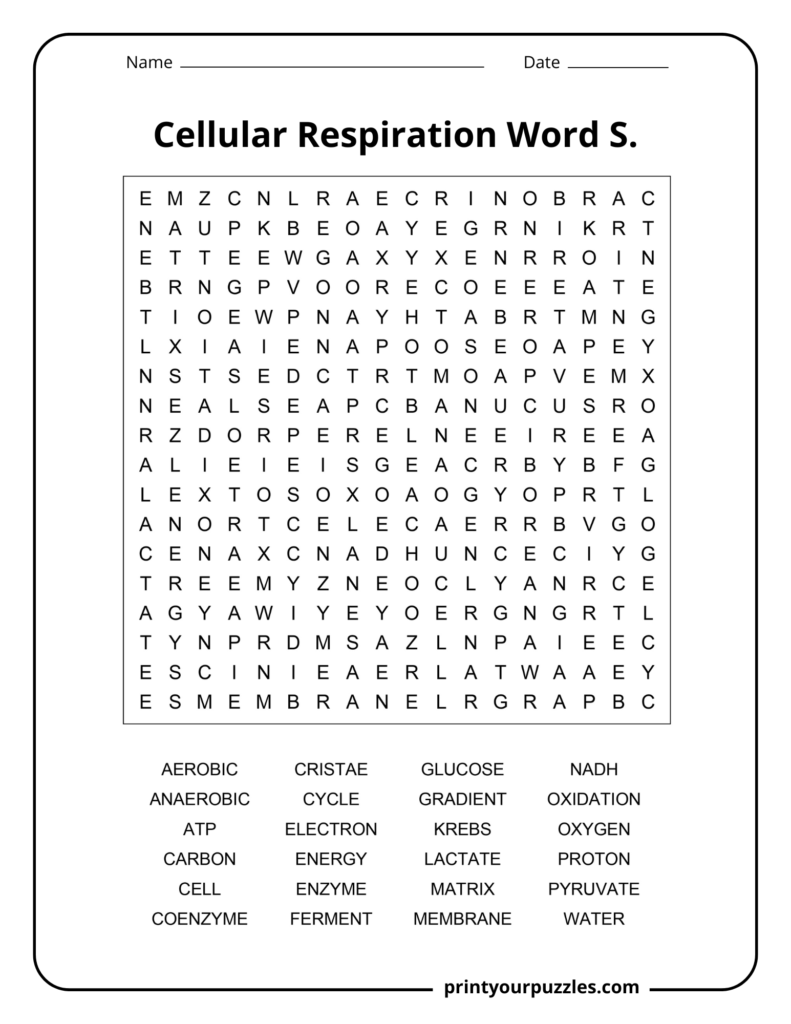
Medium Difficulty Word Search
Words to Find
AEROBIC, ANAEROBIC, ATP, CARBON, CELL, COENZYME, CRISTAE, CYCLE, ELECTRON, ENERGY, ENZYME, FERMENT, GLUCOSE, GRADIENT, KREBS, LACTATE, MATRIX, MEMBRANE, NADH, OXIDATION, OXYGEN, PROTON, PYRUVATE, WATER
All Words Defined
AEROBIC – A form of cellular respiration that requires oxygen and produces large amounts of ATP by completely breaking down glucose inside the mitochondria of cells.
ANAEROBIC – A way of releasing energy without oxygen, producing less ATP than aerobic respiration and often leading to fermentation products such as lactate or alcohol.
ATP – Adenosine triphosphate is the cell’s main energy-carrying molecule, storing usable energy that powers movement, growth, repair, transport, and numerous essential chemical reactions.
CARBON – An element found in glucose and other organic molecules, later released as carbon dioxide when fuel molecules are broken down during cellular respiration in cells.
CELL – The basic unit of life where cellular respiration supplies energy for essential activities, including growth, repair, reproduction, movement, transport, and maintaining stable internal conditions.
COENZYME – A small helper molecule that assists enzymes during reactions, often carrying electrons or chemical groups between different stages of cellular respiration, as NADH does.
CRISTAE – Folded structures of the inner mitochondrial membrane that increase surface area for the electron transport chain and efficient ATP production during aerobic cellular respiration.
CYCLE – A repeating series of chemical reactions, such as the Krebs cycle, that processes molecules, releases carbon dioxide, and transfers high-energy electrons to carrier molecules.
ELECTRON – A negatively charged particle transferred through carriers and protein complexes, releasing energy that helps create a proton gradient used for ATP production in mitochondria.
ENERGY – The capacity to perform work, released from glucose during cellular respiration and captured mainly in ATP for use by cells throughout a living organism.
ENZYME – A biological catalyst that speeds up specific chemical reactions without being consumed, allowing each stage of cellular respiration to occur efficiently under normal cellular conditions.
FERMENT – To break down sugars without oxygen, allowing cells to regenerate necessary molecules and continue glycolysis while producing only a small amount of usable ATP.
GLUCOSE – A simple sugar used as the main starting fuel in cellular respiration, where its stored chemical energy is gradually transferred into usable ATP molecules.
GRADIENT – A difference in proton concentration across the inner mitochondrial membrane that stores potential energy and drives ATP synthase during the final stage of cellular respiration.
KREBS – The mitochondrial cycle that breaks down acetyl-CoA, releases carbon dioxide, and produces NADH and FADH2 for use in the electron transport chain.
LACTATE – A product formed in animal cells during anaerobic conditions when pyruvate accepts electrons, allowing glycolysis to continue producing a limited but useful supply of ATP.
MATRIX – The fluid-filled interior of a mitochondrion where pyruvate processing and the Krebs cycle occur, producing carbon dioxide and energy-rich electron carrier molecules.
MEMBRANE – A thin cellular boundary; the inner mitochondrial membrane contains protein complexes and ATP synthase that perform electron transport, chemiosmosis, and much ATP production.
NADH – An energy-rich electron carrier produced during glycolysis and the Krebs cycle, delivering high-energy electrons to the mitochondrial electron transport chain for ATP production.
OXIDATION – A chemical process in which a molecule loses electrons, as glucose and its products do while their stored energy is transferred during cellular respiration.
OXYGEN – The final electron acceptor in aerobic respiration, combining with electrons and hydrogen ions to form water and allowing the electron transport chain to continue functioning.
PROTON – A positively charged hydrogen ion pumped across the inner mitochondrial membrane, creating a gradient that provides energy for ATP synthase to produce ATP molecules.
PYRUVATE – A three-carbon molecule formed when glucose is split during glycolysis, later entering aerobic pathways or fermentation depending on oxygen availability and the type of cell.
WATER – A product of aerobic respiration formed when oxygen accepts electrons and hydrogen ions at the end of the electron transport chain inside functioning mitochondria.
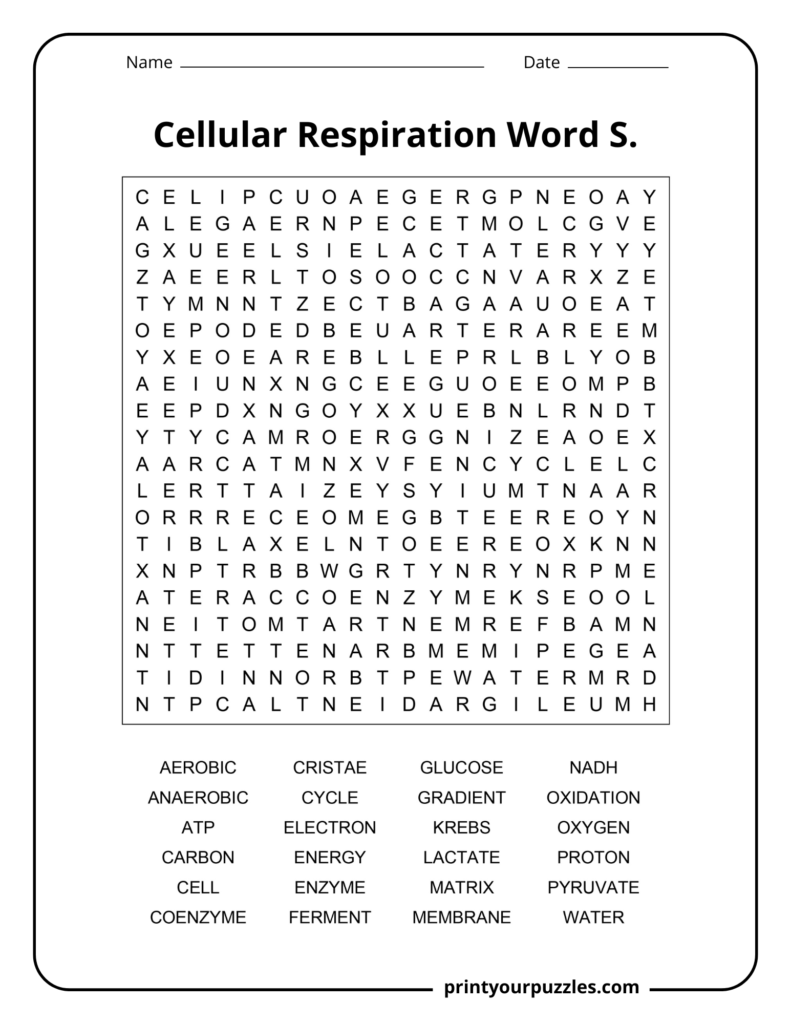
Hard Difficulty Word Search
Words to Find
AEROBIC, ANAEROBIC, ATP, CARBON, CELL, COENZYME, CRISTAE, CYCLE, ELECTRON, ENERGY, ENZYME, FERMENT, GLUCOSE, GRADIENT, KREBS, LACTATE, MATRIX, MEMBRANE, NADH, OXIDATION, OXYGEN, PROTON, PYRUVATE, WATER
5 Key FAQs About Cellular Respiration
5 Curious "Did You Know?" Facts About Cellular Respiration