

Energy is all around us and plays an essential role in everything that happens in the universe. It allows people to move, machines to operate, plants to grow, and homes to stay warm or cool. Although energy cannot always be seen directly, we can observe its effects whenever an object moves, a light shines, or heat changes the temperature of something.
In science, energy is commonly described as the ability to do work or cause change. It appears in many different forms. Kinetic energy is the energy of motion, while potential energy is stored energy that may be released later. A moving bicycle has kinetic energy, but a bicycle resting at the top of a hill has gravitational potential energy because of its position.
Other important forms include thermal, chemical, electrical, light, sound, and nuclear energy. Food contains chemical energy that the human body converts into movement and heat. Batteries also store chemical energy, which can be transformed into electrical energy to power devices. Sunlight carries radiant energy, while vibrating objects produce sound energy that travels through materials such as air and water.
One of the most important scientific principles is the law of conservation of energy. It states that energy cannot be created or destroyed. Instead, it is transferred from one object to another or transformed from one form into another. For example, when a lamp is switched on, electrical energy changes mainly into light and thermal energy.
People obtain usable energy from both renewable and nonrenewable sources. Renewable sources, including sunlight, wind, flowing water, and geothermal heat, are naturally replenished. Nonrenewable sources, such as coal, oil, natural gas, and uranium, are limited and may take millions of years to form. The ways societies produce and use energy can affect air quality, natural habitats, climate, and human health.
Learning about energy helps us understand everyday technology, environmental challenges, and the natural world. An energy word search can introduce important vocabulary while reinforcing ideas about energy forms, sources, transfers, and conservation. By recognizing how energy changes and moves, learners can better understand everything from household appliances and transportation to weather patterns, ecosystems, and the movement of planets.
Related Word Searches:
Physics | Electricity | Thermodynamics | Cellular Respiration | Photosynthesis | Chemical Reaction
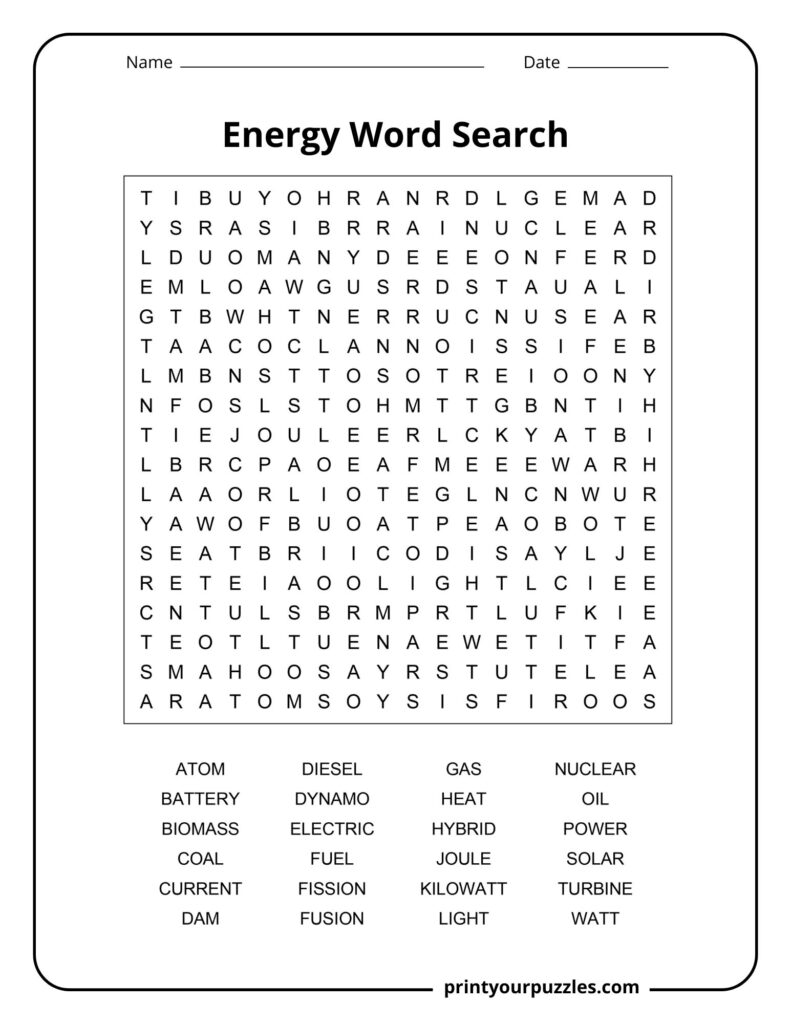
ATOM, BATTERY, BIOMASS, COAL, CURRENT, DAM, DIESEL, DYNAMO, ELECTRIC, FUEL, FISSION, FUSION, GAS, HEAT, HYBRID, JOULE, KILOWATT, LIGHT, NUCLEAR, OIL, POWER, SOLAR, TURBINE, WATT
ATOM – The smallest unit of a chemical element, composed of a nucleus containing protons and neutrons, surrounded by orbiting electrons. Atoms are the fundamental building blocks of all matter and energy processes.
BATTERY – A device that stores chemical energy and converts it into electrical energy through electrochemical reactions. Batteries power countless devices, from small electronics like phones to large electric vehicles and industrial systems.
BIOMASS – Organic material derived from plants, animals, and waste, used as a renewable energy source. Biomass can be burned directly for heat or converted into biofuels and biogas for electricity generation.
COAL – A combustible black sedimentary rock formed from ancient plant remains over millions of years. Coal is a major fossil fuel widely used for electricity generation and industrial heating, though it produces significant carbon emissions.
CURRENT – The flow of electric charge through a conductor, measured in amperes. Electric current is fundamental to powering devices, transmitting energy across distances, and operating virtually all modern electrical systems and appliances.
DAM – A large barrier built across a river to store water and generate hydroelectric power. Dams convert the potential energy of stored water into electricity by channeling flow through turbines connected to generators.
DIESEL – A type of fuel derived from petroleum, used in compression-ignition engines. Diesel engines are widely employed in transportation, heavy machinery, and backup power generators due to their high efficiency and torque output.
DYNAMO – An electrical generator that converts mechanical energy into direct current electricity using electromagnetic induction. Dynamos were among the first devices used to produce electricity commercially and paved the way for modern generators.
ELECTRIC – Relating to or powered by electricity, the flow of charged particles through conductors. Electric energy is one of the most versatile forms of energy, essential for lighting, heating, computing, and countless modern applications.
FUEL – Any material that stores potential energy and can be released through combustion or chemical reactions to produce heat or power. Common fuels include gasoline, natural gas, wood, hydrogen, and nuclear materials.
FISSION – A nuclear reaction in which a heavy atomic nucleus splits into smaller fragments, releasing enormous amounts of energy. Nuclear fission is the process used in nuclear power plants and atomic weapons to generate power.
FUSION – A nuclear reaction where light atomic nuclei combine to form a heavier nucleus, releasing tremendous energy. Fusion powers the sun and stars, and scientists are working to harness it as a clean, virtually limitless energy source.
GAS – A fossil fuel composed primarily of methane, extracted from underground reserves. Natural gas is widely used for heating, cooking, electricity generation, and industrial processes, and burns cleaner than coal or oil.
HEAT – A form of energy transferred between objects due to temperature differences, measured in joules or calories. Heat energy plays a crucial role in power generation, industrial manufacturing, cooking, and maintaining comfortable living environments.
HYBRID – A system or vehicle that combines two or more energy sources, typically a conventional fuel engine with an electric motor. Hybrid technology improves fuel efficiency and reduces emissions compared to purely fossil-fuel-powered systems.
JOULE – The standard international unit of energy, named after physicist James Prescott Joule. One joule equals the energy transferred when a force of one newton moves an object one metre in the direction of the force.
KILOWATT – A unit of power equal to one thousand watts, commonly used to measure electrical energy consumption. Kilowatts help quantify how much electricity appliances, homes, and power plants generate or consume over time.
LIGHT – Visible electromagnetic radiation that carries energy from its source to surrounding objects. Light energy from the sun is essential for life on Earth and can be harnessed through solar panels to generate clean electricity.
NUCLEAR – Relating to energy produced from reactions involving atomic nuclei, either through fission or fusion processes. Nuclear power provides large-scale, low-carbon electricity but raises concerns about radioactive waste and safety risks.
OIL – A liquid fossil fuel formed from ancient marine organisms buried deep underground over millions of years. Oil is refined into gasoline, diesel, and other products, making it one of the most widely used energy sources globally.
POWER – The rate at which energy is generated, transferred, or consumed, measured in watts. Power is a fundamental concept in physics and engineering, describing how quickly work is performed or electricity is delivered to systems.
SOLAR – Relating to energy derived from the sun’s radiation, captured using photovoltaic panels or thermal collectors. Solar energy is a clean, renewable resource increasingly adopted worldwide to reduce dependence on fossil fuels and combat climate change.
TURBINE – A rotary mechanical device that converts kinetic energy from fluid flow, such as wind, steam, or water, into useful mechanical work. Turbines are essential components in power plants, wind farms, and jet engines.
WATT – The standard unit of power in the international system, named after inventor James Watt. One watt equals one joule of energy transferred per second, and it measures the rate of energy conversion or consumption.
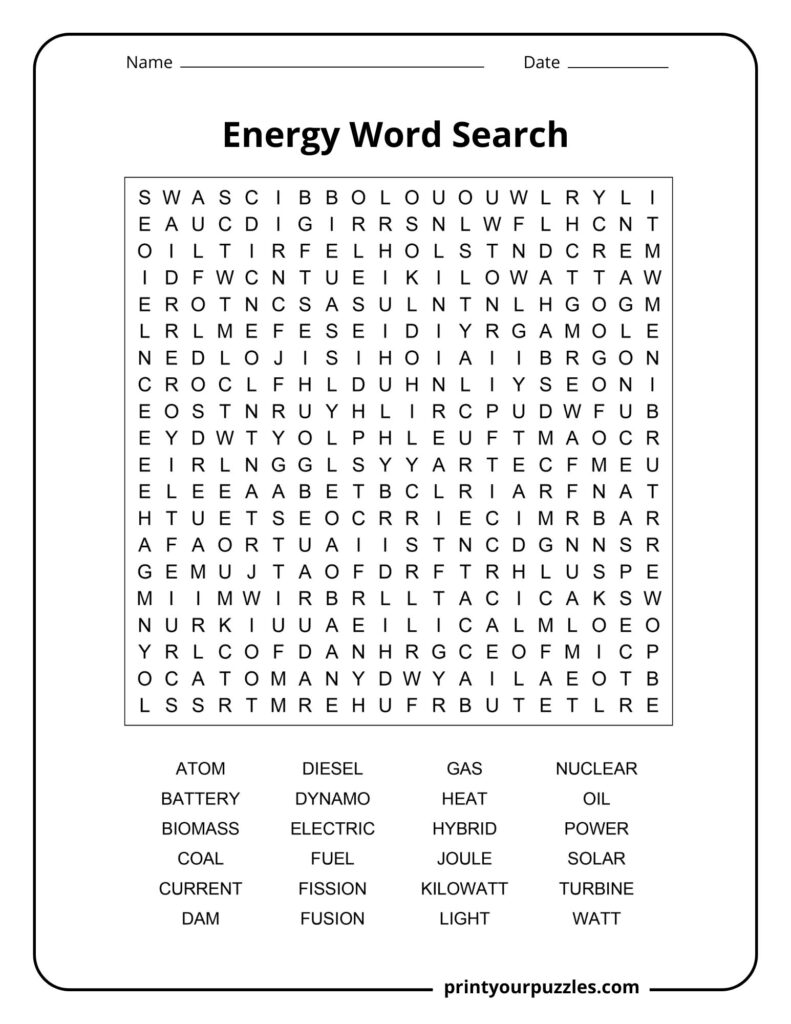
ATOM, BATTERY, BIOMASS, COAL, CURRENT, DAM, DIESEL, DYNAMO, ELECTRIC, FUEL, FISSION, FUSION, GAS, HEAT, HYBRID, JOULE, KILOWATT, LIGHT, NUCLEAR, OIL, POWER, SOLAR, TURBINE, WATT
Energy is the capacity to perform work or produce change. It exists in many forms, including kinetic, potential, thermal, electrical, and chemical, and can be transferred but never created or destroyed.
Energy sources are classified as renewable or non-renewable. Renewable sources include solar, wind, and hydropower. Non-renewable sources include fossil fuels like coal, oil, and natural gas, which are finite resources.
Renewable energy is crucial because it reduces greenhouse gas emissions, combats climate change, and decreases dependence on finite fossil fuels. It provides cleaner, sustainable alternatives that protect the environment for future generations.
Electricity is generated by converting energy from various sources. Turbines driven by steam, water, or wind spin generators that produce electric current. Solar panels convert sunlight directly into electricity through photovoltaic cells.
We can save energy by using efficient appliances, switching to LED lighting, improving home insulation, and reducing unnecessary consumption. Simple habits like turning off unused devices significantly lower energy bills and environmental impact.
The sun releases approximately 386 billion billion megawatts of energy every second through nuclear fusion, making it the most powerful energy source in our solar system.
A typical lightning bolt carries around one billion joules of energy and reaches temperatures five times hotter than the surface of the sun in a fraction of a second.
Our bodies constantly produce thermal energy through metabolic processes. Even at rest, an average person generates approximately 80 watts of power, similar to a standard incandescent light bulb.
Long before modern wind turbines existed, ancient civilizations harnessed wind power for transportation and later for grinding grain and pumping water through early windmills.
Nuclear fuel is incredibly energy-dense compared to fossil fuels. This extraordinary efficiency is why nuclear power plants can generate massive amounts of electricity using relatively small quantities of fuel.