

Thermodynamics is the branch of science that studies heat, energy, temperature, and the ways energy moves or changes form. It helps explain many familiar events, such as water boiling, ice melting, engines running, and food cooling after it is removed from an oven. Thermodynamics is important in physics, chemistry, engineering, biology, and environmental science because energy is involved in almost every natural and technological process.
A thermodynamic system is the particular object or area being studied. Everything outside that system is called the surroundings. Systems may exchange energy and matter with their surroundings in different ways. An open system exchanges both matter and energy, while a closed system exchanges energy but not matter. An isolated system does not exchange either matter or energy with its surroundings.
Thermodynamics is organized around several basic laws. The zeroth law explains that objects in thermal equilibrium have the same temperature. This principle allows thermometers to measure temperature accurately. The first law states that energy cannot be created or destroyed, but it can be transferred or converted from one form into another. For example, a car engine changes chemical energy from fuel into movement, heat, and sound.
The second law explains that heat naturally moves from a warmer object to a cooler one. It also introduces entropy, which describes how energy becomes more spread out and less available for useful work. This is why a hot drink cools in a room but does not naturally become hotter by absorbing heat from cooler air. The third law describes what happens as a substance approaches absolute zero, the lowest theoretically possible temperature.
Heat and temperature are closely connected, but they are not identical. Temperature measures the average kinetic energy of particles, while heat is energy transferred because of a temperature difference. Heat may travel through conduction, convection, or radiation. Conduction occurs through direct contact, convection involves moving liquids or gases, and radiation transfers energy through electromagnetic waves.
Completing a thermodynamics word search can introduce vocabulary such as energy, heat, entropy, system, pressure, work, equilibrium, and temperature. Understanding these terms makes it easier to explore how engines, refrigerators, power plants, living organisms, and Earth’s climate use and transfer energy. Thermodynamics provides a practical framework for understanding why energy changes occur and why many processes move naturally in only one direction.
Related Word Searches:
Energy | Entropy | Physics | States of Matter | Matter | Chemical Reaction
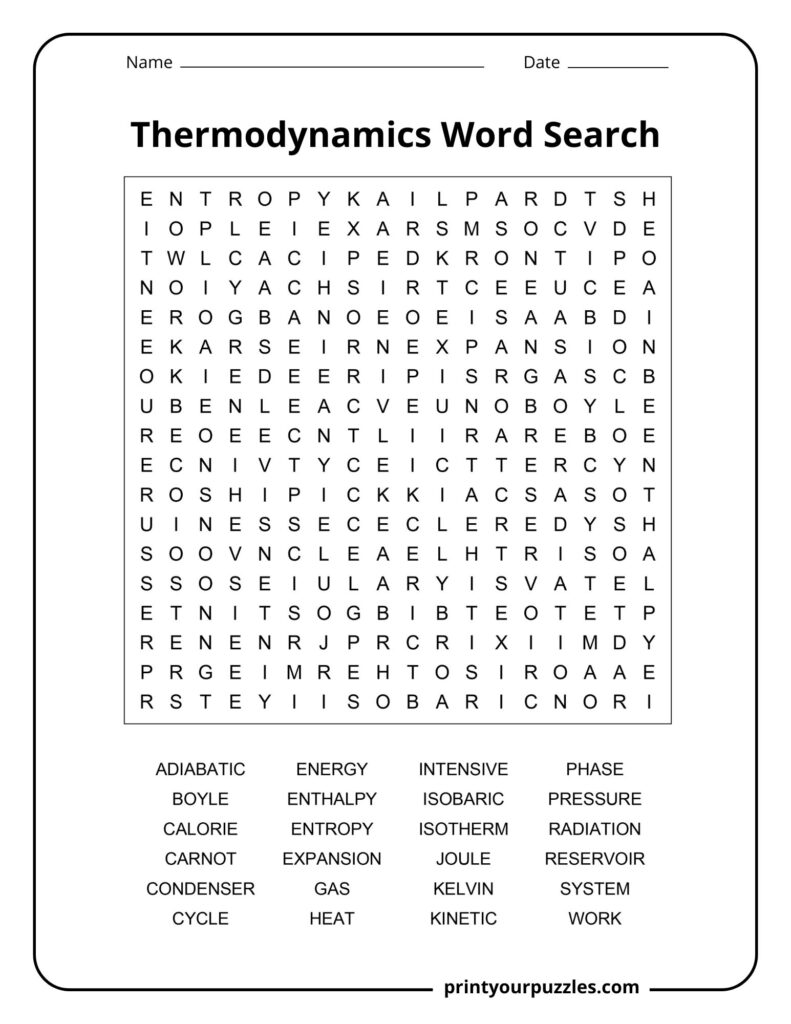
ADIABATIC, BOYLE, CALORIE, CARNOT, CONDENSER, CYCLE, ENERGY, ENTHALPY, ENTROPY, EXPANSION, GAS, HEAT, INTENSIVE, ISOBARIC, ISOTHERM, JOULE, KELVIN, KINETIC, PHASE, PRESSURE, RADIATION, RESERVOIR, SYSTEM, WORK
ADIABATIC – A thermodynamic process where no heat is exchanged between a system and its surroundings, meaning all energy changes occur through work alone, maintaining thermal isolation.
BOYLE – Robert Boyle, scientist who discovered that gas pressure and volume are inversely proportional at constant temperature, forming the foundation of gas law relationships in thermodynamics.
CALORIE – A unit of heat energy defined as the amount needed to raise one gram of water by one degree Celsius, commonly used in measuring thermal energy.
CARNOT – Sadi Carnot, physicist who developed the theoretical Carnot cycle, establishing maximum efficiency limits for heat engines operating between two temperature reservoirs, fundamental to thermodynamic theory.
CONDENSER – A heat exchanger device that converts vapor into liquid by removing heat, commonly used in refrigeration cycles, power plants, and distillation processes to release thermal energy.
CYCLE – A series of thermodynamic processes where a system returns to its initial state, completing a loop that enables continuous operation in engines and refrigeration systems.
ENERGY – The fundamental capacity to perform work or transfer heat, existing in various forms including thermal, mechanical, chemical, and electrical, conserved in all thermodynamic processes.
ENTHALPY – A thermodynamic property representing total heat content of a system at constant pressure, equal to internal energy plus pressure-volume work, symbolized by H.
ENTROPY – A measure of disorder or randomness in a system, quantifying energy unavailability for work, always increasing in isolated systems according to the second law of thermodynamics.
EXPANSION – The process where a substance increases in volume, typically when heated or when pressure decreases, performing work on surroundings and changing thermodynamic state variables.
GAS – A state of matter with no fixed shape or volume, where molecules move freely with high kinetic energy, easily compressed, and filling available space.
HEAT – Thermal energy transferred between systems due to temperature difference, flowing spontaneously from higher to lower temperature regions, measured in joules or calories in thermodynamic analysis.
INTENSIVE – A thermodynamic property independent of system size or mass, such as temperature, pressure, or density, contrasting with extensive properties that depend on quantity.
ISOBARIC – A thermodynamic process occurring at constant pressure, where volume and temperature can change while pressure remains fixed, commonly seen in atmospheric processes and heating.
ISOTHERM – A process or curve representing constant temperature conditions, where pressure and volume may vary while thermal energy remains stable throughout the transformation sequence.
JOULE – The SI unit of energy and work, defined as force of one newton acting through one meter, named after James Prescott Joule who studied heat-work equivalence.
KELVIN – The absolute temperature scale starting at absolute zero, where molecular motion theoretically stops, using same increments as Celsius but beginning at minus 273.15 degrees.
KINETIC – Relating to motion and movement, describing energy possessed by moving molecules, directly proportional to temperature in gases, fundamental to understanding thermal behavior and properties.
PHASE – A distinct, homogeneous state of matter such as solid, liquid, or gas, separated by boundaries where physical properties change discontinuously during transitions between states.
PRESSURE – Force exerted per unit area, resulting from molecular collisions in gases or applied external forces, measured in pascals, atmospheres, or pounds per square inch.
RADIATION – Heat transfer through electromagnetic waves without requiring a physical medium, enabling energy transmission through vacuum, exemplified by solar energy reaching Earth through space effectively.
RESERVOIR – A large thermal mass that can absorb or supply heat without significant temperature change, serving as constant temperature source or sink in thermodynamic cycles.
SYSTEM – A defined region or quantity of matter selected for thermodynamic study, separated from surroundings by boundaries, which can be open, closed, or isolated.
WORK – Energy transfer resulting from force acting through distance, accomplished by system expansion, compression, or mechanical action, measured in joules, converting between energy forms systematically.
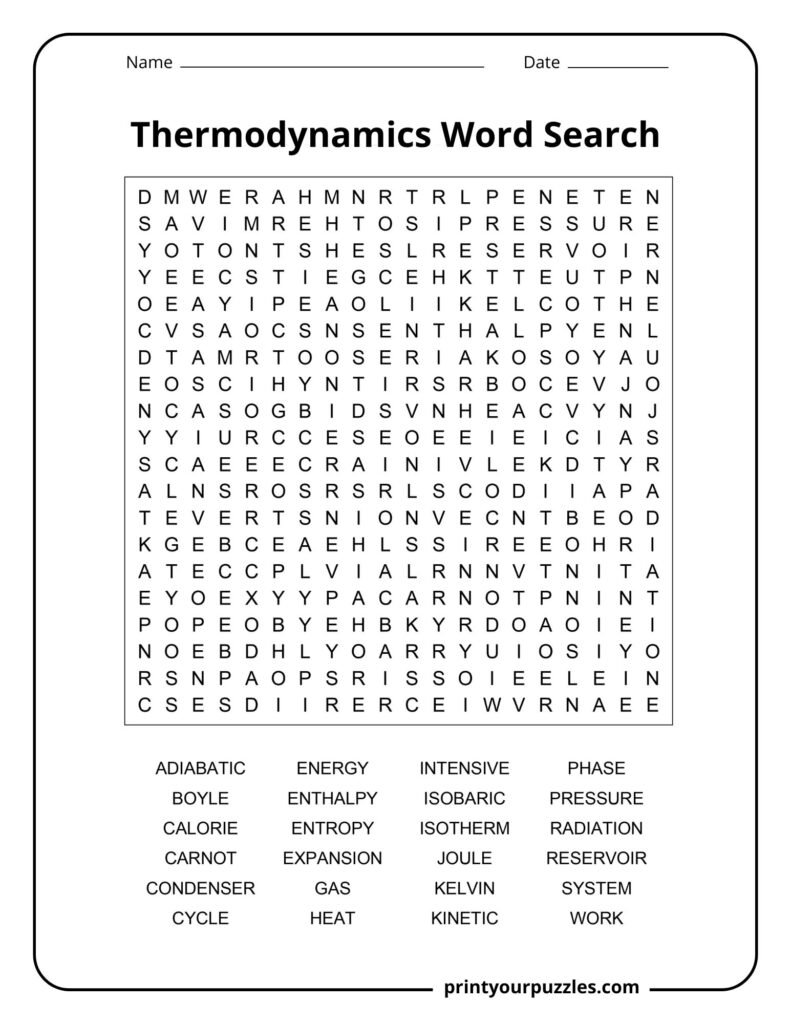
ADIABATIC, BOYLE, CALORIE, CARNOT, CONDENSER, CYCLE, ENERGY, ENTHALPY, ENTROPY, EXPANSION, GAS, HEAT, INTENSIVE, ISOBARIC, ISOTHERM, JOULE, KELVIN, KINETIC, PHASE, PRESSURE, RADIATION, RESERVOIR, SYSTEM, WORK
Thermodynamics is the branch of physics studying energy, heat, work, and their transformations in physical systems. It explains how energy flows, converts between forms, and governs natural processes.
The four laws are: Zeroth (thermal equilibrium), First (energy conservation), Second (entropy increase), and Third (absolute zero unattainability). Together they govern all energy transformations and heat transfer.
Heat is energy transferred between systems due to temperature differences, measured in joules. Temperature measures average molecular kinetic energy, indicating how hot or cold something is.
Common processes include isothermal (constant temperature), adiabatic (no heat exchange), isobaric (constant pressure), and isochoric (constant volume). Each describes specific conditions during energy transformations in systems.
Thermodynamics governs refrigerators, air conditioners, car engines, power plants, and cooking. It explains weather patterns, metabolism, and energy efficiency, making it essential for technology and understanding nature.
The Third Law of Thermodynamics states that absolute zero (-273.15°C) cannot be achieved. Scientists have reached billionths of a degree above it, but never exactly zero temperature.
According to the Second Law, entropy always increases in isolated systems. The universe becomes more disordered over time, eventually leading to theoretical “heat death” uniformity.
Coffee cooling follows Newton’s Law of Cooling, which uses exponential decay equations. The temperature drop rate is proportional to the difference between coffee and room temperature.
Carnot’s theorem proves no heat engine can be 100% efficient. Some energy must always be released as waste heat, making perpetual motion machines thermodynamically impossible.
Refrigerators remove heat from inside and release more heat outside through their coils. The total thermal energy added to your kitchen exceeds what’s removed from food.