
Geometry is the branch of mathematics that studies shapes, sizes, positions, distances, and the relationships between objects in space. It helps us understand the forms and patterns that appear all around us, from the shape of a road sign to the design of a building. Geometry is used in classrooms, science, engineering, architecture, art, technology, and many everyday activities.
The basic elements of geometry include points, lines, line segments, rays, angles, and planes. A point represents an exact position, while a line extends endlessly in both directions. When two lines meet, they can form angles. Angles are usually measured in degrees and may be classified as acute, right, obtuse, straight, or reflex, depending on their measurement.
Geometry also explores two-dimensional shapes, which have length and width. Common examples include triangles, squares, rectangles, circles, and polygons. Triangles can be classified by their sides or angles, while polygons are named according to their number of sides. Students learn to calculate the perimeter, or total distance around a shape, as well as its area, which measures the space inside it.
Three-dimensional objects have length, width, and height. Cubes, spheres, cylinders, cones, pyramids, and rectangular prisms are familiar examples. Geometry helps us calculate their surface area and volume. These skills are useful when determining how much material is needed to create a container, how much liquid a tank can hold, or how much space an object occupies.
Another important part of geometry involves symmetry, transformations, coordinates, and scale. Shapes can be reflected, rotated, translated, or enlarged while keeping certain properties. Coordinate grids allow points and figures to be located using ordered pairs, connecting geometry with algebra and graphing.
Learning geometric vocabulary is essential for understanding instructions, identifying figures, and solving problems accurately. A geometry word search can help students become familiar with terms such as angle, radius, diameter, polygon, perimeter, symmetry, and volume in an enjoyable and memorable way.
Geometry is more than a collection of shapes and formulas. It develops visual thinking, logical reasoning, measurement skills, and problem-solving abilities. By studying geometry, learners gain practical tools for understanding the structure, design, and spatial relationships of the world around them.
Related Word Searches:
Math | Algebra | Physics | Coding | Gravity | Astronomy
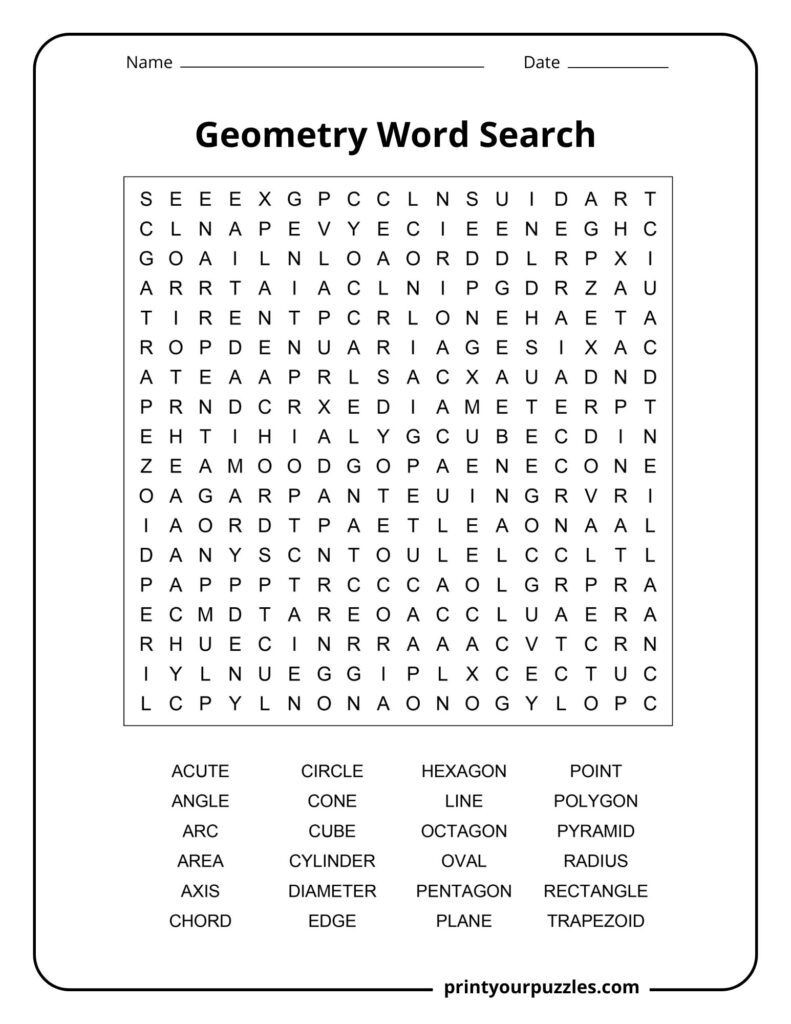
ACUTE, ANGLE, ARC, AREA, AXIS, CHORD, CIRCLE, CONE, CUBE, CYLINDER, DIAMETER, EDGE, HEXAGON, LINE, OCTAGON, OVAL, PENTAGON, PLANE, POINT, POLYGON, PYRAMID, RADIUS, RECTANGLE, TRAPEZOID
ACUTE – An angle measuring less than 90 degrees, smaller than a right angle. Acute angles appear sharp and pointed, commonly found in triangles and various geometric figures.
ANGLE – The figure formed when two rays or line segments share a common endpoint called the vertex. Angles are measured in degrees and classify geometric relationships.
ARC – A curved portion of a circle’s circumference, connecting two points on the circle. Arcs are measured by their central angle or their length along the curve.
AREA – The amount of two-dimensional space contained within a boundary or shape. Area is measured in square units such as square inches, feet, meters, or centimeters.
AXIS – A reference line used to measure coordinates or define symmetry in geometric figures. In coordinate geometry, the x-axis and y-axis form the foundation of graphing.
CHORD – A straight line segment connecting two points on a circle’s circumference. The diameter is the longest possible chord, passing directly through the circle’s center point.
CIRCLE – A perfectly round two-dimensional shape where all points on the edge are equidistant from the center. Circles have constant radius and are defined by circumference.
CONE – A three-dimensional shape with a circular base that tapers smoothly to a single point called the apex or vertex. Cones have curved surfaces connecting base to point.
CUBE – A three-dimensional solid with six equal square faces, twelve edges, and eight vertices. All angles are right angles, and all edges have identical length measurements.
CYLINDER – A three-dimensional shape with two parallel circular bases connected by a curved surface. Cylinders have constant circular cross-sections throughout their height, like cans or pipes.
DIAMETER – A straight line passing through the center of a circle, connecting two points on the circumference. The diameter is twice the radius and represents the circle’s width.
EDGE – The line segment where two faces of a three-dimensional solid meet. Edges form the boundaries and framework of polyhedrons, defining their shape and structure clearly.
HEXAGON – A polygon with six straight sides and six angles. Regular hexagons have equal sides and angles, appearing frequently in nature like honeycombs and snowflake patterns.
LINE – An infinitely long, straight one-dimensional figure extending endlessly in both directions. Lines have no thickness, width, or endpoints, only length and direction in space.
OCTAGON – A polygon with eight straight sides and eight angles. Regular octagons have equal sides and equal angles, commonly seen in stop signs and architectural designs worldwide.
OVAL – An elongated curved shape resembling a stretched circle or ellipse. Ovals are symmetrical, smooth, closed curves without corners, appearing egg-like or elliptical in form.
PENTAGON – A five-sided polygon with five angles. Regular pentagons have equal sides and equal angles, famously represented by the Pentagon building in Washington, D.C., United States.
PLANE – A flat, two-dimensional surface extending infinitely in all directions. Planes have length and width but no thickness, serving as foundations for geometric figures and constructions.
POINT – The most basic geometric element, representing an exact location in space with no size, width, length, or dimension. Points are typically labeled with capital letters.
POLYGON – A closed two-dimensional shape formed by three or more straight line segments. Polygons include triangles, quadrilaterals, pentagons, and other multi-sided figures with connected edges.
PYRAMID – A three-dimensional polyhedron with a polygonal base and triangular faces meeting at a single apex point. Egyptian pyramids exemplify this ancient, stable geometric structure perfectly.
RADIUS – The distance from the center of a circle to any point on its circumference. The radius is half the diameter and determines the circle’s size.
RECTANGLE – A four-sided polygon with four right angles and opposite sides that are parallel and equal in length. Rectangles are common quadrilaterals found throughout everyday objects.
TRAPEZOID – A quadrilateral with exactly one pair of parallel sides called bases. The non-parallel sides are called legs, creating a distinctive four-sided shape with varying angles.
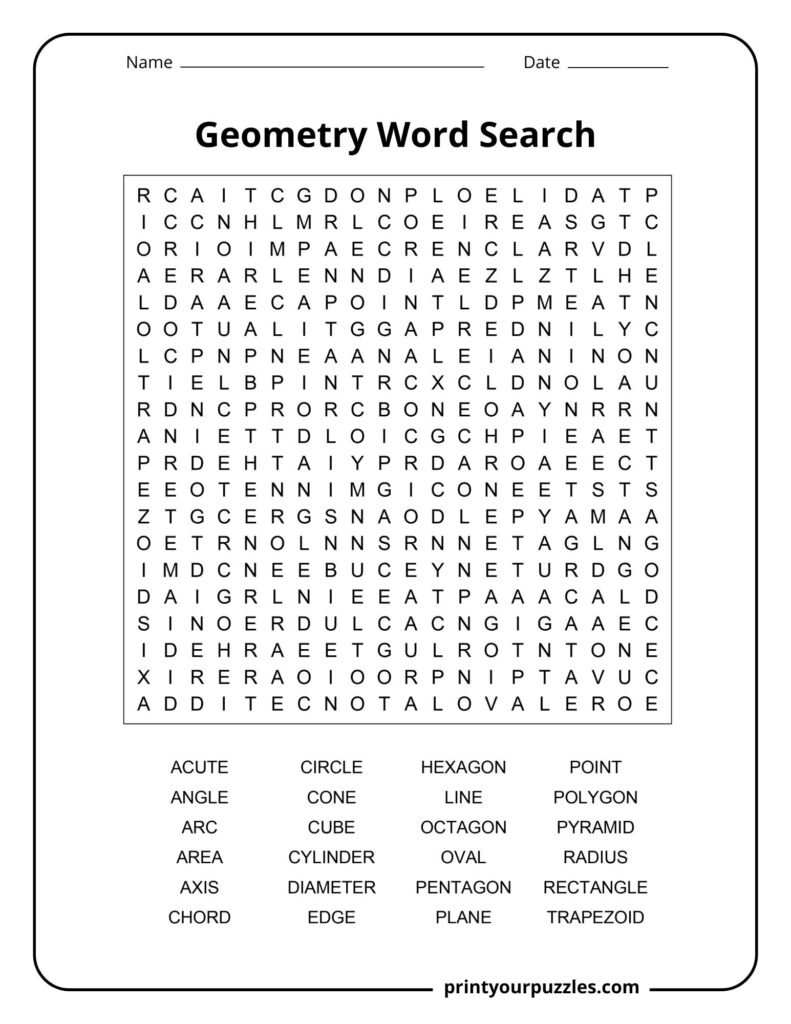
ACUTE, ANGLE, ARC, AREA, AXIS, CHORD, CIRCLE, CONE, CUBE, CYLINDER, DIAMETER, EDGE, HEXAGON, LINE, OCTAGON, OVAL, PENTAGON, PLANE, POINT, POLYGON, PYRAMID, RADIUS, RECTANGLE, TRAPEZOID
Geometry is the branch of mathematics that studies shapes, sizes, positions, and properties of space. It examines points, lines, angles, surfaces, and solids in both two and three dimensions.
Geometry is essential for architecture, engineering, art, design, and everyday problem-solving. It develops spatial reasoning, logical thinking, and visualization skills used throughout life and various professional careers.
Basic geometric shapes include circles, triangles, squares, rectangles, and polygons in two dimensions. Three-dimensional shapes include cubes, spheres, cylinders, cones, and pyramids, each with unique properties.
Two-dimensional shapes have only length and width, existing on flat surfaces like paper. Three-dimensional shapes add depth or height, occupying space like real-world objects you can hold.
Geometry appears in construction, navigation, computer graphics, robotics, and art. It helps design buildings, create video games, plan roads, develop technology, and understand patterns in nature.
Bees instinctively build hexagonal cells because this shape uses the least wax while maximizing storage space. Hexagons tessellate perfectly, creating strong structures without gaps or overlaps.
Unlike polygons with limited symmetry lines, circles possess infinitely many lines of symmetry passing through their center. Any diameter creates a perfect mirror image on both sides.
Egyptian mathematicians applied geometric principles to create precise right angles and measurements. They used rope stretchers and astronomical observations to achieve remarkable architectural accuracy without modern tools.
Traditional soccer balls feature 12 black pentagons and 20 white hexagons stitched together. This geometric pattern creates a nearly perfect sphere that rolls smoothly and predictably.
Fractals appear throughout nature in snowflakes, coastlines, and tree branches. Mathematician Benoit Mandelbrot discovered these self-similar patterns exhibit identical complexity when magnified repeatedly.