
A food chain explains how energy and nutrients move from one living organism to another within an ecosystem. Every plant and animal needs energy to survive, grow, reproduce, and carry out daily activities. However, organisms obtain this energy in different ways. Some produce their own food, while others gain energy by eating plants, animals, or both.
Most food chains begin with the Sun. Plants, algae, and certain microorganisms use sunlight to produce food through photosynthesis. These organisms are known as producers because they create the energy-rich material that supports the rest of the chain. Grass, trees, and aquatic plants are common examples of producers.
The next level usually includes primary consumers, which are animals that eat plants. They are also called herbivores. Rabbits eating grass, caterpillars feeding on leaves, and zebras grazing on plants are familiar examples. Primary consumers may then be eaten by secondary consumers, such as snakes, frogs, or small predatory fish. Larger predators, called tertiary consumers, may appear at the top of the chain. Eagles, sharks, lions, and other powerful hunters often have few natural predators.
A simple food chain might be written as grass, grasshopper, frog, snake, and eagle. The arrows between these organisms show the direction in which energy moves. Grass provides energy to the grasshopper, the grasshopper feeds the frog, and the pattern continues. At each level, some energy is used or lost as heat, so less energy is available to organisms higher in the chain.
Decomposers also play an essential role. Fungi, bacteria, and other decomposers break down dead plants and animals, returning important nutrients to the soil and water. Producers can then use these nutrients, helping the ecosystem continue its natural cycle.
In reality, most organisms belong to several connected food chains rather than just one. These overlapping relationships form a food web, which provides a more complete picture of feeding connections in an ecosystem. Changes to one population can affect many others, showing how closely living things depend on one another.
A printable food chain word search can introduce important vocabulary such as producer, consumer, predator, prey, herbivore, and decomposer. By learning how these terms connect, students can better understand energy transfer, ecological balance, and the relationships that help ecosystems remain healthy.
Related Word Searches:
Ecosystem | Ecology | Biodiversity | Photosynthesis | Botany | Biology
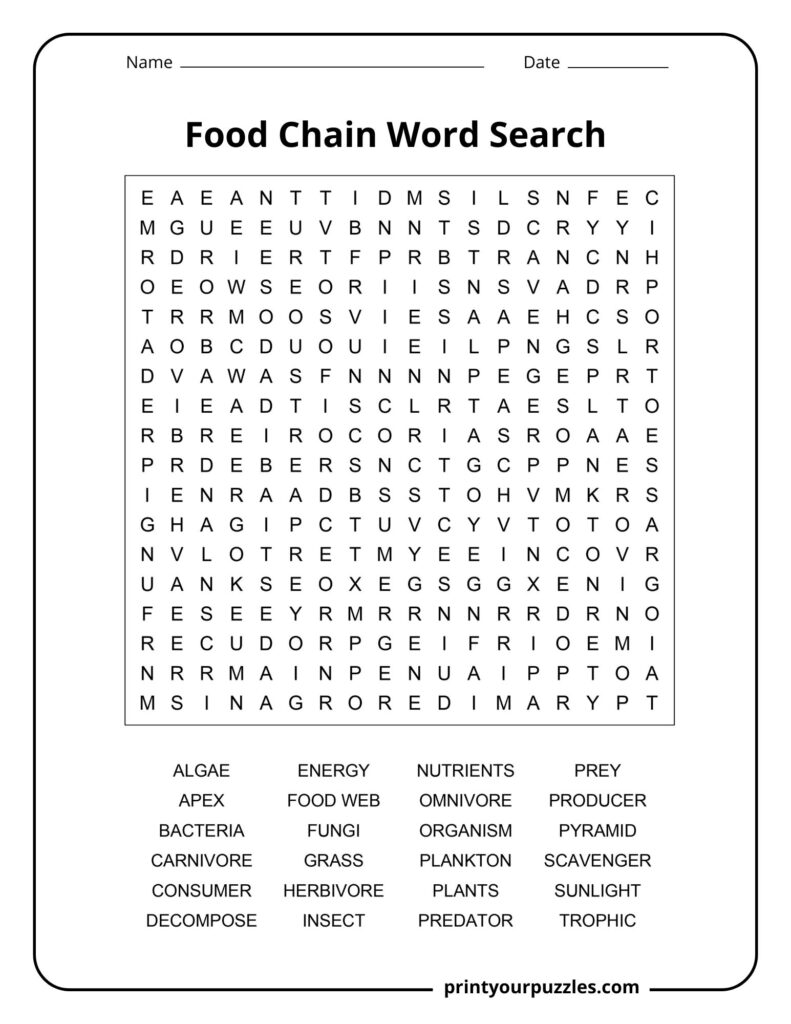
ALGAE, APEX, BACTERIA, CARNIVORE, CONSUMER, DECOMPOSE, ENERGY, FOOD WEB, FUNGI, GRASS, HERBIVORE, INSECT, NUTRIENTS, OMNIVORE, ORGANISM, PLANKTON, PLANTS, PREDATOR, PREY, PRODUCER, PYRAMID, SCAVENGER, SUNLIGHT, TROPHIC
ALGAE – Simple aquatic organisms that perform photosynthesis to produce their own food. They form the base of many aquatic food chains and provide oxygen to water ecosystems.
APEX – The top predator in a food chain that has no natural predators itself. These animals control populations below them and maintain ecosystem balance through their hunting activities.
BACTERIA – Microscopic single-celled organisms that decompose dead matter and recycle nutrients back into the ecosystem. Some bacteria also serve as producers through chemosynthesis in certain environments.
CARNIVORE – An animal that primarily eats other animals for nutrition and energy. Carnivores possess specialized teeth, claws, or hunting adaptations to capture and consume their prey effectively.
CONSUMER – An organism that cannot make its own food and must eat other organisms to obtain energy. Consumers include herbivores, carnivores, and omnivores at various food chain levels.
DECOMPOSE – The process of breaking down dead organic material into simpler substances. Decomposers return essential nutrients to soil and water, enabling producers to grow and continue the cycle.
ENERGY – The power transferred between organisms in a food chain, originally from the sun. Energy flows from producers to consumers, decreasing at each level due to metabolic processes.
FOOD WEB – A complex network showing interconnected food chains within an ecosystem. It illustrates how multiple organisms are linked through various feeding relationships, creating a more realistic ecological model.
FUNGI – Organisms like mushrooms and molds that decompose dead matter and absorb nutrients. They play crucial roles in nutrient cycling and breaking down tough organic materials like wood.
GRASS – A common producer plant that converts sunlight into energy through photosynthesis. Grasses form the foundation of many terrestrial food chains, feeding numerous herbivores across different ecosystems.
HERBIVORE – An animal that feeds exclusively on plants, including leaves, fruits, seeds, and roots. Herbivores serve as primary consumers, transferring energy from producers to higher trophic levels.
INSECT – Small invertebrate animals with six legs that occupy various food chain positions. Insects can be herbivores, carnivores, decomposers, or pollinators, making them ecologically diverse and important.
NUTRIENTS – Essential chemical substances like nitrogen, phosphorus, and minerals that organisms need for growth and survival. Nutrients cycle through ecosystems via feeding relationships and decomposition processes.
OMNIVORE – An animal that eats both plants and other animals for nutrition. Omnivores occupy multiple trophic levels and can adapt their diet based on food availability in the environment.
ORGANISM – Any individual living thing, including plants, animals, fungi, and bacteria. Organisms interact within food chains as producers, consumers, or decomposers, each playing specific ecological roles.
PLANKTON – Tiny organisms drifting in aquatic environments that form the base of marine food chains. Plankton includes photosynthetic phytoplankton and animal-like zooplankton consumed by larger organisms.
PLANTS – Photosynthetic organisms that produce their own food using sunlight, water, and carbon dioxide. Plants are primary producers, forming the essential foundation of most terrestrial food chains.
PREDATOR – An animal that hunts, kills, and consumes other animals for food. Predators help control prey populations and maintain ecosystem balance through natural selection and population regulation.
PREY – An animal that is hunted and eaten by predators in a food chain. Prey species often develop defensive adaptations like camouflage, speed, or group behavior for survival.
PRODUCER – An organism that creates its own food through photosynthesis or chemosynthesis. Producers capture energy from sunlight or chemicals, forming the first trophic level in every food chain.
PYRAMID – A diagram showing energy or biomass distribution across trophic levels in an ecosystem. Each level contains less energy than below, creating a pyramid shape representing ecological efficiency.
SCAVENGER – An animal that feeds on dead organisms and waste rather than hunting live prey. Scavengers help clean ecosystems and recycle nutrients by consuming carrion and organic debris.
SUNLIGHT – The primary energy source for most ecosystems, captured by producers during photosynthesis. Sunlight energy flows through food chains, sustaining life and driving ecological processes on Earth.
TROPHIC – Relating to the feeding levels or positions organisms occupy in a food chain. Trophic levels describe the flow of energy from producers through various consumer levels to decomposers.
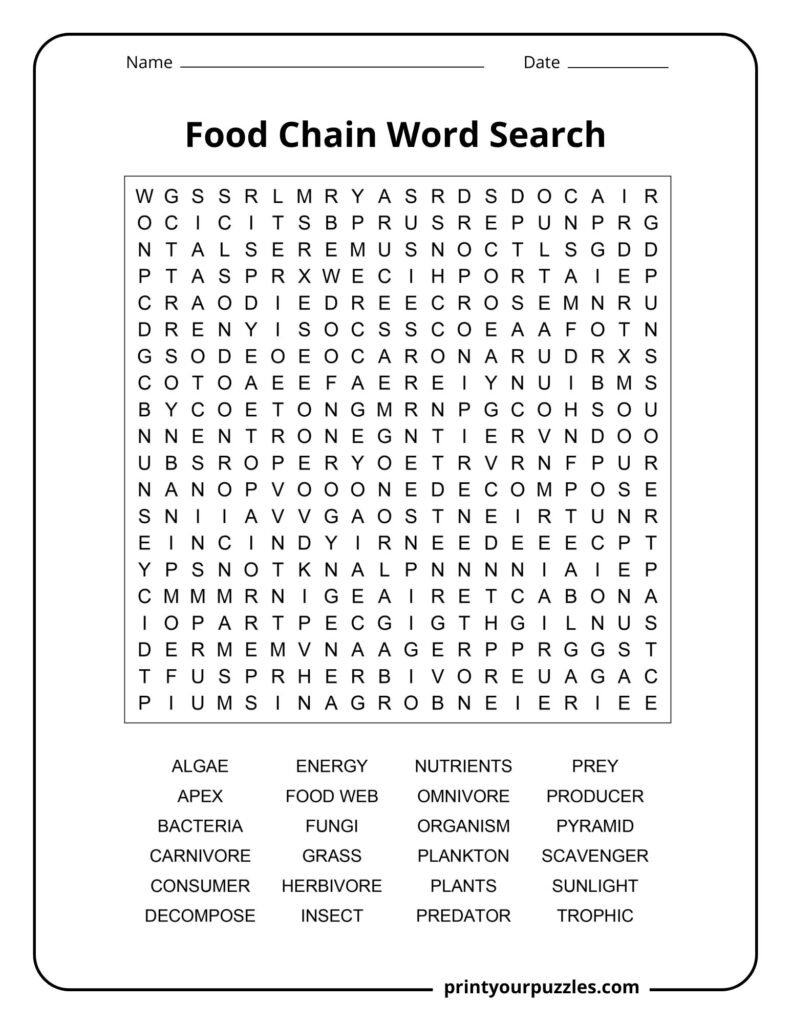
ALGAE, APEX, BACTERIA, CARNIVORE, CONSUMER, DECOMPOSE, ENERGY, FOOD WEB, FUNGI, GRASS, HERBIVORE, INSECT, NUTRIENTS, OMNIVORE, ORGANISM, PLANKTON, PLANTS, PREDATOR, PREY, PRODUCER, PYRAMID, SCAVENGER, SUNLIGHT, TROPHIC
A food chain is a linear sequence showing how energy and nutrients transfer from one organism to another through feeding relationships, starting with producers and ending with top predators.
A food chain shows a single pathway of energy flow, while a food web illustrates multiple interconnected food chains, revealing the complex feeding relationships within an actual ecosystem.
Producers convert sunlight into chemical energy through photosynthesis, creating food from non-living materials. They form the essential foundation that supports all other organisms in the food chain.
Energy decreases at each trophic level, with only about ten percent transferring upward. The rest is lost through metabolism, heat, and life processes, limiting food chain length.
Most food chains contain three to five trophic levels: producers, primary consumers, secondary consumers, tertiary consumers, and occasionally quaternary consumers at the top of the chain.
Approximately ninety percent of energy is lost as heat through metabolism and life processes at each level. This energy loss explains why food chains rarely exceed five levels.
Deep-sea hydrothermal vent communities base their food chains on chemosynthetic bacteria that convert chemicals like hydrogen sulfide into energy, completely independent of photosynthesis and sunlight.
Unlike most animals, humans function as omnivores eating plants, herbivores, and carnivores. Scientists estimate humans occupy an average trophic level of 2.21, between herbivores and carnivores.
Keystone species like sea otters control prey populations below them. When removed, their prey overgrazes producers, creating trophic cascades that dramatically alter entire ecosystem structures.
Bacteria and fungi break down dead organisms, returning essential nutrients to soil and water. Without decomposers, nutrients would remain locked in dead matter, halting all life.