Introduction to the Birth of Jesus Word Search
The birth of Jesus is one of the most important events in Christianity. It is described mainly in the Gospels of Matthew and Luke, which explain how Jesus was born in Bethlehem during the time of King Herod. Christians celebrate this event at Christmas and understand it as the fulfillment of promises about a coming Savior and Messiah.
According to the Gospel of Luke, the angel Gabriel visited a young woman named Mary in Nazareth. He told her that she would give birth to a son named Jesus, who would be called the Son of God. Mary accepted the message with faith. She was engaged to Joseph, a descendant of King David, who later received reassurance in a dream that Mary’s child had been conceived through the Holy Spirit.
Before Jesus was born, Mary and Joseph traveled from Nazareth to Bethlehem because of a census ordered by the Roman authorities. When they arrived, they found no suitable guest room available. Jesus was therefore born in humble surroundings and placed in a manger, a feeding container for animals. This simple setting has become a powerful symbol of humility and peace.
Luke also describes shepherds watching their flocks near Bethlehem. An angel appeared and announced the good news of Jesus’ birth. A heavenly host praised God, and the shepherds hurried to find Mary, Joseph, and the baby. After seeing Jesus, they shared what they had been told and returned praising God.
The Gospel of Matthew includes the visit of wise men, sometimes called Magi, who followed a star to find the newborn king. They brought gifts of gold, frankincense, and myrrh. King Herod, however, viewed the child as a threat. Joseph was warned in a dream, so the family escaped to Egypt before eventually returning and settling in Nazareth.
The birth of Jesus introduces important biblical themes such as hope, salvation, faith, humility, worship, and God’s love for humanity. A birth of Jesus word search can help readers review the people, places, symbols, and events connected with the Nativity story. While completing the puzzle, readers can remember the angel’s message, the journey to Bethlehem, the shepherds, the star, and the arrival of Jesus.
Related Word Searches:
Jesus Christ | Virgin Mary | Advent | Epiphany
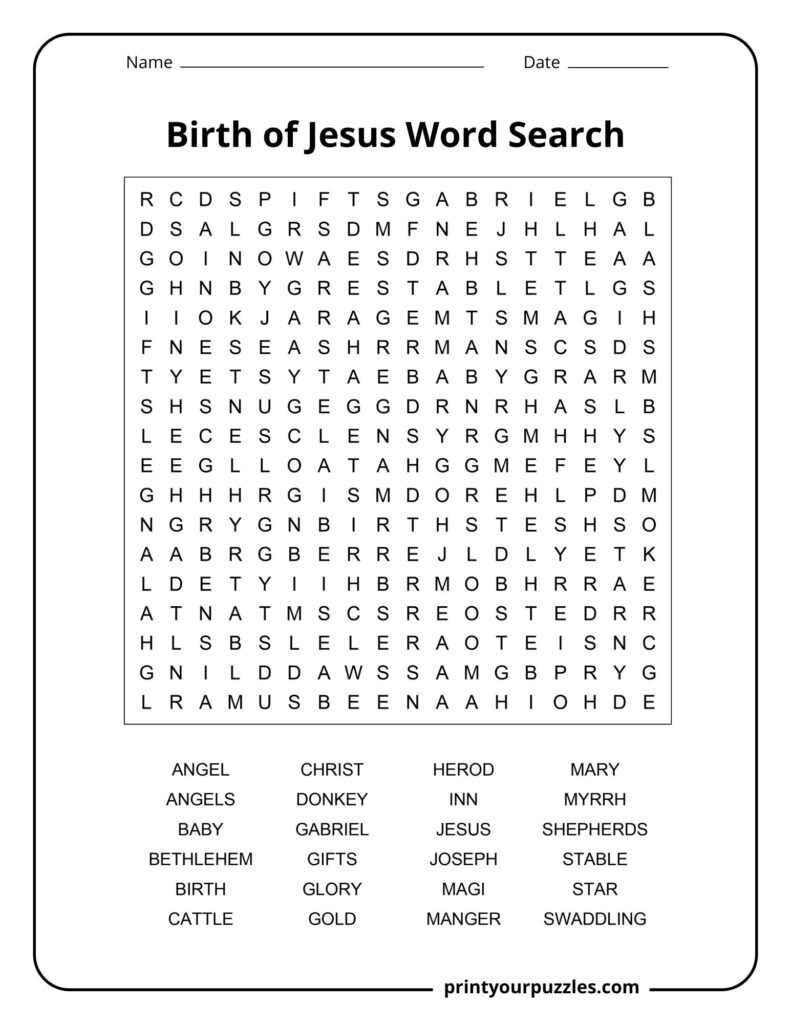
Medium Difficulty Word Search
Words to Find:
ANGEL, ANGELS, BABY, BETHLEHEM, BIRTH, CATTLE, CHRIST, DONKEY, GABRIEL, GIFTS, GLORY, GOLD, HEROD, INN, JESUS, JOSEPH, MAGI, MANGER, MARY, MYRRH, SHEPHERDS, STABLE, STAR, SWADDLING
All Words Defined
ANGEL – A heavenly messenger sent by God to announce important news about Jesus’s birth to Mary, Joseph, and the shepherds watching their flocks at night.
ANGELS – Multiple celestial beings who appeared to shepherds near Bethlehem, proclaiming “Glory to God in the highest” and announcing the Savior’s birth with great joy.
BABY – The infant Jesus Christ, born in Bethlehem, wrapped in swaddling clothes and laid in a manger because there was no room at the inn for Mary and Joseph.
BETHLEHEM – The small town in Judea, also called the City of David, where Jesus was born fulfilling ancient prophecy about the Messiah’s birthplace in Micah’s writings.
BIRTH – The miraculous nativity event when Mary gave birth to Jesus Christ, the Son of God, in a humble stable, marking the beginning of Christianity’s central story.
CATTLE – The farm animals present in the stable where Jesus was born, sharing their shelter with the Holy Family on that first Christmas night in Bethlehem.
CHRIST – The title meaning “Anointed One” or Messiah in Greek, given to Jesus as the promised Savior who would redeem humanity according to biblical prophecy and promise.
DONKEY – The humble animal traditionally believed to have carried Mary from Nazareth to Bethlehem during her pregnancy, symbolizing the modest circumstances surrounding Jesus’s birth and arrival.
GABRIEL – The archangel who appeared to Mary in Nazareth to announce she would conceive and bear God’s son, bringing the miraculous news of Jesus’s coming birth.
GIFTS – The valuable treasures of gold, frankincense, and myrrh presented to baby Jesus by the Magi from the East, symbolizing his kingship, divinity, and future sacrifice.
GLORY – The divine radiance and majesty of God that shone around the shepherds when angels appeared, announcing peace on earth and goodwill toward all people everywhere.
GOLD – The precious metal brought by the Magi as one of three gifts to Jesus, symbolizing his royalty and kingship as the prophesied ruler of Israel.
HEROD – The jealous king of Judea who sought to kill the newborn Jesus after hearing from the Magi about the birth of a rival “King of the Jews.”
INN – The lodging place in Bethlehem that had no available room for Mary and Joseph, forcing them to seek shelter in a stable where Jesus was ultimately born.
JESUS – The name meaning “God saves,” given to Mary’s son who was born in Bethlehem, the central figure of Christianity and the promised Messiah of biblical prophecy.
JOSEPH – Mary’s righteous husband, a carpenter from Nazareth who protected and cared for Mary and baby Jesus despite learning of the miraculous pregnancy through an angel’s message.
MAGI – The wise men or astrologers from eastern lands who followed a special star to Bethlehem, bringing precious gifts to worship the newborn King of the Jews.
MANGER – The animal feeding trough filled with hay that served as baby Jesus’s first cradle in the stable, symbolizing his humble birth and identification with common people.
MARY – The virgin chosen by God to be Jesus’s mother, who gave birth to the Savior in Bethlehem and treasured all these miraculous events in her heart.
MYRRH – The fragrant resin brought by the Magi as a gift to Jesus, symbolizing his future suffering, death, and burial as the sacrifice for humanity’s sins and redemption.
SHEPHERDS – The humble field workers watching their flocks at night who became the first witnesses of Jesus’s birth after angels appeared and directed them to find the baby.
STABLE – The simple shelter for animals where Mary and Joseph stayed in Bethlehem, becoming the humble birthplace of Jesus Christ when no room was available elsewhere.
STAR – The brilliant celestial sign that appeared in the sky, guiding the Magi from distant eastern lands to Bethlehem where they found and worshiped the newborn Jesus.
SWADDLING – The strips of cloth used to wrap newborn babies in ancient times, which Mary used to bind infant Jesus snugly for warmth, comfort, and protection.
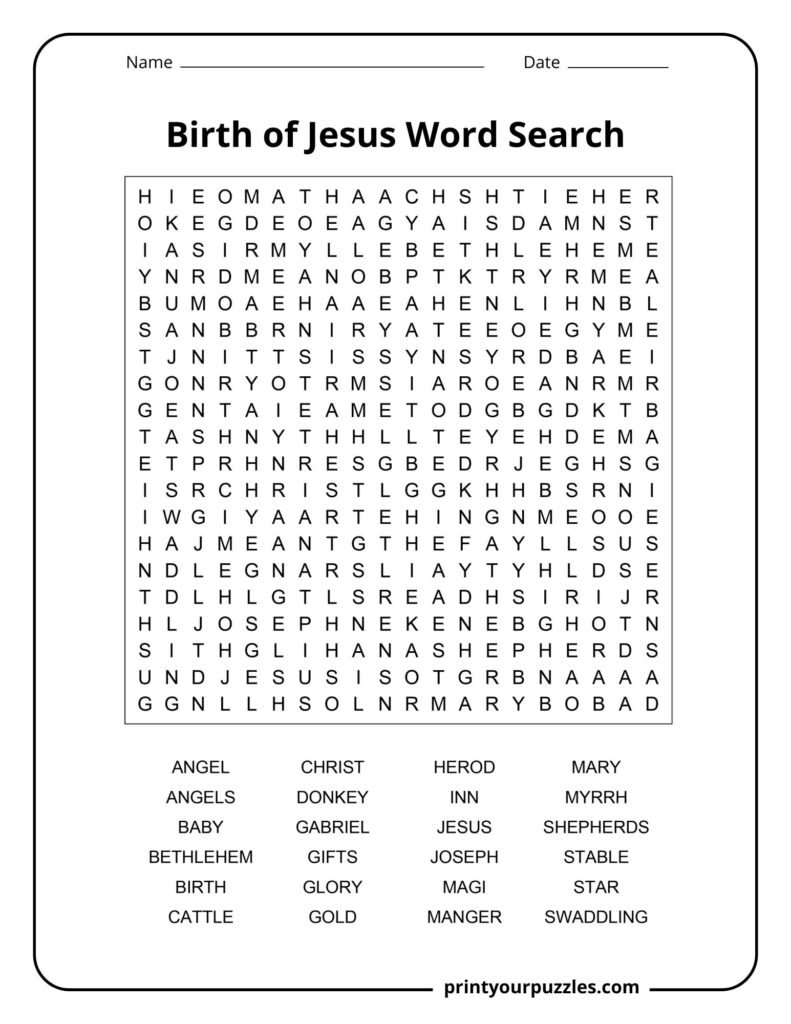
Hard Difficulty Word Search
Words to Find:
ANGEL, ANGELS, BABY, BETHLEHEM, BIRTH, CATTLE, CHRIST, DONKEY, GABRIEL, GIFTS, GLORY, GOLD, HEROD, INN, JESUS, JOSEPH, MAGI, MANGER, MARY, MYRRH, SHEPHERDS, STABLE, STAR, SWADDLING
5 Key FAQs About the Birth of Jesus
5 Curious "Did You Know?" Facts About the Birth of Jesus