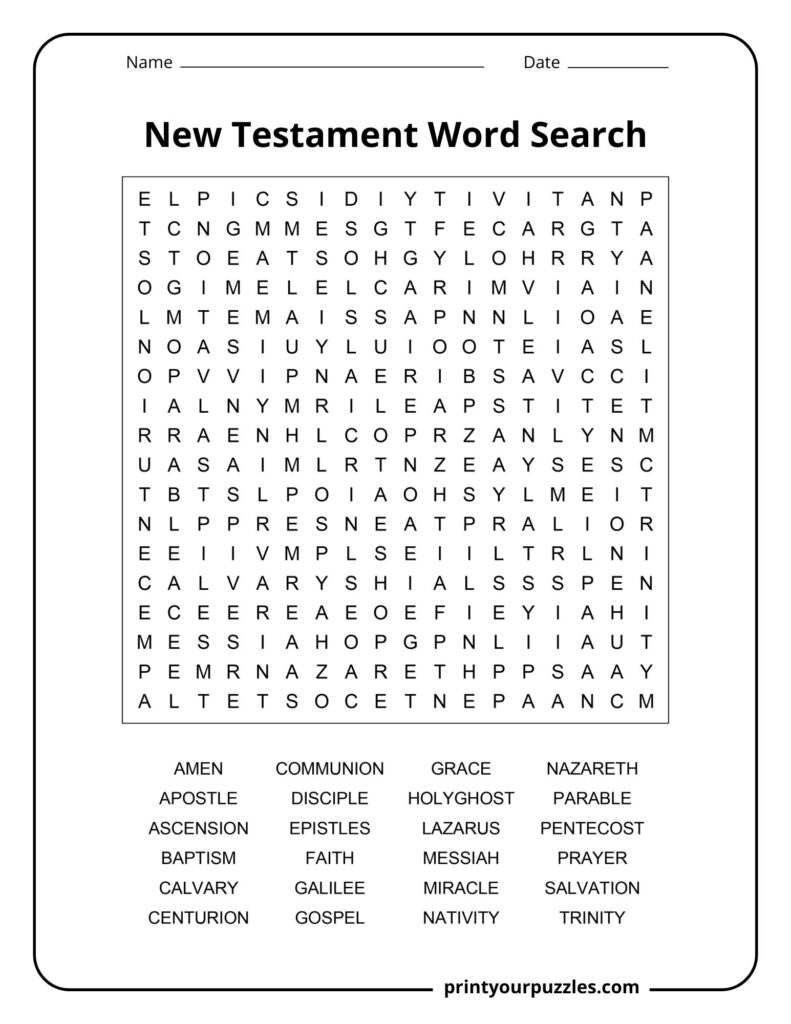
Introduction to the New Testament Word Search
The New Testament is the second main section of the Christian Bible and focuses on the life of Jesus Christ, the growth of the early Church, and the teachings of the first Christian leaders. It contains 27 books written by several authors during the first century. Together, these writings explain the central beliefs, history, and hopes of Christianity.
The New Testament begins with four books called the Gospels: Matthew, Mark, Luke, and John. Each Gospel describes the life, teachings, miracles, death, and resurrection of Jesus, although each writer presents certain events and themes in a distinctive way. Matthew often connects Jesus with Old Testament promises, Mark emphasizes His actions, Luke provides an orderly account, and John focuses strongly on His identity and divine nature.
After the Gospels comes the Book of Acts. Written as a continuation of Luke, Acts explains what happened after Jesus’ resurrection and ascension. It describes the coming of the Holy Spirit at Pentecost, the preaching of apostles such as Peter and Paul, and the spread of Christianity from Jerusalem to many parts of the Roman world.
Most of the remaining New Testament books are letters, also called epistles. Paul wrote letters to churches and individuals, offering guidance about faith, worship, unity, forgiveness, moral behavior, and Christian living. Other letters are connected with writers such as Peter, James, John, and Jude. These writings helped early believers understand how to follow Jesus while facing disagreements, persecution, and everyday challenges.
The final book is Revelation, which uses symbolic visions to describe conflict between good and evil, God’s judgment, and the hope of a renewed creation. Although some passages can be difficult to interpret, its central message encourages Christians to remain faithful and trust in God’s ultimate victory.
Important New Testament themes include love, grace, salvation, repentance, sacrifice, resurrection, discipleship, and eternal life. The books also introduce well-known figures such as Mary, John the Baptist, the twelve apostles, Mary Magdalene, Stephen, Barnabas, and Timothy.
A New Testament word search offers a great way to review important books, people, places, events, and teachings from this major section of the Bible. While completing the puzzle, readers can become more familiar with the Gospels, the apostles, the early Church, the letters, and the message of hope found throughout the New Testament.
Related Word Searches:
Jesus Christ | John the Baptist | Good Samaritan | Holy Spirit
Medium Difficulty Word Search
Words to Find:
AMEN, APOSTLE, ASCENSION, BAPTISM, CALVARY, CENTURION, COMMUNION, DISCIPLE, EPISTLES, FAITH, GALILEE, GOSPEL, GRACE, HOLY GHOST, LAZARUS, MESSIAH, MIRACLE, NATIVITY, NAZARETH, PARABLE, PENTECOST, PRAYER, SALVATION, TRINITY
All Words Defined
AMEN – A word of affirmation meaning “so be it,” used at the end of prayers and statements to express agreement, truth, and solemn confirmation of what was spoken.
APOSTLE – One of the twelve disciples personally chosen by Jesus to spread his teachings. Paul was later also named an apostle after his dramatic conversion on the road to Damascus.
ASCENSION – The miraculous event when Jesus rose bodily into heaven forty days after his resurrection, witnessed by his disciples and described in Acts 1:9, fulfilling his divine return to the Father.
BAPTISM – A sacred Christian ritual using water to symbolize purification, spiritual rebirth, and entry into the faith. Jesus himself was baptized by John the Baptist in the Jordan River.
CALVARY – The hill outside Jerusalem, also called Golgotha, where Jesus was crucified. It represents the ultimate sacrifice for humanity’s sins and is central to Christian salvation theology.
CENTURION – A Roman military officer commanding around one hundred soldiers. At the crucifixion, a centurion witnessed Jesus’s death and declared him the Son of God in Mark 15:39.
COMMUNION – The sacred ritual instituted by Jesus at the Last Supper, using bread and wine to symbolize his body and blood. Christians celebrate it regularly as a memorial of his sacrifice.
DISCIPLE – A follower and student of Jesus who learned his teachings and way of life. The twelve closest disciples were later called apostles, commissioned to spread the Gospel worldwide.
EPISTLES – Letters written by apostles, primarily Paul, to early Christian communities. Included in the New Testament, they provide theological guidance, moral instruction, and encouragement to growing churches.
FAITH – Complete trust and belief in God and Jesus Christ without requiring physical proof. Paul describes faith as the foundation of salvation, famously writing that the righteous shall live by it.
GALILEE – A northern region of ancient Israel where Jesus grew up and conducted much of his ministry. He called his first disciples there and performed many miracles along its famous sea.
GOSPEL – Meaning “good news,” the Gospel refers to the message of Jesus Christ’s life, death, and resurrection. The New Testament contains four Gospels written by Matthew, Mark, Luke, and John.
GRACE – God’s unmerited favor and love freely given to humanity despite sinfulness. In the New Testament, grace is the foundation of salvation, meaning eternal life cannot be earned but only received as a gift.
HOLY GHOST – Also known as the Holy Spirit, the third person of the Christian Trinity. He guides, comforts, and empowers believers, and descended upon the apostles at Pentecost as tongues of fire.
LAZARUS – A man from Bethany and close friend of Jesus whom Jesus raised from the dead after four days in the tomb. This extraordinary miracle demonstrated Jesus’s divine power over death itself.
MESSIAH – A Hebrew title meaning “anointed one,” equivalent to the Greek word Christ. Christians believe Jesus is the long-awaited Messiah prophesied in the Old Testament, sent to redeem all of humanity.
MIRACLE – A supernatural event performed by Jesus or the apostles through divine power. Miracles in the New Testament include healing the sick, walking on water, and raising the dead to life.
NATIVITY – The birth of Jesus Christ as described in the Gospels of Matthew and Luke. Born in a manger in Bethlehem, his arrival fulfilled ancient prophecy and marked the beginning of a new era.
NAZARETH – The town in Galilee where Jesus grew up and spent most of his life. Frequently mentioned throughout the Gospels, it gave Jesus his well-known title, Jesus of Nazareth.
PARABLE – A short, simple story used by Jesus to convey deep spiritual truths. Famous parables include the Good Samaritan, the Prodigal Son, and the Sower, each teaching lessons about God’s kingdom.
PENTECOST – A Jewish festival that became the occasion when the Holy Spirit descended upon the apostles in Jerusalem. Considered the birth of the Christian Church, it empowered believers to preach in multiple languages.
PRAYER – Direct communication with God through words, thoughts, or meditation. Jesus taught his disciples to pray using the Lord’s Prayer and often withdrew to pray alone, modeling a life of constant communion with God.
SALVATION – The deliverance of humanity from sin and its consequences through faith in Jesus Christ. The New Testament teaches that salvation is a free gift from God, secured through Christ’s death and resurrection.
TRINITY – The Christian doctrine describing one God existing in three distinct persons: Father, Son, and Holy Spirit. Though the word itself doesn’t appear in the New Testament, the concept is present throughout its writings.
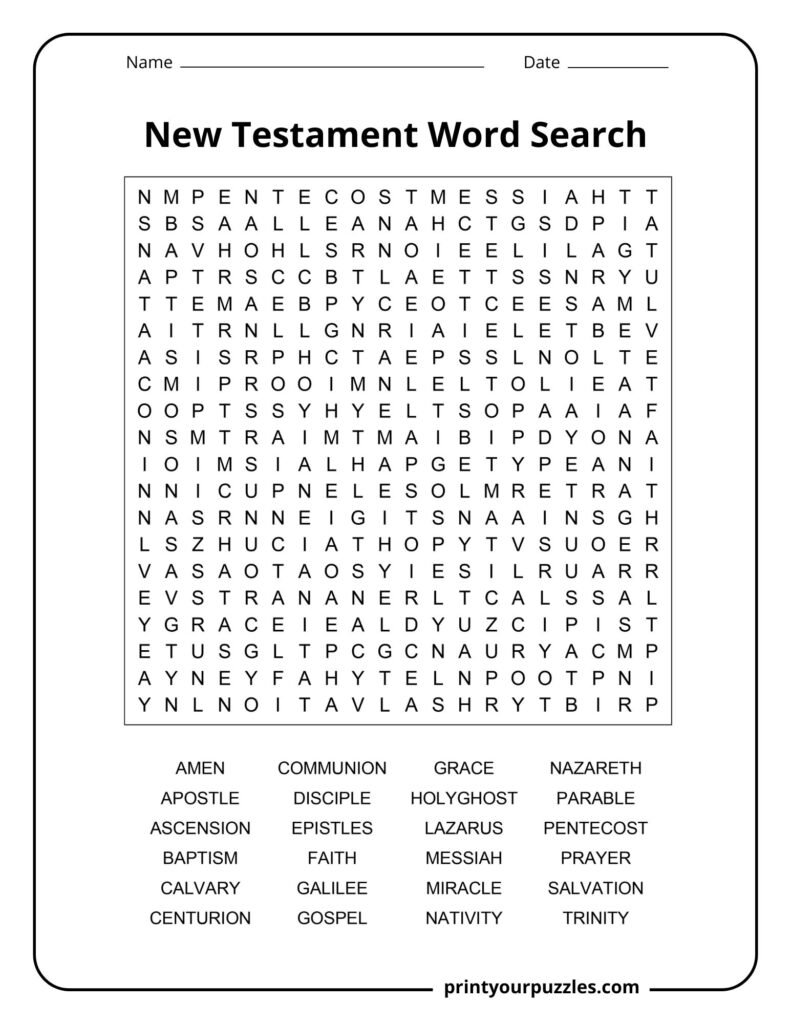
Hard Difficulty Word Search
Words to Find:
AMEN, APOSTLE, ASCENSION, BAPTISM, CALVARY, CENTURION, COMMUNION, DISCIPLE, EPISTLES, FAITH, GALILEE, GOSPEL, GRACE, HOLY GHOST, LAZARUS, MESSIAH, MIRACLE, NATIVITY, NAZARETH, PARABLE, PENTECOST, PRAYER, SALVATION, TRINITY
5 Key FAQs About the New Testament
5 Curious "Did You Know?" Facts About the New Testament