Stand almost anywhere in Colorado and the landscape seems to pull your eyes toward the horizon. To the west, the Rocky Mountains rise with snow-covered peaks, alpine forests, deep canyons, and clear mountain lakes. To the east, wide plains stretch toward the center of the United States. This contrast gives Colorado a unique identity as both a Mountain West state and a gateway to the Great Plains.
Colorado’s capital and largest city is Denver, often called the Mile High City because it sits about one mile above sea level. From Denver, visitors can travel quickly toward mountain towns, ski resorts, hiking trails, and national parks. This Colorado word search introduces many of the places, landscapes, and ideas that make the state such an exciting subject to explore.
The state’s geography is one of its most important features. Colorado is home to more than fifty mountain peaks over 14,000 feet, often called “fourteeners.” Rocky Mountain National Park protects high peaks, meadows, wildlife, and scenic roads, while Mesa Verde National Park preserves ancient cliff dwellings built by Ancestral Pueblo people. The Colorado River, one of the most important rivers in the American West, begins in the state and helps shape landscapes far beyond its borders.
Colorado’s history includes Indigenous cultures, Spanish exploration, mining, ranching, railroads, and westward expansion. It became the 38th state in 1876, earning the nickname The Centennial State because it joined the Union 100 years after the Declaration of Independence. Mining towns grew rapidly during gold and silver rushes, and many of those mountain communities still preserve their historic character today.
Modern Colorado is known for outdoor recreation, technology, aerospace, agriculture, craft brewing, tourism, and a strong connection to nature. Skiing, hiking, mountain biking, rafting, and camping are part of everyday life for many residents and visitors. The state is also home to professional sports teams, universities, farms, ranches, and fast-growing cities.
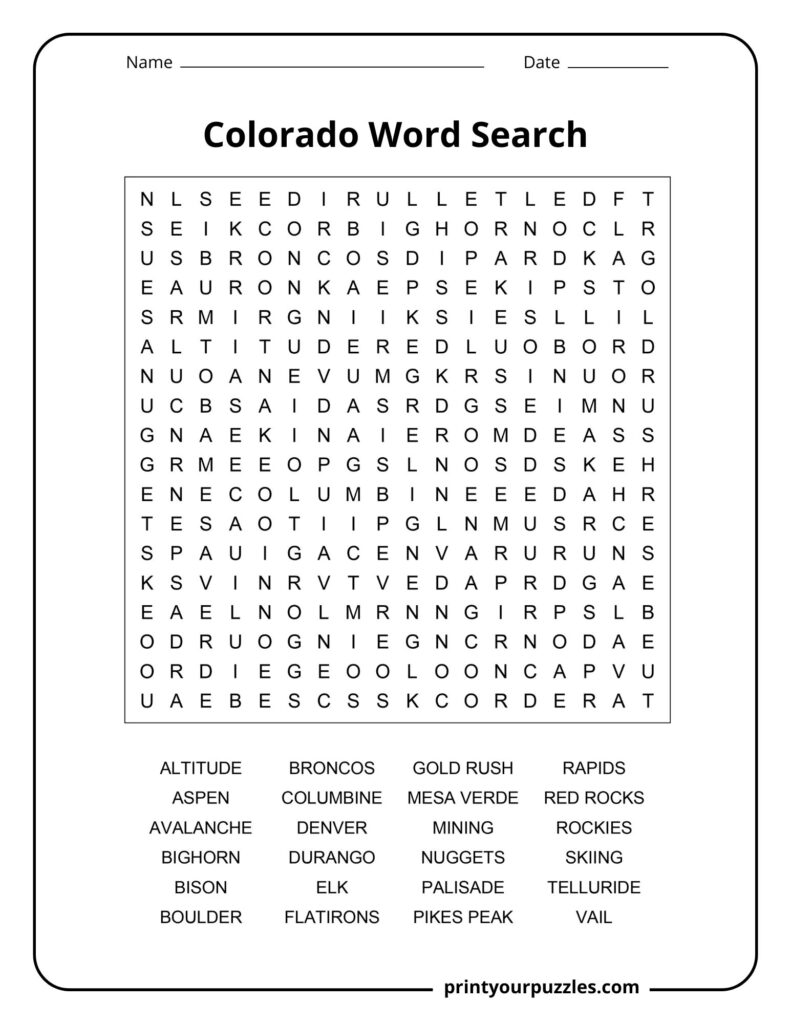
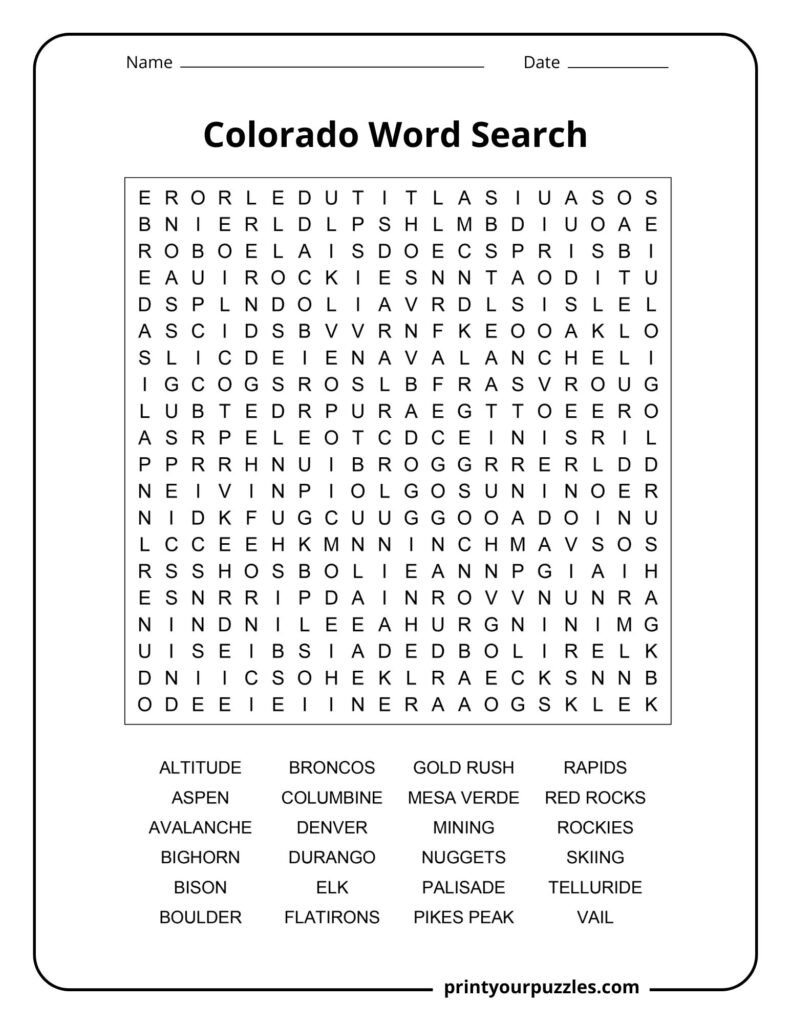
Colorado feels adventurous because so much of it invites exploration. From red rock formations to snowy summits, from ancient ruins to modern cities, the state offers a rich mix of natural beauty and human history. As you complete this free printable Colorado word search, look for words that capture the energy, landscapes, and stories of one of America’s most scenic states.
Explore more Mountain West States with our Utah word search, Wyoming word search, New Mexico word search, and the full US States Word Searches collection.
ALTITUDE – Colorado has the highest mean elevation of any U.S. state at 6,800 feet, with over fifty peaks exceeding 14,000 feet, causing unique weather and altitude sickness concerns.
ASPEN – Famous ski resort town known for world-class skiing, celebrity visitors, and beautiful golden aspen trees that blanket mountainsides each fall with spectacular yellow foliage displays.
AVALANCHE – Colorado’s NHL hockey team based in Denver, winning Stanley Cup championships, plus the dangerous natural snow slides common in Colorado’s steep mountain terrain during winter.
BIGHORN – Majestic wild sheep species native to Colorado’s Rocky Mountains, recognized by males’ distinctive large curved horns, often spotted on steep cliffs and rocky mountain terrain.
BISON – Large grazing mammals that once roamed Colorado’s plains in vast herds; now protected in parks, these iconic American animals symbolize the state’s western heritage.
BOULDER – Vibrant college city home to University of Colorado, nestled against dramatic Flatiron rock formations, known for outdoor recreation, progressive culture, and thriving tech industry scene.
BRONCOS – Denver’s beloved NFL football team, three-time Super Bowl champions, wearing orange and blue colors, uniting Colorado sports fans with passionate following and storied franchise history.
COLUMBINE – Colorado’s official state flower since 1899, this delicate blue and white wildflower blooms in mountain meadows, symbolizing the state’s natural beauty and alpine environment.
DENVER – Colorado’s capital and largest city, the “Mile High City” sits at exactly 5,280 feet elevation, offering urban culture, sports teams, and Rocky Mountain gateway access.
DURANGO – Historic southwestern Colorado town featuring the narrow-gauge railroad, Old West charm, nearby Mesa Verde, outdoor adventures, and Victorian-era architecture preserved from mining boom days.
ELK – Large deer species abundant throughout Colorado’s forests and meadows, known for males’ impressive antlers and haunting bugling calls echoing through mountains during fall mating season.
FLATIRONS – Dramatic tilted rock formations rising above Boulder, these distinctive slanted sandstone slabs are iconic landmarks visible for miles, popular for hiking and rock climbing adventures.
GOLD RUSH – The 1858-1859 Pikes Peak Gold Rush brought thousands of prospectors westward, establishing mining towns and transforming Colorado’s economy, spawning the famous slogan “Pikes Peak or Bust!”
MESA VERDE – UNESCO World Heritage Site national park preserving ancient Ancestral Puebloan cliff dwellings built into canyon walls over 700 years ago, showcasing remarkable indigenous architectural achievements.
MINING – Historic industry that built Colorado, extracting gold, silver, molybdenum, and other minerals from mountain regions, creating boom towns and shaping the state’s economic and cultural development.
NUGGETS – Denver’s NBA basketball team, named after Colorado’s gold mining heritage, competing since 1976 and winning their first championship in 2023 behind superstar Nikola Jokić.
PALISADE – Small western Colorado town near Grand Junction, famous as the state’s premier peach-growing region and emerging wine country, hosting annual fruit festivals celebrating agricultural bounty.
PIKES PEAK – Famous 14,115-foot mountain near Colorado Springs, inspiring “America the Beautiful,” accessible by highway or cog railway, offering breathtaking summit views across Colorado’s landscape.
RAPIDS – Colorado Rapids, Denver’s Major League Soccer team competing since 1996, won MLS Cup championship in 2010, representing Colorado in professional soccer with dedicated fan base.
RED ROCKS – Stunning natural amphitheater carved from ancient red sandstone formations near Morrison, hosting legendary concerts with perfect acoustics, ranked world’s best outdoor music venue repeatedly.
ROCKIES – The Rocky Mountains dominate Colorado’s landscape with towering peaks, plus Denver’s MLB baseball team, the Colorado Rockies, playing at downtown’s high-altitude Coors Field since 1993.
SKIING – Colorado’s world-renowned winter sport industry features legendary resorts like Vail, Aspen, and Breckenridge, attracting millions annually to experience champagne powder and stunning alpine terrain.
TELLURIDE – Remote box canyon ski town in southwestern Colorado, known for challenging slopes, film festival, preserved Victorian architecture, and breathtaking scenery including dramatic Bridal Veil Falls.
VAIL – Largest ski resort in Colorado, founded in 1962, offering over 5,000 acres of terrain, European-style village atmosphere, luxury amenities, and consistently ranked among world’s best.