
Connecticut may be one of the smallest states in the country, but its role in American history is anything but small. Located in the Northeast, this New England state sits between New York, Massachusetts, Rhode Island, and Long Island Sound. Hartford is the capital, while Bridgeport is the largest city. Known as The Constitution State, Connecticut offers a rich mix of colonial heritage, coastal beauty, education, industry, and culture.
Much of Connecticut’s character comes from its location. Along the southern coast, towns and cities face Long Island Sound, connecting the state to maritime trade, fishing, boating, and seaside traditions. Inland, visitors find forests, rivers, rolling hills, historic villages, and quiet town greens that reflect classic New England scenery. The Connecticut River, the longest river in New England, runs through the state and has shaped transportation, farming, and settlement for centuries.
History is especially important here. Indigenous peoples lived in the region long before European settlement, and Connecticut later became one of the original thirteen colonies. During the American Revolution, the state supplied soldiers, food, and materials to the patriot cause, earning the nickname The Provision State. Its colonial charters and early ideas about self-government also helped influence later American political thought, which is one reason Connecticut is associated with the Constitution.
A Connecticut word search can introduce students and puzzle lovers to many of the people, places, and ideas connected to this historic state. Connecticut has been home to writers, inventors, universities, manufacturers, and major insurance companies. Yale University in New Haven is one of the oldest and most famous universities in the United States. The state also played an important role in early American industry, producing clocks, firearms, tools, textiles, and other goods.
Today, Connecticut combines historic charm with modern life. Its economy includes finance, insurance, healthcare, education, advanced manufacturing, technology, and tourism. Visitors can explore Mystic Seaport, Mark Twain’s house in Hartford, coastal villages, art museums, forests, and scenic drives.
Connecticut’s identity is built from many small but meaningful details: colonial streets, university campuses, river valleys, old ports, and quiet New England landscapes. As you complete this free printable Connecticut word search, look for words that reveal how this small state helped shape the larger story of America.
Continue your Northeast States adventure with our New York word search, Rhode Island word search, Massachusetts word search, and the full US States Word Searches collection.
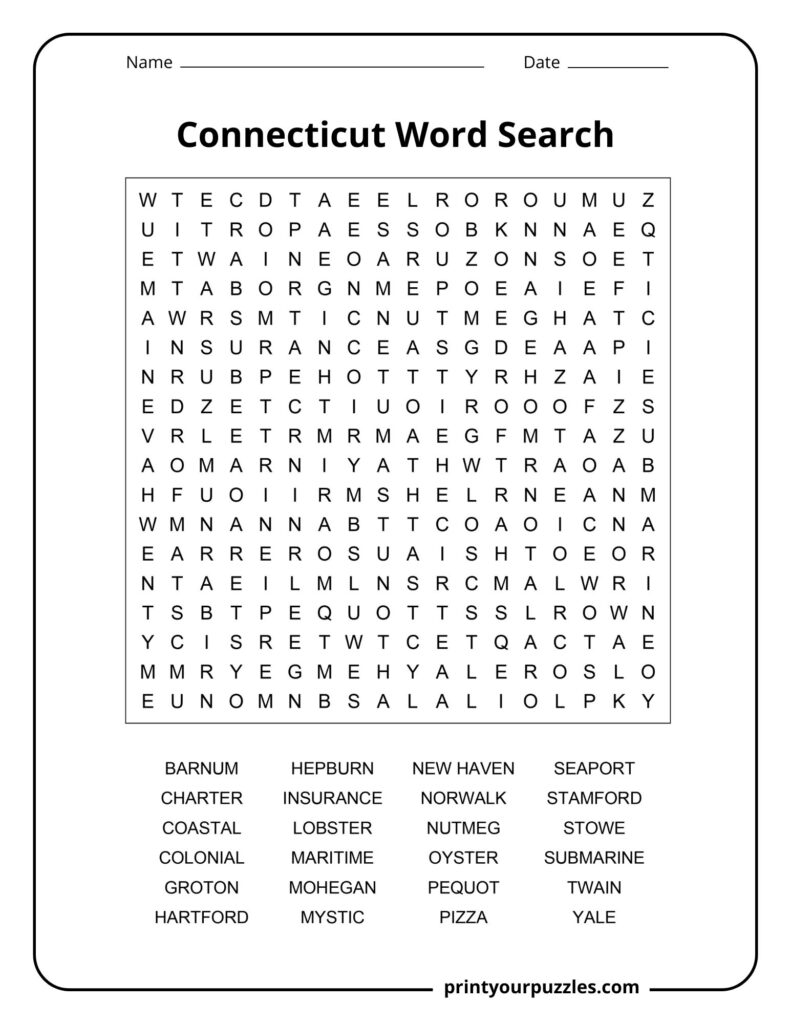
BARNUM, CHARTER, COASTAL, COLONIAL, GROTON, HARTFORD, HEPBURN, INSURANCE, LOBSTER, MARITIME, MOHEGAN, MYSTIC, NEW HAVEN, NORWALK, NUTMEG, OYSTER, PEQUOT, PIZZA, SEAPORT, STAMFORD, STOWE, SUBMARINE, TWAIN, YALE
BARNUM – P.T. Barnum was a famous showman and circus founder born in Bethel, Connecticut. He created “The Greatest Show on Earth” and served as Bridgeport’s mayor.
CHARTER – Refers to the Charter Oak, Connecticut’s legendary tree that hid the colonial charter in 1687. The state is nicknamed “The Constitution State” for its early governing document.
COASTAL – Connecticut features 618 miles of scenic Long Island Sound coastline. The shore includes beaches, harbors, and historic maritime towns that define the state’s character.
COLONIAL – Connecticut was one of the original thirteen colonies, founded in 1636. Its rich colonial heritage includes preserved historic districts, museums, and Revolutionary War sites throughout.
GROTON – Home to the Naval Submarine Base New London, the primary submarine base for the U.S. Atlantic Fleet. Groton is known as the “Submarine Capital of the World.”
HARTFORD – Connecticut’s capital city and a major insurance industry center, earning it the nickname “Insurance Capital of the World.” Founded in 1635, it’s one of America’s oldest cities.
HEPBURN – Katharine Hepburn, legendary four-time Oscar-winning actress, was born in Hartford. She remains one of Hollywood’s most iconic and celebrated performers from Connecticut.
INSURANCE – Hartford became America’s insurance capital in the 1800s. Major companies like Aetna, Travelers, and The Hartford transformed Connecticut into the nation’s insurance industry hub.
LOBSTER – Connecticut-style lobster rolls feature warm lobster meat tossed in butter, unlike Maine’s cold mayo version. This local delicacy is a beloved coastal culinary tradition.
MARITIME – Connecticut’s Long Island Sound location created a strong maritime heritage. Shipbuilding, whaling, fishing, and naval industries have shaped the state’s economy and culture for centuries.
MOHEGAN – Native American tribe indigenous to Connecticut with sovereign nation status. The Mohegan Tribe operates Connecticut’s largest resort casino and preserves important cultural heritage.
MYSTIC – Historic seaport village famous for its maritime museum, aquarium, and 19th-century whaling village recreation. Mystic embodies Connecticut’s rich seafaring and shipbuilding history beautifully.
NEW HAVEN – Connecticut’s second-largest city, home to Yale University and birthplace of the American hamburger. Famous for distinctive New Haven-style apizza and cultural institutions.
NORWALK – Coastal city known for its Maritime Aquarium, oyster harvesting tradition, and vibrant SoNo arts district. Norwalk blends historic maritime culture with modern suburban living.
NUTMEG – Connecticut’s official nickname is “The Nutmeg State,” possibly from Yankee peddlers’ reputation or the state’s industrious traders. It represents Connecticut’s entrepreneurial spirit and history.
OYSTER – Connecticut has a celebrated oyster industry dating to pre-colonial times. Norwalk oysters are especially prized, and the state hosts annual oyster festivals celebrating this tradition.
PEQUOT – Indigenous tribe that inhabited southeastern Connecticut. Today, the Mashantucket Pequot Tribe operates Foxwoods Resort Casino and maintains an important museum preserving tribal history.
PIZZA – New Haven’s distinctive coal-fired “apizza” is legendary, with Frank Pepe and Sally’s Apizza creating a unique thin-crust style. Connecticut claims America’s best pizza tradition.
SEAPORT – Connecticut’s numerous historic seaports like Mystic showcase the state’s maritime legacy. These preserved villages feature tall ships, maritime museums, and 19th-century coastal architecture.
STAMFORD – Connecticut’s third-largest city, a major corporate headquarters hub located near New York City. Stamford combines urban sophistication with coastal New England charm and culture.
STOWE – Harriet Beecher Stowe, author of “Uncle Tom’s Cabin,” lived in Hartford. Her influential anti-slavery novel helped shape American history and the abolitionist movement significantly.
SUBMARINE – Groton houses the Naval Submarine Base and USS Nautilus, the world’s first nuclear-powered submarine. Connecticut’s submarine manufacturing and naval presence define its defense industry.
TWAIN – Mark Twain lived in Hartford for 17 years, writing his masterpieces including “Tom Sawyer” and “Huckleberry Finn.” His Victorian mansion is now a popular museum.
YALE – One of America’s oldest and most prestigious Ivy League universities, founded in 1701 in New Haven. Yale significantly influences Connecticut’s education, culture, and economy.
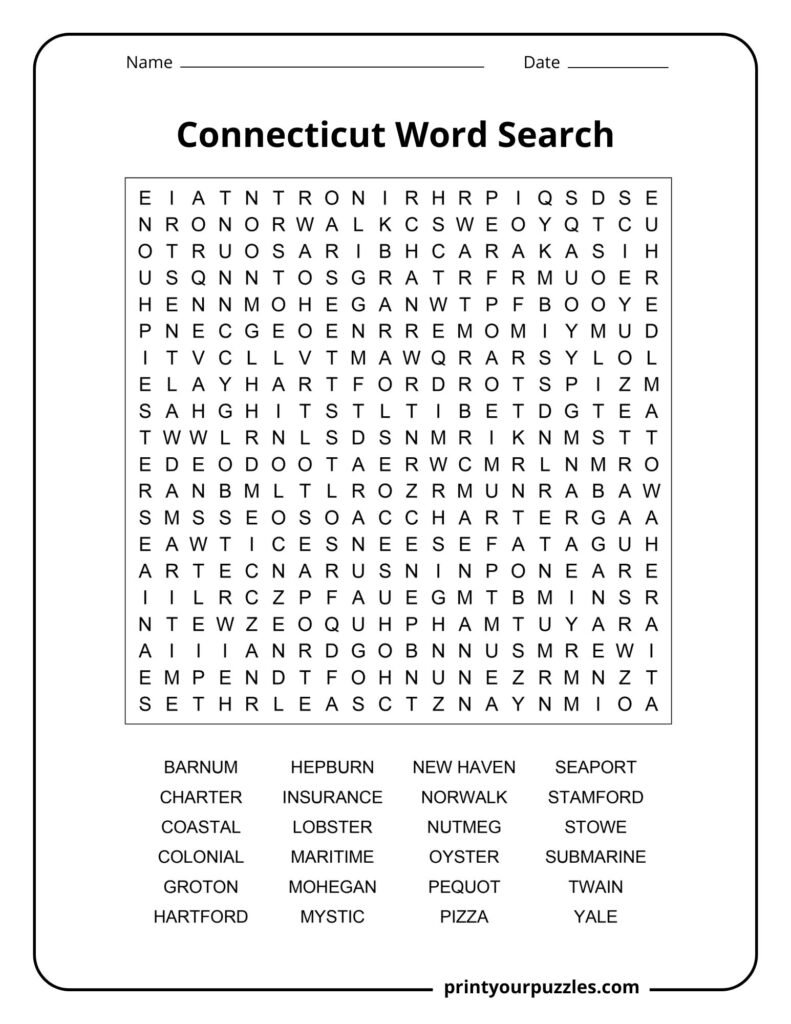
BARNUM, CHARTER, COASTAL, COLONIAL, GROTON, HARTFORD, HEPBURN, INSURANCE, LOBSTER, MARITIME, MOHEGAN, MYSTIC, NEW HAVEN, NORWALK, NUTMEG, OYSTER, PEQUOT, PIZZA, SEAPORT, STAMFORD, STOWE, SUBMARINE, TWAIN, YALE
Connecticut is famous for Yale University, maritime history, insurance industry, Mark Twain’s home, New Haven pizza, submarine manufacturing, colonial heritage, and beautiful coastal towns along Long Island Sound.
Hartford is Connecticut’s capital and largest city. Known as the “Insurance Capital of the World,” it was founded in 1635 and features rich colonial history and cultural attractions.
The nickname possibly originated from Yankee peddlers allegedly selling fake wooden nutmegs, though more likely it celebrates Connecticut traders’ shrewdness and the state’s historical spice trade and entrepreneurial spirit.
Connecticut’s economy centers on insurance, finance, aerospace manufacturing, pharmaceuticals, biotechnology, defense (especially submarines), and education. The state also has thriving tourism and maritime industries along its coastline.
Connecticut is America’s third-smallest state at 5,567 square miles with approximately 3.6 million residents. Despite its size, it’s densely populated and strategically located between New York and Boston.
For official state records and government services, visit the Connecticut State Portal. If you are planning a trip, check out CT Visit.
Louis Lassen of New Haven’s Louis’ Lunch created the first hamburger in 1900, serving ground beef between toast slices. The restaurant still operates today using the original vertical grills!
Connecticut abolished county governance in 1960, making it one of only two U.S. states without functioning county governments. Towns and cities handle all local administration independently throughout the state.
Yale students in the 1870s threw empty pie tins from Frisbie Pie Company, yelling “Frisbie!” as a warning. This campus tradition inspired the modern Frisbee toy decades later.
Connecticut rejected Prohibition and never ratified the constitutional amendment banning alcohol. The state maintained its independent stance, reflecting its “Constitution State” heritage and strong local governance traditions.
In 1878, New Haven issued the world’s first telephone directory, listing just 50 names. No numbers were included—operators connected calls manually by requesting subscribers’ names instead!