
The name “Gilded Age” describes a period in United States history that looked bright and prosperous on the surface, but had serious problems underneath. It lasted roughly from the 1870s to the early 1900s, during a time of fast economic growth, new technology, expanding cities, and major social change. The word “gilded” means covered with a thin layer of gold, which suggests that the era’s wealth and success sometimes hid poverty, inequality, and corruption.
During the Gilded Age, the United States became a powerful industrial nation. Railroads expanded across the country, factories produced goods on a larger scale, and industries such as steel, oil, banking, and transportation grew rapidly. New inventions and business methods changed how people worked, traveled, and lived.
Big business became a major force during this period. Industrialists such as Andrew Carnegie, John D. Rockefeller, J. P. Morgan, and Cornelius Vanderbilt built enormous fortunes. Some people admired them as “captains of industry” because they created jobs, improved production, and helped modernize the economy. Critics called them “robber barons” because they believed these businessmen used unfair methods, crushed competition, and gained too much power.
The Gilded Age also brought large waves of immigration and rapid urban growth. Millions of people arrived in the United States looking for work and a better life. Many settled in crowded cities, where opportunities existed but living conditions could be difficult. Poor housing, pollution, disease, low wages, long hours, and unsafe factories became serious problems for many workers and families.
These challenges led to labor movements, strikes, and demands for reform. Workers organized unions to fight for better pay, shorter hours, and safer conditions. At the same time, political machines, bribery, and the close relationship between business and government raised concerns about corruption. The problems of the Gilded Age helped prepare the way for the Progressive Era, when reformers pushed for cleaner government, stronger protections, and social change.
This Gilded Age word search helps students review vocabulary connected to industry, railroads, immigrants, factories, unions, strikes, steel, oil, wealth, cities, corruption, and reform. A Gilded Age word search can make this complex period easier to understand by connecting key terms with its growth, problems, and lasting influence.
Related Word Searches:
Progressive Era | Pullman Strike | Theodore Roosevelt | Roaring Twenties | San Francisco Earthquake | Boston Police Strike
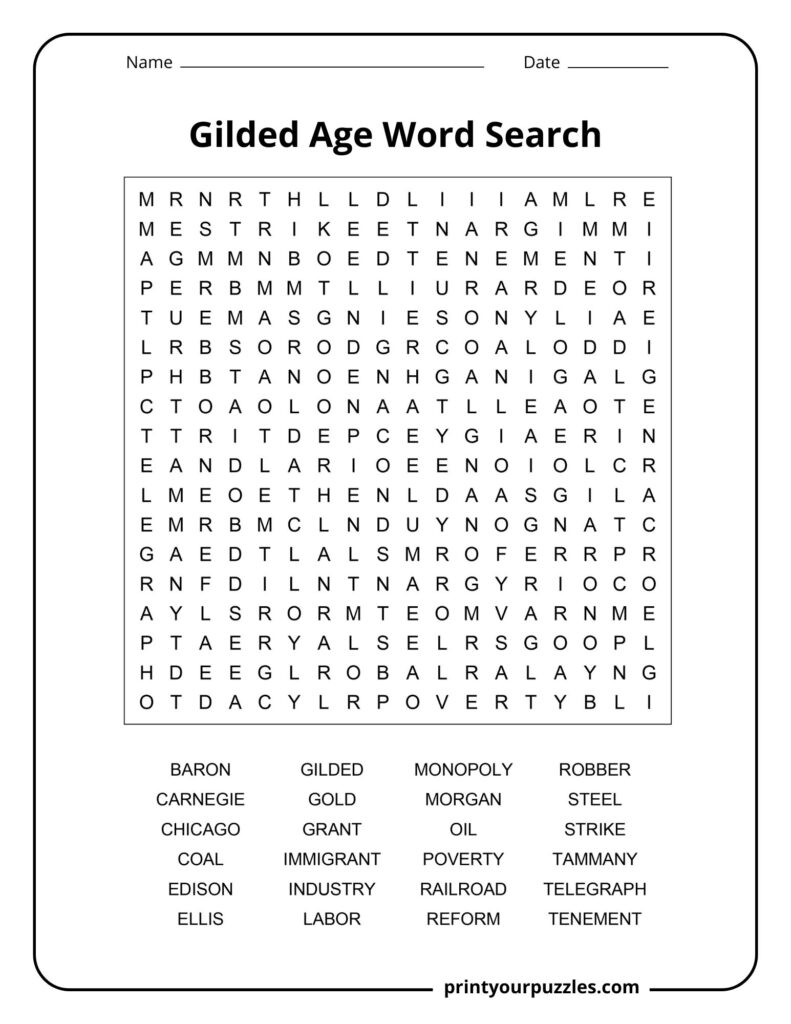
BARON, CARNEGIE, CHICAGO, COAL, EDISON, ELLIS, GILDED, GOLD, GRANT, IMMIGRANT, INDUSTRY, LABOR, MONOPOLY, MORGAN, OIL, POVERTY, RAILROAD, REFORM, ROBBER, STEEL, STRIKE, TAMMANY, TELEGRAPH, TENEMENT
BARON – Wealthy industrialist who controlled major industries through monopolistic practices. Often called “robber barons,” they accumulated vast fortunes during rapid industrial expansion and economic growth.
CARNEGIE – Andrew Carnegie, Scottish immigrant who built a steel empire. Known for philanthropy, he donated millions to libraries and education while advocating the “Gospel of Wealth” philosophy.
CHICAGO – Rapidly growing Midwestern city and industrial hub. Site of the 1893 World’s Fair, labor strikes, and innovation. Symbolized both urban opportunity and industrial challenges.
COAL – Primary energy source powering factories, railroads, and homes. Coal mining was dangerous work, often performed by immigrants in harsh conditions with frequent accidents and labor disputes.
EDISON – Thomas Edison, prolific inventor who created the light bulb, phonograph, and motion pictures. His innovations revolutionized daily life and helped establish the electrical power industry nationwide.
ELLIS – Ellis Island, the immigration processing center in New York Harbor. Millions of European immigrants entered America through its gates, seeking opportunity in the industrial economy.
GILDED – Mark Twain’s term describing the era’s superficial golden appearance masking corruption, poverty, and inequality beneath. The name captured the period’s contradictions between wealth and suffering.
GOLD – Precious metal backing currency under the gold standard. Political debates over gold versus silver currency divided the nation, affecting farmers, workers, and economic policy debates.
GRANT – Ulysses S. Grant, Civil War hero and eighteenth president. His administration faced scandals and corruption while struggling to manage Reconstruction and rapid industrial transformation nationwide.
IMMIGRANT – Millions of Europeans and Asians arrived seeking economic opportunity. They provided essential labor for factories, mines, and railroads while facing discrimination, harsh conditions, and cultural challenges.
INDUSTRY – Manufacturing and production systems that transformed America into an economic powerhouse. Rapid industrialization created wealth, jobs, and cities while causing labor conflicts and environmental degradation.
LABOR – Working class Americans who toiled in factories, mines, and railroads. They organized unions, conducted strikes, and fought for better wages, shorter hours, and safer conditions.
MONOPOLY – Complete control of an industry by one company or trust. Monopolies like Standard Oil eliminated competition, fixed prices, and accumulated enormous power, prompting antitrust legislation.
MORGAN – J.P. Morgan, powerful banker and financier who organized corporate mergers and saved the economy multiple times. He controlled railroads, steel, and banking through financial manipulation.
OIL – Petroleum industry dominated by John D. Rockefeller’s Standard Oil. Oil powered lamps, machinery, and transportation, becoming essential to industrial growth and corporate consolidation strategies.
POVERTY – Widespread destitution among workers, immigrants, and farmers. Urban slums, rural hardship, and economic inequality contrasted sharply with the extravagant wealth of industrial magnates and elites.
RAILROAD – Transcontinental and regional rail networks that connected the nation. Railroads drove economic growth, enabled western expansion, and concentrated wealth while exploiting workers and farmers.
REFORM – Progressive movements seeking to address corruption, poverty, and inequality. Reformers advocated labor rights, women’s suffrage, antitrust laws, and improved working and living conditions throughout society.
ROBBER – Term for ruthless industrialists who built empires through exploitation, corruption, and monopolistic practices. They accumulated fortunes while workers endured poverty, danger, and economic insecurity.
STEEL – Essential metal for railroads, buildings, and machinery. Carnegie’s innovations made steel production efficient and profitable, transforming construction and manufacturing while creating industrial fortunes and jobs.
STRIKE – Work stoppages organized by laborers demanding better conditions. Major strikes like Homestead and Pullman often turned violent as companies and government forces suppressed worker organizing efforts.
TAMMANY – Tammany Hall, New York City’s Democratic political machine. Led by Boss Tweed and others, it provided services to immigrants while engaging in widespread corruption and fraud.
TELEGRAPH – Revolutionary communication technology that transmitted messages instantly across vast distances. It connected businesses, coordinated railroads, and enabled rapid information exchange crucial to industrial expansion.
TENEMENT – Overcrowded urban apartment buildings housing poor workers and immigrants. These structures featured inadequate ventilation, sanitation, and light, creating dangerous, unhealthy living conditions in industrial cities.
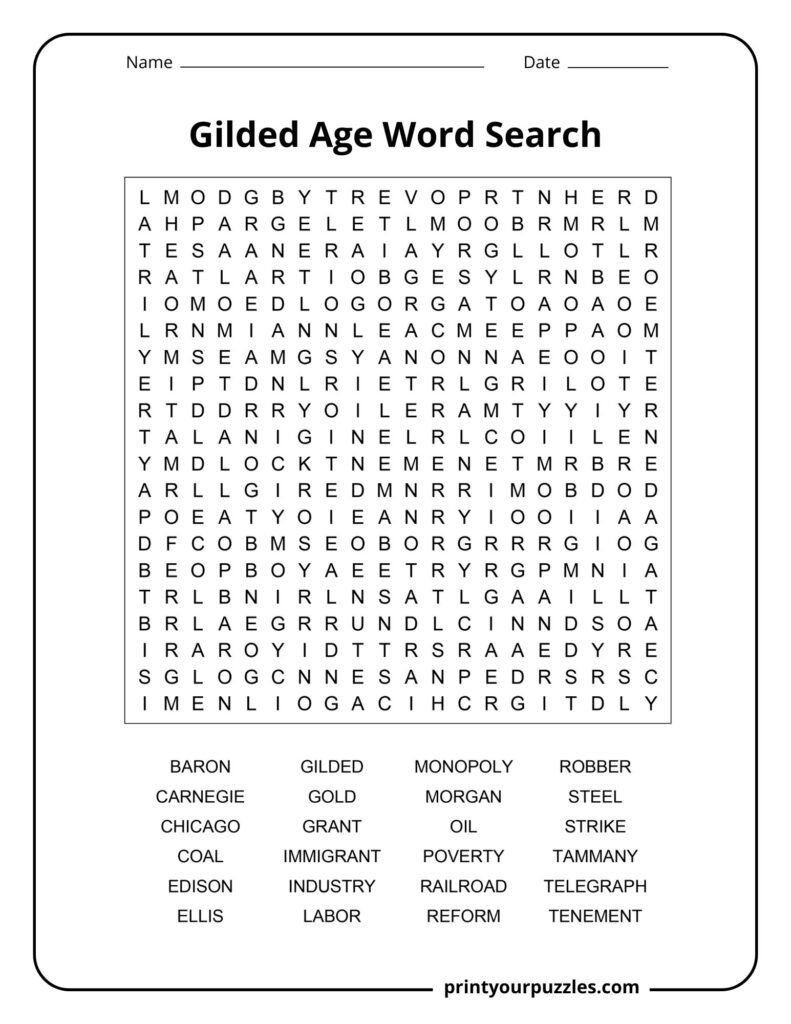
BARON, CARNEGIE, CHICAGO, COAL, EDISON, ELLIS, GILDED, GOLD, GRANT, IMMIGRANT, INDUSTRY, LABOR, MONOPOLY, MORGAN, OIL, POVERTY, RAILROAD, REFORM, ROBBER, STEEL, STRIKE, TAMMANY, TELEGRAPH, TENEMENT
The Gilded Age spanned approximately 1870 to 1900, beginning after the Civil War and Reconstruction, ending around the Progressive Era. Some historians extend it to 1896 or 1901.
Mark Twain coined the term, describing how a thin gold layer covered societal problems. Outward prosperity and elegance masked corruption, poverty, inequality, and exploitation beneath the glamorous surface.
Industrial titans included Andrew Carnegie (steel), John D. Rockefeller (oil), J.P. Morgan (banking), and Cornelius Vanderbilt (railroads). Political bosses like William Tweed also wielded significant power and influence.
Widespread poverty, dangerous working conditions, child labor, political corruption, overcrowded tenements, and extreme wealth inequality plagued society. Immigrants faced discrimination while workers struggled for basic rights.
Rapid industrialization, technological innovations (electricity, telephones, railroads), transcontinental connectivity, economic growth, and eventual labor reforms emerged. The era laid foundations for America’s twentieth-century economic dominance.
The Vanderbilt family once hosted a ball costing $250,000 (equivalent to $7 million today). Guests wore diamond-encrusted costumes while outside, workers earned barely $1 daily.
Between 1870 and 1900, massive waves of Europeans and Asians flooded American shores, seeking opportunity. Ellis Island processed up to 5,000 immigrants daily at its peak.
Approximately two million children labored in dangerous conditions, working twelve-hour shifts for pennies. Many suffered injuries, stunted growth, and received no education whatsoever during childhood.
Rockefeller controlled 90% of America’s oil refining through Standard Oil. His inflation-adjusted wealth exceeded $400 billion, making him potentially history’s richest person ever.
Chicago’s Home Insurance Building, completed in 1885, stood ten stories tall using revolutionary steel-frame construction. It launched the skyscraper revolution transforming American cities forever.