
The Muscular System allows the body to move, maintain posture, produce heat, and perform many internal actions. It is made up of more than 600 muscles that work together with bones, joints, nerves, and organs. Some muscles move when we choose to use them, while others work automatically without conscious control.
There are three main types of muscle tissue. Skeletal muscles are attached to bones and help the body walk, run, lift, smile, and perform other voluntary movements. These muscles usually work in pairs. When one muscle contracts, the opposing muscle relaxes, allowing a body part to move smoothly. The Skeletal System provides the firm framework that muscles pull against.
Smooth muscle is found inside organs and blood vessels. It helps move food through the Digestive System, controls the width of blood vessels, and supports other automatic processes. Cardiac muscle is found only in the heart. It contracts continuously to pump blood through the Circulatory System, supplying oxygen and nutrients to tissues throughout the body.
The Nervous System controls and coordinates muscle activity. The brain sends electrical signals through nerves, telling muscles when to contract and relax. This communication allows both simple actions, such as blinking, and complex movements, such as dancing or playing a sport. Reflexes can also cause muscles to react quickly before the brain has fully processed what happened.
The Muscular System also works closely with the Respiratory System. The diaphragm, a large muscle beneath the lungs, contracts and relaxes to help air move in and out of the body. Other muscles around the ribs assist with breathing. The Endocrine System influences muscle growth, energy use, and recovery by releasing hormones into the bloodstream.
Like other Body Systems, the Muscular System depends on good nutrition, regular activity, rest, and oxygen. Exercise can make muscles stronger and improve endurance, while stretching helps maintain flexibility. Muscles also produce heat when they contract, helping the body maintain a stable temperature.
A muscular system word search can help students learn important terms such as muscle, tendon, contraction, movement, strength, diaphragm, and posture. Understanding this vocabulary makes it easier to see how muscles support both visible movement and essential internal functions. From lifting an arm to pumping blood and breathing, muscles are active throughout every moment of life.
Related Word Searches:
Body Systems | Biology | Cell | Circulatory System | Cellular Respiration | Neuron
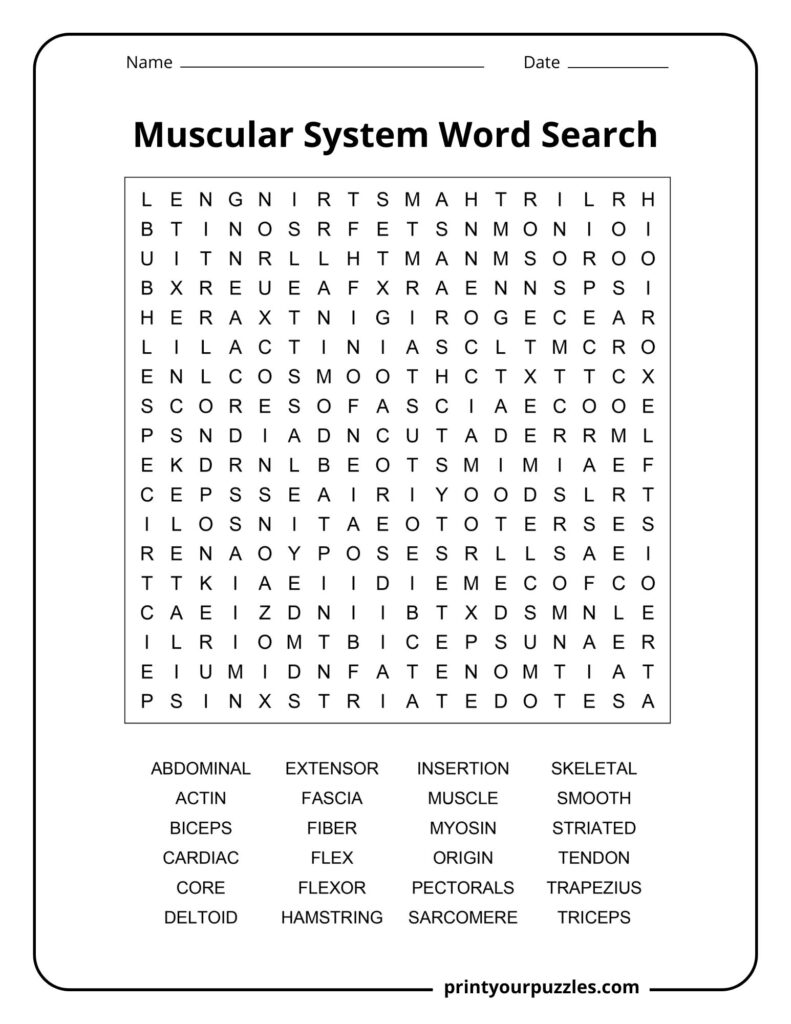
ABDOMINAL, ACTIN, BICEPS, CARDIAC, CORE, DELTOID, EXTENSOR, FASCIA, FIBER, FLEX, FLEXOR, HAMSTRING, INSERTION, MUSCLE, MYOSIN, ORIGIN, PECTORALS, SARCOMERE, SKELETAL, SMOOTH, STRIATED, TENDON, TRAPEZIUS, TRICEPS
ABDOMINAL – Muscles located in the front and sides of the abdomen that support the trunk, protect internal organs, and assist with breathing, posture, and movement.
ACTIN – A thin protein filament that works with myosin during muscle contraction. Actin slides past myosin filaments, causing muscles to shorten and generate force for movement.
BICEPS – A two-headed muscle located on the front of the upper arm responsible for flexing the elbow and rotating the forearm, commonly associated with arm strength.
CARDIAC – Specialized involuntary muscle tissue found exclusively in the heart walls that contracts rhythmically throughout life to pump blood continuously through the circulatory system without conscious control.
CORE – The group of muscles in the torso, including abdominals and back muscles, that stabilize the spine, maintain posture, and transfer force between upper and lower body.
DELTOID – The triangular-shaped shoulder muscle covering the shoulder joint, responsible for lifting and rotating the arm in multiple directions, giving shoulders their rounded appearance and strength.
EXTENSOR – A muscle that increases the angle between body parts by straightening a joint, opposite of flexors. Examples include muscles that straighten the elbow, knee, or fingers.
FASCIA – A thin connective tissue layer that surrounds and separates muscles, organs, and other structures, providing support, reducing friction, and transmitting mechanical forces throughout the body.
FIBER – An individual muscle cell, also called a myocyte, containing contractile proteins. Muscle fibers bundle together to form complete muscles capable of generating force and movement.
FLEX – The action of bending a joint or decreasing the angle between two body parts, such as bending the elbow or knee, typically performed by flexor muscles.
FLEXOR – A muscle that decreases the angle between body parts by bending a joint, opposite of extensors. Examples include muscles that bend the elbow, knee, or curl fingers.
HAMSTRING – A group of three muscles located on the back of the thigh that work together to bend the knee and extend the hip, commonly injured during running.
INSERTION – The attachment point where a muscle connects to the bone that moves during contraction, typically located farther from the body’s center than the muscle’s origin point.
MUSCLE – Contractile tissue composed of fibers that generate force and motion by shortening and lengthening. Muscles enable movement, maintain posture, and produce heat for the body.
MYOSIN – A thick protein filament that interacts with actin during muscle contraction. Myosin heads pull on actin filaments, creating the sliding motion that causes muscles to contract.
ORIGIN – The attachment point where a muscle connects to the stationary bone during contraction, typically located closer to the body’s center than the muscle’s insertion point maintains stability.
PECTORALS – The chest muscles consisting of pectoralis major and minor, responsible for moving the shoulder and arm across the body, pushing movements, and stabilizing the shoulder joint.
SARCOMERE – The basic functional unit of muscle contraction, consisting of overlapping actin and myosin filaments arranged in repeating segments. Sarcomeres shorten during contraction, producing muscle movement and force.
SKELETAL – Voluntary striated muscle tissue attached to bones by tendons, responsible for conscious body movements. Skeletal muscles work in pairs to move bones at joints through contraction.
SMOOTH – Involuntary muscle tissue found in walls of hollow organs like blood vessels, stomach, and intestines. Smooth muscle contracts slowly and rhythmically without conscious control or fatigue.
STRIATED – Muscle tissue displaying alternating light and dark bands under microscopy due to organized protein arrangement. Both skeletal and cardiac muscles are striated, unlike smooth muscle tissue.
TENDON – Strong, fibrous connective tissue that attaches muscles to bones, transmitting the force generated by muscle contractions to create movement at joints while maintaining structural stability and strength.
TRAPEZIUS – A large, diamond-shaped muscle extending across the upper back and neck that moves and stabilizes the shoulder blades, supports head movement, and maintains proper posture.
TRICEPS – A three-headed muscle located on the back of the upper arm that extends the elbow joint, opposing the biceps muscle, essential for pushing movements and straightening.
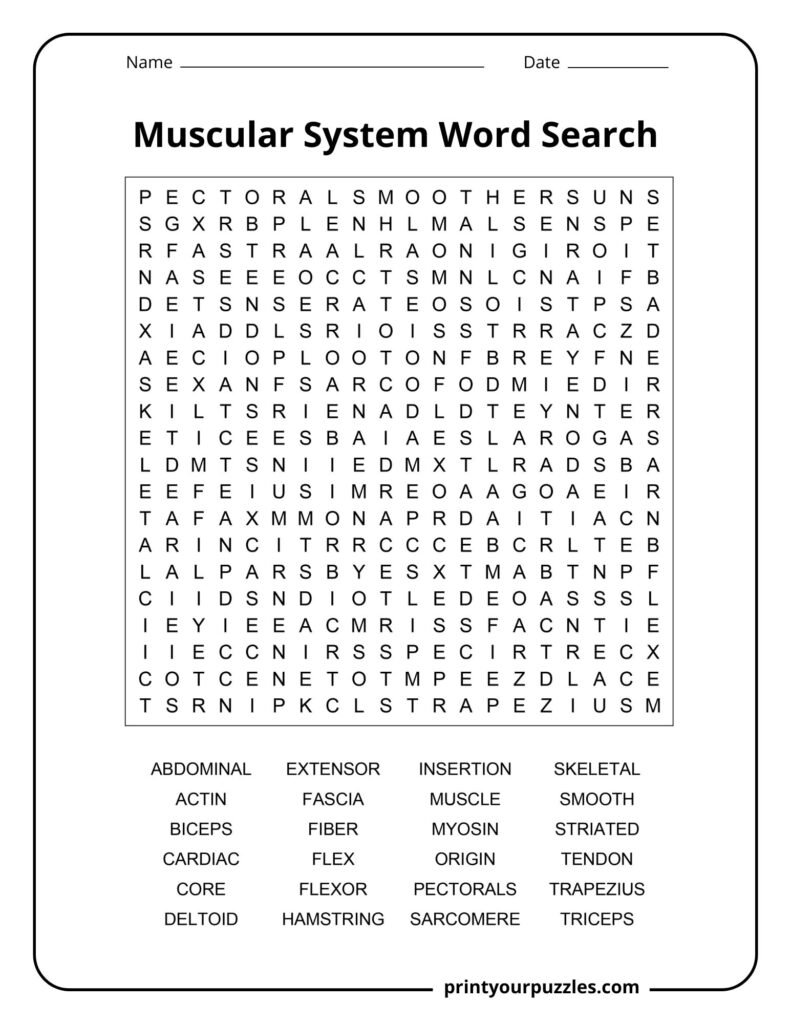
ABDOMINAL, ACTIN, BICEPS, CARDIAC, CORE, DELTOID, EXTENSOR, FASCIA, FIBER, FLEX, FLEXOR, HAMSTRING, INSERTION, MUSCLE, MYOSIN, ORIGIN, PECTORALS, SARCOMERE, SKELETAL, SMOOTH, STRIATED, TENDON, TRAPEZIUS, TRICEPS
The human body contains approximately 600 to 650 muscles, depending on how they are counted. These muscles vary greatly in size, from tiny eye muscles to large muscles like the gluteus maximus.
The three types are skeletal muscle (voluntary movement), cardiac muscle (heart contractions), and smooth muscle (involuntary organ functions). Each type has unique structures and functions suited to specific body needs.
Muscles contract when protein filaments called actin and myosin slide past each other, shortening the muscle fiber. This process requires energy from ATP and signals from the nervous system.
Muscle soreness occurs from microscopic tears in muscle fibers during intense or unfamiliar exercise. The body repairs these tears, making muscles stronger, but inflammation causes temporary discomfort and stiffness.
The masseter, or jaw muscle, is the strongest based on force exerted. However, the gluteus maximus is the largest muscle, and the heart is strongest for endurance and continuous work.
Unlike most muscles attached to bones, the tongue consists of eight interwoven muscles working independently. This unique structure allows incredible flexibility for speaking, swallowing, and tasting food with precise movements.
When muscles contract, they produce heat as a byproduct of energy metabolism. This is why shivering helps warm you up—rapid muscle contractions generate extra heat during cold conditions.
Smiling uses approximately 12 muscles, while frowning requires about 11 muscles. Despite the popular myth claiming huge differences, both expressions use similar numbers, but smiling generally feels more natural and effortless.
Eye muscles move more than 100,000 times daily while tracking, focusing, and adjusting vision. These tiny muscles work constantly during waking hours, making them the hardest-working muscles relative to size.
Muscles work by contracting and pulling on bones; they cannot push. This is why muscles are arranged in opposing pairs called antagonistic pairs, with one pulling while the other relaxes.