
The rock cycle explains how rocks are formed, changed, broken down, and created again over long periods of time. Earth’s surface may appear stable, but rocks are constantly being transformed by heat, pressure, weather, erosion, melting, and cooling. The cycle has no fixed beginning or ending because any type of rock can gradually become another type.
There are three main kinds of rock: igneous, sedimentary, and metamorphic. Igneous rock forms when melted rock cools and hardens. Melted rock beneath Earth’s surface is called magma, while melted rock that reaches the surface is known as lava. When magma or lava cools slowly, large crystals may form. Faster cooling usually produces smaller crystals. Granite and basalt are common examples of igneous rocks.
Sedimentary rock develops from small pieces of rock, minerals, shells, or organic material called sediments. Weathering breaks rocks into smaller fragments, and erosion moves those fragments by wind, water, ice, or gravity. Over time, layers of sediment build up. Pressure compacts them, while dissolved minerals cement the particles together. Sandstone, shale, and limestone are examples of sedimentary rocks. These rocks sometimes contain fossils because plant and animal remains can become trapped between sediment layers.
Metamorphic rock forms when existing rock is changed by intense heat and pressure without completely melting. These conditions can alter a rock’s minerals, texture, and appearance. For example, limestone may become marble, while shale may change into slate. This transformation often takes place deep underground, near moving tectonic plates or hot magma.
The processes of the rock cycle are closely connected. An igneous rock can be weathered into sediment and later become sedimentary rock. Sedimentary rock may be buried, heated, and compressed into metamorphic rock. If any rock melts, it can eventually cool and form new igneous rock. Uplift may then bring buried rocks back toward the surface, where weathering begins again.
A printable rock cycle word search puzzle can help students learn important vocabulary such as magma, lava, sediment, erosion, pressure, weathering, and minerals. Understanding these terms makes it easier to see how Earth continually recycles its rocky materials and reshapes the planet over millions of years.
Related Word Searches:
Plate Tectonics | Earth Layers | Erosion | Volcano | Fossil | States of Matter
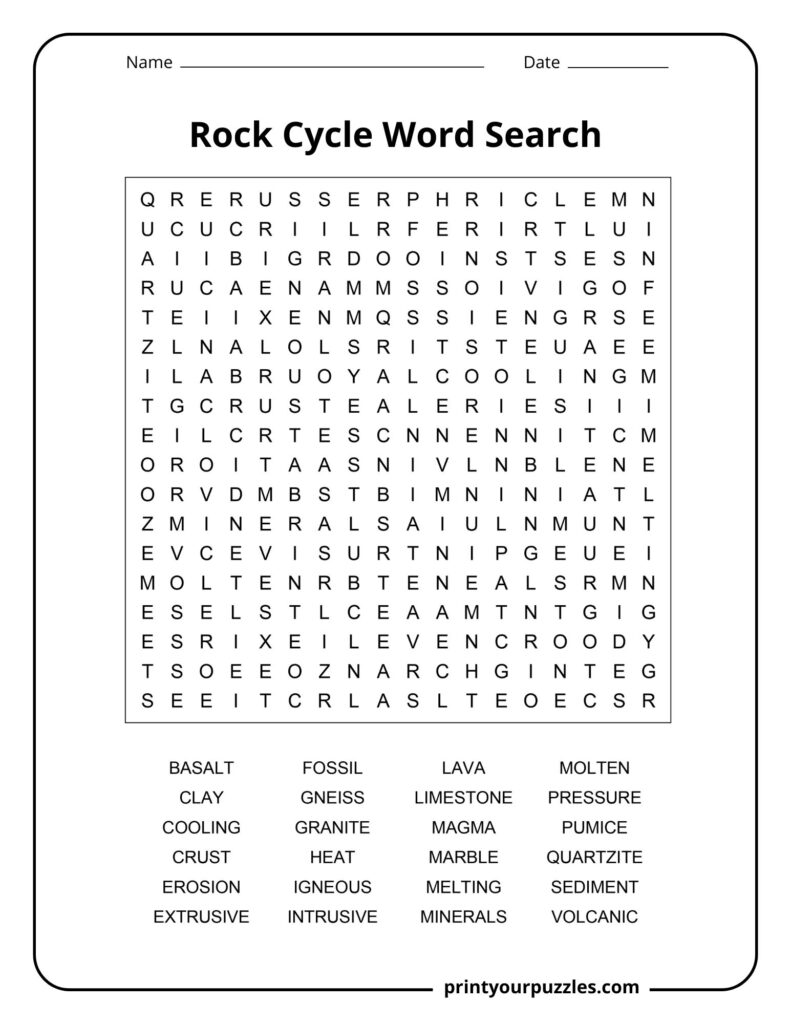
BASALT, CLAY, COOLING, CRUST, EROSION, EXTRUSIVE, FOSSIL, GNEISS, GRANITE, HEAT, IGNEOUS, INTRUSIVE, LAVA, LIMESTONE, MAGMA, MARBLE, MELTING, MINERALS, MOLTEN, PRESSURE, PUMICE, QUARTZITE, SEDIMENT, VOLCANIC
BASALT – A dark, fine-grained volcanic rock formed from rapidly cooled lava. It’s the most common extrusive igneous rock and forms much of the ocean floor.
CLAY – Tiny sedimentary particles smaller than sand that form from weathered rocks. When wet, clay becomes plastic and moldable, commonly used for making pottery and ceramics.
COOLING – The process by which molten rock loses heat and solidifies into igneous rock. Rapid cooling creates fine-grained rocks while slow cooling produces coarse-grained crystals.
CRUST – Earth’s outermost solid layer where all rocks form and exist. It includes continental and oceanic crust, ranging from five to seventy kilometers thick throughout the planet.
EROSION – The wearing away and removal of rock and soil by natural forces like water, wind, ice, and gravity. Erosion transports sediments to new locations for deposition.
EXTRUSIVE – Igneous rocks formed when magma erupts onto Earth’s surface as lava and cools quickly. Examples include basalt and pumice, characterized by fine-grained or glassy textures.
FOSSIL – Preserved remains or traces of ancient organisms found in sedimentary rocks. Fossils provide evidence of past life and help scientists understand Earth’s biological and geological history.
GNEISS – A foliated metamorphic rock with alternating light and dark bands formed under high temperature and pressure. It typically originates from granite or sedimentary rocks during metamorphism.
GRANITE – A coarse-grained intrusive igneous rock composed mainly of quartz, feldspar, and mica. It forms deep underground through slow cooling of magma and is very hard.
HEAT – Thermal energy that drives rock cycle processes including melting, metamorphism, and magma formation. Heat primarily comes from Earth’s interior and radioactive decay within the planet.
IGNEOUS – Rocks formed from the cooling and solidification of molten magma or lava. Igneous rocks are classified as either intrusive or extrusive based on cooling location.
INTRUSIVE – Igneous rocks formed when magma cools slowly beneath Earth’s surface. This slow cooling allows large crystals to develop, creating coarse-grained textures like those in granite.
LAVA – Molten rock that has erupted onto Earth’s surface through volcanic activity. When lava cools and solidifies, it forms extrusive igneous rocks like basalt or obsidian.
LIMESTONE – A sedimentary rock composed primarily of calcium carbonate, often formed from marine organisms’ shells. It can metamorphose into marble and is used in construction materials.
MAGMA – Molten rock located beneath Earth’s surface containing dissolved gases and crystals. When magma reaches the surface through eruptions, it becomes lava and forms volcanic rocks.
MARBLE – A metamorphic rock formed when limestone undergoes heat and pressure, causing recrystallization. Marble is prized for sculpture and architecture due to its beauty and workability.
MELTING – The process where solid rock transforms into liquid magma due to extreme heat, decreased pressure, or added water. Melting is essential for creating new igneous rocks.
MINERALS – Naturally occurring inorganic solids with specific chemical compositions and crystal structures. Minerals are the building blocks of all rocks and define their properties and classifications.
MOLTEN – The liquid state of rock when heated to extremely high temperatures, typically above one thousand degrees Celsius. Molten rock exists as magma underground or lava above.
PRESSURE – Force applied to rocks from overlying material or tectonic movements. Pressure causes rock compaction, metamorphism, and can change mineral structures without melting the rock completely.
PUMICE – A light-colored, porous volcanic rock formed when gas-rich lava cools rapidly. It contains numerous air pockets, making it light enough to float on water temporarily.
QUARTZITE – A hard metamorphic rock formed when sandstone undergoes heat and pressure, fusing quartz grains together. Quartzite is extremely durable and resistant to weathering and erosion.
SEDIMENT – Loose particles of rock, minerals, or organic material transported by wind, water, or ice. When sediment accumulates and lithifies, it forms sedimentary rocks over time.
VOLCANIC – Related to volcanoes and the eruption of molten rock onto Earth’s surface. Volcanic activity produces extrusive igneous rocks and shapes landscapes through lava flows and ash.
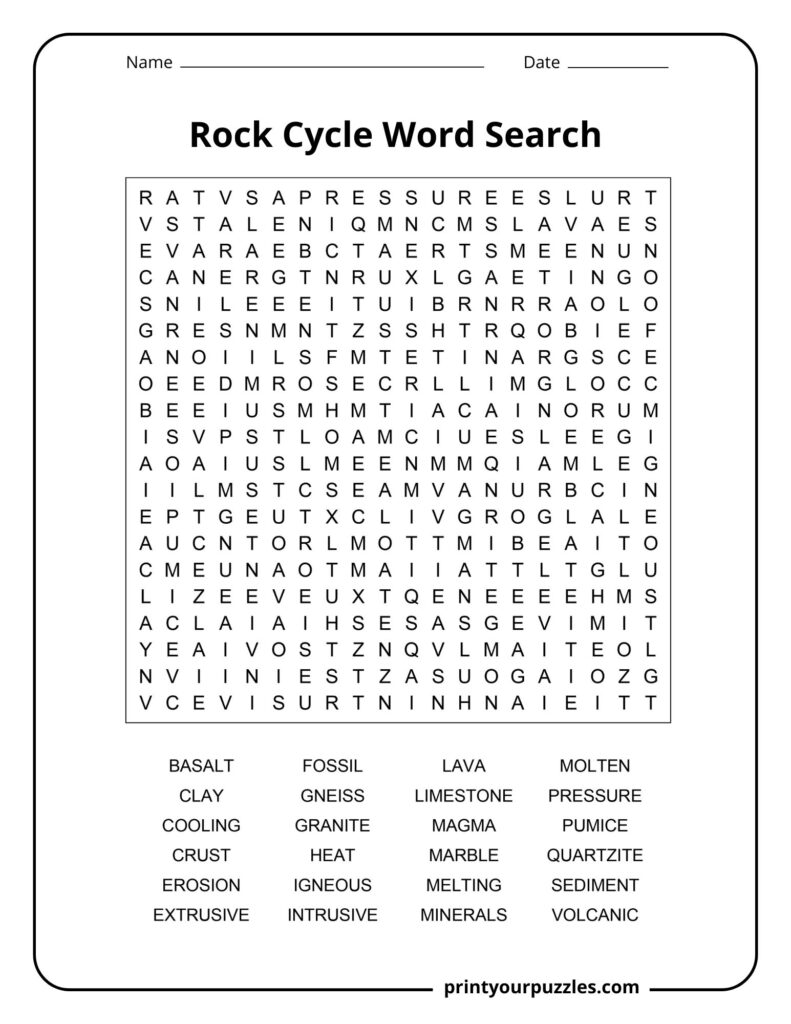
BASALT, CLAY, COOLING, CRUST, EROSION, EXTRUSIVE, FOSSIL, GNEISS, GRANITE, HEAT, IGNEOUS, INTRUSIVE, LAVA, LIMESTONE, MAGMA, MARBLE, MELTING, MINERALS, MOLTEN, PRESSURE, PUMICE, QUARTZITE, SEDIMENT, VOLCANIC
The rock cycle is a continuous process where rocks transform between three types—igneous, sedimentary, and metamorphic—through geological processes like melting, cooling, weathering, erosion, heat, and pressure over time.
The three rock types are igneous (formed from cooled magma or lava), sedimentary (formed from compressed sediments), and metamorphic (formed when existing rocks change under heat and pressure).
The rock cycle has no fixed duration and can take millions to billions of years. Some transformations occur quickly through volcanic activity, while others require extensive time and pressure.
The rock cycle is powered by Earth’s internal heat from the core and mantle, tectonic plate movements, weathering and erosion from wind and water, and pressure from overlying materials.
Yes, rocks can transform directly between any types without following a specific sequence. For example, igneous rocks can become metamorphic rocks directly or sedimentary rocks can melt into magma.
The oldest known rocks, found in Canada and Australia, date back approximately four billion years, having survived countless transformations through Earth’s rock cycle since the planet’s early formation.
A single piece of granite can weather into sediment, compact into sedimentary rock, transform into metamorphic rock under pressure, melt into magma, and cool back into granite repeatedly.
Diamonds crystallize deep within Earth’s mantle under extreme pressure and heat, then reach the surface through volcanic eruptions, making them among the rock cycle’s most spectacular products.
Through subduction zones, oceanic crust and sediments descend into the mantle where they melt, eventually returning to the surface as volcanic rocks, completing the rock cycle continuously.
Unlike ancient continental rocks, oceanic crust is typically less than two hundred million years old because it’s constantly created at mid-ocean ridges and recycled at subduction zones.