Massachusetts is one of the places where the story of the United States feels especially close. Walk through Boston, visit an old coastal town, or explore a historic village, and it becomes easy to see how deeply this small New England state has influenced American history. Located in the Northeast, Massachusetts has Boston as both its capital and largest city. Known as The Bay State, it combines colonial landmarks, world-famous universities, ocean traditions, innovation, and classic New England charm.
History is everywhere in Massachusetts. Indigenous peoples lived in the region for thousands of years before English settlers arrived in the early 1600s. Plymouth is closely connected to the Pilgrims and early colonial life, while Boston became a center of revolutionary activity in the 1700s. Events such as the Boston Tea Party, the Boston Massacre, and the battles of Lexington and Concord helped lead to the American Revolution. A Massachusetts word search can introduce students and puzzle lovers to many of these important people, places, and events.
The state’s geography is small but varied. Along the Atlantic Coast, Massachusetts includes harbors, beaches, islands, fishing towns, and famous destinations such as Cape Cod, Martha’s Vineyard, and Nantucket. Inland areas include forests, hills, rivers, college towns, and the Berkshire Mountains in the west. This mix of coast, countryside, and city life gives Massachusetts a strong and recognizable identity.
Education and ideas are central to the state’s character. Harvard University, founded in 1636, is the oldest institution of higher education in the United States, and Massachusetts is also home to MIT and many other respected colleges and universities. The state has shaped American literature, science, medicine, technology, politics, and reform movements for centuries.
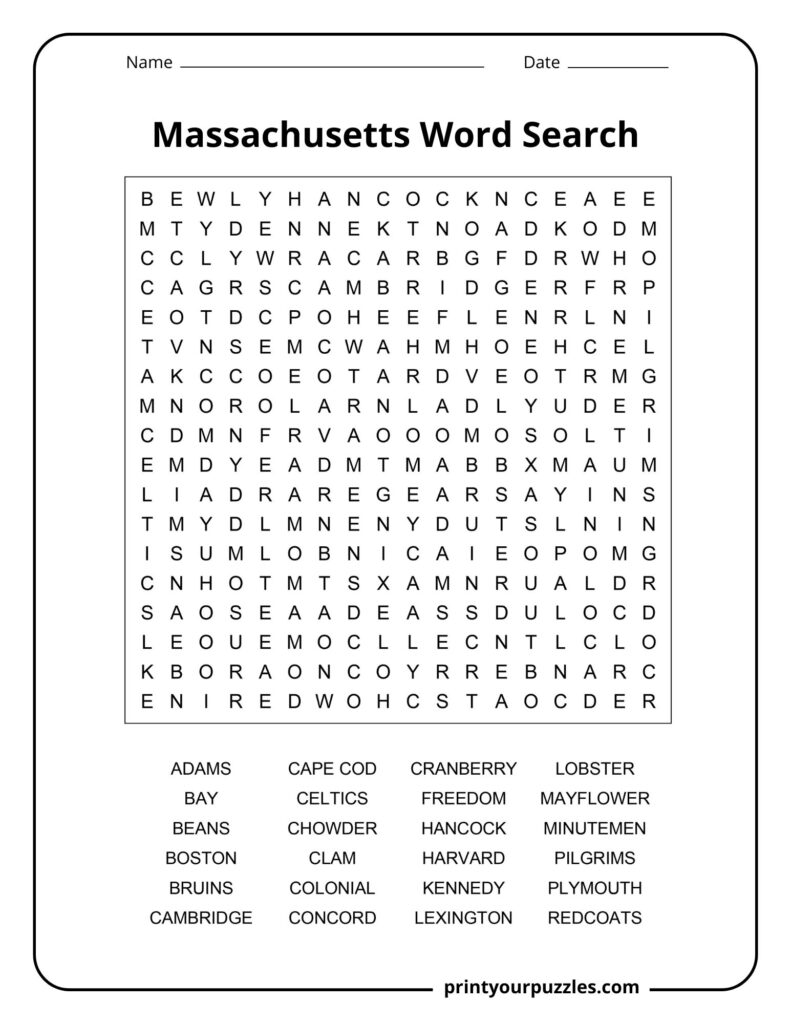
Massachusetts also has a lively cultural side. Clam chowder, lobster rolls, baked beans, cranberries, and fresh seafood connect its food traditions to both the ocean and New England history. Boston sports teams, the Boston Marathon, museums, libraries, and historic neighborhoods add even more energy. As you complete this free printable Massachusetts word search, look for words that reveal how this small state helped shape America through history, learning, culture, and invention.
Add more Northeast States puzzles to your collection with our Connecticut word search, Rhode Island word search, Vermont word search, and the full US States Word Searches collection.
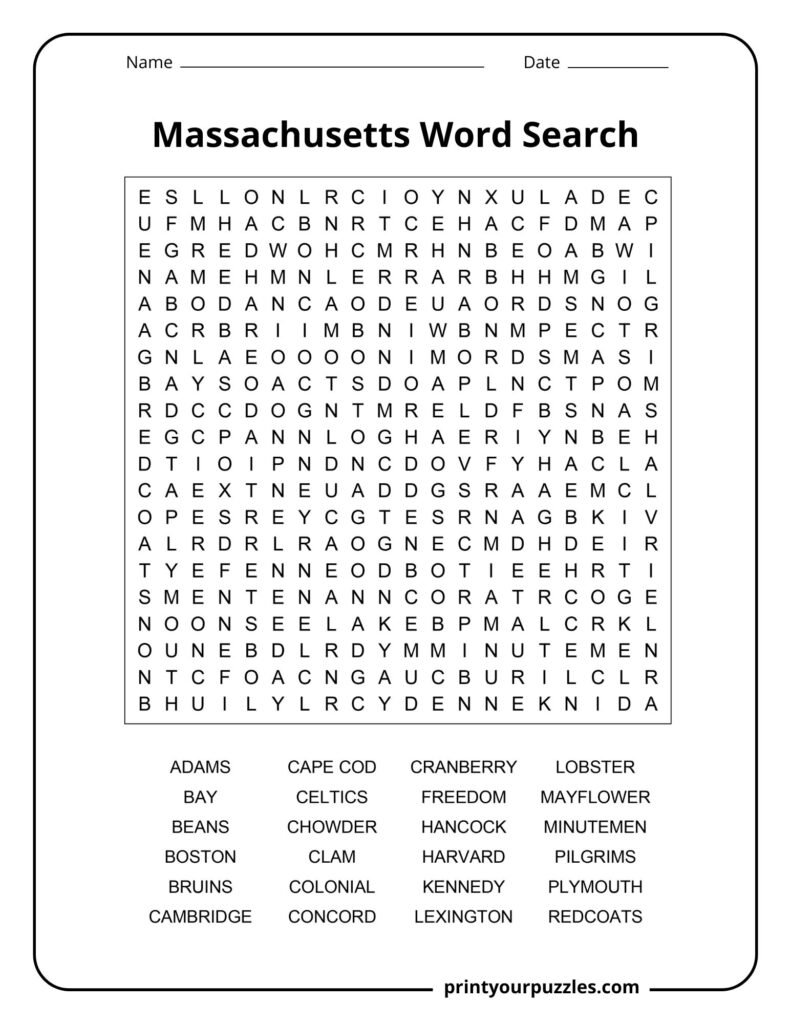
ADAMS, BAY, BEANS, BOSTON, BRUINS, CAMBRIDGE, CAPE COD, CELTICS, CHOWDER, CLAM, COLONIAL, CONCORD, CRANBERRY, FREEDOM, HANCOCK, HARVARD, KENNEDY, LEXINGTON, LOBSTER, MAYFLOWER, MINUTEMEN, PILGRIMS, PLYMOUTH, REDCOATS
ADAMS – Founding father family from Massachusetts; John Adams was second U.S. president, and his son John Quincy Adams became sixth president, both born in Quincy.
BAY – Massachusetts Bay gave the state its name, a historic body of water where Pilgrims and Puritans first settled, forming the Massachusetts Bay Colony.
BEANS – Boston baked beans are iconic Massachusetts dish, slow-cooked navy beans with molasses and salt pork, earning Boston the nickname “Beantown” in American culinary history.
BOSTON – State capital and largest city, founded 1630; crucial American Revolution site, major education hub, and cultural center known for sports, history, and distinctive accent.
BRUINS – Boston’s professional ice hockey team, founded 1924; one of NHL’s “Original Six” franchises, with black and gold colors representing city’s proud sports tradition.
CAMBRIDGE – Historic city across Charles River from Boston, home to Harvard University and MIT, renowned worldwide as intellectual capital with revolutionary academic contributions.
CAPE COD – Distinctive hook-shaped peninsula extending into Atlantic Ocean, famous for beaches, seafood, lighthouses, Kennedy compound, and quintessential New England summer vacation destination.
CELTICS – Boston’s legendary NBA basketball team, founded 1946, with record seventeen championships and green shamrock symbolizing Irish-American heritage and Boston’s sporting excellence.
CHOWDER – New England clam chowder is Massachusetts signature soup: creamy, white, potato-based with clams, never tomato-based like Manhattan style, served throughout coastal restaurants.
CLAM – Essential Massachusetts seafood, harvested from coastal waters; featured in chowder, clam bakes, stuffed clams, and fried clam strips at seaside restaurants statewide.
COLONIAL – Massachusetts was central to colonial America, established 1620s-1630s by Pilgrims and Puritans, shaping early American government, religion, education, and revolutionary independence movements.
CONCORD – Historic Massachusetts town where American Revolution’s first battle occurred April 1775, also home to transcendentalist writers Emerson, Thoreau, Alcott, and Hawthorne.
CRANBERRY – Massachusetts is major cranberry producer; the tart red berry thrives in state’s boggy wetlands, harvested dramatically each fall when bogs flood crimson.
FREEDOM – The Freedom Trail is Boston’s 2.5-mile red-brick walking path connecting sixteen historically significant American Revolution sites, from Boston Common to Bunker Hill Monument.
HANCOCK – John Hancock, Massachusetts merchant and statesman, famous for his large signature on Declaration of Independence; served as Massachusetts governor and Continental Congress president.
HARVARD – America’s oldest university, established 1636 in Cambridge; prestigious Ivy League institution producing numerous presidents, Nobel laureates, and leaders across all fields.
KENNEDY – Powerful political family from Massachusetts; President John F. Kennedy, Senators Robert and Ted Kennedy shaped twentieth-century American politics from their Boston roots.
LEXINGTON – Historic town where Revolutionary War began April 19, 1775, with “shot heard ’round the world” on Lexington Green when Minutemen confronted British redcoats.
LOBSTER – Iconic Massachusetts seafood, Atlantic Ocean crustacean served steamed, in rolls, bisques, and bakes; symbol of New England coastal cuisine and fishing industry heritage.
MAYFLOWER – Ship carrying 102 Pilgrims from England to Plymouth in 1620, establishing first permanent European settlement in New England, founding cornerstone of Massachusetts history.
MINUTEMEN – Colonial Massachusetts militia members ready to fight “at a minute’s notice”; citizen-soldiers who defended Lexington and Concord against British forces in 1775.
PILGRIMS – English Separatists who sailed on Mayflower, established Plymouth Colony 1620, celebrated first Thanksgiving, seeking religious freedom and creating Massachusetts foundation story.
PLYMOUTH – Site of first permanent European settlement in New England (1620); where Pilgrims landed, signed Mayflower Compact, establishing self-governance principles and Thanksgiving tradition.
REDCOATS – British soldiers in red uniforms who occupied Boston, marched to Lexington and Concord 1775, sparking Revolutionary War against Massachusetts colonists’ resistance.
ADAMS, BAY, BEANS, BOSTON, BRUINS, CAMBRIDGE, CAPE COD, CELTICS, CHOWDER, CLAM, COLONIAL, CONCORD, CRANBERRY, FREEDOM, HANCOCK, HARVARD, KENNEDY, LEXINGTON, LOBSTER, MAYFLOWER, MINUTEMEN, PILGRIMS, PLYMOUTH, REDCOATS