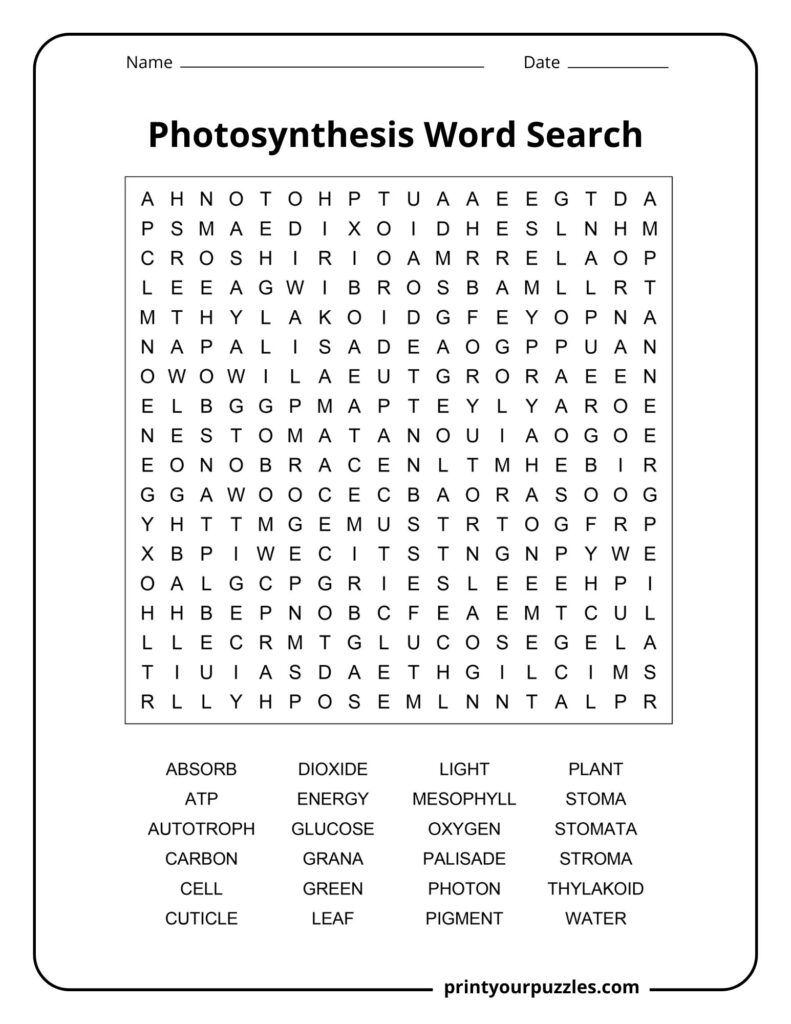
Introduction to Photosynthesis Word Search
Photosynthesis is the natural process that allows plants, algae, and certain bacteria to use light energy to produce food. It is one of the most important biological processes on Earth because it supports nearly every food chain and releases much of the oxygen found in the atmosphere. Without photosynthesis, most living organisms would not have the energy or oxygen necessary to survive.
In plants, photosynthesis mainly takes place inside the leaves. Plant cells contain structures called chloroplasts, which hold a green pigment known as chlorophyll. Chlorophyll absorbs energy from sunlight, especially red and blue wavelengths, while reflecting green light. This reflected green light is why most leaves appear green.
To carry out photosynthesis, a plant needs three main ingredients: sunlight, water, and carbon dioxide. The roots absorb water from the soil and transport it through the stem to the leaves. Carbon dioxide enters the leaves from the air through tiny openings called stomata. Using energy captured from sunlight, the plant transforms water and carbon dioxide into glucose and oxygen.
Glucose is a type of sugar that stores chemical energy. Plants use it to grow, repair damaged tissues, produce flowers and fruits, and complete other essential activities. Some glucose is used immediately, while the rest may be stored as starch for later use. Oxygen is produced as a by-product and released into the surrounding air through the stomata.
Photosynthesis involves two main stages. During the light-dependent reactions, chlorophyll captures sunlight and converts it into chemical energy. These reactions also split water molecules and release oxygen. During the second stage, often called the Calvin cycle, the plant uses the captured energy to turn carbon dioxide into glucose. Together, these stages allow light energy to become stored food energy.
Several factors can affect how quickly photosynthesis happens, including light intensity, carbon dioxide levels, temperature, and water availability. A shortage of any one of these resources may slow the process. For example, a plant without enough water may close its stomata, reducing the amount of carbon dioxide it can absorb.
A printable photosynthesis word search can help students recognize important vocabulary such as chlorophyll, sunlight, glucose, oxygen, carbon dioxide, stomata, and chloroplast. Understanding these terms makes it easier to see how plants produce food, support ecosystems, and help maintain the balance of gases in Earth’s atmosphere.
Related Word Searches:
Botany | Cell | Cellular Respiration | Biology | Energy | Ecosystem
Medium Difficulty Word Search
Words to Find:
ABSORB, ATP, AUTOTROPH, CARBON, CELL, CUTICLE, DIOXIDE, ENERGY, GLUCOSE, GRANA, GREEN, LEAF, LIGHT, MESOPHYLL, OXYGEN, PALISADE, PHOTON, PIGMENT, PLANT, STOMA, STOMATA, STROMA, THYLAKOID, WATER
All Words Defined
ABSORB – To take in or soak up light energy, water, or other substances. During photosynthesis, chlorophyll absorbs light energy from the sun to power chemical reactions.
ATP – Adenosine triphosphate, the primary energy currency molecule in cells. Photosynthesis produces ATP during light-dependent reactions, which cells use to fuel various biological processes and growth.
AUTOTROPH – An organism capable of producing its own food from inorganic substances using light or chemical energy. Plants, algae, and some bacteria are autotrophs that perform photosynthesis.
CARBON – A chemical element essential for life, found in carbon dioxide gas. Plants absorb carbon dioxide from the atmosphere and use it to build glucose molecules during photosynthesis.
CELL – The basic structural and functional unit of all living organisms. Plant cells contain chloroplasts where photosynthesis occurs, converting light energy into chemical energy stored in sugars.
CUTICLE – A waxy, waterproof protective layer covering the outer surface of leaves and stems. It prevents water loss while allowing light to penetrate for photosynthesis in underlying tissues.
DIOXIDE – Refers to carbon dioxide, a gas containing one carbon atom and two oxygen atoms. Plants absorb carbon dioxide through stomata to use as raw material in photosynthesis.
ENERGY – The capacity to do work or cause change. Photosynthesis converts light energy from the sun into chemical energy stored in glucose molecules, which organisms use for growth.
GLUCOSE – A simple sugar molecule produced during photosynthesis. It serves as the primary energy source for plants and is used to build more complex carbohydrates like starch and cellulose.
GRANA – Stacks of flattened, disc-shaped thylakoid membranes inside chloroplasts. Grana are the sites where light-dependent reactions of photosynthesis occur, capturing and converting solar energy into chemical form.
GREEN – The color reflected by chlorophyll pigments in plants. Leaves appear green because chlorophyll absorbs red and blue light wavelengths while reflecting green light back to our eyes.
LEAF – The primary photosynthetic organ of most plants, typically flat and green. Leaves are specifically adapted to maximize light absorption and gas exchange for efficient photosynthesis and energy production.
LIGHT – Electromagnetic radiation visible to the human eye, essential for photosynthesis. Plants capture light energy, primarily from the sun, and convert it into chemical energy to produce glucose and oxygen.
MESOPHYLL – The internal tissue of a leaf located between upper and lower epidermis layers. Rich in chloroplasts, mesophyll cells are where most photosynthesis occurs, including palisade and spongy layers.
OXYGEN – A gas molecule released as a byproduct of photosynthesis when water molecules split. Oxygen is essential for cellular respiration in most living organisms and makes up approximately twenty-one percent.
PALISADE – The upper layer of mesophyll tissue in leaves, containing tightly packed, column-shaped cells. Rich in chloroplasts, palisade cells are optimally positioned to absorb maximum sunlight for efficient photosynthesis.
PHOTON – A particle or quantum of light energy that travels in waves. Chlorophyll molecules in plants capture photons from sunlight to initiate the light-dependent reactions of photosynthesis.
PIGMENT – A colored molecule that absorbs specific wavelengths of light. Chlorophyll is the primary pigment in photosynthesis, absorbing red and blue light while reflecting green wavelengths to our eyes.
PLANT – A multicellular organism that performs photosynthesis to produce its own food. Plants contain chlorophyll in their cells, enabling them to convert sunlight, water, and carbon dioxide into glucose.
STOMA – A microscopic pore on the leaf surface, surrounded by two guard cells. Stomata allow carbon dioxide to enter the leaf for photosynthesis and release oxygen and water vapor.
STOMATA – Plural of stoma; tiny pores on leaf surfaces that regulate gas exchange. Stomata open to allow carbon dioxide in for photosynthesis and close to prevent excessive water loss.
STROMA – The fluid-filled space inside chloroplasts surrounding the thylakoid membranes. The stroma contains enzymes necessary for light-independent reactions, where carbon dioxide is converted into glucose during photosynthesis.
THYLAKOID – A membrane-bound compartment inside chloroplasts where light-dependent reactions occur. Thylakoids contain chlorophyll and other pigments that capture light energy and produce ATP and NADPH for sugar synthesis.
WATER – A molecule composed of hydrogen and oxygen, essential for photosynthesis. Plants absorb water through roots and split water molecules during light reactions, releasing oxygen as a byproduct.
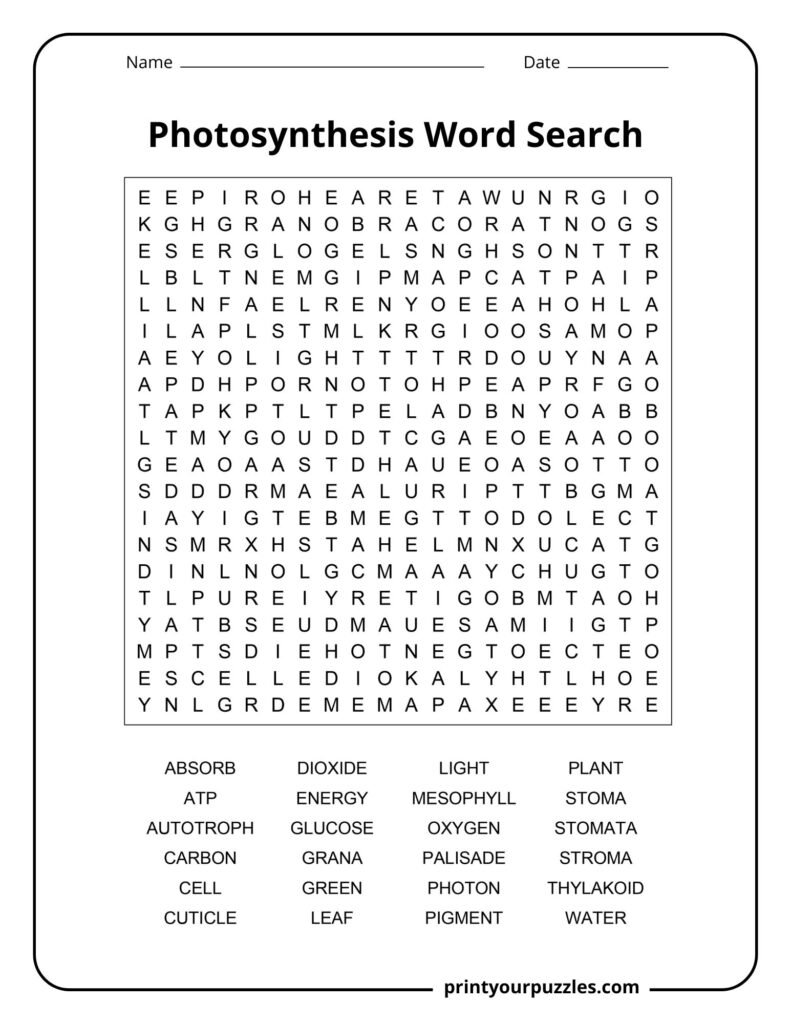
Hard Difficulty Word Search
Words to Find:
ABSORB, ATP, AUTOTROPH, CARBON, CELL, CUTICLE, DIOXIDE, ENERGY, GLUCOSE, GRANA, GREEN, LEAF, LIGHT, MESOPHYLL, OXYGEN, PALISADE, PHOTON, PIGMENT, PLANT, STOMA, STOMATA, STROMA, THYLAKOID, WATER
5 Key FAQs About Photosynthesis
5 Curious "Did You Know?" Facts About Photosynthesis