
Plate tectonics is the scientific theory that explains how Earth’s outer surface changes over time. Although the ground beneath us may seem solid and motionless, the planet’s crust is divided into enormous sections called tectonic plates. These plates move very slowly across a softer, hotter layer of Earth known as the mantle. Their movement is usually measured in only a few centimeters each year, but over millions of years, it can completely reshape continents and oceans.
Earth’s outermost layer is called the lithosphere, which includes the crust and the uppermost part of the mantle. The lithosphere is broken into several major plates and many smaller ones. These plates carry continents, ocean floors, or a combination of both. Heat from deep inside Earth helps create movement within the mantle, causing the plates above it to shift gradually.
The places where tectonic plates meet are known as plate boundaries. There are three main types. At divergent boundaries, plates move apart, allowing magma to rise and form new crust. This process often happens beneath oceans, creating underwater mountain ranges called mid-ocean ridges. At convergent boundaries, plates move toward each other. One plate may be pushed beneath another in a process called subduction, or two continental plates may collide and form mountains. At transform boundaries, plates slide past each other, sometimes producing powerful earthquakes.
Plate tectonics helps scientists explain many important geological events and landforms. Earthquakes, volcanic eruptions, mountain ranges, ocean trenches, and islands are often connected to plate movement. For example, the Himalayas formed when the Indian Plate collided with the Eurasian Plate. Many volcanoes and earthquakes also occur around the Pacific Ocean in an area commonly called the Ring of Fire.
The theory also explains how continents have changed position throughout Earth’s history. Millions of years ago, most land was joined together in a supercontinent called Pangaea. Over time, plate movement separated this landmass into the continents we recognize today.
A printable plate tectonics word search puzzle can help students learn essential vocabulary such as crust, mantle, magma, fault, boundary, subduction, earthquake, and volcano. Understanding these terms makes it easier to see how Earth’s surface is constantly moving, changing, and creating the landscapes around us.
Related Word Searches:
Earth Layers | Volcano | Rock Cycle | Erosion | Fossil | States of Matter
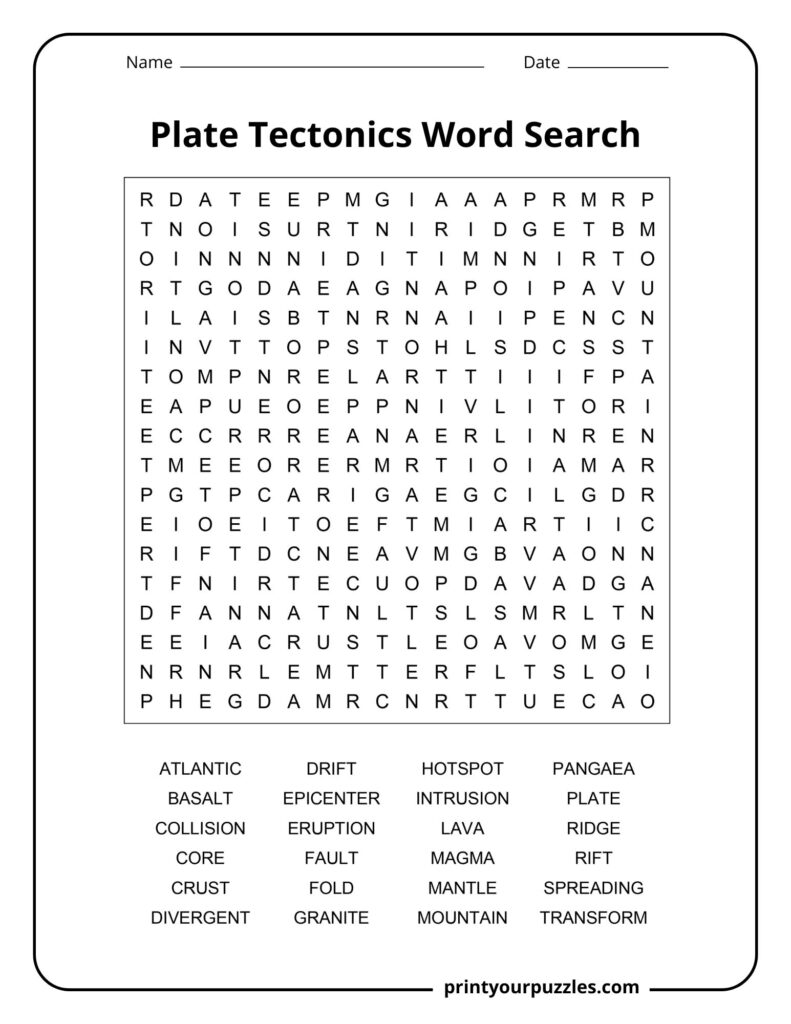
ATLANTIC, BASALT, COLLISION, CORE, CRUST, DIVERGENT, DRIFT, EPICENTER, ERUPTION, FAULT, FOLD, GRANITE, HOTSPOT, INTRUSION, LAVA, MAGMA, MANTLE, MOUNTAIN, PANGAEA, PLATE, RIDGE, RIFT, SPREADING, TRANSFORM
ATLANTIC – Ocean formed by divergent plate boundaries, featuring the Mid-Atlantic Ridge where the Eurasian and North American plates separate from African and South American plates.
BASALT – Dark, dense volcanic rock formed from cooled lava, commonly found in oceanic crust and created at divergent boundaries where magma rises from the mantle.
COLLISION – Convergent boundary where two continental plates crash together, creating mountain ranges through intense compression and upward thrust of crustal material, like the Himalayas formation.
CORE – Earth’s innermost layer composed primarily of iron and nickel, divided into solid inner core and liquid outer core, generating our planet’s magnetic field through convection.
CRUST – Earth’s thin, rigid outermost layer where we live, divided into thicker continental crust and thinner, denser oceanic crust that forms tectonic plates.
DIVERGENT – Plate boundary where two tectonic plates move apart, allowing magma to rise and create new oceanic crust, forming mid-ocean ridges and rift valleys.
DRIFT – Continental drift theory proposed by Alfred Wegener, describing how continents slowly move across Earth’s surface over millions of years due to tectonic plate movement.
EPICENTER – Point on Earth’s surface directly above an earthquake’s focus or hypocenter, where seismic waves reach first and shaking is typically most intense and damaging.
ERUPTION – Explosive or effusive release of magma, gases, and ash from a volcano when pressure overcomes the overlying rock, creating lava flows and pyroclastic material.
FAULT – Fracture in Earth’s crust where rock masses have moved past each other, caused by tectonic stress, potentially generating earthquakes when sudden movement occurs.
FOLD – Curved or bent rock layers formed when tectonic forces compress crustal rocks, creating anticlines, upward arches, and synclines, downward troughs, in mountain building.
GRANITE – Light-colored igneous rock forming continental crust, composed mainly of quartz and feldspar, created when magma cools slowly deep underground forming large crystals.
HOTSPOT – Stationary plume of extremely hot magma rising from deep mantle, creating volcanoes in plate interiors like Hawaii, independent of plate boundary locations.
INTRUSION – Body of igneous rock formed when magma cools and solidifies beneath Earth’s surface, creating features like batholiths, dikes, and sills without reaching surface.
LAVA – Molten rock that reaches Earth’s surface through volcanic eruptions, flowing downslope and cooling into solid igneous rock, creating various landforms and textures.
MAGMA – Molten rock beneath Earth’s surface containing dissolved gases and crystals, generated by mantle melting, which becomes lava when erupted from volcanoes onto surface.
MANTLE – Earth’s thickest layer between crust and core, composed of hot, dense silicate rock that flows slowly through convection, driving tectonic plate movement above.
MOUNTAIN – Elevated landform rising significantly above surrounding terrain, commonly formed by tectonic plate collisions, volcanic activity, or uplift caused by compression and folding processes.
PANGAEA – Ancient supercontinent existing approximately 300 million years ago, containing all Earth’s landmasses before breaking apart through plate tectonics into today’s continents.
PLATE – Large, rigid section of Earth’s lithosphere that moves slowly over the asthenosphere, interacting at boundaries to create earthquakes, volcanoes, and mountain ranges.
RIDGE – Underwater mountain range formed at divergent boundaries where oceanic plates separate, allowing magma to rise and create new seafloor through continuous volcanic activity.
RIFT – Valley formed where continental crust is being pulled apart by divergent forces, creating normal faults and volcanic activity, potentially leading to ocean basin formation.
SPREADING – Process occurring at mid-ocean ridges where new oceanic crust forms as plates diverge, magma rises, cools, and pushes older crust outward symmetrically.
TRANSFORM – Plate boundary where two plates slide horizontally past each other in opposite directions, creating earthquakes but typically no volcanic activity, like California’s San Andreas.
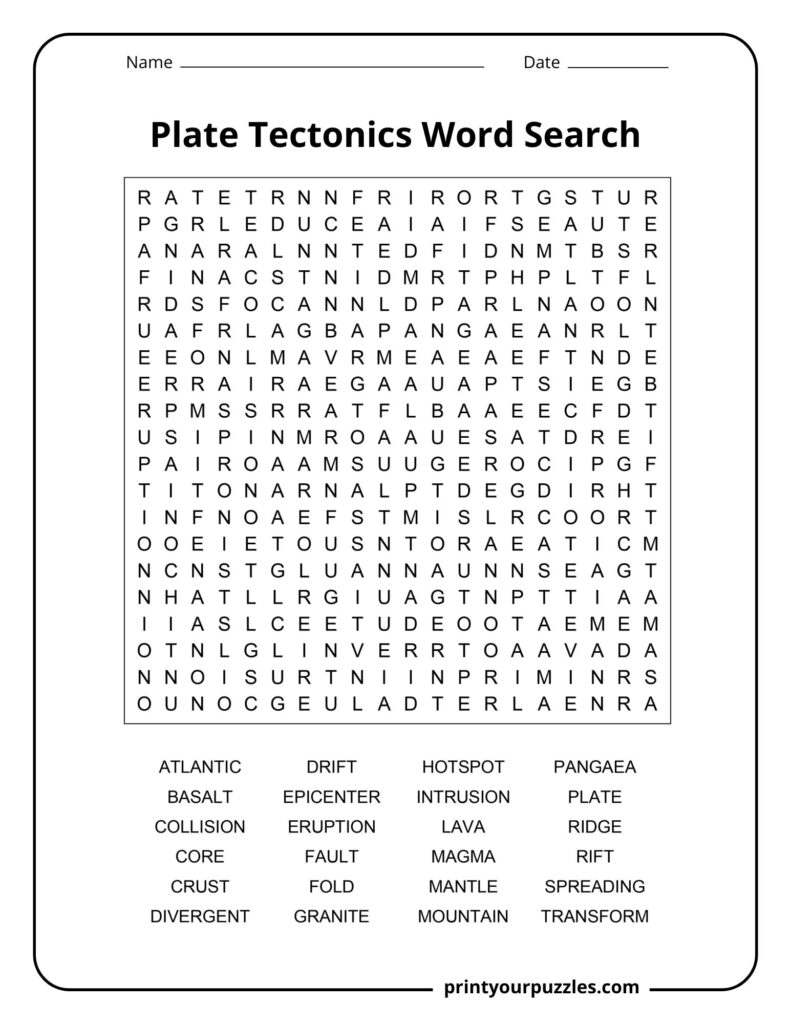
ATLANTIC, BASALT, COLLISION, CORE, CRUST, DIVERGENT, DRIFT, EPICENTER, ERUPTION, FAULT, FOLD, GRANITE, HOTSPOT, INTRUSION, LAVA, MAGMA, MANTLE, MOUNTAIN, PANGAEA, PLATE, RIDGE, RIFT, SPREADING, TRANSFORM
Plate tectonics is the scientific theory explaining how Earth’s lithosphere is divided into large, moving plates that interact at boundaries, causing earthquakes, volcanoes, and mountain formation.
Convection currents in Earth’s hot mantle drive plate movement. Heat from the core causes molten rock to rise, cool, sink, and circulate, dragging plates along.
Earth has seven major tectonic plates: Pacific, North American, Eurasian, African, Antarctic, Indo-Australian, and South American, plus numerous smaller plates covering the surface.
The three plate boundaries are divergent, where plates separate; convergent, where plates collide; and transform, where plates slide horizontally past each other creating friction.
Tectonic plates move extremely slowly, typically 2-10 centimeters per year, roughly the same rate as fingernails grow, but creating dramatic geological changes over millions of years.
The Himalayas, including Mount Everest, rise approximately 4 millimeters annually due to the ongoing collision between the Indian and Eurasian plates, making Earth’s tallest mountain continually higher.
The Mid-Atlantic Ridge spreads about 2.5 centimeters yearly, expanding the Atlantic Ocean, while the Pacific Ocean gradually contracts as plates subduct along its edges.
Scientists predict that in approximately 250 million years, Earth’s continents will merge again into a supercontinent called “Pangaea Ultima” or “Amasia,” continuing the supercontinent cycle.
This horseshoe-shaped zone around the Pacific Ocean hosts about 450 volcanoes and experiences 90% of the world’s earthquakes due to intense tectonic plate interactions.
The Pacific Plate carries Hawaii northwest approximately 7 centimeters annually toward Japan. In millions of years, Hawaii will eventually be subducted into the Aleutian Trench.