Cells are the basic building blocks of life. Every living organism, from the smallest bacterium to the largest whale, is made of one or more cells. Some organisms consist of only a single cell, while humans, animals, and plants contain trillions of cells working together. Although most cells are too small to see without a microscope, they carry out all the essential activities needed to keep an organism alive.
A cell is surrounded by a cell membrane, a thin protective layer that controls what enters and leaves. Inside the cell is a jelly-like substance called cytoplasm, where many important chemical reactions take place. Most cells also contain genetic material known as DNA. DNA stores the instructions that tell the cell how to grow, function, reproduce, and respond to its environment.
There are two main types of cells: prokaryotic and eukaryotic. Prokaryotic cells are simpler and do not have a nucleus. Bacteria and archaea are made of this type of cell. Eukaryotic cells are generally larger and more complex. They contain a nucleus that protects the DNA, as well as specialized structures called organelles. Animals, plants, fungi, and protists are all made of eukaryotic cells.
Each organelle performs a particular task. Mitochondria release energy from food through cellular respiration, while ribosomes make proteins that cells need for growth and repair. Plant cells contain chloroplasts, which capture light energy during photosynthesis. They also have a rigid cell wall that provides support and protection. Animal cells do not have chloroplasts or cell walls, but they contain other structures that help them perform their specialized roles.
In multicellular organisms, cells have different shapes and functions. Nerve cells transmit signals, muscle cells produce movement, and red blood cells carry oxygen around the body. Similar cells join together to form tissues, tissues combine to make organs, and organs work together in organ systems.
Cells can also grow and divide. Cell division allows organisms to develop, replace damaged cells, and reproduce. However, the process must be carefully controlled because uncontrolled cell division can lead to diseases such as cancer.
Learning about cells helps explain how living things grow, use energy, heal, and survive. A cell word search can make this topic more engaging by introducing important vocabulary related to cell structures, functions, and biological processes in an enjoyable way.
Related Word Searches:
Cell Division | DNA | Cellular Respiration | Biology | Bacteria | Genetics
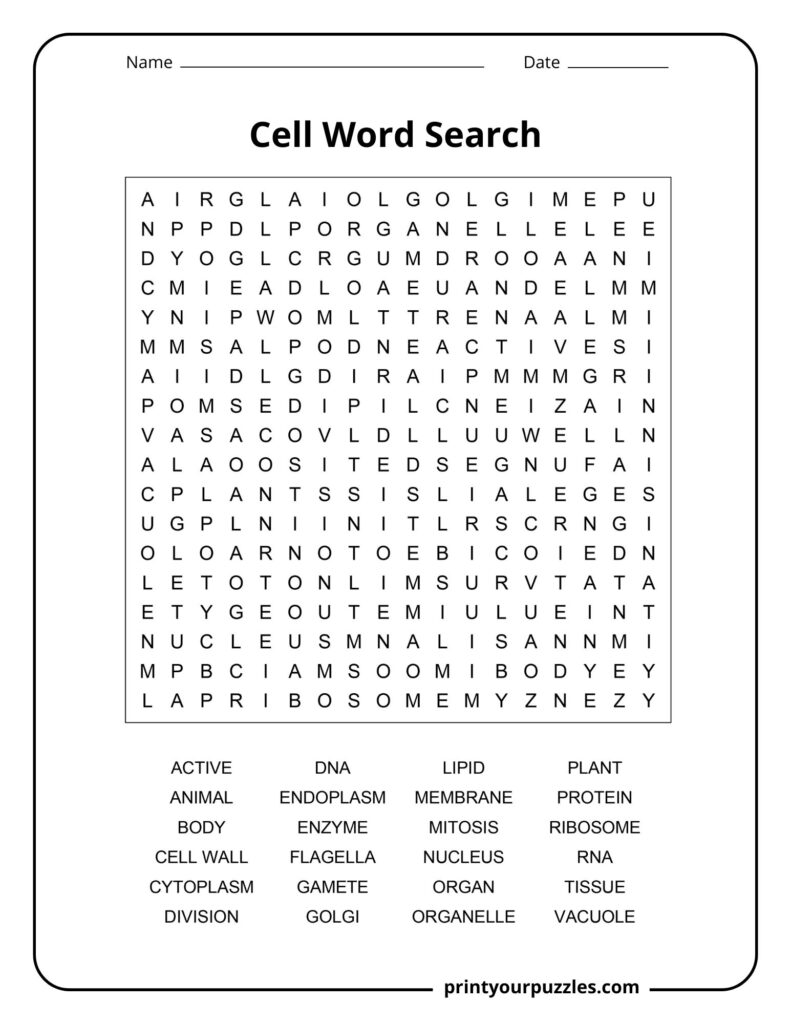
ACTIVE, ANIMAL, BODY, CELL WALL, CYTOPLASM, DIVISION, DNA, ENDOPLASM, ENZYME, FLAGELLA, GAMETE, GOLGI, LIPID, MEMBRANE, MITOSIS, NUCLEUS, ORGAN, ORGANELLE, PLANT, PROTEIN, RIBOSOME, RNA, TISSUE, VACUOLE
ACTIVE – Describes cells or processes that are functioning, moving, or requiring energy to transport materials across membranes against concentration gradients through active transport mechanisms.
ANIMAL – Multicellular organisms whose cells lack cell walls and chloroplasts. Animal cells contain centrioles and often have smaller vacuoles compared to plant cells for various functions.
BODY – The complete physical structure of an organism, composed of trillions of specialized cells working together in tissues, organs, and organ systems to maintain life.
CELL WALL – A rigid outer layer surrounding plant, fungal, and bacterial cells, providing structural support and protection. Made primarily of cellulose in plants, maintaining cell shape.
CYTOPLASM – The gel-like substance filling the cell between the nucleus and membrane, containing organelles, proteins, and nutrients. Site of many metabolic reactions and cellular activities.
DIVISION – The process by which cells reproduce, splitting into two daughter cells through mitosis or meiosis, enabling growth, repair, and reproduction in living organisms.
DNA – Deoxyribonucleic acid, the hereditary material containing genetic instructions for development, functioning, and reproduction. Forms a double helix structure storing information in nucleotide sequences.
ENDOPLASM – The inner, more fluid portion of cytoplasm in certain cells, particularly amoebas. Contains organelles and is distinct from the outer, more gel-like ectoplasm layer.
ENZYME – Biological catalysts that speed up chemical reactions in cells without being consumed. Proteins with specific shapes that bind to substrates, lowering activation energy required.
FLAGELLA – Whip-like appendages extending from certain cells, enabling movement through liquid environments. Longer than cilia, they propel cells by rotating or undulating in coordinated patterns.
GAMETE – Reproductive cells (sperm or egg) containing half the normal chromosome number. They unite during fertilization to form a zygote with complete genetic information.
GOLGI – Also called Golgi apparatus or Golgi body, this organelle modifies, packages, and distributes proteins and lipids received from the endoplasmic reticulum throughout the cell.
LIPID – Fat molecules including oils, waxes, and steroids that store energy and form cell membranes. Hydrophobic compounds essential for cellular structure, signaling, and insulation.
MEMBRANE – A thin, flexible barrier surrounding cells and organelles, controlling substance passage. Made of phospholipid bilayers with embedded proteins, maintaining cellular integrity and selective permeability.
MITOSIS – Cell division process producing two identical daughter cells from one parent cell. Ensures equal distribution of duplicated chromosomes, essential for growth and tissue repair.
NUCLEUS – The cell’s control center containing genetic material (DNA) organized into chromosomes. Surrounded by a nuclear envelope, it regulates gene expression and cellular activities.
ORGAN – A structure composed of different tissues working together to perform specific functions within an organism, such as the heart, lungs, liver, or brain.
ORGANELLE – Specialized structures within cells performing specific functions, such as mitochondria for energy production, ribosomes for protein synthesis, or lysosomes for digestion and waste removal.
PLANT – Organisms with cells containing cell walls, chloroplasts for photosynthesis, and large central vacuoles. They produce their own food using sunlight, water, and carbon dioxide.
PROTEIN – Large molecules made of amino acid chains, performing diverse cellular functions including structural support, enzyme catalysis, transport, signaling, and immune defense throughout the body.
RIBOSOME – Small organelles responsible for protein synthesis by reading messenger RNA sequences and assembling amino acids into polypeptide chains. Found free or attached to endoplasmic reticulum.
RNA – Ribonucleic acid, a nucleic acid that copies and transmits genetic information from DNA. Essential for protein synthesis, existing as messenger, transfer, and ribosomal forms.
TISSUE – Groups of similar cells working together to perform specific functions. Four main types exist: epithelial, connective, muscle, and nervous tissue in animal bodies.
VACUOLE – Membrane-bound sacs storing water, nutrients, or waste products within cells. Plant cells have large central vacuoles maintaining turgor pressure; animal cells have smaller ones.
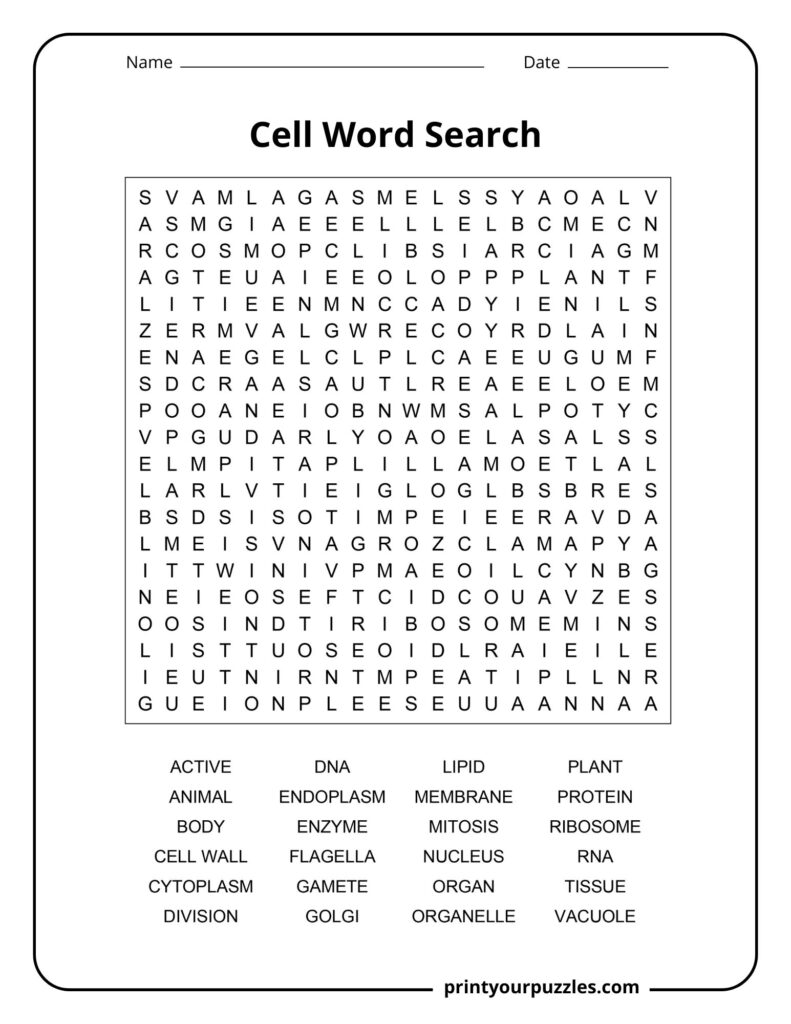
ACTIVE, ANIMAL, BODY, CELL WALL, CYTOPLASM, DIVISION, DNA, ENDOPLASM, ENZYME, FLAGELLA, GAMETE, GOLGI, LIPID, MEMBRANE, MITOSIS, NUCLEUS, ORGAN, ORGANELLE, PLANT, PROTEIN, RIBOSOME, RNA, TISSUE, VACUOLE