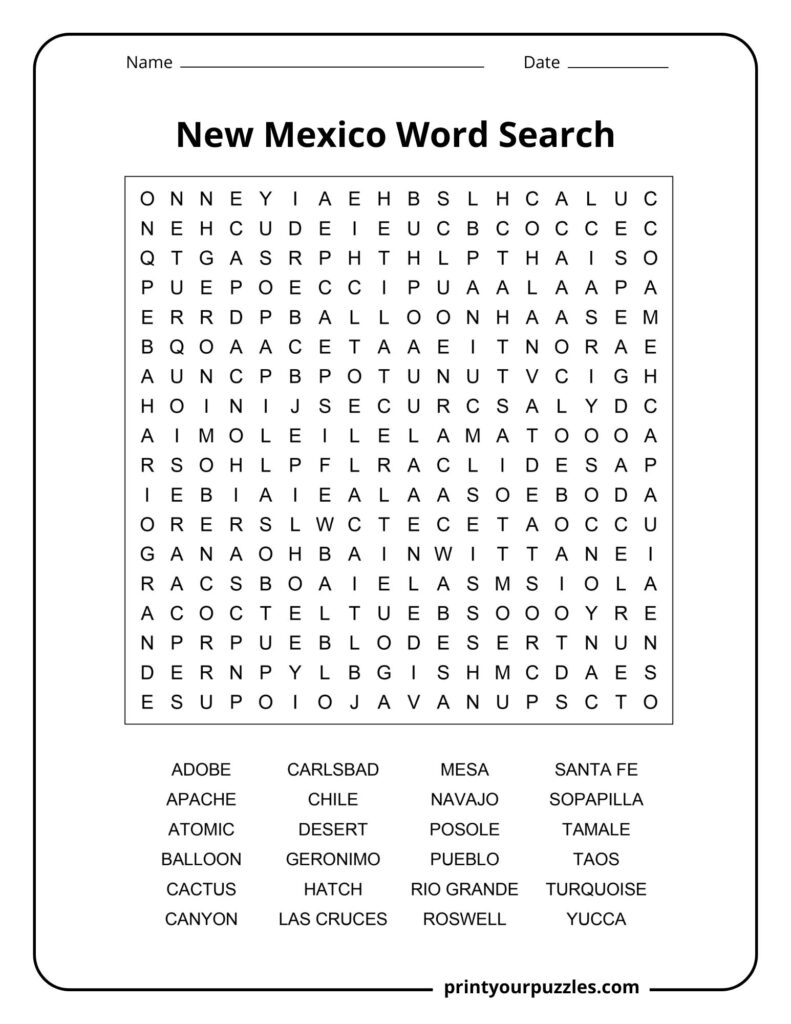
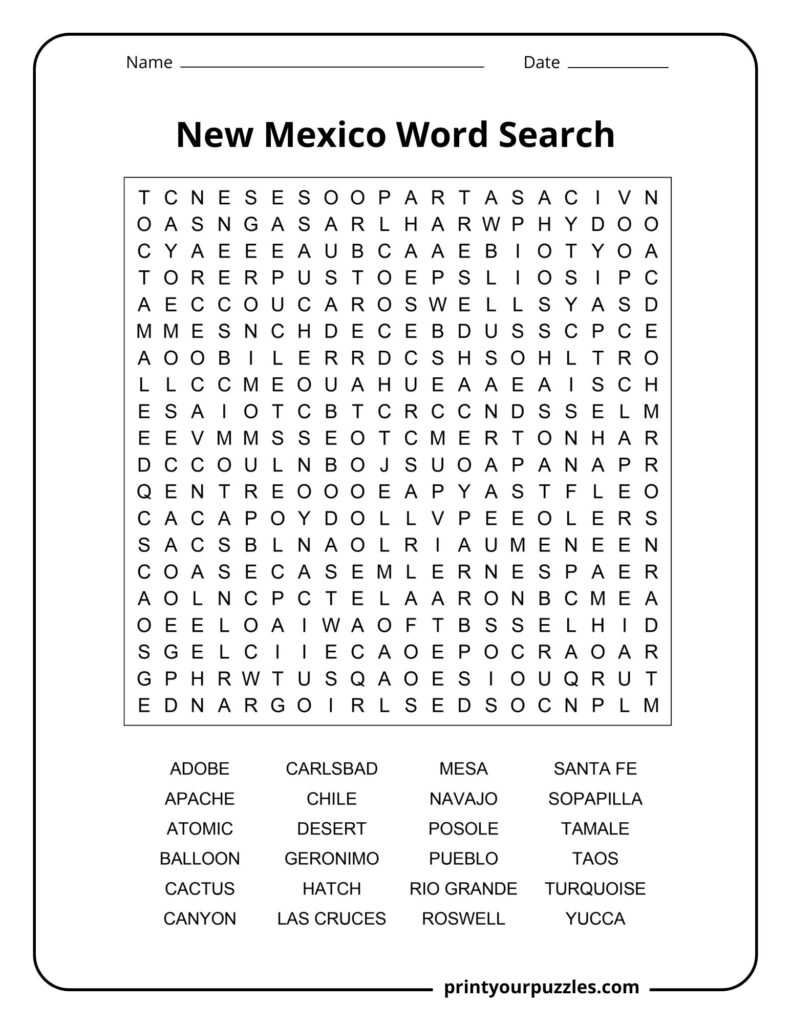
New Mexico is a state where the past feels close to the surface. Adobe buildings glow in the desert light, ancient pueblos stand near modern towns, and wide skies stretch above mesas, mountains, canyons, and dry valleys. Located in the Mountain West, New Mexico has Santa Fe as its capital and Albuquerque as its largest city. Known as The Land of Enchantment, it is one of the most visually distinctive states in the United States.
The landscape of New Mexico is full of color and contrast. Deserts, grasslands, river valleys, volcanic fields, forests, and mountain ranges all shape the state’s geography. The Rio Grande runs through the heart of New Mexico, supporting communities, farms, wildlife, and historic settlements. White Sands National Park, with its bright gypsum dunes, is one of the most unusual natural places in the country. These landscapes give a New Mexico word search many rich themes, from desert plants and wildlife to rivers, pueblos, and national parks.
Long before New Mexico became the 47th state in 1912, Indigenous peoples built complex communities throughout the region. Pueblo cultures, along with the Navajo, Apache, and other Native nations, remain central to the state’s identity today. Spanish colonization also left a deep influence on language, religion, architecture, place names, and traditions. This blend of Native American, Hispanic, Mexican, and Anglo histories makes New Mexico one of the most culturally layered states in America.
Art and science both play important roles here. Santa Fe and Taos are known for galleries, museums, adobe architecture, and creative communities, while Los Alamos is connected to scientific research and the history of the atomic age. New Mexico’s economy includes energy, tourism, agriculture, film production, government research, aerospace, and technology.
Food is woven naturally into New Mexico’s identity, especially red and green chile, which appear in dishes such as enchiladas, tamales, posole, carne adovada, and breakfast burritos. The official state question, “Red or green?” refers to chile preference and shows how deeply local flavors matter. As you complete this free printable New Mexico word search, look for words connected to its deserts, cultures, foods, mountains, art, science, and enchanting Southwestern spirit.
Continue exploring the Mountain West States with our Texas word search, Arizona word search, Colorado word search, and the full US States Word Searches collection.
ADOBE – Traditional building material made from sun-dried mud bricks mixed with straw, characteristic of New Mexico’s architecture and used extensively in pueblo structures and historic buildings.
APACHE – Native American tribe with strong historical presence in New Mexico, known for their warrior traditions and leaders like Geronimo who resisted American expansion in the Southwest.
ATOMIC – Refers to Los Alamos National Laboratory where the first atomic bomb was developed during World War II’s Manhattan Project, making New Mexico the birthplace of the nuclear age.
BALLOON – References the Albuquerque International Balloon Fiesta, the world’s largest hot air balloon festival held annually each October, attracting hundreds of colorful balloons and thousands of visitors worldwide.
CACTUS – Desert plant abundant throughout New Mexico’s arid landscape, including varieties like prickly pear and cholla, adapted to survive in harsh, dry conditions with minimal rainfall.
CANYON – Deep valleys carved by erosion, found throughout New Mexico’s landscape, offering dramatic geological formations and important cultural sites for indigenous peoples and modern outdoor recreation.
CARLSBAD – City in southeastern New Mexico, home to Carlsbad Caverns National Park, featuring massive underground limestone caves with spectacular stalactite and stalagmite formations attracting visitors globally.
CHILE – Essential ingredient in New Mexican cuisine, grown extensively in Hatch Valley, available in red and green varieties, and the official state question: “Red or green?”
DESERT – Characterizes much of New Mexico’s climate and terrain, including Chihuahuan Desert regions with unique flora, fauna, and stunning landscapes shaped by minimal rainfall and extreme temperatures.
GERONIMO – Famous Apache leader and warrior who resisted American expansion in the Southwest, with strong historical connections to New Mexico and the Apache tribes of the region.
HATCH – Small village in southern New Mexico, internationally famous as the “Chile Capital of the World,” producing premium chile peppers celebrated annually during the Hatch Chile Festival.
LAS CRUCES – New Mexico’s second-largest city, located in the Mesilla Valley near the Mexican border, known for its chile production, New Mexico State University, and rich cultural heritage.
MESA – Flat-topped elevated landform with steep sides, common throughout New Mexico’s landscape, created by erosion and characteristic of the Southwest’s distinctive geological formations and scenic beauty.
NAVAJO – Largest Native American tribe in the United States, with significant population and reservation land in northwestern New Mexico, maintaining rich cultural traditions, language, and artistic heritage.
POSOLE – Traditional New Mexican hominy stew made with pork or chicken, chile, and spices, commonly served during holidays and celebrations, representing the state’s rich culinary fusion traditions.
PUEBLO – Native American communities and their distinctive multi-story adobe dwellings, with nineteen pueblos currently in New Mexico, maintaining ancient cultural traditions, languages, and governance systems continuously.
RIO GRANDE – Major river flowing through New Mexico from Colorado to Mexico, providing crucial water resources, supporting agriculture, creating the Rio Grande Valley, and defining cultural boundaries.
ROSWELL – City in southeastern New Mexico, internationally famous for alleged 1947 UFO incident, now a tourist destination celebrating extraterrestrial themes with museums, festivals, and alien-themed attractions.
SANTA FE – New Mexico’s capital and oldest state capital in America, founded in 1610, renowned for its pueblo-style architecture, thriving art scene, and rich multicultural history.
SOPAPILLA – Fried pastry pillow served throughout New Mexico, typically enjoyed with honey as dessert or stuffed with savory fillings, representing the state’s unique blend of Native and Spanish cuisines.
TAMALE – Traditional dish of masa dough filled with meat, cheese, or vegetables, wrapped in corn husks and steamed, central to New Mexican celebrations and holiday traditions.
TAOS – Historic town and arts community in northern New Mexico, home to Taos Pueblo, one of the oldest continuously inhabited communities, attracting artists, skiers, and cultural tourists.
TURQUOISE – Blue-green gemstone extensively mined in New Mexico, the official state gem, used traditionally in Native American jewelry and artwork, symbolizing the region’s artistic heritage.
YUCCA – Desert plant with sharp, pointed leaves and tall flower stalks, common throughout New Mexico, adapted to arid conditions, and the official state flower since 1927.