
The Space Race was a Cold War competition between the United States and the Soviet Union. It began in the late 1950s and continued through the 1960s, as both countries tried to prove their scientific, technological, military, and political strength. Space exploration became a way for each superpower to show the world that its system was more advanced.
The Space Race was not only about rockets and astronauts. It was also part of the larger rivalry between the United States and the Soviet Union during the Cold War. The United States represented democracy and capitalism, while the Soviet Union promoted communism and one-party rule. Success in space became a symbol of national power and global influence.
The Soviet Union shocked the world in 1957 by launching Sputnik, the first artificial satellite to orbit Earth. This achievement made many Americans worry that the United States was falling behind in science, technology, and missile development. The launch of Sputnik helped increase support for science education, engineering, and a stronger American space program.
The Soviets reached another major milestone in 1961 when Yuri Gagarin became the first human to travel into space and orbit Earth. This success added pressure on the United States to respond. In 1958, the United States had created NASA to lead its civilian space program and organize the country’s efforts in exploration, research, and technology.
President John F. Kennedy gave the Space Race a clear goal when he challenged the United States to land a person on the Moon before the end of the 1960s. This goal required enormous planning, courage, scientific knowledge, and engineering skill. NASA’s Mercury, Gemini, and Apollo programs helped prepare astronauts and spacecraft for the challenge.
In 1969, Apollo 11 achieved that goal. Neil Armstrong and Buzz Aldrin walked on the Moon, while Michael Collins orbited above in the command module. The Moon landing became a major victory for the United States and a defining moment in space exploration.
The Space Race helped advance rockets, satellites, computers, communications, materials, and scientific research. It also changed how people imagined Earth, technology, and the future. Students can use this Space Race Word Search to review vocabulary connected to Sputnik, NASA, Apollo, Moon, rockets, astronauts, satellites, Cold War, Gagarin, Armstrong, and technology. These words help connect the competition’s causes, achievements, risks, and lasting importance.
Related Word Searches:
Cold War | John F. Kennedy | Cuban Missile Crisis | Dwight D. Eisenhower | Lyndon B. Johnson | Ronald Reagan
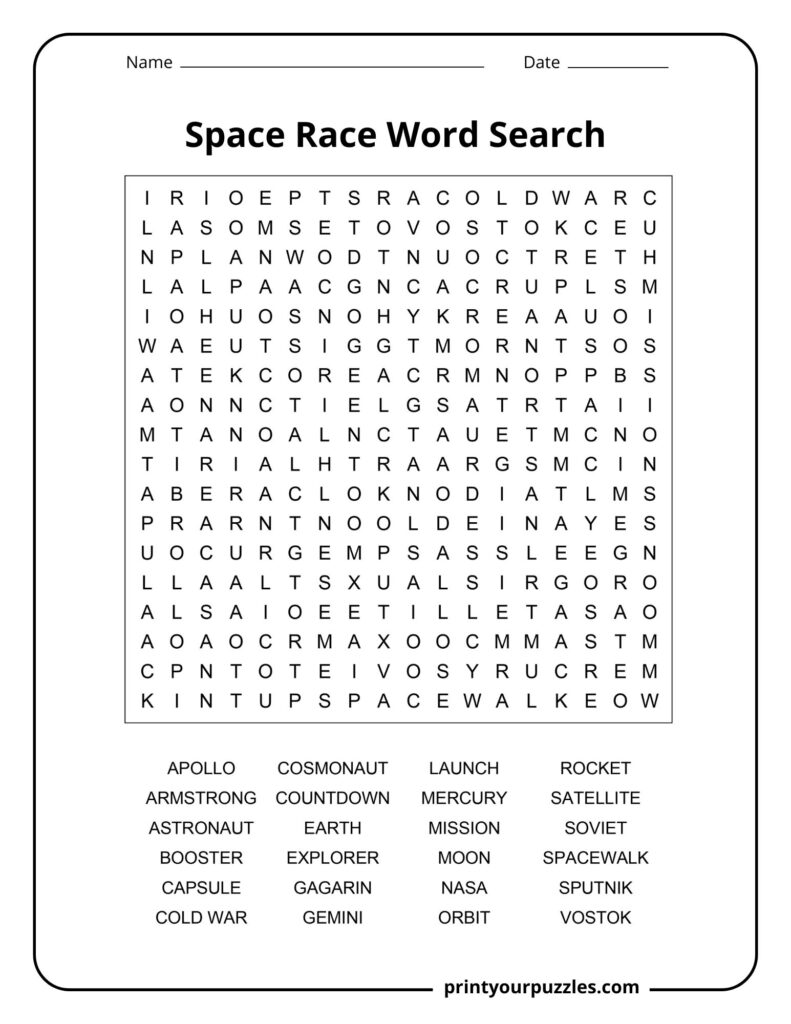
APOLLO, ARMSTRONG, ASTRONAUT, BOOSTER, CAPSULE, COLD WAR, COSMONAUT, COUNTDOWN, EARTH, EXPLORER, GAGARIN, GEMINI, LAUNCH, MERCURY, MISSION, MOON, NASA, ORBIT, ROCKET, SATELLITE, SOVIET, SPACEWALK, SPUTNIK, VOSTOK
APOLLO – NASA’s lunar exploration program that successfully landed twelve astronauts on the Moon between 1969 and 1972, achieving President Kennedy’s goal of reaching the Moon before decade’s end.
ARMSTRONG – Neil Armstrong, American astronaut who became the first human to walk on the Moon on July 20, 1969, during the Apollo 11 mission, famously saying “one small step.”
ASTRONAUT – A person trained by a spacefaring nation to command, pilot, or serve as a crew member aboard spacecraft. American space explorers are called astronauts, unlike Soviet cosmonauts.
BOOSTER – Powerful rocket engines that provide initial thrust to launch spacecraft from Earth’s surface, overcoming gravity. Boosters separate after fuel depletion, allowing the main vehicle to continue its journey.
CAPSULE – The pressurized compartment that houses astronauts during space missions. These cone-shaped modules protected crews during launch, orbit, and re-entry through Earth’s atmosphere with heat shields.
COLD WAR – The political and ideological rivalry between the United States and Soviet Union from 1947 to 1991, driving competition in space exploration, technology, and military capabilities without direct warfare.
COSMONAUT – The Russian term for space explorers trained by the Soviet or Russian space program. Yuri Gagarin became the first cosmonaut to orbit Earth in 1961, beginning human spaceflight.
COUNTDOWN – The backward counting sequence before rocket launch, checking all systems and procedures. This dramatic process builds anticipation and ensures perfect timing for engine ignition and liftoff from the launch pad.
EARTH – Our home planet, the third from the Sun. The Space Race allowed humanity to view Earth from space for the first time, revealing its fragile beauty as a blue marble.
EXPLORER – America’s first successful satellite program, launched in 1958. Explorer 1 discovered Earth’s radiation belts, marking the United States’ entry into the Space Race after Sputnik’s launch shocked the nation.
GAGARIN – Yuri Gagarin, Soviet cosmonaut who became the first human in space on April 12, 1961. His historic Vostok 1 flight orbited Earth once, making him an international hero.
GEMINI – NASA’s second human spaceflight program, conducted from 1965 to 1966. Gemini missions tested spacewalking, orbital rendezvous, and docking techniques essential for reaching the Moon successfully.
LAUNCH – The moment a rocket lifts off from its pad, propelled by powerful engines. Launches require precise timing, weather conditions, and coordination among thousands of engineers and technicians monitoring systems.
MERCURY – America’s first human spaceflight program from 1958 to 1963. Six Mercury missions successfully sent astronauts into space, including Alan Shepard’s historic first American spaceflight in May 1961.
MISSION – A specific spaceflight operation with defined objectives, crew, and timeline. Each mission during the Space Race had particular goals, from testing equipment to achieving historic milestones like lunar landings.
MOON – Earth’s natural satellite and the ultimate goal of the Space Race. The Moon became humanity’s first extraterrestrial destination, with Apollo 11 achieving the first successful manned lunar landing.
NASA – The National Aeronautics and Space Administration, America’s civilian space agency established in 1958. NASA conducted Mercury, Gemini, and Apollo programs, ultimately winning the race to the Moon.
ORBIT – The curved path a spacecraft or satellite travels around Earth or another celestial body, balanced between gravitational pull and forward velocity. Achieving orbit was an early Space Race milestone.
ROCKET – Powerful vehicles that propel spacecraft beyond Earth’s atmosphere using controlled explosions. Rockets must reach extreme speeds to overcome gravity, carrying satellites, probes, and astronauts into space successfully.
SATELLITE – An artificial object placed into orbit around Earth or other celestial bodies. Satellites revolutionized communications, weather forecasting, navigation, and military intelligence during the competitive Space Race era.
SOVIET – Relating to the Union of Soviet Socialist Republics, America’s Cold War rival. The Soviet space program achieved many firsts, including first satellite, first human, and first spacewalk in space.
SPACEWALK – Extravehicular activity where astronauts exit their spacecraft to work in the vacuum of space. Soviet cosmonaut Alexei Leonov performed history’s first spacewalk in March 1965, followed by American achievements.
SPUTNIK – The world’s first artificial satellite, launched by the Soviet Union on October 4, 1957. Sputnik’s beeping signals shocked America, triggering the Space Race and accelerating technological competition dramatically.
VOSTOK – The Soviet spacecraft program that carried the first humans into space. Vostok capsules were spherical, single-pilot vehicles that achieved historic milestones including Gagarin’s pioneering orbital flight in 1961.
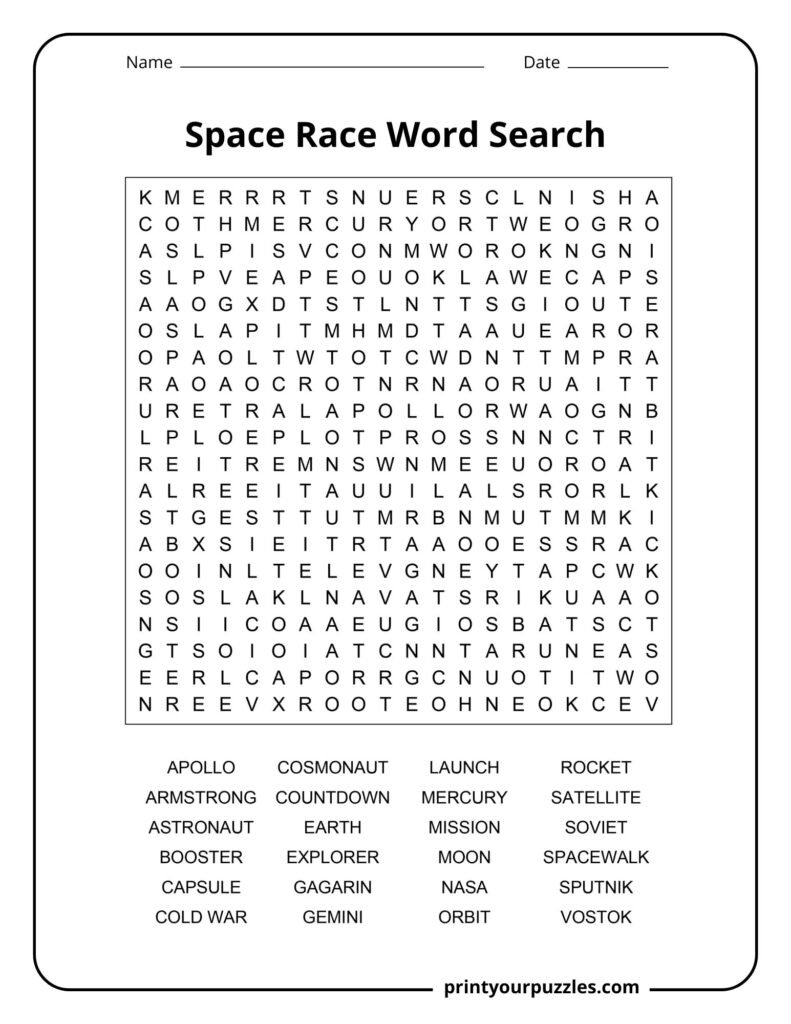
APOLLO, ARMSTRONG, ASTRONAUT, BOOSTER, CAPSULE, COLD WAR, COSMONAUT, COUNTDOWN, EARTH, EXPLORER, GAGARIN, GEMINI, LAUNCH, MERCURY, MISSION, MOON, NASA, ORBIT, ROCKET, SATELLITE, SOVIET, SPACEWALK, SPUTNIK, VOSTOK
The Space Race began in 1957 with the Soviet launch of Sputnik and effectively ended in 1975 with the Apollo-Soyuz mission, symbolizing cooperation between former rivals.
The United States is generally considered the winner after successfully landing astronauts on the Moon in 1969, though the Soviet Union achieved many earlier milestones in space exploration.
The Space Race emerged from Cold War tensions between the United States and Soviet Union. Both superpowers sought technological superiority, military advantages, and global prestige through space achievements.
Major milestones included Sputnik’s launch, Yuri Gagarin’s first human spaceflight, the first spacewalk, and Apollo 11’s historic Moon landing, each representing unprecedented human technological capability and courage.
The Space Race accelerated development of satellite communications, computer miniaturization, GPS navigation, weather forecasting, and materials science. Many everyday technologies originated from space program innovations and research investments.
The Soviet Union sent Laika, a stray dog from Moscow, into orbit aboard Sputnik 2 in November 1957, weeks before any human spaceflight, paving the way for understanding space’s effects.
Apollo 11’s lunar module was nearly empty as Armstrong manually piloted past boulder fields to find a safe landing spot, making the historic achievement even more dramatic and dangerous.
The Apollo 11 Moon landing became the most-watched television broadcast in history, uniting humanity in awe as Armstrong took his first steps on the lunar surface that July night.
The United States and Soviet Union repurposed intercontinental ballistic missiles designed for nuclear weapons into launch vehicles, demonstrating the Space Race’s deep connections to Cold War military competition.
NASA employed brilliant female mathematicians like Katherine Johnson to perform complex calculations by hand, making crucial contributions to successful Mercury and Apollo missions despite facing discrimination.