
North Dakota is a state of open horizons, quiet strength, and landscapes that reveal their beauty slowly. Located in the Midwest, along the Canadian border, it belongs to the northern Great Plains and is known for wide prairies, farmland, river valleys, rugged badlands, and dramatic skies. Bismarck is the capital, while Fargo is the largest city and an important center for education, healthcare, business, and culture.
The geography of North Dakota is shaped by space and contrast. Much of the state is covered by fertile plains used for farming and ranching, but the western region looks very different. There, the Badlands create a rugged landscape of colorful rock formations, buttes, canyons, grasslands, and wildlife. Theodore Roosevelt National Park protects part of this scenery and honors the president whose time in Dakota Territory helped shape his love of conservation. These landscapes give a North Dakota word search many strong themes, from prairies and rivers to wildlife, farming, and national parks.
Long before North Dakota became the 39th state in 1889, Indigenous nations lived across the region, including the Mandan, Hidatsa, Arikara, Dakota, Lakota, and others. Their histories, cultures, and connections to the Missouri River and surrounding plains remain essential to understanding the state. Later, fur traders, explorers, settlers, railroad builders, farmers, and immigrant communities helped shape North Dakota’s towns and economy.
Agriculture remains one of the state’s most important industries. North Dakota produces wheat, barley, sunflowers, soybeans, corn, canola, cattle, and other crops connected to its rich plains. Energy is also important, including oil, natural gas, wind power, and lignite coal. The state’s economy also includes healthcare, education, manufacturing, technology, tourism, and transportation.
Local traditions often reflect the region’s climate and immigrant heritage. Knoephla soup, lefse, kuchen, bison, walleye, chokecherries, and hearty prairie meals all connect to North Dakota’s communities. Winters can be harsh, but they are part of the state’s character, shaping a culture of resilience and practicality. As you complete this free printable North Dakota word search, look for words connected to its prairies, badlands, rivers, wildlife, farms, foods, and northern plains spirit.
Keep traveling across the Midwest States and northern plains with our South Dakota word search, Minnesota word search, Montana word search, and the full US States Word Searches collection.
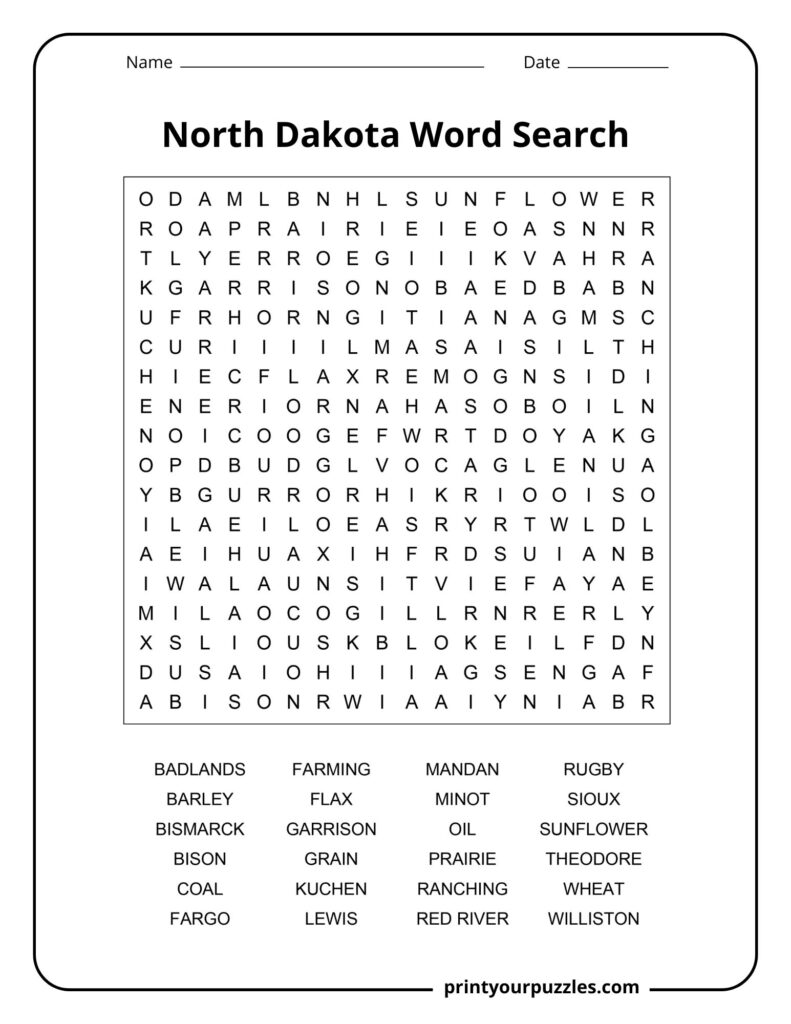
BADLANDS, BARLEY, BISMARCK, BISON, COAL, FARGO, FARMING, FLAX, GARRISON, GRAIN, KUCHEN, LEWIS, MANDAN, MINOT, OIL, PRAIRIE, RANCHING, RED RIVER, RUGBY, SIOUX, SUNFLOWER, THEODORE, WHEAT, WILLISTON
BADLANDS – Rugged terrain in western North Dakota featuring dramatic rock formations, colorful layered sediment, and unique geological features. Theodore Roosevelt National Park protects much of this distinctive landscape.
BARLEY – Important cereal grain crop grown extensively across North Dakota’s farmland. The state ranks among the top US producers, using barley for livestock feed and malting.
BISMARCK – North Dakota’s capital city located on the Missouri River. Named after German chancellor Otto von Bismarck, it serves as the state’s political and governmental center.
BISON – Massive native grazing mammals that once roamed the Great Plains in millions. Today, North Dakota maintains wild herds and ranches, symbolizing prairie heritage and conservation efforts.
COAL – Fossil fuel mined extensively in western North Dakota, particularly lignite coal. The state’s coal deposits power electricity generation and contribute significantly to the regional economy.
FARGO – North Dakota’s largest city, located on the Red River bordering Minnesota. Known for its vibrant downtown, growing economy, and as a regional cultural and educational hub.
FARMING – Agriculture dominates North Dakota’s economy and landscape. Family farms produce wheat, barley, soybeans, corn, and other crops, making the state a leading agricultural producer nationwide.
FLAX – Flowering plant cultivated for its seeds and fiber. North Dakota leads US flax production, with seeds used for linseed oil, livestock feed, and human consumption.
GARRISON – Major dam on the Missouri River creating Lake Sakakawea, one of America’s largest reservoirs. Provides flood control, hydroelectric power, recreation, and irrigation for the region.
GRAIN – Cereal crops including wheat, barley, and corn that dominate North Dakota agriculture. The state’s grain elevators and rail systems transport harvests to national and international markets.
KUCHEN – Traditional German pastry popular among North Dakota’s German-Russian immigrant descendants. This sweet cake features fruit or custard toppings, reflecting the state’s rich cultural heritage.
LEWIS – Meriwether Lewis, co-leader of the Lewis and Clark Expedition that explored North Dakota territory in 1804-1806, establishing crucial relationships with Native American tribes and mapping routes.
MANDAN – Native American tribe historically inhabiting the Missouri River region and a city named after them. The Mandan people were skilled farmers, traders, and builders of earth lodges.
MINOT – North Dakota’s fourth-largest city, known as “Magic City” due to rapid early growth. Home to Minot Air Force Base and the annual North Dakota State Fair.
OIL – Petroleum extracted from the Bakken Formation in western North Dakota. The oil boom dramatically transformed the state’s economy, population, and infrastructure since the early 2000s.
PRAIRIE – Vast grassland ecosystem that once covered most of North Dakota. Native grasses, wildflowers, and wildlife characterize these plains, though much has been converted to agricultural use.
RANCHING – Livestock raising, particularly cattle, across North Dakota’s grasslands. Ranches utilize prairie pastures for grazing, contributing to the state’s agricultural economy and Western heritage traditions.
RED RIVER – Major river forming North Dakota’s eastern border with Minnesota. Flows northward to Canada, prone to spring flooding, and supports agriculture in the fertile Red River Valley.
RUGBY – Small town in north-central North Dakota, officially recognized as the geographical center of North America. Features a monument marking this unique continental distinction and tourist attraction.
SIOUX – Native American tribes including the Lakota, Dakota, and Nakota peoples who historically inhabited the region. Continue cultural traditions on reservations throughout North Dakota today.
SUNFLOWER – North Dakota’s official state flower, symbolizing the prairie landscape. Wild sunflowers bloom across the state, while cultivated varieties are harvested commercially for seeds and oil.
THEODORE – Theodore Roosevelt, 26th US President, who ranched in North Dakota’s Badlands during the 1880s. His conservation experiences there profoundly influenced his environmental policies and legacy.
WHEAT – North Dakota’s most important crop and leading agricultural product. The state ranks first nationally in spring wheat production, with vast golden fields defining the landscape.
WILLISTON – Northwest North Dakota city that experienced explosive growth during the Bakken oil boom. Serves as a hub for oil extraction, refining, and related industries in the region.
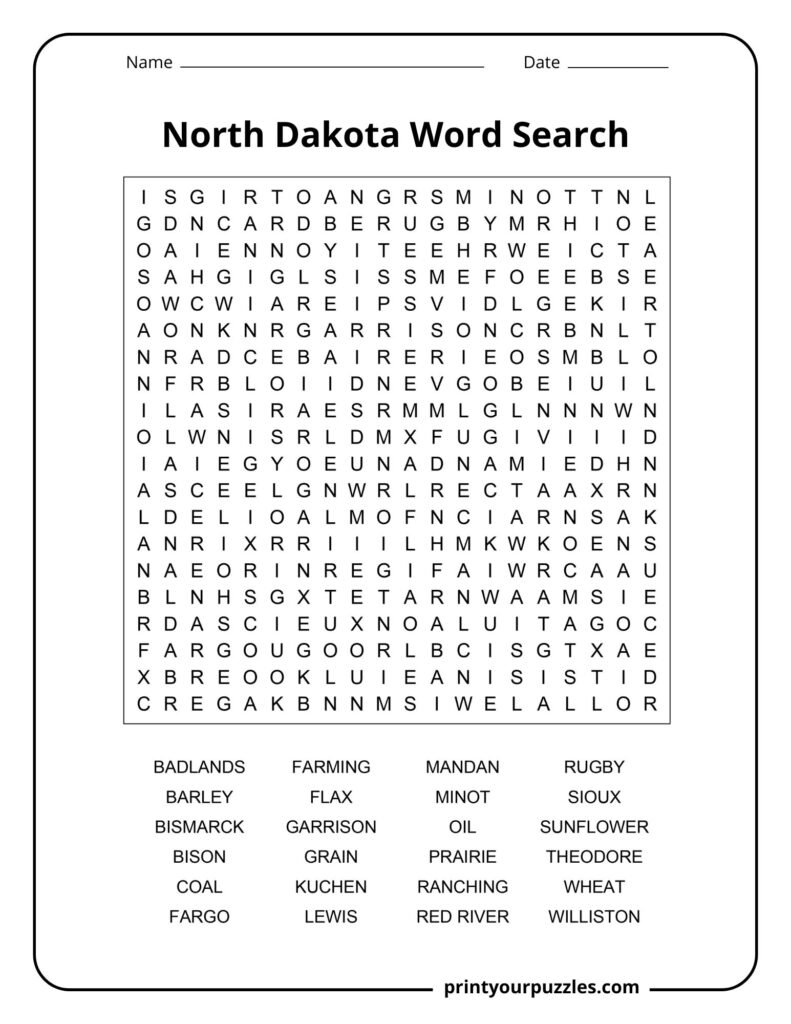
BADLANDS, BARLEY, BISMARCK, BISON, COAL, FARGO, FARMING, FLAX, GARRISON, GRAIN, KUCHEN, LEWIS, MANDAN, MINOT, OIL, PRAIRIE, RANCHING, RED RIVER, RUGBY, SIOUX, SUNFLOWER, THEODORE, WHEAT, WILLISTON
North Dakota is renowned for agriculture, particularly wheat and barley production, the Bakken oil fields, Theodore Roosevelt National Park’s Badlands, and being the geographical center of North America.
Bismarck serves as North Dakota’s capital city. Located on the Missouri River in south-central North Dakota, it’s the state’s second-largest city and governmental hub.
The nickname honors the International Peace Garden on the US-Canada border. This 2,300-acre botanical garden symbolizes peaceful relations between the two nations and showcases stunning floral displays.
North Dakota experiences a continental climate with cold, snowy winters and warm summers. Temperature extremes are common, ranging from below-zero winter conditions to hot summer days.
Agriculture dominates, producing wheat, barley, soybeans, and livestock. Oil extraction from the Bakken Formation, coal mining, manufacturing, and tourism also contribute significantly to the economy.
For official state records and government services, visit the North Dakota State Portal. If you are planning a trip, check out North Dakota Tourism.
Despite its harsh winters, North Dakota leads the nation in honey production. Abundant wildflowers and sunflower fields provide excellent foraging for honeybees during summer months.
Less than two percent of North Dakota is naturally forested. The prairie landscape is dominated by grasslands, with most trees planted by settlers or found along rivers.
A stone monument in Rugby designates the spot equidistant from the continent’s extremities. This small town proudly celebrates its unique position at North America’s heart.
Until 2013, North Dakota was the only US state without a Starbucks location. The first store finally opened in Fargo, ending the state’s coffee chain-free status.
Several indigenous languages including Mandan, Hidatsa, and Dakota are critically endangered. Tribal communities work diligently to preserve these languages through education programs and cultural initiatives.