
Math is the study of numbers, shapes, patterns, quantities, and relationships. It helps people understand how things work, solve problems, and make informed decisions. Although mathematics is often associated with classrooms, equations, and calculations, it is also part of everyday life. People use math when shopping, cooking, measuring distances, planning schedules, managing money, or comparing prices.
The subject includes several important branches. Arithmetic focuses on basic operations such as addition, subtraction, multiplication, and division. Algebra uses letters and symbols to represent unknown values and relationships. Geometry explores shapes, angles, lines, areas, and spaces, while statistics helps organize and interpret information. Other areas, such as calculus and probability, are used to study change, movement, chance, and complex patterns.
Math develops logical thinking because it encourages learners to examine information carefully and follow clear steps. A difficult problem may seem confusing at first, but breaking it into smaller parts can make it easier to solve. Mathematics also teaches accuracy, patience, and persistence. Sometimes the first method does not work, so learners must try another approach and check whether their final answer makes sense.
Patterns are especially important in mathematics. They appear in number sequences, geometric designs, music, architecture, nature, and technology. Recognizing patterns can help people predict what may happen next and understand connections between different ideas. For example, engineers use mathematical patterns when designing buildings, while scientists use calculations to analyze experiments and explain natural events.
Math is also essential in many careers. Accountants, doctors, programmers, architects, scientists, economists, and construction workers all rely on mathematical skills. Even jobs that do not involve advanced formulas may require measurements, percentages, budgeting, or data interpretation.
Building a strong mathematical vocabulary can make the subject easier to understand. A math word search offers an enjoyable way to review useful terms such as fraction, equation, angle, decimal, product, graph, and perimeter. Becoming familiar with these words helps students recognize important concepts and feel more confident when reading instructions or solving problems.
Math is not simply about memorizing formulas or finding correct answers. It is a practical way of thinking that helps people identify patterns, evaluate information, and approach challenges logically. With practice and curiosity, learners can develop skills that are useful throughout school, work, and daily life.
Related Word Searches:
Algebra | Geometry | Coding | Physics | Gravity | Astronomy
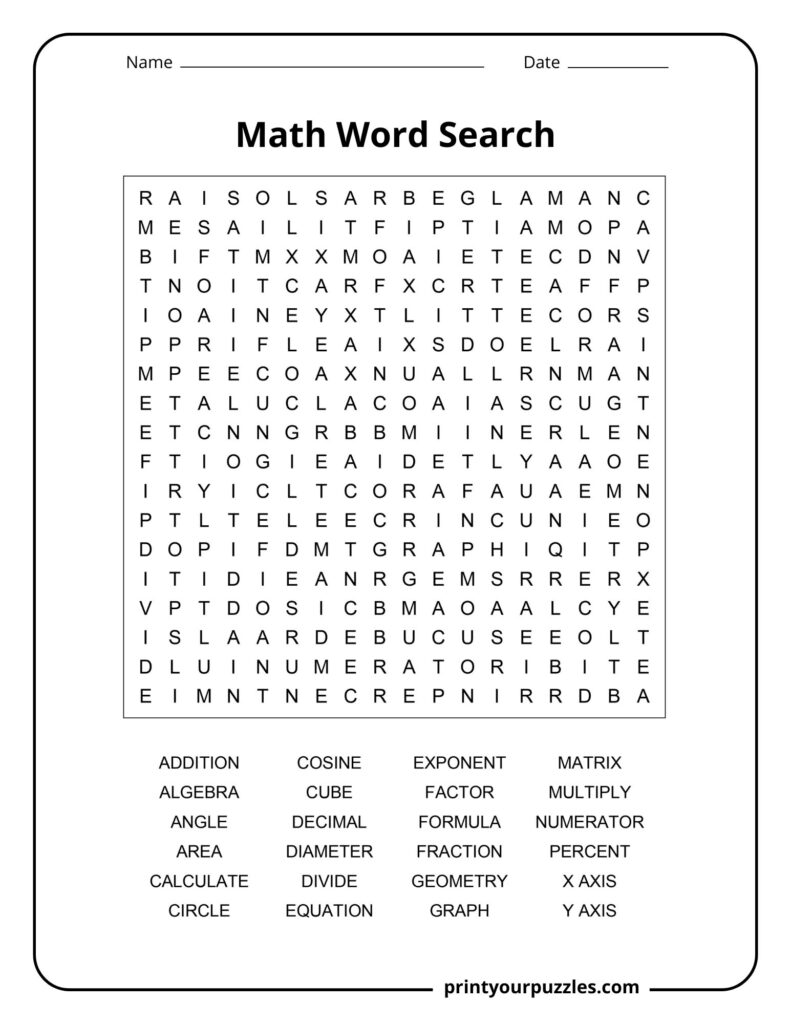
ADDITION, ALGEBRA, ANGLE, AREA, CALCULATE, CIRCLE, COSINE, CUBE, DECIMAL, DIAMETER, DIVIDE, EQUATION, EXPONENT, FACTOR, FORMULA, FRACTION, GEOMETRY, GRAPH, MATRIX, MULTIPLY, NUMERATOR, PERCENT, X AXIS, Y AXIS
ADDITION – The mathematical operation of combining two or more numbers to find their total sum, represented by the plus sign and fundamental to arithmetic.
ALGEBRA – A branch of mathematics using letters and symbols to represent numbers and quantities in formulas and equations, allowing generalized problem-solving and pattern analysis.
ANGLE – The space measured in degrees between two intersecting lines or surfaces that meet at a common point called a vertex, ranging from zero to three hundred sixty degrees.
AREA – The measurement of the two-dimensional space inside a shape or surface, typically expressed in square units like square meters, feet, or centimeters.
CALCULATE – To determine a numerical answer or result through mathematical operations, computation, or systematic reasoning using formulas, algorithms, and established mathematical principles to solve problems.
CIRCLE – A perfectly round two-dimensional shape where all points on its boundary are equidistant from a fixed central point, having constant radius and diameter.
COSINE – A trigonometric function representing the ratio of the adjacent side to the hypotenuse in a right-angled triangle, abbreviated as cos and used extensively in mathematics.
CUBE – A three-dimensional solid object with six equal square faces, twelve edges, and eight vertices, or the mathematical result of multiplying a number by itself twice.
DECIMAL – A number system based on ten, using a decimal point to separate whole numbers from fractional parts expressed in tenths, hundredths, thousandths, and so forth.
DIAMETER – A straight line passing through the center of a circle or sphere, connecting two points on opposite sides of its boundary, measuring twice the radius length.
DIVIDE – The mathematical operation of splitting a number into equal parts or determining how many times one number contains another, represented by the division symbol.
EQUATION – A mathematical statement showing that two expressions are equal, typically containing an equals sign and often including unknown variables that need to be solved systematically.
EXPONENT – A number indicating how many times a base number is multiplied by itself, written as a superscript positioned above and to the right of the base.
FACTOR – A whole number that divides evenly into another number without leaving a remainder, or a multiplicative component of an algebraic expression that can be separated.
FORMULA – A mathematical rule or relationship expressed using symbols, numbers, and variables that shows how to calculate a specific quantity, result, or solve particular types of problems.
FRACTION – A numerical quantity representing a part of a whole, expressed as one number divided by another, consisting of a numerator positioned over a denominator.
GEOMETRY – The branch of mathematics studying shapes, sizes, positions, properties, angles, and dimensions of figures existing in two-dimensional planes and three-dimensional space, including practical applications.
GRAPH – A visual representation of data or mathematical relationships using points, lines, curves, or bars plotted on coordinate axes to clearly display patterns, trends, and comparative information.
MATRIX – A rectangular array of numbers, symbols, or expressions systematically arranged in horizontal rows and vertical columns, used in linear algebra for various mathematical operations.
MULTIPLY – The mathematical operation of repeated addition, combining equal groups to find the total product of two or more numbers, represented by the multiplication sign.
NUMERATOR – The top number in a fraction that indicates how many equal parts of the whole are being considered, counted, or represented in the fractional expression.
PERCENT – A way of expressing a number as a fraction of one hundred, represented by the percentage symbol and meaning “per hundred” in mathematical contexts.
X AXIS – The horizontal reference line in a coordinate system, typically running left to right, used to measure and plot the first coordinate value of points.
Y AXIS – The vertical reference line in a coordinate system, typically running up and down, used to measure and plot the second coordinate value of points.
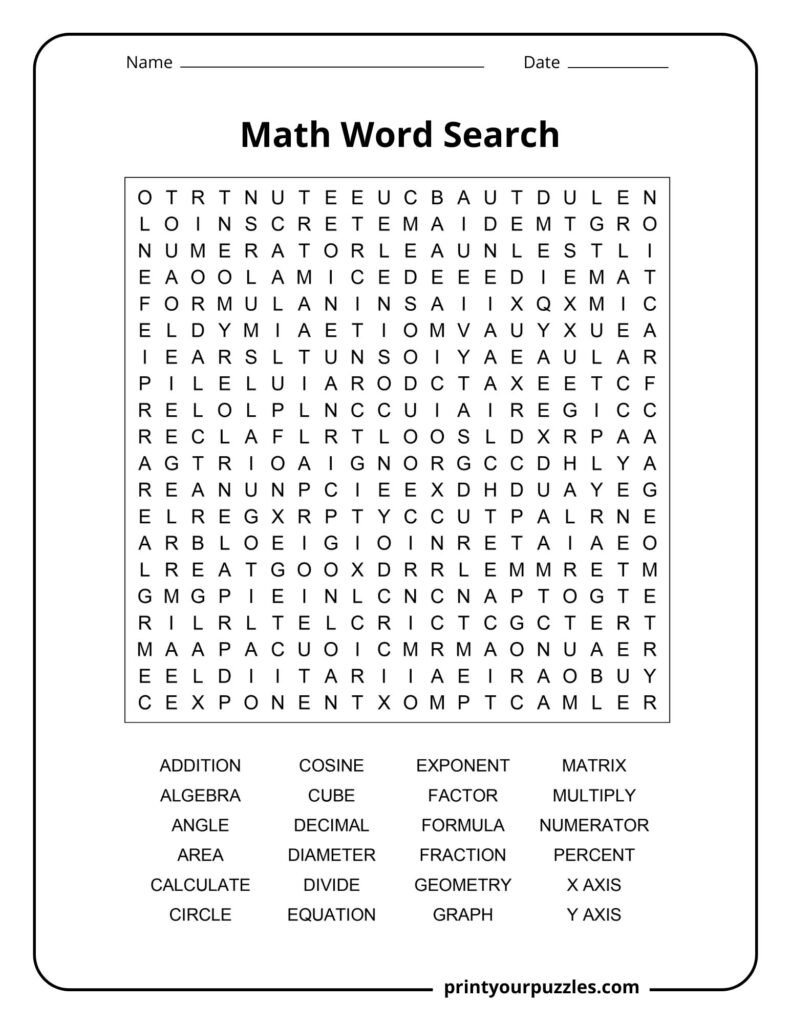
ADDITION, ALGEBRA, ANGLE, AREA, CALCULATE, CIRCLE, COSINE, CUBE, DECIMAL, DIAMETER, DIVIDE, EQUATION, EXPONENT, FACTOR, FORMULA, FRACTION, GEOMETRY, GRAPH, MATRIX, MULTIPLY, NUMERATOR, PERCENT, X AXIS, Y AXIS
Math is essential for managing finances, cooking measurements, time management, shopping calculations, and understanding statistics. It develops critical thinking, problem-solving skills, and logical reasoning used in countless daily decisions.
The primary branches include arithmetic, algebra, geometry, trigonometry, calculus, and statistics. Each branch focuses on different concepts, from basic operations to advanced analysis, serving various applications in science and technology.
Practice regularly with varied problems, understand concepts rather than memorizing formulas, ask questions when confused, use real-world applications, and seek help from teachers, tutors, or online resources when needed.
Engineering, computer science, finance, accounting, architecture, data analysis, physics, economics, actuarial science, and teaching all require solid mathematical abilities. Many modern careers increasingly depend on quantitative and analytical skills.
Yes, many people find math challenging at various levels. Success often requires consistent practice, proper foundational understanding, and patience. Different learning styles may need different approaches, and seeking help is completely normal.
Welsh mathematician Robert Recorde created this symbol because he believed nothing could be more equal than two parallel lines of the same length, revolutionizing mathematical notation forever.
Ancient Babylonians, Mayans, and Indians all developed the concept of zero at different times. Indian mathematician Brahmagupta established rules for calculating with zero in 628 CE, transforming mathematics.
“Mathema” means “that which is learnt” or “knowledge.” The ancient Greeks considered mathematics essential education, viewing it as the foundation for understanding philosophy, science, and the universe.
While there are infinitely many prime numbers, they appear less frequently among larger numbers. Between one and one hundred, there are twenty-five primes; between nine hundred and one thousand, only fourteen.
Despite this incredible precision, most scientific calculations only require about forty decimal places of pi. Ancient civilizations approximated pi using simple fractions like twenty-two divided by seven.