
Wyoming feels like one of the wildest and most spacious places in the United States. Located in the Mountain West, it is a state of high plains, rugged mountains, deep canyons, open ranchland, clear rivers, and dramatic skies. Cheyenne is the capital and largest city, but much of Wyoming’s identity comes from its wide-open landscapes and small communities. Known as The Equality State, Wyoming has a proud history of independence, frontier life, and natural beauty.
The state’s geography is unforgettable. Yellowstone National Park, the first national park in the world, protects geysers, hot springs, waterfalls, forests, rivers, and extraordinary wildlife. Old Faithful, the Grand Prismatic Spring, and the Yellowstone River are among its most famous natural features. South of Yellowstone, Grand Teton National Park rises with sharp mountain peaks, alpine lakes, and some of the most beautiful scenery in the Rocky Mountains. These landmarks give a Wyoming word search many powerful themes to explore.
Long before Wyoming became the 44th state in 1890, Indigenous peoples lived, hunted, traveled, and traded across the region, including the Shoshone, Arapaho, Crow, Cheyenne, Lakota, and others. Later, fur traders, pioneers, railroad workers, miners, ranchers, and cowboys helped shape Wyoming’s frontier identity. Trails such as the Oregon Trail, California Trail, Mormon Trail, and Pony Express route passed through the state, connecting Wyoming to the larger story of westward migration.
Ranching remains one of Wyoming’s strongest symbols. Cattle, horses, rodeos, cowboy culture, and open range traditions are still important parts of local life. The state’s economy also includes energy, mining, tourism, agriculture, transportation, and outdoor recreation. Coal, natural gas, oil, wind energy, and trona all contribute to Wyoming’s modern industries, while visitors come for hiking, fishing, camping, skiing, wildlife watching, and national parks.
Wyoming’s food traditions often reflect ranching, hunting, and mountain life, with beef, bison, trout, elk, chili, and hearty Western meals appearing in local culture. Yet the state is best remembered for its sense of space: bison moving across grasslands, mountains glowing at sunset, geysers rising from the earth, and roads that seem to continue forever. As you complete this free printable Wyoming word search, look for words connected to its parks, wildlife, trails, ranches, mountains, history, and Western spirit.
Explore more Mountain West States geography with our Montana word search, Colorado word search, Idaho word search, and the full US States Word Searches collection.
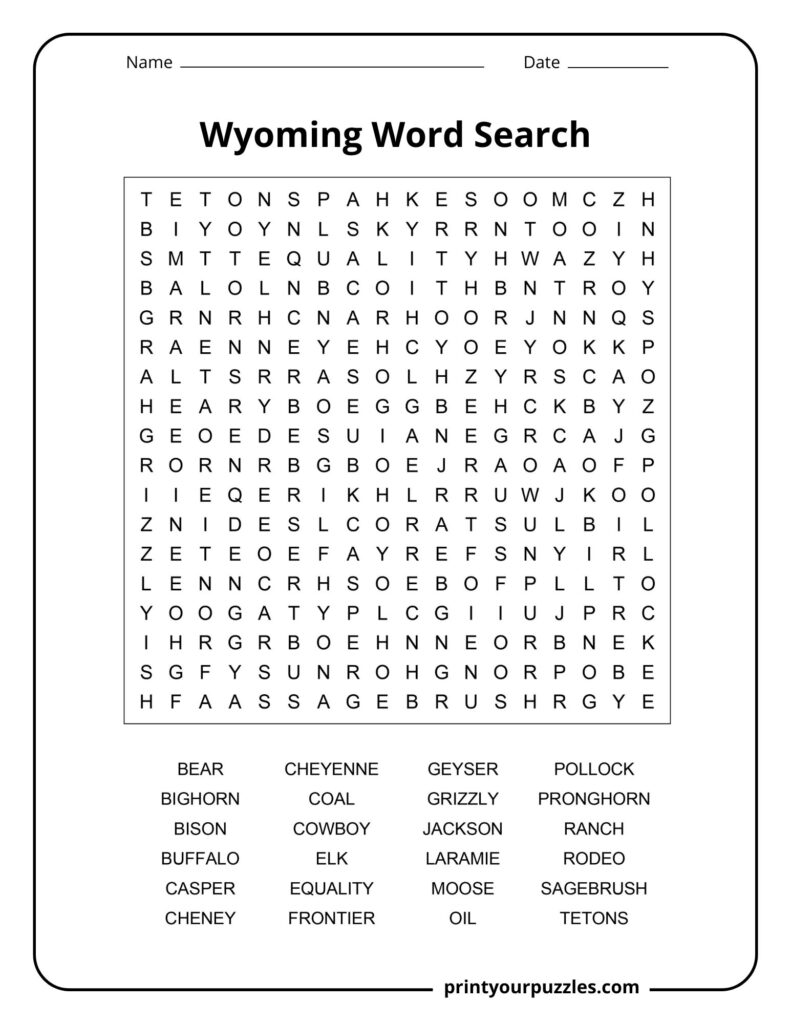
BEAR, BIGHORN, BISON, BUFFALO, CASPER, CHENEY, CHEYENNE, COAL, COWBOY, ELK, EQUALITY, FRONTIER, GEYSER, GRIZZLY, JACKSON, LARAMIE, MOOSE, OIL, POLLOCK, PRONGHORN, RANCH, RODEO, SAGEBRUSH, TETONS
BEAR – Large mammals found throughout Wyoming’s wilderness areas, including black bears in forests and mountains, important to the state’s wildlife ecosystem and tourism.
BIGHORN – Bighorn sheep, Wyoming’s state mammal, known for massive curved horns. Also refers to the Bighorn Mountains and Bighorn National Forest in northern Wyoming.
BISON – America’s largest land mammal, roaming Yellowstone National Park in Wyoming. Once nearly extinct, now thriving herds symbolize conservation success and the American West.
BUFFALO – Common name for bison; Buffalo Bill Cody founded the town of Cody, Wyoming. The animal remains iconic to Wyoming’s heritage and western identity.
CASPER – Wyoming’s second-largest city, located along the North Platte River. Named after Fort Caspar, it’s known as the “Oil City” for petroleum industry significance.
CHENEY – Dick Cheney, former U.S. Vice President under George W. Bush, represented Wyoming in Congress and maintained strong political ties to the state throughout his career.
CHEYENNE – Wyoming’s capital and largest city, named after the Cheyenne Native American tribe. Home to the famous Cheyenne Frontier Days rodeo, the world’s largest outdoor rodeo.
COAL – Major natural resource in Wyoming’s Powder River Basin, making the state America’s top coal producer. Coal mining drives significant economic activity and employment statewide.
COWBOY – Iconic symbol of Wyoming culture; cattle ranchers and rodeo riders embody the state’s frontier heritage. The cowboy image defines Wyoming’s identity and traditions.
ELK – Large deer species abundant in Wyoming, particularly around Yellowstone and Grand Teton. The National Elk Refuge in Jackson Hole protects thousands during winter months.
EQUALITY – Wyoming’s state nickname, “The Equality State,” commemorates being first to grant women voting rights in 1869 and elect the first female governor, Nellie Tayloe Ross.
FRONTIER – Represents Wyoming’s Wild West heritage and pioneering spirit. Cheyenne Frontier Days celebrates this legacy annually with rodeos, parades, and western cultural events nationwide.
GEYSER – Hot springs that periodically erupt water and steam, abundant in Yellowstone National Park. Old Faithful is the world’s most famous geyser, erupting approximately hourly.
GRIZZLY – Large brown bears inhabiting Yellowstone and Grand Teton ecosystems. Wyoming hosts one of the lower forty-eight states’ few remaining grizzly bear populations, carefully protected.
JACKSON – Jackson Hole valley town near Grand Teton National Park, famous for world-class skiing, western charm, and iconic elk antler arches framing the town square.
LARAMIE – University town in southeastern Wyoming, home to the University of Wyoming. Named after French trapper Jacques La Ramie, situated on high plains elevation.
MOOSE – Largest member of deer family, found in Wyoming’s mountains and river valleys. Grand Teton National Park and surrounding areas support healthy moose populations.
OIL – Crucial Wyoming industry; the state produces significant crude oil from various fields. Oil extraction and refining provide substantial economic revenue and employment opportunities.
POLLOCK – Jackson Pollock, influential abstract expressionist painter, was born in Cody, Wyoming in 1912. His revolutionary drip painting technique transformed modern American art forever.
PRONGHORN – Fastest land animal in North America, abundant across Wyoming’s plains and grasslands. Often called antelope, pronghorns are uniquely North American, not true antelopes.
RANCH – Large livestock farms define Wyoming’s agricultural landscape and economy. Cattle and sheep ranching continues centuries-old traditions across the state’s vast open spaces.
RODEO – Competitive western sport featuring bronc riding, bull riding, and roping events. Wyoming hosts numerous rodeos, with Cheyenne Frontier Days being the most famous celebration.
SAGEBRUSH – Aromatic shrub covering Wyoming’s plains and valleys, the state flower. This hardy plant symbolizes the rugged, arid landscape characteristic of Wyoming’s ecosystem.
TETONS – Grand Teton mountain range in northwestern Wyoming, featuring dramatic jagged peaks rising abruptly from Jackson Hole valley. Popular destination for climbing, hiking, and photography.
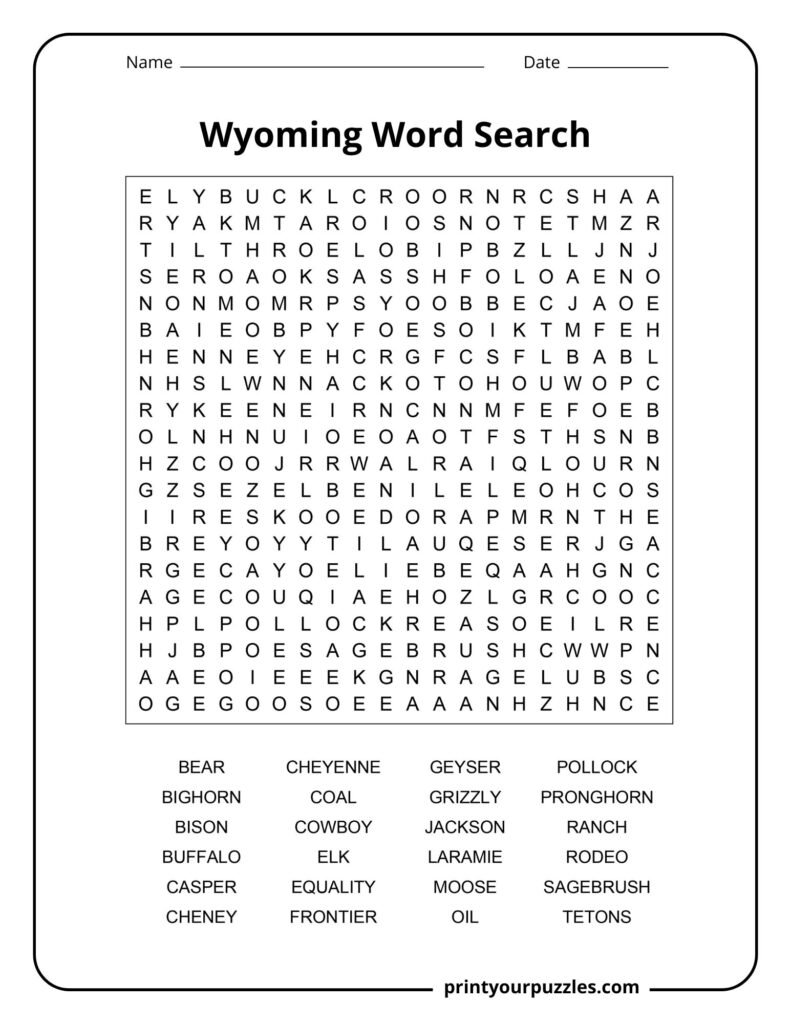
BEAR, BIGHORN, BISON, BUFFALO, CASPER, CHENEY, CHEYENNE, COAL, COWBOY, ELK, EQUALITY, FRONTIER, GEYSER, GRIZZLY, JACKSON, LARAMIE, MOOSE, OIL, POLLOCK, PRONGHORN, RANCH, RODEO, SAGEBRUSH, TETONS
Wyoming is famous for Yellowstone and Grand Teton National Parks, cowboy culture, rodeos, vast wilderness, abundant wildlife including bison and elk, coal and oil production, and low population density.
Cheyenne serves as both Wyoming’s capital and largest city, located in the southeastern corner. It’s home to the famous Cheyenne Frontier Days, the world’s largest outdoor rodeo.
Wyoming earned this nickname by being the first territory to grant women voting rights in 1869 and the first state to elect a female governor, Nellie Tayloe Ross, in 1924.
Wyoming has approximately 580,000 residents, making it the least populous U.S. state. The harsh climate, rugged terrain, remote location, and limited urban centers contribute to low population density.
Wyoming’s economy relies heavily on mineral extraction including coal, oil, and natural gas from the Powder River Basin. Tourism, agriculture, and cattle ranching also provide significant economic contributions.
For official state records and government services, visit the Wyoming State Portal. If you are planning a trip, check out Travel Wyoming.
Established in 1872, Yellowstone National Park became the world’s first national park, setting a precedent for conservation efforts globally and protecting extraordinary geothermal features and wildlife forever.
Wyoming is one of few states without personal or corporate income taxes, relying instead on mineral extraction revenues and sales taxes, making it attractive for businesses and residents.
President Theodore Roosevelt designated Devils Tower as the nation’s first national monument in 1906. This striking volcanic rock formation rises 867 feet above northeastern Wyoming’s landscape.
James Cash Penney opened his first store, “The Golden Rule,” in Kemmerer, Wyoming in 1902. This small shop evolved into the nationwide JCPenney department store chain.
Since 1936, Wyoming license plates have displayed a distinctive bucking horse and rider symbol called “Steamboat,” celebrating the state’s cowboy heritage and rodeo culture on every vehicle.