Introduction to the Presidents' Day Word Search
cPresidents’ Day is a federal holiday in the United States observed on the third Monday in February. It is widely associated with honoring the nation’s presidents, especially George Washington and Abraham Lincoln. However, the official federal name of the holiday remains Washington’s Birthday, reflecting its original purpose of commemorating the first president of the United States.
George Washington was born on February 22, 1732. He served as commander of the Continental Army during the American Revolution and later became the country’s first president. During the nineteenth century, Americans began holding celebrations, speeches, and public events near his birthday. In 1879, Washington’s Birthday became a federal holiday, and it was later observed nationwide.
Abraham Lincoln, the sixteenth president, was born on February 12, 1809. Because his birthday falls in the same month, many states and communities began connecting the February holiday with both Washington and Lincoln. Lincoln is remembered for leading the country during the Civil War, preserving the Union, and issuing the Emancipation Proclamation. Over time, the popular name Presidents’ Day became increasingly common.
The holiday was moved to the third Monday in February under the Uniform Monday Holiday Act, which took effect in 1971. This change created a three-day weekend for many workers and students. Because the date always falls between February 15 and February 21, it never occurs on Washington’s actual birthday.
Observances vary across the country. Schools, museums, libraries, and historic sites may organize lessons, exhibitions, reenactments, or activities about presidential history and the responsibilities of the executive branch. Some people visit monuments, presidential libraries, birthplaces, or museums connected with former leaders.
Presidents’ Day has also become closely associated with retail sales, especially promotions involving cars, furniture, appliances, and clothing. Although shopping advertisements are highly visible, the holiday still provides an opportunity to learn about leadership, elections, government, and the decisions that have shaped American history.
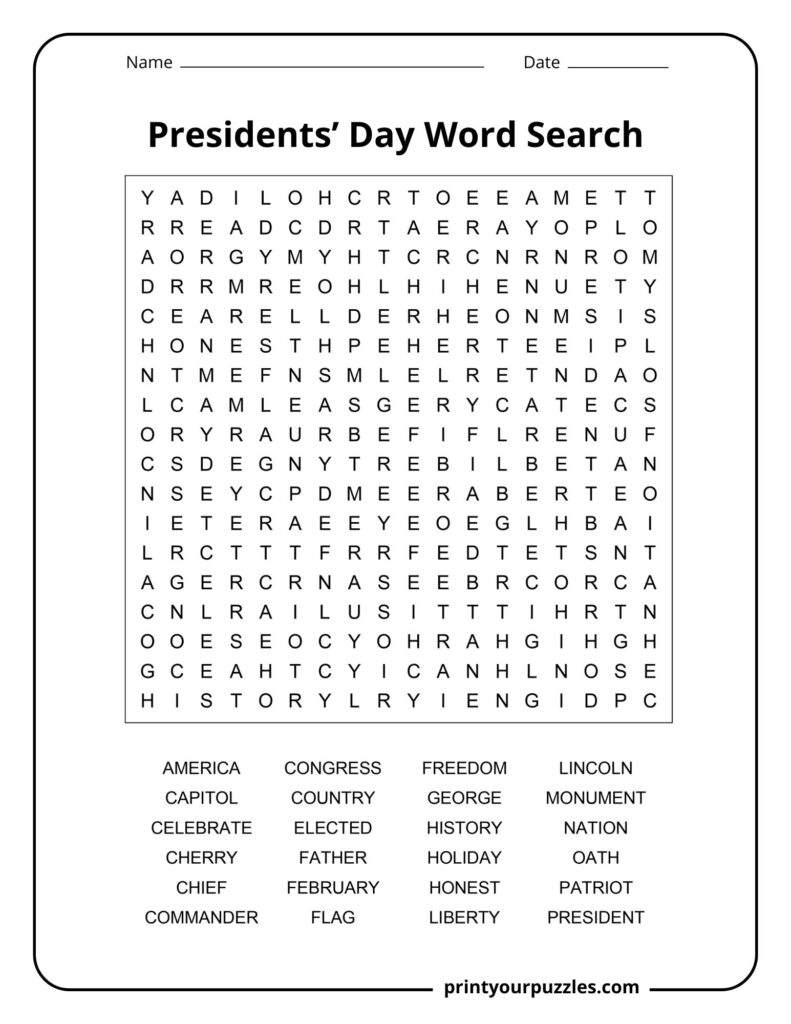
Discover the people, symbols, offices, and important events connected with the nation’s leaders through this Presidents’ Day word search printable, featuring 24 carefully selected words inspired by Washington, Lincoln, the White House, elections, leadership, government, history, and presidential traditions.
Related Word Searches:
Constitution Day | Independence Day | 4th of July | Martin Luther King Jr. Day | Memorial Day
Medium Difficulty Word Search
Words to Find:
AMERICA, CAPITOL, CELEBRATE, CHERRY, CHIEF, COMMANDER, CONGRESS, COUNTRY, ELECTED, FATHER, FEBRUARY, FLAG, FREEDOM, GEORGE, HISTORY, HOLIDAY, HONEST, LIBERTY, LINCOLN, MONUMENT, NATION, OATH, PATRIOT, PRESIDENT
All Words Defined
AMERICA – The United States of America, a nation founded in 1776, celebrated for its democracy, freedom, and the leadership of presidents who have shaped its history and values.
CAPITOL – The building in Washington, D.C., where the United States Congress meets to create laws. It symbolizes American democracy and the legislative branch of government that works alongside presidents.
CELEBRATE – To honor and observe a special occasion with joy and festivities. President’s Day celebrates the birthdays and contributions of George Washington, Abraham Lincoln, and all American presidents throughout history.
CHERRY – A small red fruit associated with the legendary story of young George Washington admitting to cutting down his father’s cherry tree, demonstrating his honesty and integrity from childhood.
CHIEF – The highest-ranking leader or head of an organization. The president serves as Chief Executive of the United States, commanding the military and overseeing the executive branch of government.
COMMANDER – The leader who directs military forces. The president holds the title Commander in Chief, giving them supreme authority over all United States armed forces and national defense operations.
CONGRESS – The legislative branch of the United States government, consisting of the Senate and House of Representatives. Congress creates laws that the president signs or vetoes, maintaining governmental checks and balances.
COUNTRY – A nation with its own government and borders. The United States is the country led by the president, who serves as head of state and represents American interests domestically.
ELECTED – Chosen through voting by citizens to hold a position of leadership. American presidents are elected every four years through a democratic process involving primaries, campaigns, and the Electoral College.
FATHER – George Washington is called the “Father of Our Country” for his leadership during the Revolutionary War and as America’s first president, establishing precedents that shaped the presidency forever.
FEBRUARY – The second month of the year when President’s Day is celebrated. Both George Washington and Abraham Lincoln were born in February, making it significant for honoring presidential leadership.
FLAG – The Stars and Stripes, the national symbol of the United States featuring red and white stripes and white stars on blue. Presidents serve under this flag, protecting the nation it represents.
FREEDOM – The power to act, speak, and think without restraint. American presidents have worked throughout history to protect and expand freedom, liberty, and civil rights for all citizens and beyond.
GEORGE – George Washington, America’s first president who served from 1789 to 1797. He led the Continental Army to victory and established many presidential traditions still followed by leaders today.
HISTORY – The study of past events and people. President’s Day honors the historical significance of American presidents and their lasting impact on the nation’s development, policies, and democratic values.
HOLIDAY – A day of celebration when people take time off from work or school. President’s Day is a federal holiday observed annually on the third Monday in February nationwide.
HONEST – Truthful and trustworthy in character. Abraham Lincoln earned the nickname “Honest Abe” for his integrity and straightforward nature, qualities Americans admire in their presidents and leaders throughout history.
LIBERTY – Freedom from oppressive restrictions and the right to self-governance. Presidents take an oath to preserve, protect, and defend liberty as a fundamental American principle enshrined in the Constitution.
LINCOLN – Abraham Lincoln, the sixteenth president who led America through the Civil War and ended slavery with the Emancipation Proclamation. His leadership preserved the Union and expanded freedom for all.
MONUMENT – A structure built to commemorate important people or events. The Washington Monument and Lincoln Memorial in Washington, D.C., honor these presidents and their contributions to American history and democracy.
NATION – A large group of people united under one government within specific borders. The president leads the American nation, representing its citizens and making decisions that affect the entire country.
OATH – A solemn promise or pledge. Every president takes the Oath of Office, swearing to faithfully execute their duties and preserve, protect, and defend the Constitution of the United States.
PATRIOT – A person who loves and supports their country. Presidents are expected to be patriots who put national interests first, serving with dedication to protect and improve America for all.
PRESIDENT – The elected head of state and chief executive of the United States. This leader serves a four-year term, commanding the military, enforcing laws, and representing America on the world stage.
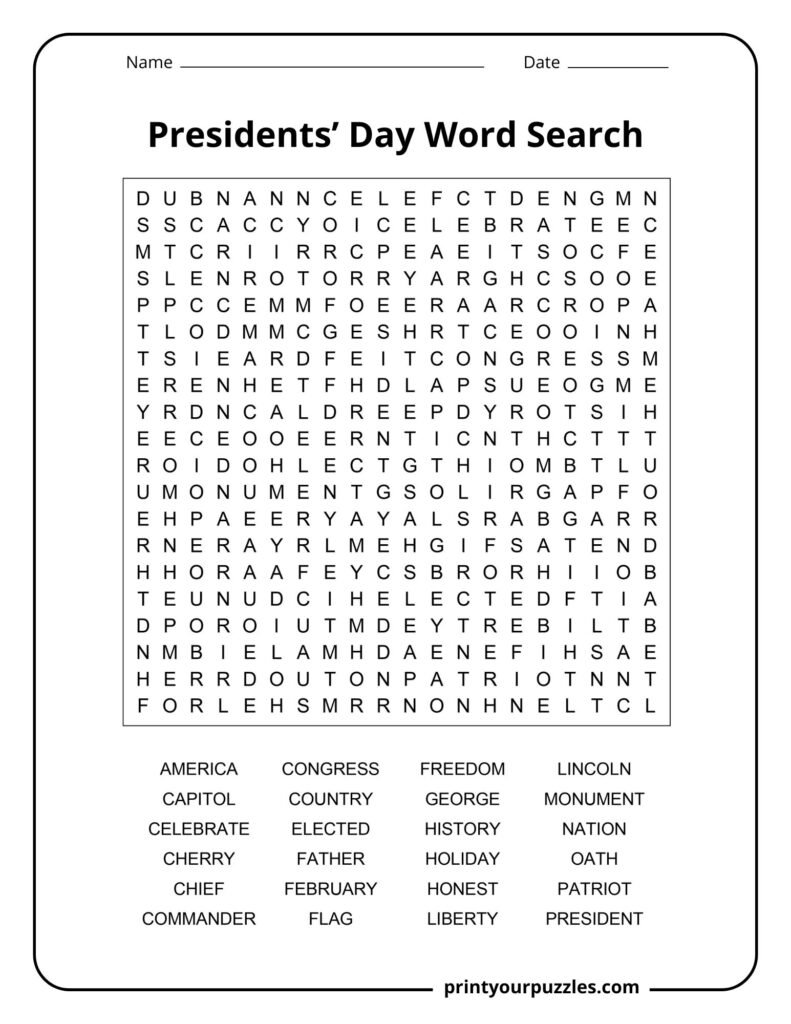
Hard Difficulty Word Search
Words to Find:
AMERICA, CAPITOL, CELEBRATE, CHERRY, CHIEF, COMMANDER, CONGRESS, COUNTRY, ELECTED, FATHER, FEBRUARY, FLAG, FREEDOM, GEORGE, HISTORY, HOLIDAY, HONEST, LIBERTY, LINCOLN, MONUMENT, NATION, OATH, PATRIOT, PRESIDENT
5 Key FAQs About Presidents' Day
5 Curious "Did You Know?" Facts About Presidents' Day