Introduction to the Molecule Word Search
A molecule is a tiny group of atoms joined together by chemical bonds. Molecules make up many of the substances found in the world around us, including water, oxygen, sugar, and carbon dioxide. Although molecules are far too small to see without specialized scientific equipment, they are essential parts of everyday life. The air we breathe, the food we eat, and the materials used to build homes, clothes, and technology all contain molecules.
Atoms are the basic building blocks of molecules. When two or more atoms bond together, they form a molecule with its own structure and properties. Some molecules contain atoms of the same element. For example, an oxygen molecule is made of two oxygen atoms bonded together and is written as O₂. Other molecules contain atoms from different elements. Water, written as H₂O, consists of two hydrogen atoms and one oxygen atom.
The way atoms are arranged within a molecule is extremely important. Two molecules may contain similar atoms but behave differently because their atoms are connected in different patterns. Chemical bonds hold these atoms together, and the most common molecular bond is called a covalent bond. In this type of bond, atoms share electrons, helping them become more stable.
Molecules vary greatly in size and complexity. Some are simple, containing only two atoms, while others include thousands or even millions of atoms. DNA, proteins, and many plastics are examples of very large molecules. Scientists study molecular shapes, bonds, and reactions to understand how substances behave and how new materials or medicines can be developed.
Molecules are constantly moving and interacting. During a chemical reaction, existing bonds may break and new bonds may form, rearranging atoms into different molecules. For example, plants use sunlight, water, and carbon dioxide during photosynthesis to create glucose and oxygen. This process demonstrates how molecules can change while the atoms themselves remain present.
Completing a molecule word search can help learners recognize key vocabulary such as atom, bond, element, compound, electron, formula, and reaction. Understanding these terms makes it easier to explore chemistry, biology, and the molecular processes that shape living organisms and the physical world.
Related Word Searches:
Atom | Chemistry | Chemical Elements | Chemical Reaction | Matter | Cellular Respiration
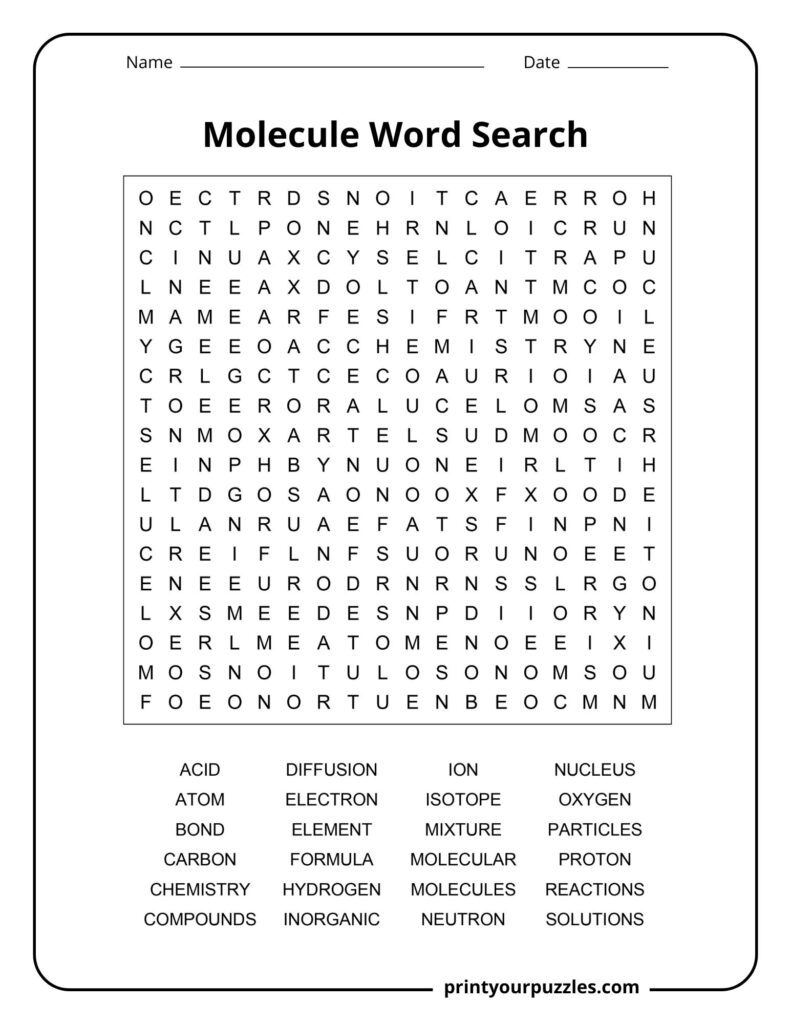
Medium Difficulty Word Search
Words to Find:
ACID, ATOM, BOND, CARBON, CHEMISTRY, COMPOUNDS, DIFFUSION, ELECTRON, ELEMENT, FORMULA, HYDROGEN, INORGANIC, ION, ISOTOPE, MIXTURE, MOLECULAR, MOLECULES, NEUTRON, NUCLEUS, OXYGEN, PARTICLES, PROTON, REACTIONS, SOLUTIONS
All Words Defined
ACID – A chemical substance that releases hydrogen ions in water, tastes sour, turns blue litmus paper red, and has a pH value below seven on the scale.
ATOM – The smallest unit of matter that retains the properties of an element, consisting of a nucleus containing protons and neutrons, surrounded by orbiting electrons in shells.
BOND – A chemical connection between two atoms formed by sharing or transferring electrons, holding atoms together in molecules and compounds through attractive forces creating stable structures.
CARBON – A nonmetallic element with atomic number six that forms the basis of organic chemistry, capable of bonding with many elements to create millions of different compounds.
CHEMISTRY – The scientific study of matter, its properties, composition, structure, and the changes it undergoes during chemical reactions and interactions with energy and other substances.
COMPOUNDS – Substances formed when two or more different elements chemically combine in fixed proportions, creating new materials with properties distinct from their constituent elements.
DIFFUSION – The spontaneous movement of particles from areas of higher concentration to lower concentration, continuing until equilibrium is reached throughout the medium without external energy.
ELECTRON – A negatively charged subatomic particle that orbits the nucleus of an atom, participating in chemical bonding and electrical conductivity with negligible mass compared to protons.
ELEMENT – A pure substance consisting of only one type of atom that cannot be broken down into simpler substances by chemical means, represented on the periodic table.
FORMULA – A symbolic representation using chemical symbols and numbers showing the types and quantities of atoms present in a molecule or compound, indicating its composition.
HYDROGEN – The lightest and most abundant element in the universe with atomic number one, consisting of one proton and one electron, essential for water formation.
INORGANIC – Describing chemical compounds that do not contain carbon-hydrogen bonds, typically including minerals, metals, salts, and other substances not derived from living organisms.
ION – An atom or molecule that has gained or lost one or more electrons, resulting in a positive or negative electrical charge affecting its chemical behavior.
ISOTOPE – Variants of a chemical element having the same number of protons but different numbers of neutrons, resulting in different atomic masses while maintaining similar chemical properties.
MIXTURE – A combination of two or more substances that are physically blended but not chemically bonded, retaining their individual properties and capable of being separated physically.
MOLECULAR – Relating to or consisting of molecules, describing the level of organization where atoms are bonded together to form discrete units with specific properties and structures.
MOLECULES – Groups of two or more atoms held together by chemical bonds, forming the smallest units of compounds that retain the chemical properties of that substance.
NEUTRON – An electrically neutral subatomic particle found in atomic nuclei with mass nearly equal to a proton, contributing to atomic mass and stability without affecting chemical properties.
NUCLEUS – The dense central core of an atom containing protons and neutrons, comprising most of the atom’s mass while occupying only a tiny fraction of its volume.
OXYGEN – A highly reactive nonmetallic element with atomic number eight, essential for respiration and combustion, comprising about twenty-one percent of Earth’s atmosphere by volume.
PARTICLES – Tiny units of matter including atoms, molecules, ions, and subatomic components that make up all substances, exhibiting both wave-like and particle-like properties.
PROTON – A positively charged subatomic particle found in the nucleus of every atom, determining the element’s identity through its atomic number and having mass approximately equal to neutrons.
REACTIONS – Chemical processes where substances interact to form new products by breaking existing bonds and creating new ones, involving energy changes and rearrangement of atoms.
SOLUTIONS – Homogeneous mixtures where one substance (solute) is uniformly dissolved in another (solvent), forming a single phase with consistent composition and properties throughout.
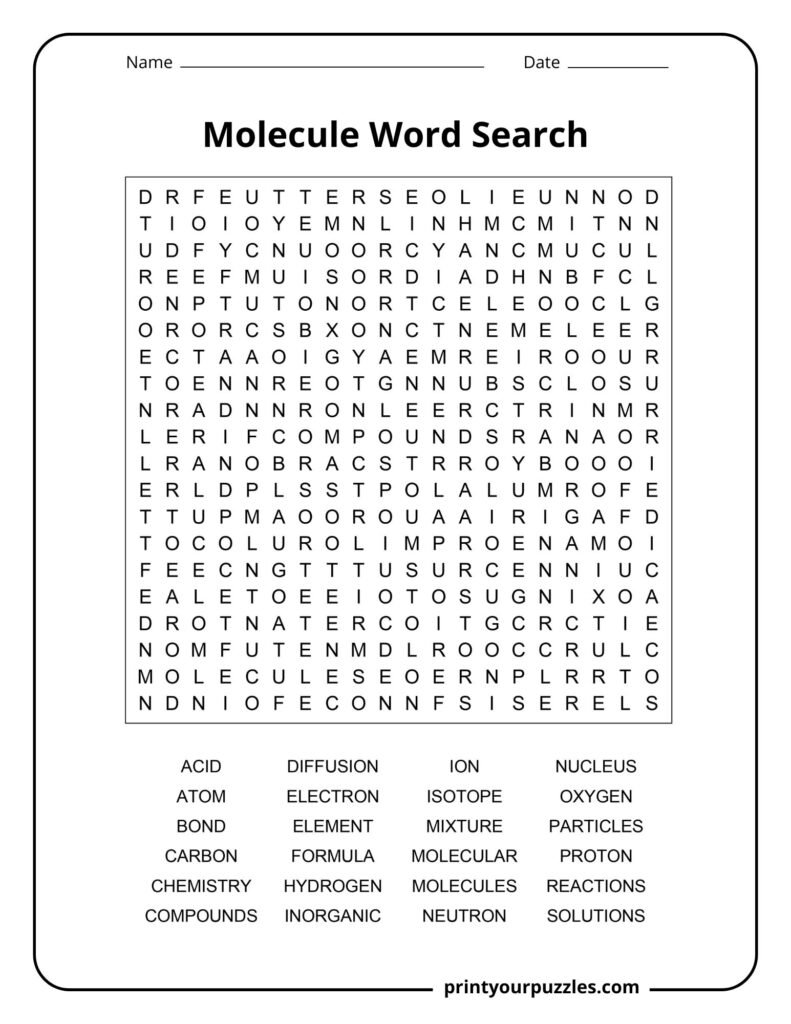
Hard Difficulty Word Search
Words to Find:
ACID, ATOM, BOND, CARBON, CHEMISTRY, COMPOUNDS, DIFFUSION, ELECTRON, ELEMENT, FORMULA, HYDROGEN, INORGANIC, ION, ISOTOPE, MIXTURE, MOLECULAR, MOLECULES, NEUTRON, NUCLEUS, OXYGEN, PARTICLES, PROTON, REACTIONS, SOLUTIONS
5 Key FAQs About Molecules
5 Curious "Did You Know?" Facts About Molecules