
Helena rises from a valley surrounded by the Rocky Mountains, giving Montana’s capital a dramatic setting shaped by gold-rush history, western architecture, outdoor recreation, and a strong sense of place. Despite its relatively small population, the city offers an impressive mixture of museums, historic districts, trails, local art, and regional food.
Helena began during the Montana gold rush of the 1860s, when prospectors discovered gold in Last Chance Gulch. The settlement grew rapidly as miners, merchants, and entrepreneurs arrived, and the wealth generated during those years left a lasting architectural legacy. When Montana became a state in 1889, Helena was later confirmed as the permanent capital.
The city’s gold-rush past is especially visible around Last Chance Gulch, now one of the most enjoyable areas to explore on foot. Historic buildings, shops, restaurants, galleries, and public art line the streets, while nearby landmarks recall the period when Helena was one of the wealthiest communities in the American West. Another worthwhile stop is the Montana Historical Society Museum, where exhibits introduce visitors to Indigenous cultures, frontier life, mining, transportation, and the broader story of the state.
Art has an important presence in Helena. The city supports galleries, studios, live performances, and creative events, while the Archie Bray Foundation for the Ceramic Arts has helped make Helena especially significant in the world of contemporary ceramics. Its studios and grounds attract artists from around the country and give the capital a cultural identity far beyond its size.
Outdoor recreation is equally easy to find. Mount Helena City Park offers hiking trails and panoramic views over the city and surrounding mountains, making it one of the best places to appreciate Helena’s setting. Nearby forests and open landscapes provide further opportunities for hiking, cycling, and wildlife watching.
Montana flavors also appear throughout the local food scene. Visitors may find bison, beef, trout, huckleberry desserts, hearty breakfasts, craft beer, and dishes inspired by ranching and mountain traditions.
A Helena word search can introduce readers to vocabulary connected with gold mining, ceramics, Montana history, mountain landscapes, food, and western culture. With historic streets, creative institutions, and trails almost at its doorstep, Helena combines frontier heritage with an unexpectedly artistic spirit.
Related Word Searches:
Montana | Boise | Cheyenne | Bismarck | Salt Lake City
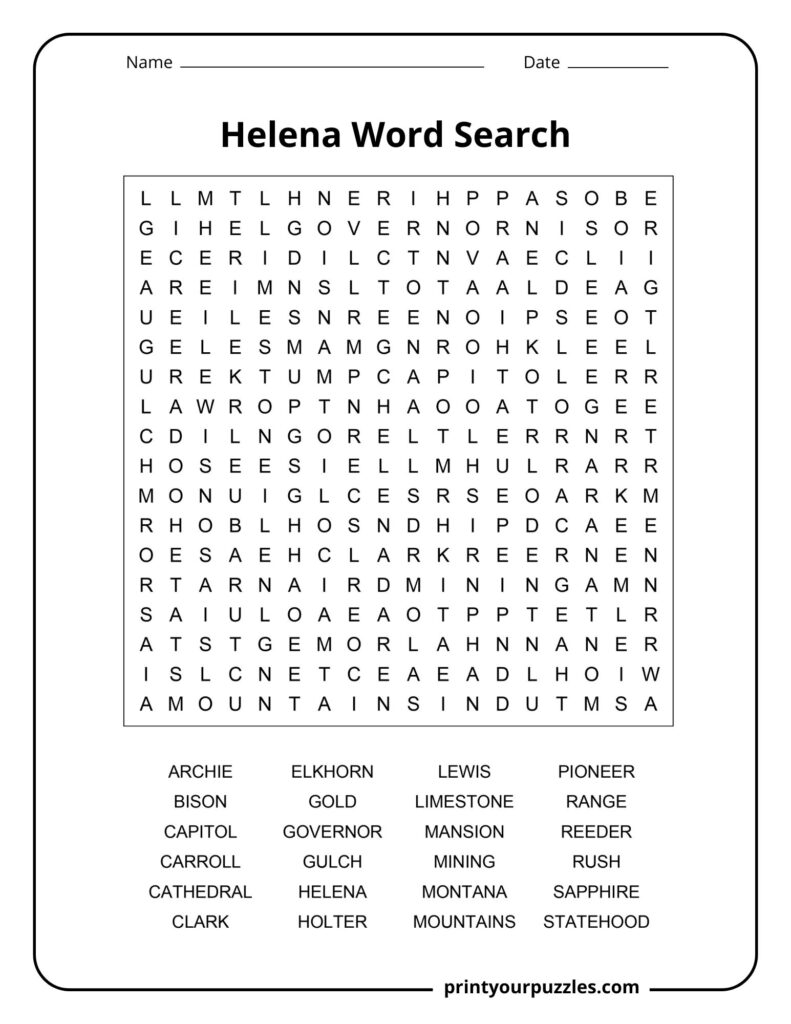
ARCHIE, BISON, CAPITOL, CARROLL, CATHEDRAL, CLARK, ELKHORN, GOLD, GOVERNOR, GULCH, HELENA, HOLTER, LEWIS, LIMESTONE, MANSION, MINING, MONTANA, MOUNTAINS, PIONEER, RANGE, REEDER, RUSH, SAPPHIRE, STATEHOOD
ARCHIE – Archie Bray founded the renowned Archie Bray Foundation for Ceramic Arts in Helena, establishing an internationally recognized center for pottery and ceramic education.
BISON – American bison roam Montana’s landscapes and represent the state’s wildlife heritage, symbolizing the wild spirit of the American West and frontier history.
CAPITOL – Montana’s State Capitol building stands prominently in Helena, featuring a distinctive copper dome and serving as the seat of state government since completion.
CARROLL – Carroll College is Helena’s private Catholic liberal arts institution, founded in 1909, providing higher education and contributing significantly to the city’s academic community.
CATHEDRAL – The Cathedral of St. Helena is a stunning Gothic Revival church with twin spires, modeled after Vienna’s Votivkirche, dominating Helena’s skyline magnificently.
CLARK – William Clark co-led the Corps of Discovery expedition through Montana with Meriwether Lewis, exploring territories that would later include Helena’s region.
ELKHORN – The Elkhorn Mountains form a prominent range near Helena, offering outdoor recreation, mining history, and scenic beauty to residents and visitors alike.
GOLD – Gold discovery in Last Chance Gulch in 1864 founded Helena, creating a prosperous mining camp that eventually became Montana’s thriving capital city.
GOVERNOR – Helena serves as Montana’s capital, housing the governor’s office and official residence, making it the center of state executive government operations.
GULCH – Last Chance Gulch is Helena’s historic main street where gold was discovered, now featuring shops, restaurants, and celebrating the city’s mining origins.
HELENA – Montana’s capital city, founded during the gold rush in 1864, nestled in the Rocky Mountains with rich history and vibrant cultural heritage.
HOLTER – The Holter Museum of Art showcases contemporary art exhibitions and community programs, serving as Helena’s premier visual arts institution and cultural gathering space.
LEWIS – Meriwether Lewis co-led the historic Lewis and Clark Expedition through Montana territories, exploring western lands and documenting the region’s natural resources.
LIMESTONE – Limestone quarried locally provided building material for many historic Helena structures, giving the city’s architecture its distinctive character and lasting durability.
MANSION – The Governor’s Mansion, built in 1959, serves as the official residence for Montana’s governor, hosting state functions and representing Montana’s governmental history.
MINING – Mining built Helena’s economy from gold rush origins through silver and other minerals, shaping the city’s development and lasting cultural identity.
MONTANA – The “Treasure State” encompasses Helena as its capital, known for mountains, mining heritage, outdoor recreation, and Big Sky Country’s natural beauty.
MOUNTAINS – Mountain ranges surrounding Helena provide stunning scenery, outdoor recreation opportunities, and define the city’s geography within the northern Rocky Mountains region.
PIONEER – Pioneer settlers transformed Helena from mining camp to thriving city, establishing businesses, homes, and institutions that formed Montana’s eventual capital.
RANGE – Mountain ranges including the Elkhorns and Big Belts encircle Helena, creating dramatic landscapes and offering hiking, skiing, and wilderness exploration opportunities.
REEDER – Reeder’s Alley is Helena’s preserved historic district featuring 1870s miners’ cottages, shops, and boardwalks, showcasing authentic gold rush era architecture.
RUSH – The gold rush of 1864 brought thousands of prospectors to Last Chance Gulch, founding Helena and creating Montana’s wealthiest nineteenth-century city.
SAPPHIRE – Montana sapphires, including those from nearby deposits, represent the state’s gemstone legacy, with Helena serving as a center for gem trade.
STATEHOOD – Montana achieved statehood in 1889, with Helena designated as capital in 1894 after competing with Anaconda, cementing its role as government center.
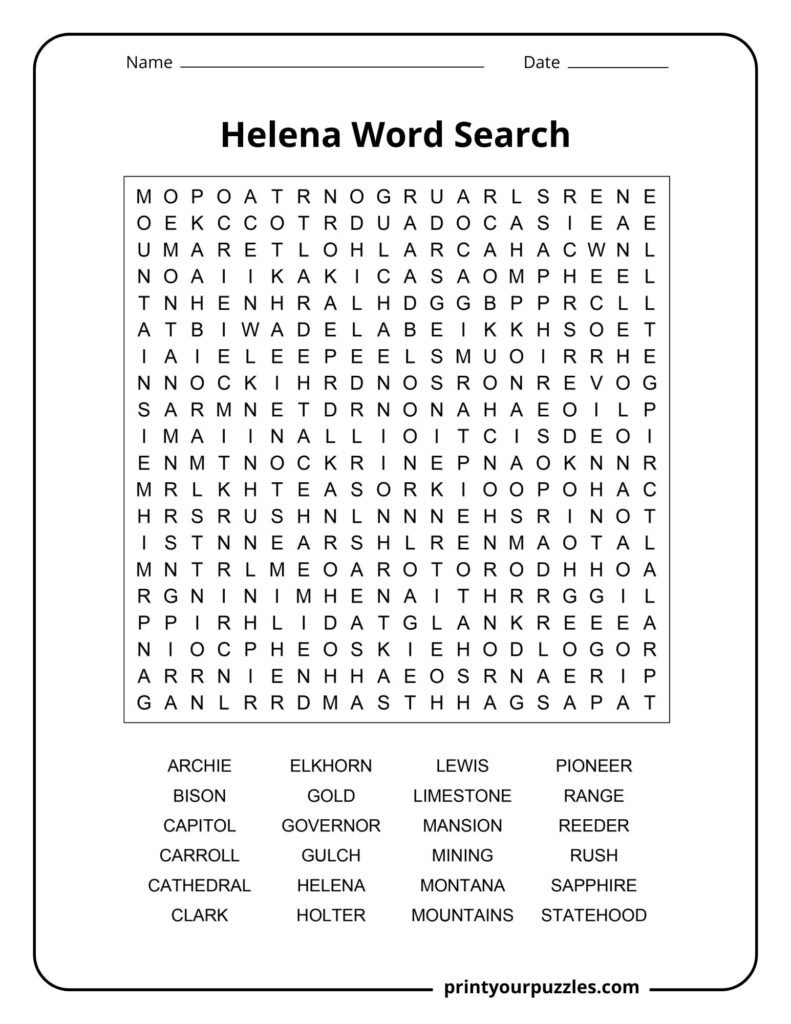
ARCHIE, BISON, CAPITOL, CARROLL, CATHEDRAL, CLARK, ELKHORN, GOLD, GOVERNOR, GULCH, HELENA, HOLTER, LEWIS, LIMESTONE, MANSION, MINING, MONTANA, MOUNTAINS, PIONEER, RANGE, REEDER, RUSH, SAPPHIRE, STATEHOOD
Helena is known for its gold rush history, stunning Cathedral of St. Helena, Montana State Capitol, outdoor recreation, and status as one of America’s smallest state capitals.
Helena became Montana’s capital in 1894 after a heated election against Anaconda. Its central location and wealth from gold mining helped secure its designation.
Top attractions include the Cathedral of St. Helena, State Capitol building, Last Chance Gulch historic district, Reeder’s Alley, Holter Museum, and Mount Helena hiking trails.
Helena experiences four distinct seasons with cold, snowy winters and warm, dry summers. The semi-arid climate features temperature variations and approximately 300 sunny days annually.
Helena offers hiking Mount Helena, skiing, fishing, mountain biking, camping in nearby national forests, exploring Gates of the Mountains, and enjoying numerous trails year-round.
For official city information, government updates, and public services, visit the City of Helena website. If you are planning a trip, check out the official tourism portal, Visit Helena.
During the 1880s gold rush boom, Helena boasted approximately 50 millionaires among its 13,000 residents, earning it the nickname “Queen City of the Rockies.”
Four prospectors called it their “last chance” before giving up and heading home. Fortunately, they discovered gold on July 14, 1864, founding Helena.
Construction began in 1908 and finished in 1924. The twin 230-foot spires contain hand-carved Bavarian stained glass windows imported from Munich, Germany.
The magnitude 6.2 earthquake caused significant damage throughout the city, killing four people and destroying numerous historic buildings, reshaping Helena’s architectural landscape forever.
This small Catholic college with approximately 1,400 students has dominated NAIA football, winning national titles in 2002, 2003, 2004, 2005, 2007, and 2010.