
Juneau feels less like a conventional capital and more like a city tucked inside the wilderness. Mountains rise sharply behind downtown, waterways stretch toward the Inside Passage, and glaciers, forests, and wildlife are never far away. Alaska’s capital combines government with outdoor adventure, Native heritage, fishing traditions, art, and some of the most dramatic scenery of any state capital.
The city grew during the late nineteenth-century gold rush after prospectors discovered gold in the area. Mining camps expanded into a permanent settlement, and Juneau eventually became the capital of Alaska Territory before remaining the state capital after Alaska entered the Union in 1959. Its isolated location is one of its most unusual characteristics: no road connects Juneau directly with the rest of Alaska or the continental highway system, so visitors generally arrive by air or sea.
One of the most memorable experiences is visiting the Mendenhall Glacier, located just outside the city. Trails and viewpoints allow visitors to see the glacier, surrounding mountains, waterfalls, and forested landscape. Another excellent activity is taking a boat excursion into nearby waters, where travelers may spot humpback whales, sea lions, bald eagles, and other wildlife.
Juneau also offers a strong cultural connection to Alaska Native communities, particularly the Tlingit people. The Alaska State Museum explores Indigenous cultures, Russian-American history, mining, fishing, and everyday life across the state. Native carving, weaving, jewelry, and contemporary art can also be found in local galleries and cultural spaces.
Seafood naturally plays a major role in the city’s food culture. Salmon, halibut, king crab, black cod, and other fresh catches appear on local menus, often alongside berries and ingredients associated with Alaska’s forests and coastal environment.
Downtown Juneau is compact and walkable, with historic buildings, shops, galleries, cafés, and waterfront views. Visitors can also ride the Goldbelt Tram up Mount Roberts for sweeping views over the city and surrounding channels.
A printable Juneau word search puzzle can introduce readers to vocabulary connected with glaciers, wildlife, Native heritage, mining, seafood, and Alaska’s coastal landscape. Few capitals feel as closely connected to the natural world as Juneau, where city life and wilderness exist almost side by side.
Related Word Searches:
Alaska | Olympia | Salem | Boise | Sacramento
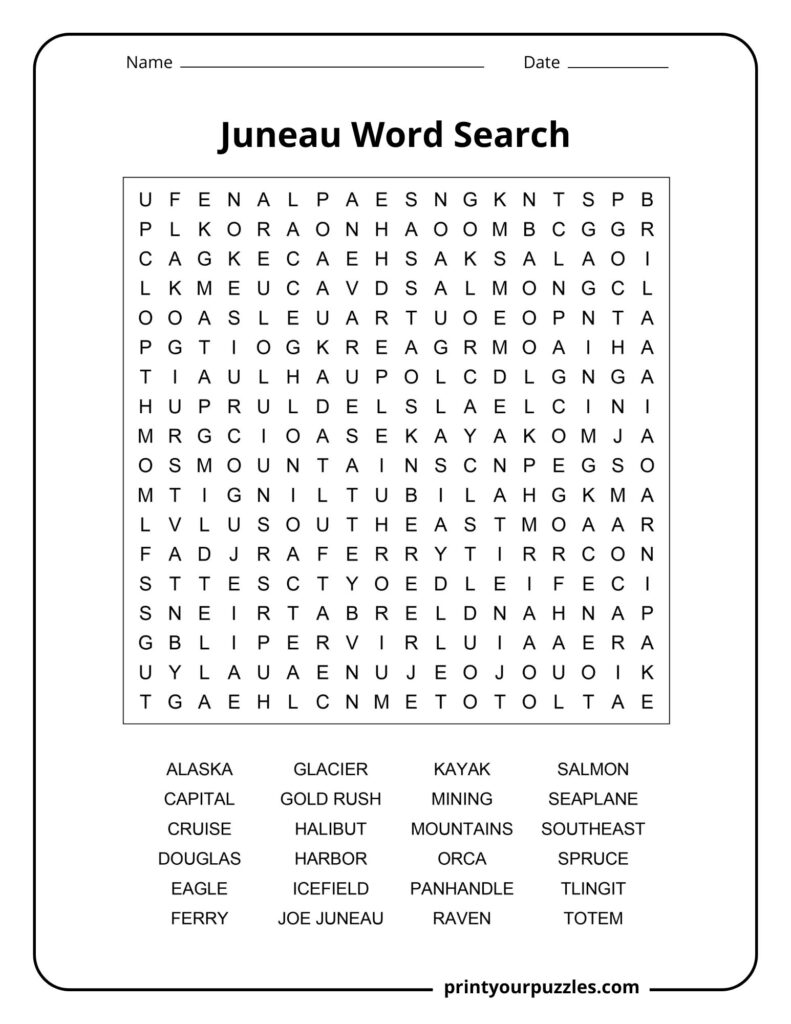
ALASKA, CAPITAL, CRUISE, DOUGLAS, EAGLE, FERRY, GLACIER, GOLD RUSH, HALIBUT, HARBOR, ICEFIELD, JOE JUNEAU, KAYAK, MINING, MOUNTAINS, ORCA, PANHANDLE, RAVEN, SALMON, SEAPLANE, SOUTHEAST, SPRUCE, TLINGIT, TOTEM
ALASKA – The 49th U.S. state and largest by area, known for wilderness, wildlife, and extreme weather. Juneau serves as its capital city despite being inaccessible by road.
CAPITAL – Juneau has been Alaska’s capital since 1906, making it the only U.S. state capital inaccessible by road and the second largest capital by area in America.
CRUISE – Juneau is a major cruise ship destination, welcoming over one million passengers annually during summer months, making tourism vital to the local economy and culture.
DOUGLAS – Douglas Island sits across Gastineau Channel from downtown Juneau. The community of Douglas is connected by bridge and considered part of greater Juneau’s municipality.
EAGLE – Bald eagles are abundant in Juneau year-round, often seen fishing along shorelines and perched in trees. They’re a symbol of Alaska’s pristine wilderness and natural beauty.
FERRY – The Alaska Marine Highway ferry system provides essential transportation connecting Juneau to other Southeast Alaska communities, serving as the region’s waterborne highway for passengers and vehicles.
GLACIER – Mendenhall Glacier is Juneau’s most famous attraction, a massive river of ice flowing from the Juneau Icefield. It’s easily accessible and visited by thousands annually.
GOLD RUSH – The 1880 gold rush established Juneau after Joe Juneau and Richard Harris discovered gold. Mining operations continued for decades, shaping the city’s early development and economy.
HALIBUT – Pacific halibut is a prized flatfish abundant in Juneau’s waters. Sport fishing and commercial halibut fishing are popular activities, with the fish being a local culinary staple.
HARBOR – Juneau’s harbors accommodate commercial fishing vessels, cruise ships, seaplanes, and recreational boats. The waterfront serves as the city’s lifeline for transportation, commerce, and tourism.
ICEFIELD – The Juneau Icefield spans 1,500 square miles across the Coast Mountains, feeding numerous glaciers including Mendenhall. It’s one of North America’s largest icefields outside polar regions.
JOE JUNEAU – Joe Juneau was the gold prospector who, with Richard Harris, discovered gold in 1880. The city was named in his honor, establishing what became Alaska’s capital.
KAYAK – Kayaking is extremely popular in Juneau’s protected waters, offering access to glaciers, wildlife, and scenic coastlines. Both guided tours and independent paddling attract residents and tourists.
MINING – Gold mining established Juneau in 1880 and dominated the economy for decades. The Alaska-Juneau Mine was once the world’s largest low-grade ore mine before closing in 1944.
MOUNTAINS – The Coast Mountains form a dramatic backdrop to Juneau, with peaks rising thousands of feet directly from the ocean. They create Juneau’s stunning fjord-like setting and unique geography.
ORCA – Orca whales, also called killer whales, frequent Juneau’s waters, especially during summer salmon runs. Whale watching tours offer opportunities to observe these magnificent marine mammals.
PANHANDLE – Southeast Alaska’s panhandle is a narrow strip of coastal land and islands stretching south from Alaska’s main landmass. Juneau sits near the region’s center.
RAVEN – Ravens are intelligent, common birds throughout Juneau and hold deep significance in Tlingit culture and mythology. They’re seen daily throughout the city in all seasons.
SALMON – Five salmon species spawn in Juneau’s streams and rivers. Salmon fishing supports commercial, subsistence, and sport fisheries while being crucial to local ecosystems and culture.
SEAPLANE – Float planes are essential transportation in Juneau, connecting the roadless capital to other communities. The distinctive sound of seaplanes is part of daily life in the city.
SOUTHEAST – Southeast Alaska, or the Alaska Panhandle, encompasses Juneau and surrounding communities. This temperate rainforest region features fjords, islands, glaciers, and dense forests throughout.
SPRUCE – Sitka spruce and other spruce species dominate Juneau’s temperate rainforest. These towering evergreens create the lush, green landscape characteristic of Southeast Alaska’s coastal environment.
TLINGIT – The Tlingit are the indigenous people of Southeast Alaska who inhabited the Juneau area for thousands of years. Their culture, art, and traditions remain vibrant today.
TOTEM – Totem poles are carved wooden monuments created by Tlingit and other Northwest Coast indigenous peoples. These important cultural symbols tell stories, honor ancestors, and display clan crests throughout Juneau.
ALASKA, CAPITAL, CRUISE, DOUGLAS, EAGLE, FERRY, GLACIER, GOLD RUSH, HALIBUT, HARBOR, ICEFIELD, JOE JUNEAU, KAYAK, MINING, MOUNTAINS, ORCA, PANHANDLE, RAVEN, SALMON, SEAPLANE, SOUTHEAST, SPRUCE, TLINGIT, TOTEM
Juneau became Alaska’s capital in 1906 due to its gold rush prominence and central location in Southeast Alaska. It replaced Sitka as the territorial capital during the mining boom era.
No, Juneau is inaccessible by road. Visitors must arrive by airplane or ferry through the Alaska Marine Highway System, making it the only U.S. state capital without road access.
Juneau has approximately 32,000 residents, making it Alaska’s third-largest city. The population includes downtown Juneau, Douglas Island, and surrounding areas within the expansive 3,255-square-mile municipality.
Summer months from May through September offer the warmest weather, longest daylight hours, and peak tourism season. Cruise ships visit during this period, and wildlife viewing opportunities are excellent.
Mendenhall Glacier, whale watching tours, Mount Roberts Tramway, Alaska State Museum, and Glacier Gardens are top attractions. Visitors also enjoy kayaking, fishing, hiking, and exploring Tlingit cultural heritage sites.
For official city information, government updates, and public services, visit the City of Juneau website. If you are planning a trip, check out the official tourism portal, Travel Juneau.
Covering 3,255 square miles, Juneau is larger than Rhode Island and Delaware combined. However, most of this area consists of wilderness, glaciers, mountains, and icefields rather than urban development.
The Juneau Icefield holds approximately 1,000 cubic miles of ice, surpassing Switzerland’s total ice volume. This massive frozen expanse feeds 38 major glaciers flowing from the Coast Mountains.
Unlike most state capitols, Juneau’s government building is a modest six-story structure built in 1931 without a traditional dome. It’s one of America’s least ornate state capitol buildings.
Juneau ranks as one of America’s rainiest cities, receiving approximately 92 inches of precipitation yearly. The temperate rainforest climate creates lush vegetation but requires residents to embrace rainy weather.
The city was briefly called Rockwell and Harrisburg before settling on Juneau. Several voter initiatives have attempted relocating Alaska’s capital to Anchorage or Wasilla but failed due to costs.