
Jackson, Mississippi, carries a story shaped by Southern history, music, literature, civil rights, and the landscapes of the Deep South. As the state capital, it serves as an important political and economic center, but its museums, cultural institutions, neighborhoods, and regional traditions reveal a much broader identity.
Founded in 1821 and named for Andrew Jackson, the city was selected because of its central location within Mississippi. Jackson grew steadily during the nineteenth and twentieth centuries, although the Civil War brought destruction and disruption. Later, the city became deeply connected to the Civil Rights Movement, with activists, churches, journalists, and community leaders playing important roles in the struggle for equality.
One of the most meaningful places to visit is the Mississippi Civil Rights Museum, where powerful exhibits trace the history of segregation, activism, resistance, and change across the state. Nearby, the Museum of Mississippi History explores a much longer story, from Indigenous cultures and early settlement to agriculture, industry, and modern life.
Jackson also has strong artistic traditions. Blues and gospel music are closely tied to Mississippi, and the city has long supported musicians, writers, painters, and performers. The Mississippi Museum of Art adds another dimension with collections and exhibitions focused on Southern, American, and contemporary works, while murals and live music help keep the city’s creative culture visible beyond museum walls.
Food is equally important to Jackson’s personality. Soul food, fried catfish, barbecue, cornbread, greens, biscuits, and pecan desserts reflect long-standing regional traditions, while newer restaurants bring additional influences and updated interpretations of Southern cooking.
For time outdoors, visitors can explore LeFleur’s Bluff State Park, where trails, woodland, and the Pearl River provide a natural escape within the metropolitan area. Historic neighborhoods and local districts also reward slower exploration, revealing churches, older homes, community institutions, and architectural details connected to different periods of the city’s growth.
A Jackson word search can introduce readers to vocabulary connected with civil rights, blues, Southern food, museums, literature, and Mississippi history. Jackson’s combination of powerful historical stories, creative traditions, and distinctive regional culture makes it one of the most meaningful capitals to explore in the South.
Related Word Searches:
Mississippi | Montgomery | Baton Rouge | Little Rock | Nashville
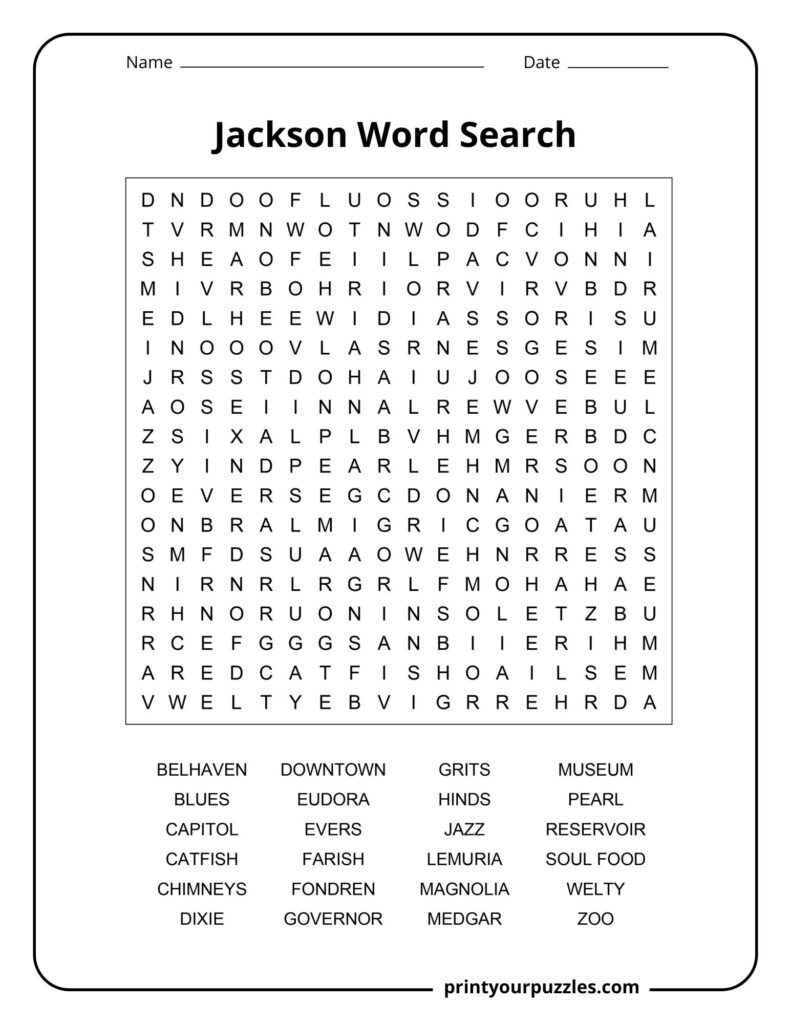
BELHAVEN, BLUES, CAPITOL, CATFISH, CHIMNEYS, DIXIE, DOWNTOWN, EUDORA, EVERS, FARISH, FONDREN, GOVERNOR, GRITS, HINDS, JAZZ, LEMURIA, MAGNOLIA, MEDGAR, MUSEUM, PEARL, RESERVOIR, SOUL FOOD, WELTY, ZOO
BELHAVEN – Historic Jackson neighborhood known for tree-lined streets and beautiful early 20th-century homes. Also home to Belhaven University, a private Christian liberal arts institution founded in 1883.
BLUES – Musical genre deeply rooted in Mississippi’s African American heritage. Jackson’s blues scene connects to the state’s rich musical legacy, influencing American music history profoundly.
CAPITOL – Mississippi’s State Capitol building, completed in 1903. This Beaux-Arts style structure serves as the seat of state government and features a distinctive gold-leaf dome visible throughout downtown.
CATFISH – Quintessential Mississippi Delta cuisine, typically fried and served with hushpuppies. This freshwater fish is a staple in Jackson’s restaurants, representing authentic Southern comfort food traditions.
CHIMNEYS – Refers to “Two Mississippi Museums,” whose distinctive chimney-like towers mark Jackson’s skyline. These architectural features symbolize the city’s commitment to preserving history and cultural heritage.
DIXIE – Regional term representing Southern cultural identity and heritage. While complex and sometimes controversial, it reflects Jackson’s historical connection to the Deep South’s traditions and history.
DOWNTOWN – Jackson’s central business and governmental district along Capitol Street. Features historic buildings, museums, and restaurants, serving as the political and cultural heart of Mississippi’s capital city.
EUDORA – Refers to Eudora Welty, Pulitzer Prize-winning author born in Jackson. Her literary works captured Southern life with remarkable insight, making her one of America’s greatest writers.
EVERS – Medgar Evers, civil rights activist assassinated in
Jackson in 1963. His courage fighting segregation and racial injustice made him a pivotal figure in American civil rights history.
FARISH – Historic Farish Street, Jackson’s renowned African American business and entertainment district. Once called “America’s main street,” it thrived during segregation, showcasing
Black economic and cultural achievement.
FONDREN – Eclectic, artsy Jackson neighborhood known for independent shops, galleries, restaurants, and vibrant creative community. This district embodies Jackson’s contemporary cultural renaissance and bohemian spirit.
GOVERNOR – Mississippi’s chief executive, with the Governor’s Mansion located in downtown Jackson since 1842. This position represents the state’s highest elected office and political leadership.
GRITS – Ground corn staple of Southern breakfast cuisine, served throughout Jackson restaurants. This humble dish represents authentic Southern foodways and regional culinary traditions passed through generations.
HINDS – Hinds County, where Jackson serves as county seat. Named after General Thomas Hinds, it’s Mississippi’s most populous county, encompassing the capital and surrounding communities.
JAZZ – Musical genre celebrated in Jackson through festivals and venues. The city’s jazz scene connects to Mississippi’s broader musical heritage, featuring local and touring artists regularly.
LEMURIA – Beloved independent bookstore in Jackson’s Fondren neighborhood since 1975. This literary landmark hosts author events, supports local writers, and serves as a community cultural gathering place.
MAGNOLIA – Mississippi’s state flower and tree, symbolizing the South’s natural beauty. These fragrant white blooms represent Jackson’s landscape and Mississippi’s official state identity throughout America.
MEDGAR – Medgar Evers, NAACP field secretary murdered outside his Jackson home in 1963. His assassination galvanized the civil rights movement, making him a martyr for racial equality.
MUSEUM – Jackson hosts multiple museums including the Mississippi Museum of Art and Civil Rights Museum. These institutions preserve state history, culture, and artistic heritage for future generations.
PEARL – Pearl River flows along Jackson’s eastern boundary, providing recreation and natural beauty. This waterway has shaped the city’s development, geography, and occasional flooding challenges throughout history.
RESERVOIR – Ross Barnett Reservoir, massive lake northeast of Jackson created in 1960s. This popular recreation area offers boating, fishing, and waterfront living for metropolitan area residents.
SOUL FOOD – Traditional African American cuisine featuring collard greens, fried chicken, cornbread, and sweet potatoes. Jackson’s soul food restaurants preserve these authentic culinary traditions and cultural heritage.
WELTY – Eudora Welty, Jackson’s most celebrated literary figure and Pulitzer Prize winner. Her preserved home is now a museum, honoring her profound contributions to American literature.
ZOO – Jackson Zoo, established in 1919, features diverse animal exhibits and educational programs. Despite recent challenges, it represents the city’s commitment to family entertainment and wildlife conservation.
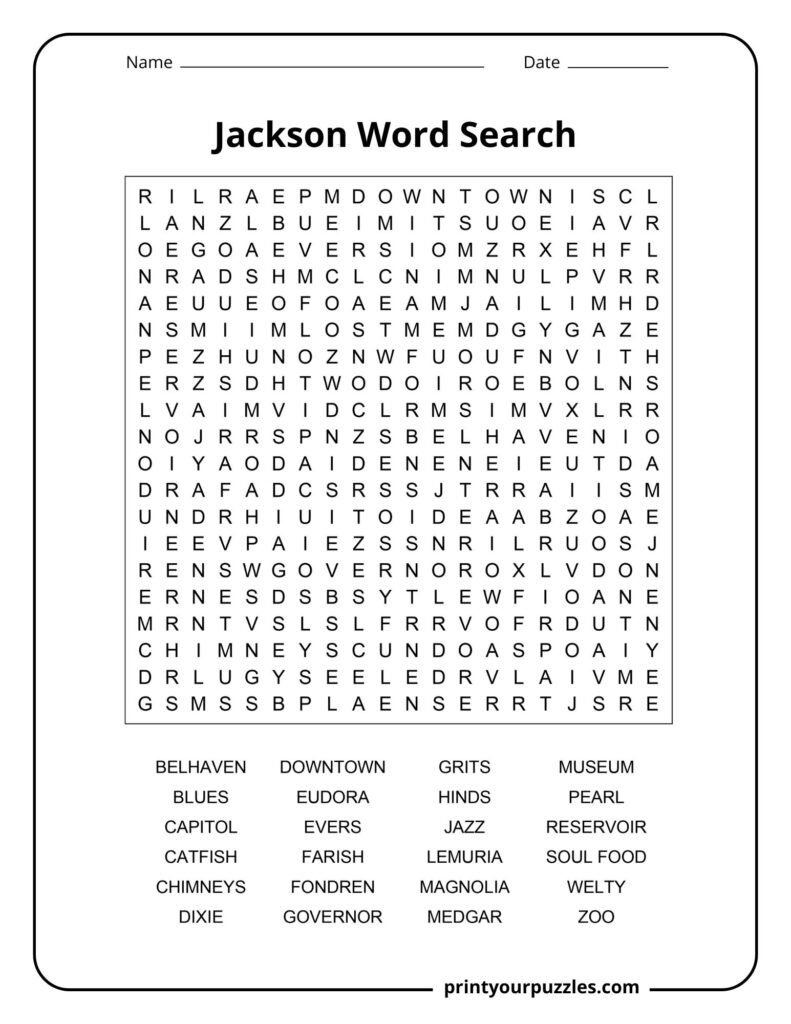
BELHAVEN, BLUES, CAPITOL, CATFISH, CHIMNEYS, DIXIE, DOWNTOWN, EUDORA, EVERS, FARISH, FONDREN, GOVERNOR, GRITS, HINDS, JAZZ, LEMURIA, MAGNOLIA, MEDGAR, MUSEUM, PEARL, RESERVOIR, SOUL FOOD, WELTY, ZOO
Jackson is known as Mississippi’s capital city, its pivotal role in civil rights history, being Eudora Welty’s hometown, authentic Southern cuisine, and rich blues musical heritage throughout the Delta region.
Jackson was named after General Andrew Jackson, who later became the seventh U.S. President. The city was founded in 1821 and designated as Mississippi’s state capital that same year.
Top attractions include the Mississippi Civil Rights Museum, Eudora Welty House, Mississippi Museum of Art, State Capitol building, Fondren neighborhood’s shops and galleries, and the historic Farish Street district.
Jackson’s population is approximately 150,000-180,000 residents within city limits, making it Mississippi’s most populous city. The greater metropolitan area includes roughly 580,000 people across surrounding counties.
You must try authentic soul food, fried catfish with hushpuppies, creamy grits, comeback sauce (a local specialty), tamales, sweet tea, and traditional Southern comfort foods at family-owned restaurants.
For official city information, government updates, and public services, visit the City of Jackson website. If you are planning a trip, check out the official tourism portal, Visit Jackson.
The acclaimed author was born in her family’s Tudor Revival home in 1909 and lived there until her death in 2001. Today, it’s a museum preserving her literary legacy.
Union General William T. Sherman burned much of Jackson during the Civil War in 1863, earning the city the nickname “Chimneyville” because only chimneys remained standing among the ruins.
During segregation, this thriving African American business district featured Black-owned banks, theaters, restaurants, and shops, representing remarkable economic achievement despite oppressive Jim Crow laws throughout the South.
The distinctive gilded dome, visible throughout downtown Jackson, was restored in the 1980s using genuine 23-karat gold leaf, making it gleam brilliantly under the Southern sun.
The Jackson Volcano, dormant for approximately 70 million years, lies beneath the city. This ancient geological feature occasionally causes minor earthquakes and affects the region’s unique underground geology.