
Lansing has a practical Midwestern character, but beneath its government-centered reputation lies a city shaped by automobiles, education, rivers, museums, and neighborhood culture. Michigan’s capital sits where the Grand and Red Cedar rivers meet, giving it both an urban core and easy access to green spaces.
The city’s rise began in the nineteenth century, when Michigan lawmakers chose Lansing as the state capital in 1847. At the time, the area was still relatively small, but the decision encouraged rapid development. Industry soon followed, and Lansing became especially important to automobile manufacturing, helping connect the city with Michigan’s broader role in American industrial history.
One of the most interesting places to visit is the R.E. Olds Transportation Museum, which explores the legacy of Ransom E. Olds and Lansing’s contribution to the automobile industry. Historic vehicles, engines, and exhibits show how transportation transformed both the city and the nation. Families may also enjoy the Impression 5 Science Center, where hands-on exhibits make science and technology accessible to younger visitors.
Art and culture are closely linked with the presence of Michigan State University in neighboring East Lansing. The university brings exhibitions, concerts, theater, sports, and academic life to the metropolitan area. The Eli and Edythe Broad Art Museum, with its striking contemporary design, adds a bold architectural and artistic presence.
Outdoor activities are easy to find along the Lansing River Trail, which follows the Grand and Red Cedar rivers and connects parks, neighborhoods, and attractions. Walking or cycling the trail offers a relaxed way to experience the city beyond downtown streets.
Lansing’s food scene reflects both Michigan traditions and a diverse modern population. Visitors may find coney-style hot dogs, locally grown produce, craft beer, comfort food, and dishes influenced by Middle Eastern, Mexican, Asian, and other communities. Farmers markets and neighborhood restaurants add to that variety.
Our Lansing word search can introduce readers to vocabulary connected with automobiles, rivers, science, university life, art, and Michigan history. With industrial heritage, cultural institutions, and miles of riverfront paths, Lansing reveals a capital city that is more varied and active than its low-key image might suggest.
Related Word Searches:
Michigan | Madison | Columbus | Indianapolis | Springfield
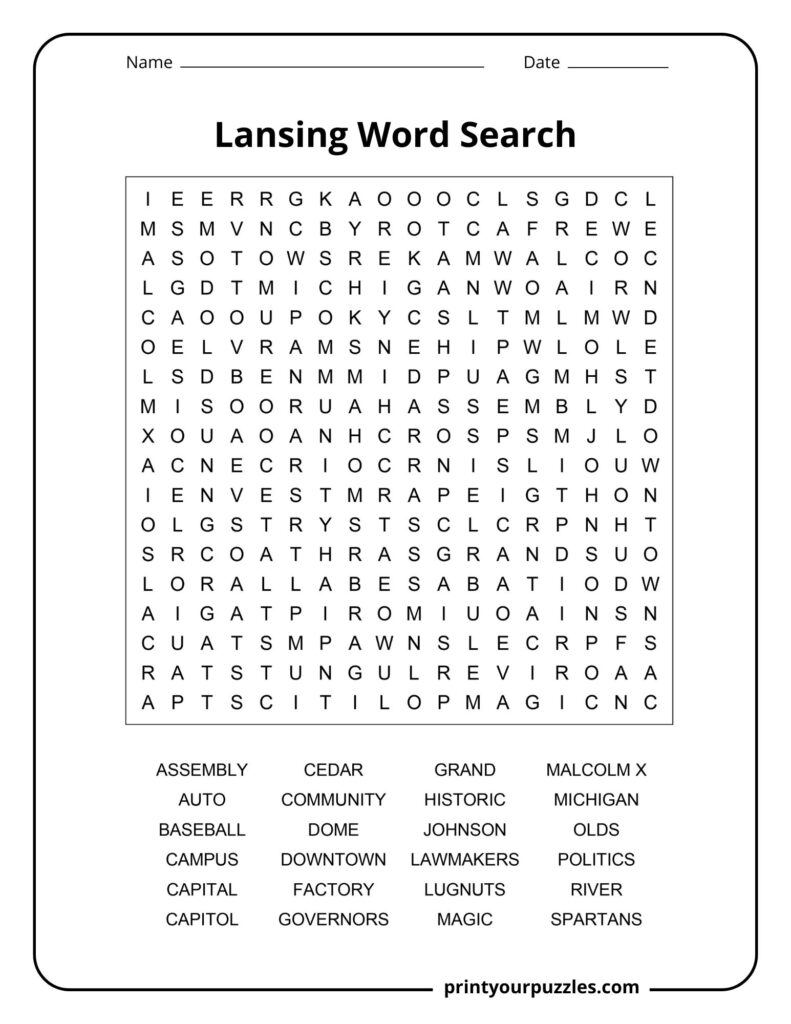
ASSEMBLY, AUTO, BASEBALL, CAMPUS, CAPITAL, CAPITOL, CEDAR, COMMUNITY, DOME, DOWNTOWN, FACTORY, GOVERNORS, GRAND, HISTORIC, JOHNSON, LAWMAKERS, LUGNUTS, MAGIC, MALCOLM X, MICHIGAN, OLDS, POLITICS, RIVER, SPARTANS
ASSEMBLY – Refers to both Michigan’s legislative assembly that meets in Lansing and the automotive assembly lines that historically defined the city’s industrial economy and manufacturing heritage.
AUTO – Lansing’s automotive manufacturing legacy, home to multiple General Motors plants and birthplace of Oldsmobile, making it a significant center of American automobile production history.
BASEBALL – The Lansing Lugnuts minor league baseball team plays at Jackson Field downtown, providing affordable family entertainment and connecting the community through America’s favorite pastime.
CAMPUS – Michigan State University’s expansive campus borders East Lansing, influencing the region’s culture, economy, and identity with over 50,000 students and world-class research facilities.
CAPITAL – Lansing became Michigan’s state capital in 1847, replacing Detroit, serving as the governmental center where state laws are created and major political decisions are made.
CAPITOL – The Michigan State Capitol building, completed in 1879, is a stunning architectural landmark featuring Victorian design and serving as the seat of state government operations.
CEDAR – The Red Cedar River flows through the region, providing natural beauty, recreational opportunities, and serving as a defining geographical feature for both Lansing and MSU.
COMMUNITY – Lansing’s diverse, resilient community of approximately 120,000 residents represents various backgrounds, creating a welcoming Midwestern city with strong neighborhoods and civic pride throughout.
DOME – The iconic Capitol dome rises 267 feet above Lansing’s skyline, featuring ornate Victorian architecture and serving as a recognizable symbol of Michigan’s government and state pride.
DOWNTOWN – Lansing’s revitalized downtown features restaurants, entertainment venues, government buildings, and cultural attractions, serving as the urban heart of Michigan’s capital city and surrounding region.
FACTORY – Automotive factories, particularly General Motors plants, have employed generations of workers, shaping Lansing’s economy, culture, and identity as a blue-collar manufacturing city since Oldsmobile’s founding.
GOVERNORS – Michigan’s governors work from Lansing, leading state policy and administration. The governor’s mansion and executive offices are located here, making it the center of executive power.
GRAND – The Grand River flows through downtown Lansing, providing scenic beauty, recreational trails, and historically powering mills that contributed to the city’s early industrial development and growth.
HISTORIC – Lansing’s rich history includes Native American heritage, becoming state capital, automotive innovation with Oldsmobile, and civil rights connections, making it historically significant beyond its governmental role.
JOHNSON – Earvin “Magic” Johnson, NBA legend and Hall of Famer, was born in Lansing and played for Michigan State, becoming the city’s most famous sports ambassador.
LAWMAKERS – Michigan’s state legislators convene in Lansing to debate, create, and pass laws affecting millions of residents, making the city the center of state-level democratic governance.
LUGNUTS – The Lansing Lugnuts are the city’s beloved Class-A minor league baseball team, affiliated with the Oakland Athletics, entertaining families at Jackson Field since 1996.
MAGIC – Earvin “Magic” Johnson’s nickname represents his legendary basketball skills, championship legacy with Michigan State and the Lakers, and his enduring connection to his Lansing
hometown.
MALCOLM X – Influential civil rights leader and human rights activist, was born Malcolm Little in Lansing in 1925, adding significant historical importance to the city.
MICHIGAN – Lansing serves as Michigan’s capital city, representing the state’s government, hosting state offices, and symbolizing Michigan’s political identity and administrative center for state operations.
OLDS – Ransom E. Olds founded Oldsmobile in Lansing in 1897, pioneering mass production automotive manufacturing and establishing the city’s century-long legacy as a major automobile production center.
POLITICS – As Michigan’s capital, Lansing is the epicenter of state politics where legislators debate policy, lobbyists advocate positions, and political campaigns focus attention on governance and elections.
RIVER – Both the Grand River and Red Cedar River flow through the Lansing area, providing natural beauty, recreation, wildlife habitat, and historically supporting the region’s industrial development.
SPARTANS – Michigan State University’s Spartans compete in Big Ten athletics, with successful basketball and football programs creating regional pride and significant cultural impact throughout the Lansing area.
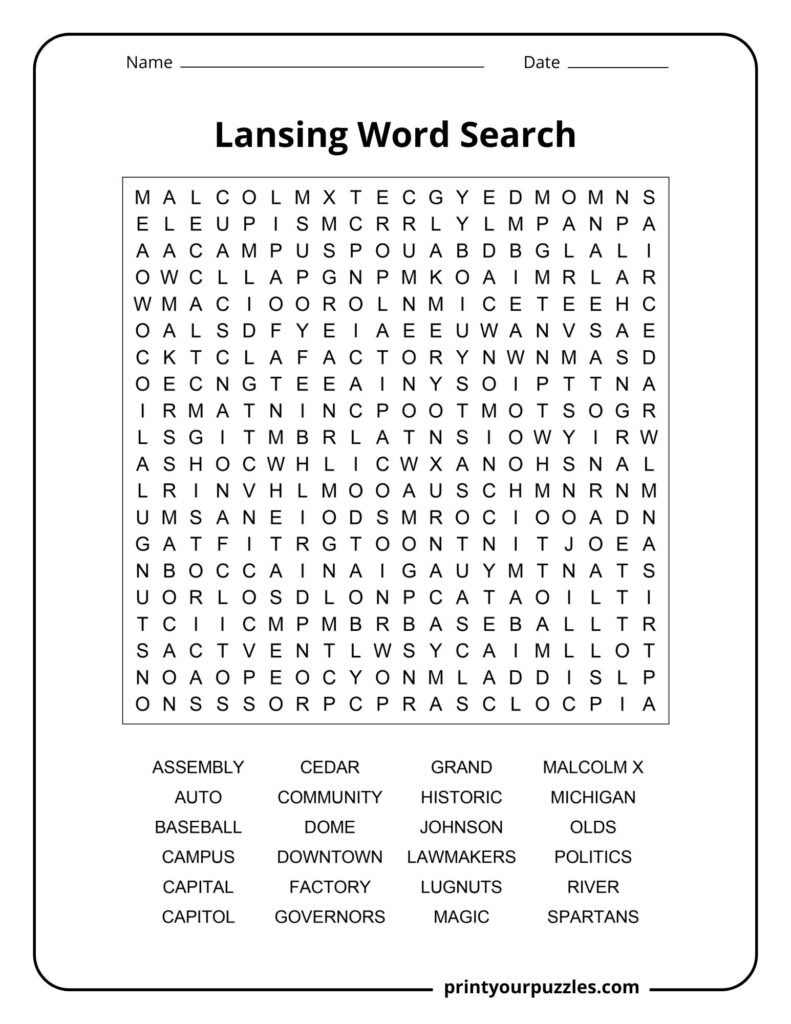
ASSEMBLY, AUTO, BASEBALL, CAMPUS, CAPITAL, CAPITOL, CEDAR, COMMUNITY, DOME, DOWNTOWN, FACTORY, GOVERNORS, GRAND, HISTORIC, JOHNSON, LAWMAKERS, LUGNUTS, MAGIC, MALCOLM X, MICHIGAN, OLDS, POLITICS, RIVER, SPARTANS
Lansing became Michigan’s capital in 1847 because legislators wanted a more centrally located capital city. The location offered better access for residents statewide and reduced Detroit’s concentrated political power.
Lansing is famous for being Michigan’s capital, the birthplace of Oldsmobile and automotive manufacturing, home to Michigan State University, and the hometown of Magic Johnson and Malcolm X.
Lansing has approximately 120,000 residents within city limits. The greater Lansing metropolitan area, including East Lansing and surrounding communities, totals around 550,000 people, making it Michigan’s third-largest metro.
Government operations, automotive manufacturing (particularly General Motors), education through Michigan State University, healthcare, and insurance are Lansing’s primary industries, providing diverse employment opportunities for residents and economic stability.
Visitors should explore the Michigan State Capitol building, Michigan History Museum, Potter Park Zoo, Lansing River Trail, Michigan State University campus, and downtown restaurants. Catch a Lugnuts baseball game for local entertainment.
For official city information, government updates, and public services, visit the City of Lansing website. If you are planning a trip, check out the official tourism portal, Choose Lansing.
The influential civil rights leader was born Malcolm Little at Lansing General Hospital. His family home was burned by white supremacists, profoundly shaping his childhood and future activism.
In 1847, Lansing was merely wilderness called “Michigan Township.” Legislators selected this undeveloped central location specifically to build a new capital city practically from scratch, angering Detroit residents.
Ransom Olds’ curved-dash Oldsmobile, built in Lansing starting 1901, pioneered assembly-line manufacturing before Henry Ford. His innovative production methods revolutionized the entire automotive industry forever.
Michigan’s stunning 1879 Capitol features intricate hand-painted ceiling details, ornate Victorian architecture, and nearly 1,000 rooms spread across multiple floors, making it an architectural masterpiece worth touring extensively.
The Silver Bells in the City holiday celebration transforms downtown Lansing each November with massive fireworks, attracting over 50,000 spectators. It’s become Michigan’s official kickoff to Christmas season.