
Surrounded by forests and shaped by the Kennebec River, Augusta feels very different from the large metropolitan capitals found elsewhere in the United States. Maine’s capital combines government, historic architecture, riverside scenery, and the quieter character associated with much of New England. Its modest size is part of its appeal, allowing visitors to experience important landmarks without losing the atmosphere of a small city.
The Kennebec River has influenced Augusta since its earliest days. Indigenous peoples lived and traveled through the region long before European settlement, using the river as an important transportation route. English settlers later established communities in the area, and Augusta gradually developed as a center for trade and local government. When Maine separated from Massachusetts and became a state in 1820, Portland initially served as the capital. Augusta was selected several years later because of its more central location, and the state government moved there in 1832.
One of the city’s most distinctive buildings is the Maine State House, designed in part by noted architect Charles Bulfinch. Visitors can explore the Capitol area and then walk to the nearby Maine State Museum, whose collections tell stories about the state’s Indigenous heritage, industries, natural environment, and everyday life. Together, these attractions provide an excellent introduction to Maine beyond its famous coastline.
For a change of pace, the Kennebec River Rail Trail offers another enjoyable way to experience Augusta. Walking or cycling along sections of the trail reveals river views and connects the capital with neighboring communities. History enthusiasts can also visit the Old Fort Western area, where an eighteenth-century wooden fort recalls an earlier chapter of life along the Kennebec.
Maine culture is closely connected with craftsmanship, nature, and regional food. Around Augusta, visitors can encounter local art, handmade products, and seasonal community events. Lobster may be Maine’s most famous culinary symbol, but the state is also associated with blueberries, maple products, seafood chowders, whoopie pies, and dishes prepared with ingredients from local farms.
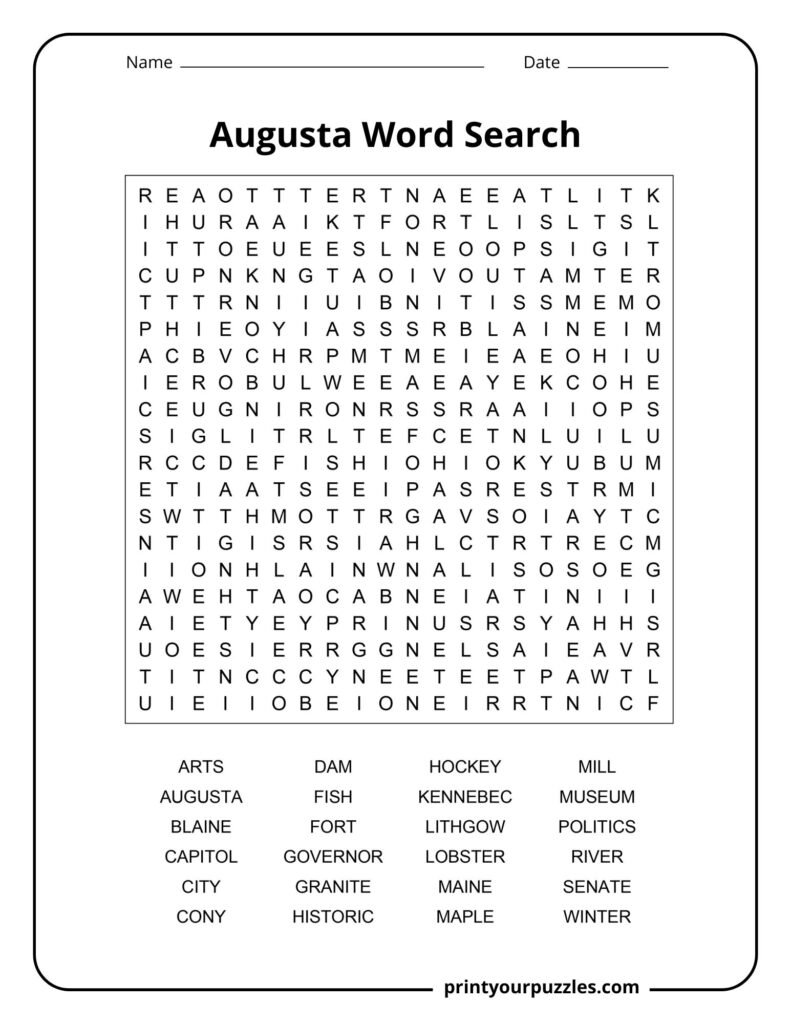
A prinable Augusta word search puzzle can bring together vocabulary inspired by the Kennebec River, state government, historic landmarks, Maine traditions, and outdoor life. Quiet rather than flashy, Augusta shows that a capital does not need towering skyscrapers to tell an important and engaging story.
Related Word Searches:
Maine | Concord | Montpelier | Boston | Providence

ARTS, AUGUSTA, BLAINE, CAPITOL, CITY, CONY, DAM, FISH, FORT, GOVERNOR, GRANITE, HISTORIC, HOCKEY, KENNEBEC, LITHGOW, LOBSTER, MAINE, MAPLE, MILL, MUSEUM, POLITICS, RIVER, SENATE, WINTER
ARTS – Augusta hosts various cultural programs and galleries, including performances at the Capitol and community theater productions that celebrate Maine’s creative heritage and local artists.
AUGUSTA – Maine’s capital city since 1827, located on the Kennebec River. Population approximately 18,000, serving as the governmental and administrative center of the state.
BLAINE – James G. Blaine, prominent Augusta resident who served as Speaker of the House, Secretary of State, and 1884 presidential candidate. His mansion still stands.
CAPITOL – The Maine State House, built in 1832 with Charles Bulfinch’s design, features a distinctive dome and serves as the seat of Maine’s legislature and government.
CITY – Augusta became Maine’s capital in 1827 due to its central location. The city combines governmental functions with residential neighborhoods and commercial districts along the river.
CONY – Samuel Cony served as Maine’s governor during the Civil War era. Cony High School, Augusta’s public high school, bears his name honoring his legacy.
DAM – The Edwards Dam on the Kennebec River was removed in 1999, the first major federal dam removal, restoring fish passage and river ecology significantly.
FISH – The Kennebec River supports various fish species. After dam removal, alewives, shad, and striped bass returned, restoring historical fishing traditions in the area.
FORT – Fort Western, built in 1754, is America’s oldest surviving wooden fort. Now a museum, it preserves colonial and Revolutionary War history along the Kennebec.
GOVERNOR – Maine’s governor works from the State House in Augusta, serving as chief executive. The Blaine House serves as the official governor’s residence since 1919.
GRANITE – Maine granite, abundant in the region, was used extensively in Augusta’s historic buildings. The state’s granite industry contributed significantly to local economic development.
HISTORIC – Augusta’s history spans Native American settlements, colonial forts, industrial mills, and political significance. Many preserved buildings showcase architectural heritage from multiple centuries.
HOCKEY – Ice hockey is popular in Augusta, with youth leagues and high school teams. The city’s cold winters provide ideal conditions for this beloved Maine sport.
KENNEBEC – The Kennebec River flows through Augusta’s heart, historically powering mills and facilitating transportation. Today it offers recreation and defines the city’s geography and character.
LITHGOW – The Lithgow Public Library, established in 1896, serves Augusta with extensive collections, community programs, and historic architecture. It’s a cultural cornerstone for residents.
LOBSTER – Though Augusta is inland, Maine lobster is central to state identity. Local restaurants serve this iconic seafood, connecting the capital to coastal traditions.
MAINE – The Pine Tree State, admitted to the Union in 1820. Augusta became its capital, centralizing government for the northernmost New England state.
MAPLE – Maple trees are abundant in Augusta, providing brilliant fall foliage. Maple syrup production represents an important traditional industry throughout Maine’s rural regions.
MILL – Historic textile and lumber mills lined the Kennebec River, driving Augusta’s nineteenth-century industrial growth. Mill buildings remain as architectural reminders of this manufacturing heritage.
MUSEUM – The Maine State Museum showcases natural history, Native American artifacts, and industrial heritage. Fort Western operates as a living history museum presenting colonial life.
POLITICS – As Maine’s capital, Augusta is the center of state politics. The legislature meets here, and political debates, campaigns, and governmental decisions shape daily life.
RIVER – The Kennebec River, flowing 170 miles to the Atlantic, shaped Augusta’s location and development. It provided power, transportation, and continues defining the city’s landscape.
SENATE – The Maine Senate, part of the state legislature, meets in Augusta’s Capitol. Thirty-five senators represent districts statewide, debating and passing state laws annually.
WINTER – Augusta experiences harsh Maine winters with heavy snow and cold temperatures. Winter activities include skiing, ice fishing, and hockey, embracing the challenging seasonal climate.
ARTS, AUGUSTA, BLAINE, CAPITOL, CITY, CONY, DAM, FISH, FORT, GOVERNOR, GRANITE, HISTORIC, HOCKEY, KENNEBEC, LITHGOW, LOBSTER, MAINE, MAPLE, MILL, MUSEUM, POLITICS, RIVER, SENATE, WINTER
Augusta became Maine’s capital in 1827, replacing Portland. Its central location made it more accessible to residents statewide, facilitating better governmental representation and communication across the state.
Augusta has approximately 18,000 residents, making it Maine’s third-largest city by area but a relatively small capital. The greater Augusta area includes surrounding communities totaling around 60,000 people.
Top attractions include the Maine State House with its iconic dome, Fort Western historic site, Maine State Museum, Viles Arboretum, and the scenic Kennebec River Rail Trail for outdoor recreation.
Augusta’s central geographic location on the Kennebec River made it accessible from all regions. Its position facilitated travel for legislators statewide, replacing the coastal Portland with a more equitable location.
Augusta experiences four distinct seasons with cold, snowy winters averaging 60+ inches annually, mild springs, warm summers reaching 80°F, and spectacular fall foliage. True northern New England climate prevails.
For official city information, government updates, and public services, visit the City of Augusta website. If you are planning a trip, check out the official tourism portal, Visit Augusta.
In 1999, the Edwards Dam was demolished after 162 years, pioneering river restoration nationwide. Fish populations rebounded dramatically, with millions of alewives returning to spawn upstream annually.
Arnold’s troops traveled up the Kennebec River through Fort Western en route to Canada. This Revolutionary War expedition ended disastrously but remains significant in American military history.
Built in 1754 during the French and Indian War, Fort Western has been continuously preserved for 270 years, offering authentic colonial-era architecture and living history demonstrations today.
The iconic dome was regilded in 1910 with real gold leaf, requiring periodic restoration. It contains approximately 1,500 books of gold, making it shimmer beautifully above Augusta.
Despite being Maine’s capital since 1827, Augusta maintains a modest population of just 18,000 residents, creating an intimate small-town atmosphere unusual for governmental centers nationwide.