
This Abraham Lincoln word search honors one of America’s most remarkable leaders—the sixteenth President of the United States who guided the nation through its greatest crisis. Abraham Lincoln served as president from 1861 until his assassination in 1865, leading the country during the devastating Civil War while working to end slavery and preserve the Union.
Born on February 12, 1809, in a humble log cabin in Hodgenville, Kentucky, Lincoln rose from poverty through self-education and determination. He eventually settled in Illinois, where he became a successful lawyer and earned the nickname “Honest Abe” for his integrity. His famous debates with Stephen Douglas brought him national prominence, leading to his election as president in 1860.
Lincoln’s presidency fundamentally transformed America. He issued the Emancipation Proclamation, freeing enslaved people in Confederate states, and supported the Thirteenth Amendment to abolish slavery nationwide. His leadership preserved the United States as one nation and extended the promise of freedom to millions. Tragically, John Wilkes Booth assassinated Lincoln at Ford’s Theatre on April 14, 1865, just days after the war’s end.
This Abraham Lincoln word search printable goes beyond a typical puzzle by providing comprehensive educational content. You’ll find detailed definitions for all 24 words, a helpful FAQ section answering key questions about Lincoln’s life, and a fascinating “Did You Know?” section featuring surprising facts—like Lincoln being the only U.S. president to hold a patent!
Whether you’re a student, educator, or history enthusiast, this word search printable offers an engaging way to explore Lincoln’s extraordinary legacy while sharpening your puzzle-solving skills.
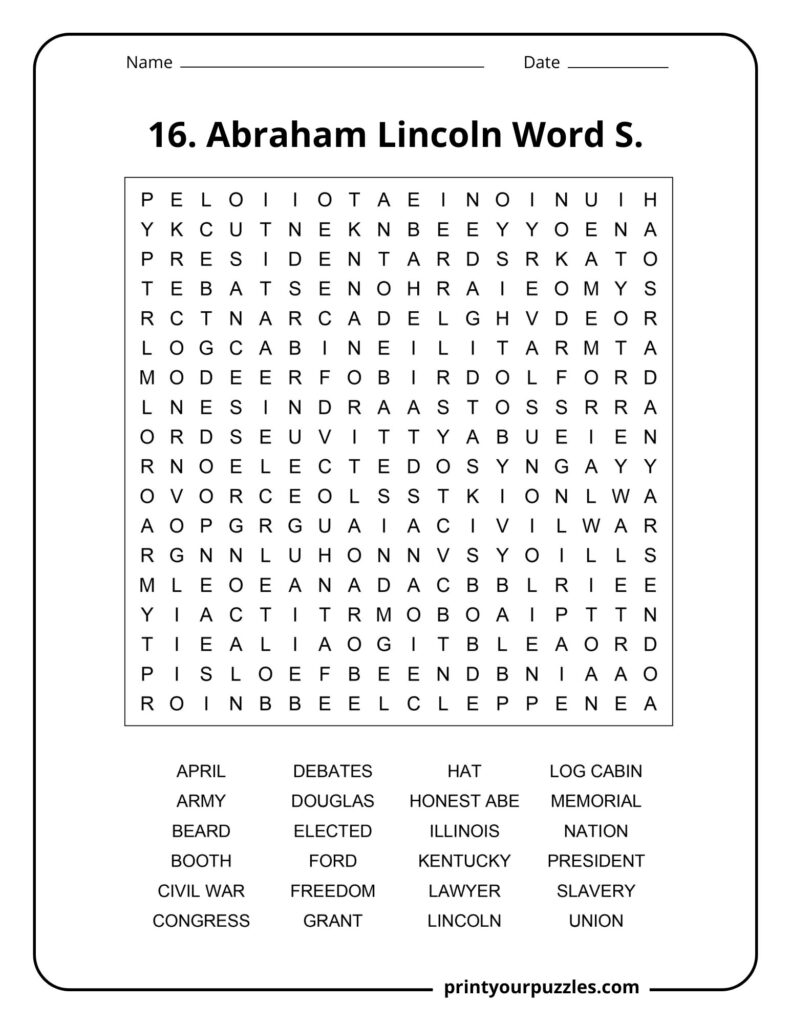
APRIL, ARMY, BEARD, BOOTH, CIVIL WAR, CONGRESS, DEBATES, DOUGLAS, ELECTED, FORD, FREEDOM, GRANT, HAT, HONEST ABE, ILLINOIS, KENTUCKY, LAWYER, LINCOLN, LOG CABIN, MEMORIAL, NATION, PRESIDENT, SLAVERY, UNION
APRIL – The month in 1865 when Abraham Lincoln was assassinated at Ford’s Theatre, just days after the Civil War effectively ended with Lee’s surrender.
ARMY – The Union military forces that Lincoln commanded as Commander-in-Chief during the Civil War, fighting to preserve the United States and end slavery.
BEARD – Lincoln’s distinctive facial hair style without a mustache, which he grew after an eleven-year-old girl suggested it would improve his appearance during his campaign.
BOOTH – John Wilkes Booth, the Confederate sympathizer and actor who assassinated President Lincoln at Ford’s Theatre on April 14, 1865, during a play performance.
CIVIL WAR – The devastating 1861-1865 conflict between Northern and Southern states over slavery and states’ rights that dominated Lincoln’s presidency and tested the nation’s survival.
CONGRESS – The legislative branch of government with which Lincoln worked to pass critical legislation including the Emancipation Proclamation and constitutional amendments
during wartime.
DEBATES – The famous 1858 Lincoln-Douglas debates in Illinois, seven public discussions about slavery that brought Lincoln national prominence though he lost the Senate race.
DOUGLAS – Stephen A. Douglas, Lincoln’s political rival who defeated him in the 1858 Illinois Senate race but lost to him in the 1860 presidential election.
ELECTED – Lincoln’s victory in the 1860 presidential election as the first Republican president, which triggered Southern states’ secession and led to the Civil War.
FORD – Ford’s Theatre in Washington, D.C., where Lincoln was shot while watching the play “Our American Cousin” on April 14, 1865, dying the next morning.
FREEDOM – The liberty Lincoln sought to extend to enslaved people through the Emancipation Proclamation and Thirteenth Amendment, fundamentally transforming American society and fulfilling founding principles.
GRANT – Ulysses S. Grant, the successful Union general whom Lincoln appointed as commanding general, ultimately leading the North to victory in the Civil War.
HAT – Lincoln’s iconic tall stovepipe hat, which he frequently wore and sometimes used to store important documents and letters while traveling or working.
HONEST ABE – The beloved nickname “Honest Abe” earned through Lincoln’s reputation for integrity, truthfulness, and fairness during his years as a lawyer and politician.
ILLINOIS – The state where Lincoln lived most of his adult life, practiced law, served in the legislature, and launched his political career before becoming president.
KENTUCKY – Lincoln’s birthplace state, where he was born on February 12, 1809, in a one-room log cabin in Hodgenville before his family moved to Indiana.
LAWYER – Lincoln’s profession before politics, practicing law in Illinois where he gained a reputation for skill, honesty, and representing clients fairly in courtrooms.
LINCOLN – Abraham Lincoln, the sixteenth President of the United States who led the nation through the Civil War and ended slavery, becoming one of America’s greatest leaders.
LOG CABIN – The humble one-room log cabin where Lincoln was born in Kentucky, symbolizing his rise from poverty to the presidency through hard work and determination.
MEMORIAL – The Lincoln Memorial in Washington, D.C., featuring a massive statue of seated Lincoln, dedicated in 1922 to honor the president who preserved the Union.
NATION – The United States that Lincoln fought to preserve as one country during the Civil War, describing it in the Gettysburg Address as government for the people.
PRESIDENT – The office of the sixteenth President that Lincoln held from March 1861 until his assassination in April 1865, leading during America’s most challenging crisis.
SLAVERY – The institution of forced labor that Lincoln opposed morally and politically, ultimately ending it through the Emancipation Proclamation and supporting the Thirteenth
Amendment’s passage.
UNION – The United States as a unified nation that Lincoln dedicated his presidency to preserving against Southern secession, believing the country must remain indivisible and whole.
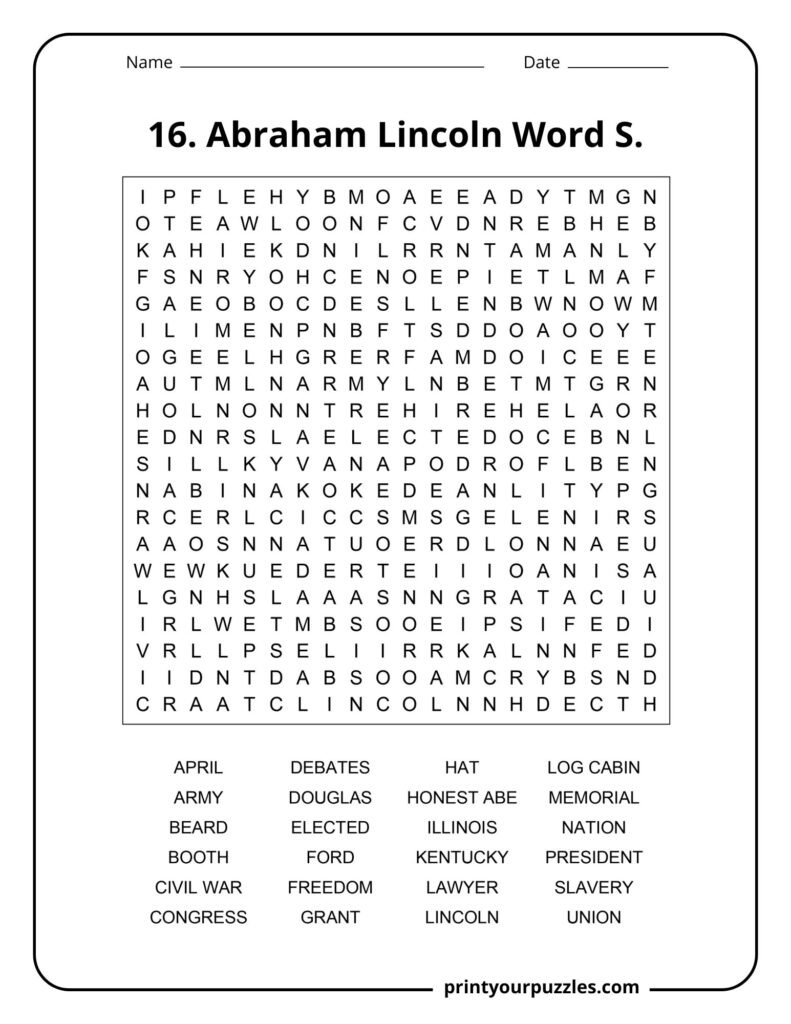
APRIL, ARMY, BEARD, BOOTH, CIVIL WAR, CONGRESS, DEBATES, DOUGLAS, ELECTED, FORD, FREEDOM, GRANT, HAT, HONEST ABE, ILLINOIS, KENTUCKY, LAWYER, LINCOLN, LOG CABIN, MEMORIAL, NATION, PRESIDENT, SLAVERY, UNION
Abraham Lincoln was born on February 12, 1809, in a one-room log cabin in Hodgenville, Kentucky. His family later moved to Indiana and eventually Illinois.
Lincoln preserved the Union during the Civil War, abolished slavery through the Emancipation Proclamation, and demonstrated extraordinary leadership during America’s most challenging crisis, fundamentally transforming the nation.
Lincoln was assassinated by John Wilkes Booth at Ford’s Theatre in Washington, D.C., on April 14, 1865, while watching a play. He died the following morning.
Lincoln was a self-taught lawyer who practiced in Illinois for over twenty years. He earned a reputation for honesty, fairness, and skill in the courtroom.
The Emancipation Proclamation was Lincoln’s 1863 executive order that declared freedom for enslaved people in Confederate states, transforming the Civil War into a fight for human liberty and freedom.
For official administration records and historical biography, visit the Abraham Lincoln page in the White House Archives. If you are planning a trip or looking for personal papers, check out the official Abraham Lincoln Presidential Library & Museum.
Team of Rivals: The Political Genius of Abraham Lincoln by Doris Kearns Goodwin. A masterpiece revealing Lincoln’s genius in assembling a cabinet of former rivals, showcasing the leadership that preserved the Union.
Lincoln invented and patented a device to lift boats over shoals and obstructions in 1849. This makes him the only president with a patent for an invention.
Lincoln was a skilled wrestler in his youth with an impressive record. He’s honored in the National Wrestling Hall of Fame for his nearly undefeated wrestling career.
On April 14, 1865, Lincoln signed legislation creating the U.S. Secret Service to combat currency counterfeiting. Ironically, he was shot that same evening at Ford’s Theatre.
Lincoln attended school for less than one year total throughout his childhood. He was largely self-educated, teaching himself law, mathematics, and literature through borrowed books.
Just days before his death, Lincoln told friends about a disturbing dream where he saw a covered corpse in the White House and was told the president had been killed.