
This Alan Greenspan word search invites you to explore the life and legacy of one of the most influential economic figures in modern history. Alan Greenspan was an American economist who served as Chairman of the Federal Reserve, the central banking system of the United States, from 1987 until 2006. Appointed by President Ronald Reagan and reappointed by three subsequent presidents of both parties, he guided national monetary policy for over eighteen years from Washington, D.C., primarily by adjusting interest rates to balance inflation, growth, and employment.
Why does he matter? Greenspan presided over one of the longest economic expansions in American history, earning the nickname “Maestro,” though critics later linked his low-rate, deregulation-friendly approach to the 2008 financial crisis. His cautious, famously cryptic testimony before Congress was studied so closely that investors and journalists scrambled to decode his every carefully chosen word. Born in New York City in 1926, he passed away on June 22, 2026, at the age of 100, from complications of Parkinson’s disease.
Did you know he played clarinet and saxophone in a professional swing band before studying economics? That musical chapter is one of several surprises you’ll uncover here.
To make this puzzle genuinely educational, this Alan Greenspan word search includes a helpful FAQ section, a curious Did You Know? section, and clear definitions for all 24 hidden words, so solvers learn while they play.
Print it, grab a pencil, and enjoy this Alan Greenspan word search printable—a fun, informative word search printable for students, teachers, and curious minds alike.
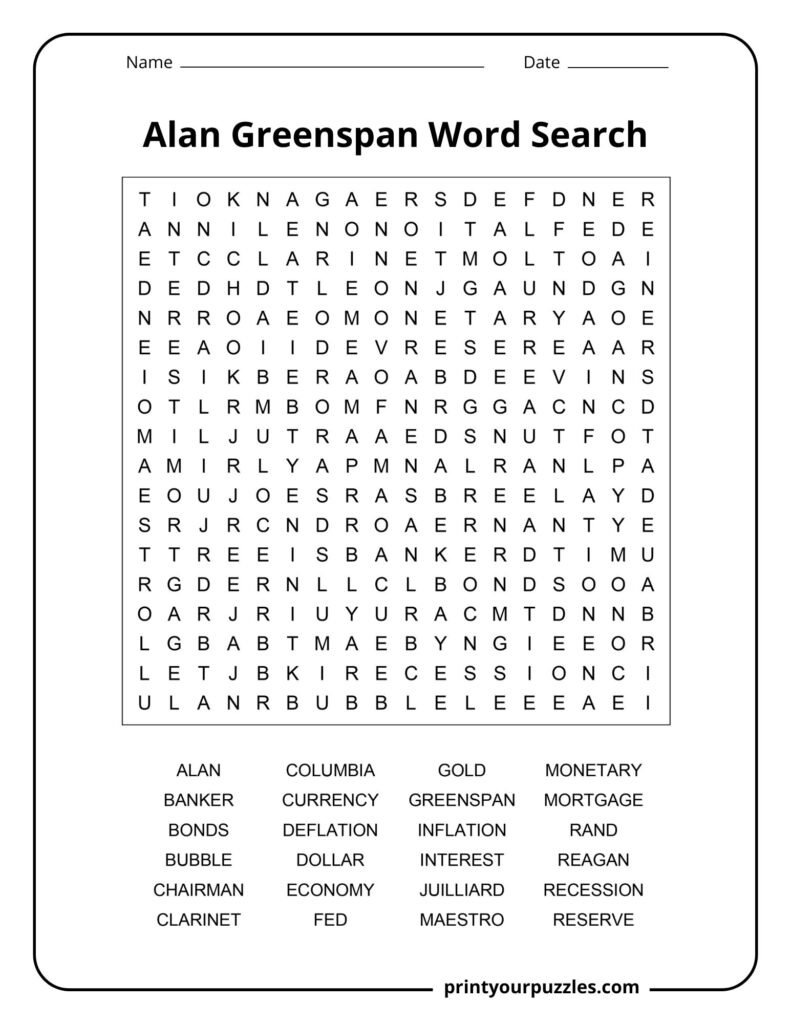
ALAN, BANKER, BONDS, BUBBLE, CHAIRMAN, CLARINET, COLUMBIA, CURRENCY, DEFLATION, DOLLAR, ECONOMY, FED, GOLD, GREENSPAN, INFLATION, INTEREST, JUILLIARD, MAESTRO, MONETARY, MORTGAGE, RAND, REAGAN, RECESSION, RESERVE
ALAN – Alan Greenspan’s first name; the American economist who served as Chairman of the Federal Reserve from 1987 to 2006, becoming one of the most influential central bankers ever.
BANKER – A person who manages money, credit, and financial transactions; Greenspan was the nation’s most prominent central banker, steering monetary policy across nearly two decades and four presidents.
BONDS – Debt securities issued by governments or companies to raise money; their yields respond closely to Federal Reserve decisions, which Greenspan influenced throughout his lengthy chairmanship tenure.
BUBBLE – An unsustainable surge in asset prices driven by speculation; Greenspan famously warned of “irrational exuberance,” yet later faced criticism over the housing bubble’s collapse.
CHAIRMAN – The leader heading an organization or committee; Greenspan held the title of Federal Reserve Chairman for over eighteen years, guiding American monetary policy through numerous economic cycles.
CLARINET – A woodwind musical instrument Greenspan studied seriously in his youth; he attended Juilliard and briefly toured professionally with a swing band before pursuing economics instead.
COLUMBIA – The Ivy League university in New York where Greenspan studied economics; he earned his bachelor’s, master’s, and later doctoral degrees from this prestigious institution.
CURRENCY – Money circulating as a medium of exchange within an economy; the Federal Reserve under Greenspan managed the dollar’s stability through interest rates and money supply.
DEFLATION – A sustained decline in general price levels across an economy; Greenspan watched carefully for deflationary risks, sometimes cutting interest rates aggressively to prevent dangerous downward spirals.
DOLLAR – The official currency of the United States; as Federal Reserve Chairman, Greenspan’s monetary decisions profoundly affected the dollar’s value, strength, and standing in global markets.
ECONOMY – The system of production, distribution, and consumption of goods and services; Greenspan’s policies shaped the American economy’s growth, inflation, and employment for nearly twenty years.
FED – Common shorthand for the Federal Reserve, America’s central banking system; Greenspan chaired the Fed from 1987 until 2006, wielding enormous influence over national economic conditions.
GOLD – A precious metal historically used to back currencies; Greenspan, influenced by gold-standard ideas early on, nonetheless presided over a system based entirely on fiat money.
GREENSPAN – The surname of Alan Greenspan, the legendary Federal Reserve Chairman whose decisions, testimony, and famously cryptic speaking style dominated economic policy discussions for almost two decades.
INFLATION – A general rise in prices that erodes purchasing power over time; controlling inflation was central to Greenspan’s mission, often achieved by adjusting key interest rates.
INTEREST – The cost of borrowing money, expressed as a rate; Greenspan’s Fed repeatedly raised and lowered interest rates to manage inflation, growth, and overall economic stability.
JUILLIARD – The renowned New York performing arts school Greenspan attended as a young musician; he studied clarinet there before abandoning music to pursue a career in economics.
MAESTRO – An honored master, often a conductor; this nickname, popularized by Bob Woodward’s book, celebrated Greenspan’s seemingly masterful orchestration of the American economy during boom years.
MONETARY – Relating to money, currency, and the money supply; Greenspan directed monetary policy at the Federal Reserve, primarily by setting interest rates to influence economic activity.
MORTGAGE – A loan used to purchase property, secured by that real estate; low interest rates under Greenspan fueled a mortgage boom later linked to the financial crisis.
RAND – Ayn Rand, the novelist and philosopher who profoundly mentored young Greenspan; her free-market, individualist philosophy shaped his economic worldview throughout his early professional development and beyond.
REAGAN – President Ronald Reagan, who first appointed Greenspan as Federal Reserve Chairman in 1987; this nomination launched Greenspan’s remarkably long and influential tenure leading American monetary policy.
RECESSION – A significant, sustained decline in economic activity; Greenspan navigated several recessions, adjusting interest rates to soften downturns and encourage recovery during his lengthy chairmanship.
RESERVE – Funds held back for future needs or stability; the Federal Reserve, which Greenspan chaired, derives its name from the reserves banks maintain within the system.
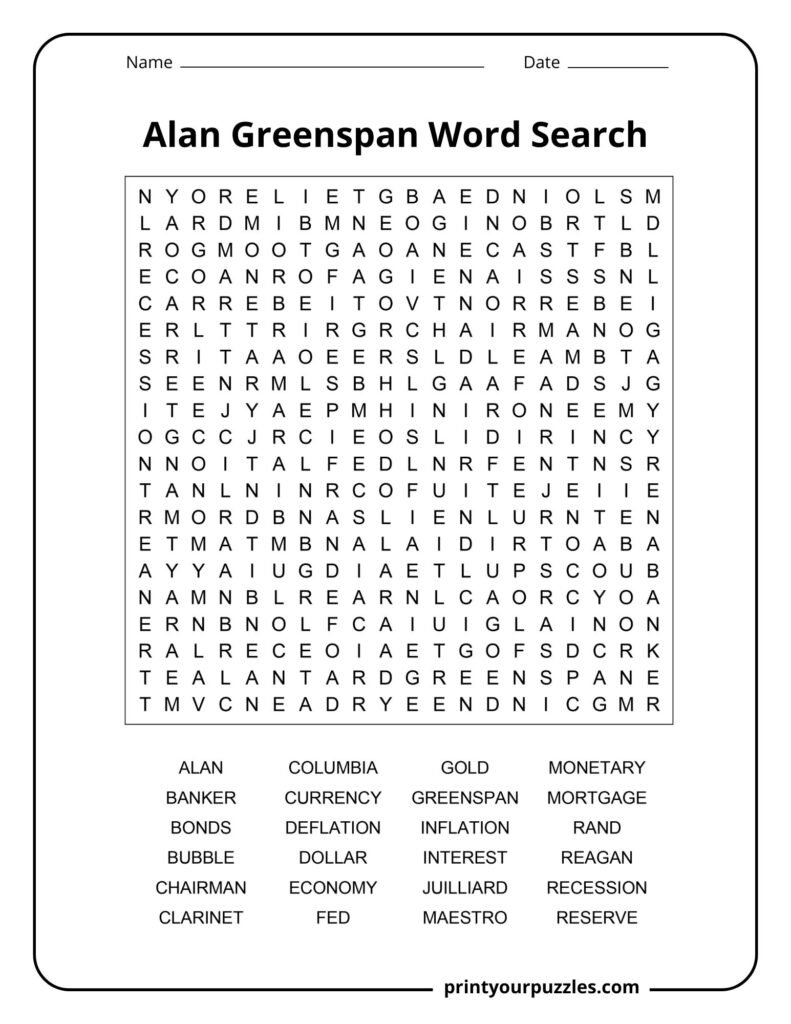
ALAN, BANKER, BONDS, BUBBLE, CHAIRMAN, CLARINET, COLUMBIA, CURRENCY, DEFLATION, DOLLAR, ECONOMY, FED, GOLD, GREENSPAN, INFLATION, INTEREST, JUILLIARD, MAESTRO, MONETARY, MORTGAGE, RAND, REAGAN, RECESSION, RESERVE
Alan Greenspan is an American economist who served as Chairman of the Federal Reserve from 1987 to 2006, making him one of history’s most influential central bankers.
He led the Federal Reserve for over eighteen years, from August 1987 until January 2006, appointed by President Reagan and reappointed by three subsequent presidents across both parties.
The nickname, popularized by Bob Woodward’s 2000 book, reflected his perceived skill at orchestrating sustained economic growth, low inflation, and prosperity throughout much of the 1990s.
Critics argue his prolonged low interest rates and opposition to regulation helped inflate the housing bubble; he later admitted flaws in his free-market assumptions before Congress.
He trained as a professional musician, studying clarinet at Juilliard and touring with a swing band, before earning economics degrees from Columbia University and founding a consulting firm.
Capitalism in America: An Economic History of the United States by Alan Greenspan, Adrian Wooldridge. This book matters because it distills Greenspan’s lifetime of economic insight into an accessible narrative explaining how innovation and creative destruction built American prosperity, offering readers a sweeping framework for understanding the forces that shaped the nation’s economy.
Before economics, he toured as a clarinet and saxophone player with the Henry Jerome orchestra, even reportedly handling the band’s tax paperwork between performances.
He belonged to her inner circle and contributed essays to her work, embracing her free-market philosophy that profoundly shaped his lifelong economic worldview.
In 1997 he wed NBC correspondent Andrea Mitchell; she reportedly struggled to understand his cryptic marriage proposals because of his famously indirect, ambiguous speaking style.
In a 1996 speech, he used those words questioning inflated stock valuations, and the phrase instantly became famous, later titling a bestselling book by economist Robert Shiller.
President George W. Bush awarded him America’s highest civilian honor in 2005, recognizing his decades of influential public service leading the nation’s central banking system.