
Algebra word search puzzles offer an engaging and educational way to reinforce mathematical vocabulary while providing entertainment for students and math enthusiasts alike. This specially designed Algebra word search printable features 24 carefully selected terms that are fundamental to understanding algebraic concepts and operations. Each word has been chosen to represent essential elements of algebra, from basic operations like addition and multiplication to more advanced concepts such as exponents, logarithms, and parabolas.
What makes this word search printable particularly valuable is that all 24 words are clearly defined with detailed explanations ranging from 20 to 30 words each. These comprehensive definitions help learners not only locate the terms within the puzzle grid but also understand their mathematical meanings and applications. The words are presented alphabetically and in capital letters, making them easy to reference.
Whether you’re a teacher looking for classroom activities, a student reviewing algebra concepts, or simply someone who enjoys mathematical puzzles, this resource combines fun with learning. Challenge yourself to find all the hidden algebra terms while expanding your mathematical vocabulary and deepening your understanding of this essential branch of mathematics.
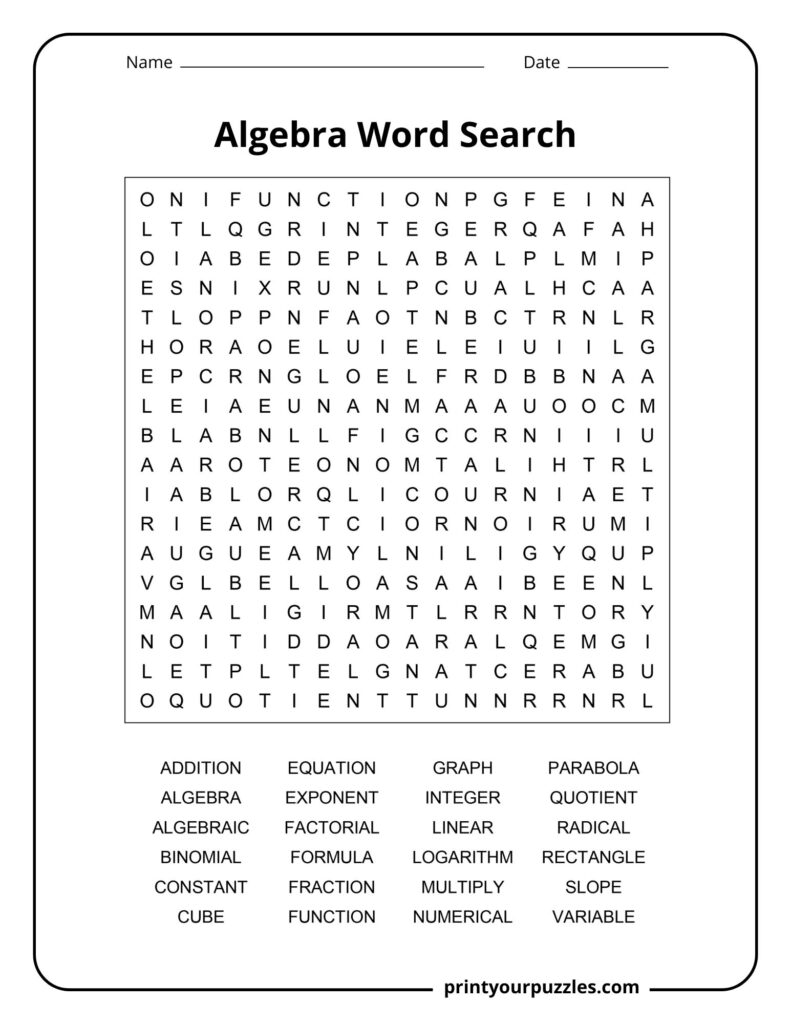
ADDITION, ALGEBRA, ALGEBRAIC, BINOMIAL, CONSTANT, CUBE, EQUATION, EXPONENT, FACTORIAL, FORMULA, FRACTION, FUNCTION, GRAPH, INTEGER, LINEAR, LOGARITHM, MULTIPLY, NUMERICAL, PARABOLA, QUOTIENT, RADICAL, RECTANGLE, SLOPE, VARIABLE
ADDITION – The mathematical operation of combining two or more numbers to find their sum or total value, represented by the plus sign.
ALGEBRA – A branch of mathematics using letters and symbols to represent numbers and quantities in formulas and equations to solve problems systematically.
ALGEBRAIC – Relating to or involving algebra, characterized by the use of symbols, variables, and mathematical operations to express relationships and solve equations.
BINOMIAL – An algebraic expression containing exactly two terms separated by a plus or minus sign, such as x plus y or a minus b.
CONSTANT – A fixed value that does not change within a mathematical expression or equation, often represented by a specific number or letter.
CUBE – The result of multiplying a number by itself three times, or a three-dimensional geometric shape with six equal square faces.
EQUATION – A mathematical statement showing that two expressions are equal, connected by an equals sign, often requiring solving to find unknown values.
EXPONENT – A number indicating how many times a base number is multiplied by itself, written as a superscript to the right of the base.
FACTORIAL – The product of all positive integers less than or equal to a given number, denoted by an exclamation mark, used in permutations and combinations.
FORMULA – A mathematical rule or relationship expressed using symbols and variables, providing a method to calculate a specific value or solve a problem.
FRACTION – A numerical quantity representing a part of a whole, expressed as one number divided by another, with a numerator and denominator.
FUNCTION – A mathematical relationship where each input value corresponds to exactly one output value, often expressed as an equation or rule.
GRAPH – A visual representation of mathematical data or functions using coordinate axes, showing relationships between variables through points, lines, or curves.
INTEGER – A whole number that can be positive, negative, or zero, with no fractional or decimal parts, used in counting and ordering.
LINEAR – Relating to or resembling a straight line, or describing equations and relationships where variables have exponents of one, producing straight-line graphs.
LOGARITHM – The power to which a base number must be raised to produce a given number, serving as the inverse operation of exponentiation.
MULTIPLY – To perform the mathematical operation of combining equal groups or repeated addition, finding the product of two or more numbers together.
NUMERICAL – Relating to or expressed in numbers, involving calculations or measurements rather than theoretical or symbolic representations, emphasizing quantitative aspects of mathematics.
PARABOLA – A symmetrical U-shaped curve formed by graphing a quadratic equation, where every point is equidistant from a focus and directrix line.
QUOTIENT – The result obtained when one number is divided by another, representing how many times the divisor fits into the dividend completely.
RADICAL – A mathematical symbol indicating a root operation, most commonly the square root, used to find numbers that when multiplied produce given values.
RECTANGLE – A four-sided polygon with opposite sides equal and parallel, containing four right angles, commonly used in geometry and area calculations.
SLOPE – A measure of the steepness or incline of a line on a graph, calculated by dividing the vertical rise by the horizontal run between any two points on the line.
VARIABLE – A symbol, typically a letter, representing an unknown or changing value in mathematical expressions, equations, or functions that can vary.
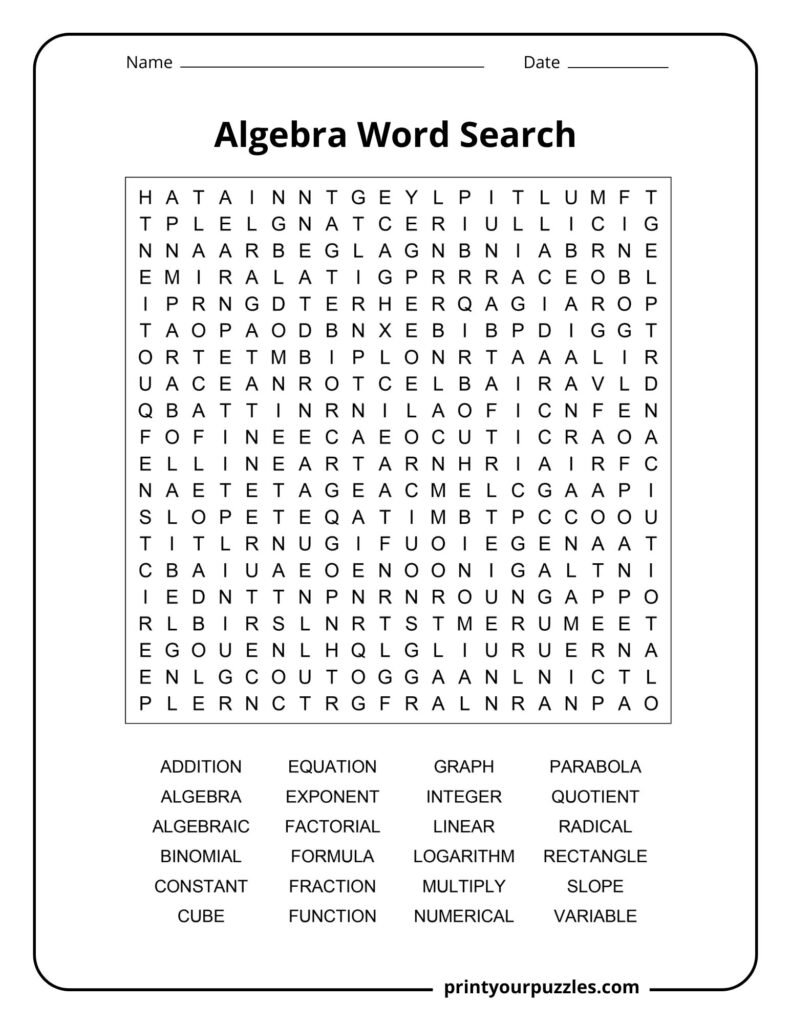
ADDITION, ALGEBRA, ALGEBRAIC, BINOMIAL, CONSTANT, CUBE, EQUATION, EXPONENT, FACTORIAL, FORMULA, FRACTION, FUNCTION, GRAPH, INTEGER, LINEAR, LOGARITHM, MULTIPLY, NUMERICAL, PARABOLA, QUOTIENT, RADICAL, RECTANGLE, SLOPE, VARIABLE
Algebra is a branch of mathematics using symbols and letters to represent numbers in equations. It’s essential for problem-solving, critical thinking, and forms the foundation for advanced mathematics, science, engineering, and technology careers.
An expression is a mathematical phrase combining numbers, variables, and operations without an equals sign. An equation contains an equals sign, stating that two expressions have the same value and can be solved.
Variables are letters or symbols representing unknown or changing values in mathematical statements. They allow us to write general formulas, solve problems with missing information, and express relationships between quantities flexibly.
Algebra uses addition, subtraction, multiplication, and division as fundamental operations. It also includes exponentiation, finding roots, and working with fractions. These operations follow specific order-of-operations rules for solving expressions correctly.
Most students begin learning basic algebraic concepts in middle school, around ages 11-13, with pre-algebra. Formal Algebra I courses usually start in eighth or ninth grade, introducing equations, functions, and graphing systematically.
The term “algebra” derives from the Arabic word “al-jabr,” meaning “reunion of broken parts,” from mathematician Muhammad al-Khwarizmi’s ninth-century book that established algebra as a distinct mathematical discipline.
Babylonian mathematicians solved quadratic equations using geometric methods around 2000 BCE, long before modern algebraic notation existed. They used words and diagrams instead of symbols to represent mathematical relationships.
Modern encryption technology protecting online banking, shopping, and communications relies heavily on algebraic equations and number theory. Complex algebraic algorithms keep your personal data safe from hackers daily.
Welsh mathematician Robert Recorde created the equals symbol (=) because he believed nothing could be “more equal” than two parallel lines. Before this, equations were written entirely in words.
Meteorologists use complex algebraic equations and functions to model atmospheric conditions, predict storms, and forecast temperatures. These mathematical models process massive amounts of data to generate accurate weather predictions.
Purus ut praesent facilisi dictumst sollicitudin cubilia ridiculus.