
This Andrew Jackson word search explores the fascinating life of America’s seventh president, a man who fundamentally reshaped American democracy and remains one of the most controversial figures in U.S. history. Andrew Jackson served as president from 1829 to 1837, rising from orphaned frontier boy to war hero to powerful political leader.
Born in 1767 on the Carolina frontier, Jackson embodied the spirit of westward expansion and the emerging American West. His military victories during the War of 1812, particularly the Battle of New Orleans, made him a national hero. As president, Jackson championed the common man, established the Democratic Party, dismantled the Second Bank of the United States, and wielded executive power more forcefully than any predecessor. His Tennessee plantation, the Hermitage, served as his beloved home throughout his adult life.
This Andrew Jackson word search printable goes beyond a simple puzzle by incorporating comprehensive educational features. Each of the 24 words includes a detailed 20-30 word definition explaining its historical significance. The puzzle also features a dedicated FAQ section answering common questions about Jackson’s presidency and policies, plus a fascinating “Did You Know?” section revealing surprising facts—including how Jackson’s pet parrot was removed from his funeral for cursing!
Whether you’re a student studying the Jacksonian era or a history enthusiast, this word search printable transforms puzzle-solving into an engaging learning experience, making it perfect for classrooms, homeschooling, or personal enrichment while discovering the complex legacy of Old Hickory.
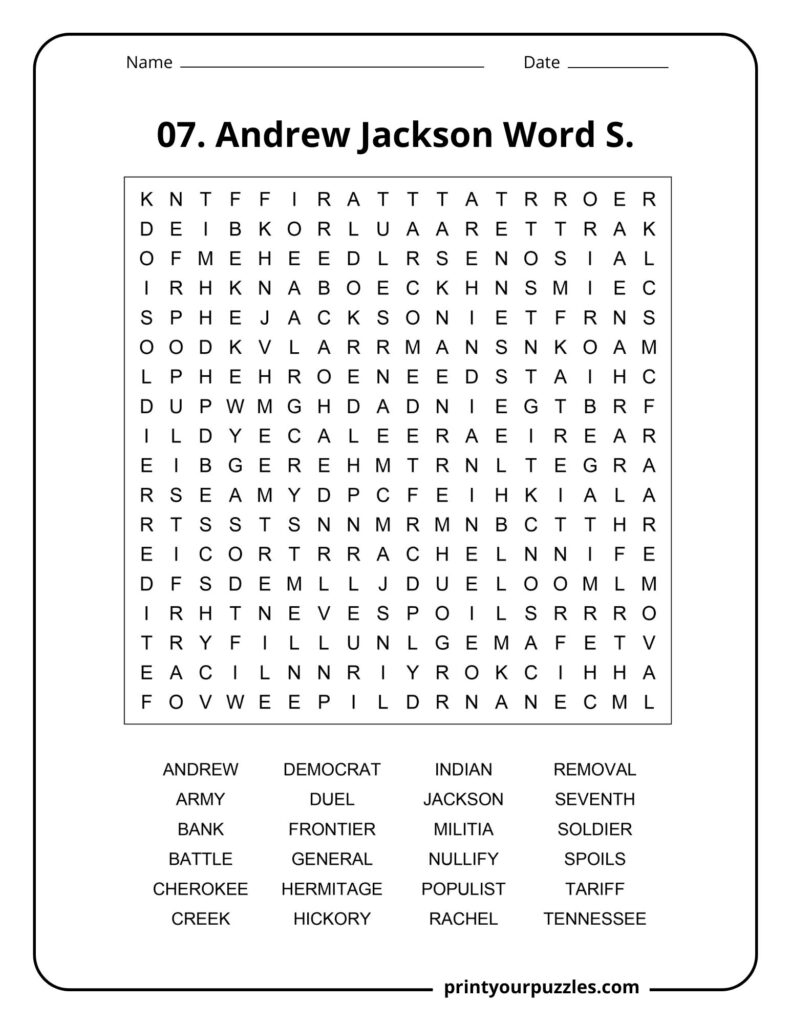
ANDREW, ARMY, BANK, BATTLE, CHEROKEE, CREEK, DEMOCRAT, DUEL, FRONTIER, GENERAL, HERMITAGE, HICKORY, INDIAN, JACKSON, MILITIA, NULLIFY, POPULIST, RACHEL, REMOVAL, SEVENTH, SOLDIER, SPOILS, TARIFF, TENNESSEE
ANDREW – Jackson’s first name, of Scottish origin. He was named after his father Andrew Jackson Sr., who died before his birth in 1767.
ARMY – Jackson served as a major general in the U.S. Army, leading troops in the War of 1812 and various campaigns against Native American tribes.
BANK – The Second Bank of the United States, which Jackson opposed and ultimately destroyed by vetoing its recharter and withdrawing federal deposits during the Bank War.
BATTLE – Jackson fought in numerous battles including Horseshoe Bend, New Orleans, and various conflicts during the Creek War and Seminole Wars, establishing his military reputation.
CHEROKEE – Native American nation forcibly relocated westward under Jackson’s policies, enduring the tragic Trail of Tears in 1838, resulting in thousands of deaths.
CREEK – The Creek War (1813-1814) where Jackson defeated the Red Stick Creeks at Horseshoe Bend, gaining national fame and acquiring millions of acres for American settlement.
DEMOCRAT – Jackson founded the Democratic Party, America’s oldest existing political party, championing common people against elites and establishing new political coalition patterns.
DUEL – Jackson participated in multiple duels defending his and his wife’s honor, most notably killing Charles Dickinson in 1806, carrying a bullet near his heart thereafter.
FRONTIER – Jackson embodied the frontier spirit as the first president from the western frontier, representing rough-hewn settlers rather than eastern aristocratic establishment.
GENERAL – Military rank Jackson achieved, commanding forces in the War of 1812 and leading the decisive victory at the Battle of New Orleans in January 1815.
HERMITAGE – Jackson’s plantation home near Nashville, Tennessee, where he lived with his wife Rachel and enslaved over one hundred people throughout his lifetime.
HICKORY – Nickname “Old Hickory” earned during the War of 1812, referring to his toughness and strength, as hickory wood is notably hard and resilient.
INDIAN – Jackson’s Indian Removal policy forced southeastern tribes westward, resulting in the 1830 Indian Removal Act and devastating displacement of Native American populations.
JACKSON – His surname, becoming synonymous with populist democracy, strong executive power, and the controversial expansion policies of the Jacksonian era in American history.
MILITIA – Jackson commanded Tennessee militia forces during the War of 1812 and Creek War, relying on citizen-soldiers rather than professional troops for many campaigns.
NULLIFY – The Nullification Crisis (1832-1833) when South Carolina claimed the right to nullify federal tariffs; Jackson threatened military force to preserve federal authority.
POPULIST – Jackson’s political style appealed directly to common citizens, expanded voting rights for white men, and challenged established financial and political elites nationwide.
RACHEL – Jackson’s beloved wife Rachel Donelson Robards, whose marriage controversy haunted them both; she died shortly before his presidential inauguration in 1829.
REMOVAL – The Indian Removal Act of 1830 authorized relocating eastern Native American tribes westward, causing immense suffering and death during forced marches.
SEVENTH – Jackson served as the seventh President of the United States from 1829 to 1837, serving two complete terms during a transformative period.
SOLDIER – Jackson’s identity as a military man shaped his presidency; he joined the Continental Army at thirteen and maintained military bearing throughout life.
SPOILS – The “spoils system” where Jackson replaced government officials with political supporters, declaring “to the victor belong the spoils of the enemy.”
TARIFF – Protective tariffs became controversial during Jackson’s presidency, particularly the 1828 “Tariff of Abominations” and subsequent nullification crisis with South
Carolina.
TENNESSEE – Jackson’s adopted home state where he made his fortune, served as senator and judge, and built his Hermitage plantation before becoming president.
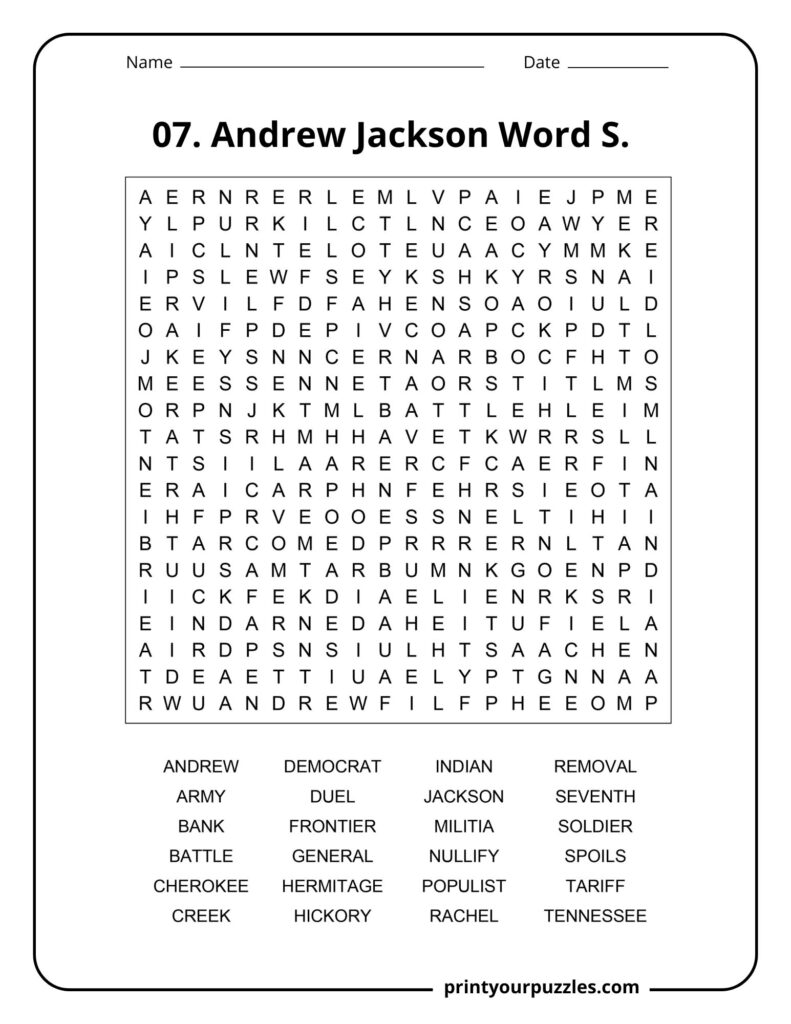
ANDREW, ARMY, BANK, BATTLE, CHEROKEE, CREEK, DEMOCRAT, DUEL, FRONTIER, GENERAL, HERMITAGE, HICKORY, INDIAN, JACKSON, MILITIA, NULLIFY, POPULIST, RACHEL, REMOVAL, SEVENTH, SOLDIER, SPOILS, TARIFF, TENNESSEE
Jackson earned this nickname during the War of 1812 because his soldiers considered him as tough and sturdy as hickory wood, America’s hardest timber.
The Indian Removal Act of 1830 forcibly relocated Native American tribes westward, causing the Trail of Tears where thousands of Cherokee and other tribal members died.
Jackson believed the Second Bank of the United States concentrated too much power among wealthy elites, undermining democracy and favoring the rich over ordinary citizens.
Jackson expanded voting rights for white men, established the Democratic Party, strengthened presidential power, and introduced the spoils system where political supporters received government positions.
Jackson’s decisive victory at the Battle of New Orleans in January 1815 made him a national hero, though the battle occurred after the peace treaty ended the War of 1812.
For official administration records and historical biography, visit the Andrew Jackson page in the White House Archives. If you are planning a trip or looking for personal papers, check out his official estate, The Hermitage.
American Lion: Andrew Jackson in the White House by Jon Meacham. Pulitzer Prize winner. Meacham captures the ferocious energy of a president who redefined executive power and American populism.
In 1835, Richard Lawrence fired two pistols at Jackson, but both misfired. The furious 67-year-old president then beat his would-be assassin with his cane.
Jackson’s African Grey parrot, Poll, reportedly learned to curse so profusely that mourners had to remove the bird from the 1845 funeral service.
After an 1806 duel with Charles Dickinson, Jackson lived with a bullet in his chest causing chronic pain, coughing up blood, and frequent infections.
Both Jackson’s parents and his two brothers died before he turned fourteen, leaving him alone to navigate the Revolutionary War’s chaos and aftermath.
A New York farmer sent the massive cheese to the White House in 1835. Jackson served it at a public reception, and crowds devoured it within hours.