
This engaging April Fools’ Day word search celebrates the most playful holiday of the year with 24 carefully selected words that capture the spirit of pranks, jokes, and lighthearted mischief. Perfect for classrooms, family activities, or personal entertainment, this puzzle challenges players of all ages to find hidden words related to April Fools’ Day traditions.
What makes this April Fools’ Day word search printable special is its comprehensive approach to learning and fun. Each of the 24 words included in the puzzle comes with a detailed 20-30 word definition, helping players understand the meaning and context of terms like Bamboozle, Jester, Hoax, and Gullible. This educational component transforms a simple puzzle into a valuable learning experience that builds vocabulary while entertaining.
The word search printable format allows for easy printing and sharing, making it convenient for teachers, parents, and event organizers. Whether you’re planning an April Fools party, need classroom activities, or simply want to celebrate this whimsical holiday, this word search provides the perfect blend of challenge and education. All words are nine letters or fewer, ensuring accessibility while maintaining an engaging level of difficulty for puzzle enthusiasts everywhere.
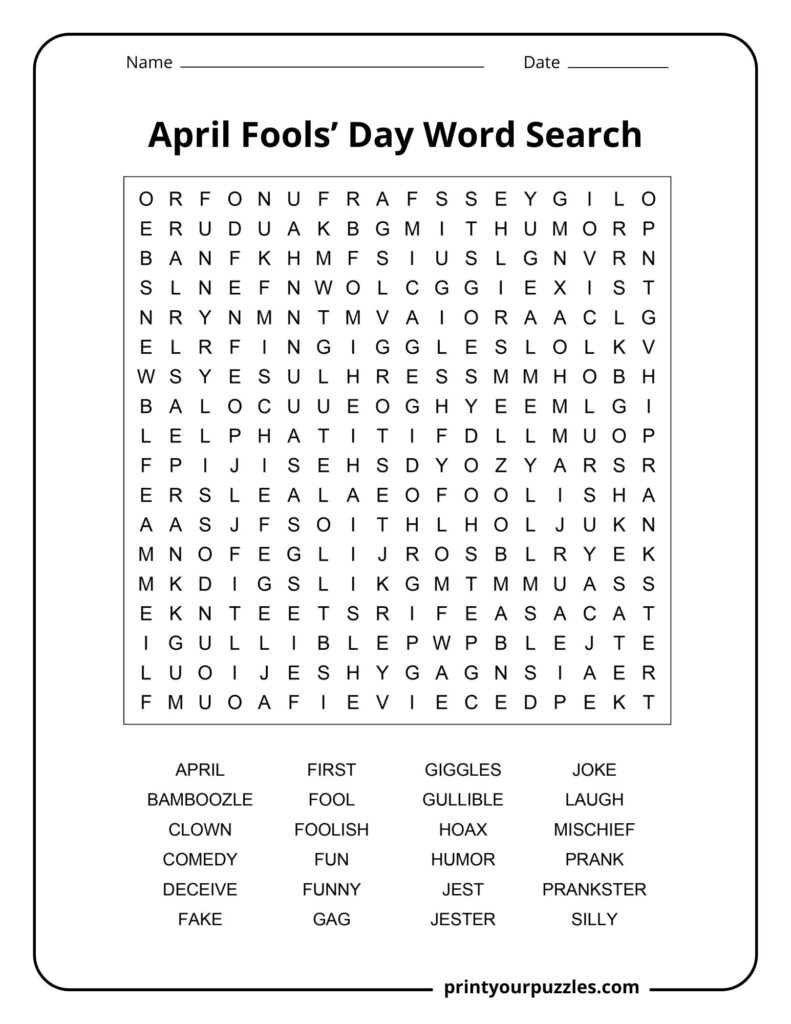
APRIL, BAMBOOZLE, CLOWN, COMEDY, DECEIVE, FAKE, FIRST, FOOL, FOOLISH, FUN, FUNNY, GAG, GIGGLES, GULLIBLE, HOAX, HUMOR, JEST, JESTER, JOKE, LAUGH, MISCHIEF, PRANK, PRANKSTER, SILLY
APRIL – The fourth month of the year, specifically celebrated on April 1st as April Fools Day, a traditional day dedicated to playing harmless pranks and jokes on others.
BAMBOOZLE – To trick, deceive, or confuse someone through clever manipulation or misleading information, often used to describe successfully pulling off an elaborate prank or deception on an unsuspecting victim.
CLOWN – A comedic performer who wears colorful costumes and makeup to entertain audiences, or someone who acts foolishly and playfully to amuse others, embodying the spirit of lighthearted mischief.
COMEDY – A form of entertainment designed to provoke laughter and amusement through humorous situations, witty dialogue, exaggerated characters, or absurd scenarios that highlight the lighter side of human nature and experience.
DECEIVE – To deliberately mislead or trick someone into believing something false, often through cunning schemes or false information, which is a central element of successful April Fools pranks and jokes.
FAKE – Something that is not genuine, real, or authentic; an imitation or counterfeit item often used in pranks to mislead someone into believing they’re experiencing something real when it’s actually false.
FIRST – Refers to April 1st, the specific date when April Fools Day is celebrated worldwide, marking the traditional day for playing practical jokes and spreading harmless hoaxes on unsuspecting friends.
FOOL – A person who has been tricked or deceived, or someone who acts unwisely and without good judgment, often the target of April Fools pranks who falls for the joke.
FOOLISH – Lacking good sense or judgment, acting in a silly or unwise manner, often describing behavior that is playfully ridiculous or the result of being successfully pranked on April Fools Day.
FUN – The experience of enjoyment, amusement, and lighthearted pleasure derived from playful activities, jokes, and entertaining situations, which is the ultimate goal of April Fools Day celebrations and harmless pranks.
FUNNY – Something that causes laughter, amusement, or entertainment through humor, wit, or absurdity; describing jokes, pranks, or situations that successfully elicit a positive, cheerful response from people who experience them.
GAG – A joke, prank, or humorous trick designed to amuse and entertain others, often involving visual comedy or surprising elements that catch people off guard and provoke laughter through unexpected situations.
GIGGLES – Soft, repeated laughter expressing amusement, nervousness, or delight, often the natural response when someone successfully pulls off a harmless prank or witnesses something genuinely funny and entertaining during April Fools.
GULLIBLE – Easily deceived, tricked, or persuaded to believe something false due to trusting nature or lack of skepticism, describing the ideal target for April Fools pranks who readily accepts improbable stories.
HOAX – A deliberately fabricated falsehood or deception designed to trick people into believing something untrue, often elaborate schemes or false news stories commonly circulated during April Fools Day celebrations worldwide.
HUMOR – The quality of being amusing, entertaining, or comical; the ability to perceive and express what is funny, absurd, or incongruous, which forms the foundation of all April Fools jokes.
JEST – A playful joke, witty remark, or humorous comment made in fun rather than seriousness, often characterized by lighthearted teasing or clever wordplay designed to amuse rather than offend or harm.
JESTER – A historical entertainer employed by royal courts to amuse nobility through jokes, tricks, and comedic performances, wearing distinctive colorful costumes and embodying the spirit of playful foolishness and professional humor.
JOKE – A humorous story, statement, or action intended to provoke laughter and amusement, often involving unexpected twists, wordplay, or absurd situations that catch listeners off guard with their clever punchlines.
LAUGH – To express amusement, joy, or happiness through vocal sounds and physical reactions, the natural human response to humor, jokes, and funny situations that brings people together through shared enjoyment.
MISCHIEF – Playful misbehavior or harmless troublemaking that causes minor annoyance or amusement rather than serious harm, perfectly describing the spirit of April Fools Day pranks and lighthearted tricks played on others.
PRANK – A playful trick or practical joke designed to surprise, confuse, or mildly embarrass someone in a harmless and humorous way, the quintessential activity associated with April Fools Day celebrations.
PRANKSTER – A person who regularly plays tricks and practical jokes on others for amusement, someone skilled in creating clever, harmless pranks that surprise and entertain their targets without causing genuine harm.
SILLY – Lacking seriousness or common sense in a playful, lighthearted way; characterized by foolish but harmless behavior that amuses others, perfectly capturing the spirit of April Fools Day fun and merriment.
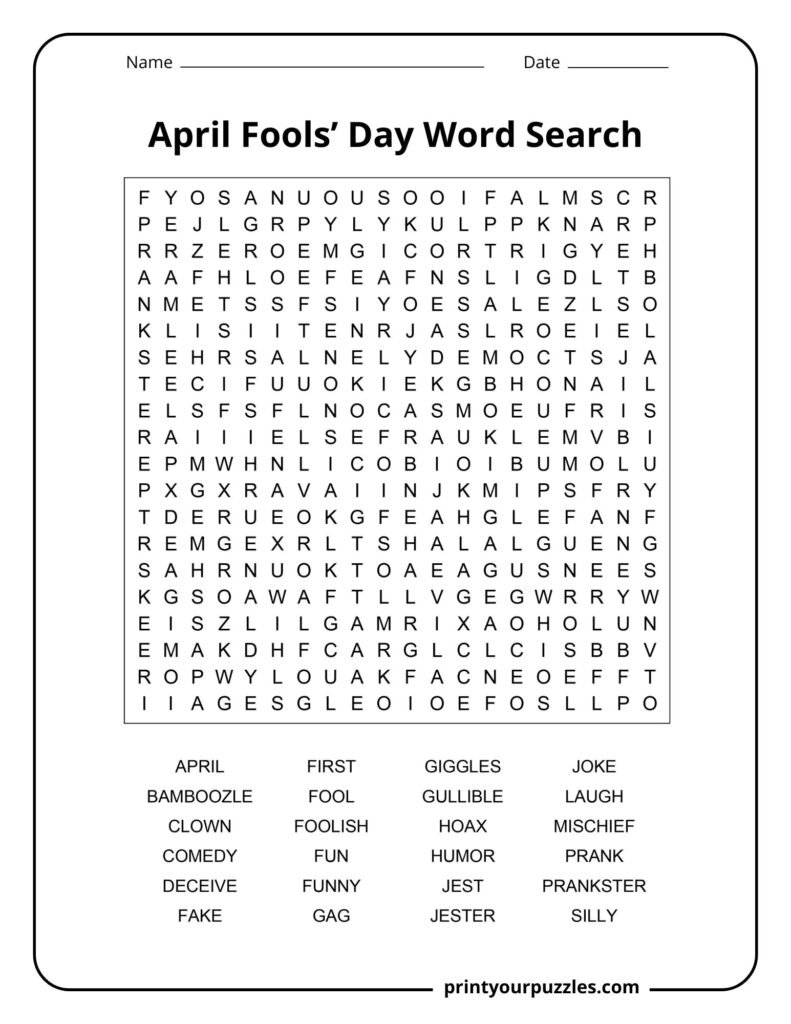
APRIL, BAMBOOZLE, CLOWN, COMEDY, DECEIVE, FAKE, FIRST, FOOL, FOOLISH, FUN, FUNNY, GAG, GIGGLES, GULLIBLE, HOAX, HUMOR, JEST, JESTER, JOKE, LAUGH, MISCHIEF, PRANK, PRANKSTER, SILLY
April Fools Day is celebrated annually on April 1st worldwide. The pranking tradition typically ends at noon in some countries, though many celebrate throughout the entire day.
The exact origin remains uncertain, but theories include connections to ancient Roman festivals, the French calendar change in 1582, and medieval European spring celebrations marking seasonal transitions and renewal.
Popular pranks include fake news announcements, switched salt and sugar containers, plastic wrap on doorways, fake lottery tickets, whoopee cushions, changing computer settings, and harmless office supply tricks.
Yes! Pranks should be harmless, never cause physical or emotional harm, avoid expensive damage, respect boundaries, and always reveal the joke afterward with good humor and kindness.
France has “Poisson d’Avril” (paper fish), Scotland celebrates two days, Spain pranks on December 28th, and many countries feature elaborate media hoaxes and corporate joke advertisements annually.
Companies like Google, BMW, and Netflix annually produce fake products and announcements to entertain customers, generating massive publicity and social media engagement through creative, humorous marketing campaigns on April 1st.
Their documentary showed Swiss farmers “harvesting” spaghetti from trees, and many British viewers actually called asking how to grow their own spaghetti plants, making it history’s most famous media hoax.
In France it’s “Poisson d’Avril” (April Fish), Scotland calls it “Hunt the Gowk Day,” and in Portuguese-speaking countries it’s “Dia das Mentiras” (Day of Lies), each with unique traditions.
When France switched from the Julian to Gregorian calendar in 1582, those still celebrating New Year in late March became targets of jokes and were called “April fools.”
Their hoaxes include Gmail Motion (controlling email with body movements), Google Nose (scratch-and-sniff search), and Google Maps Pac-Man, blending technology with humor to entertain millions globally annually.
Purus ut praesent facilisi dictumst sollicitudin cubilia ridiculus.