
This Arizona word search puzzle offers an exciting journey through the Grand Canyon State’s rich history, culture, and natural wonders. Perfect for students, teachers, puzzle enthusiasts, and anyone fascinated by the Southwest, this engaging activity features twenty-four carefully selected words that capture Arizona’s unique identity.
Discover terms representing Arizona’s iconic landscapes—from towering saguaro cacti to dramatic canyons—alongside legendary figures like Geronimo and John McCain. Search for major cities including Phoenix and Tucson, Native American tribes such as Apache, Navajo, and Hopi, plus cultural treasures like turquoise and frybread. Each word reflects something meaningful about what makes Arizona special.
What sets this puzzle apart is that every word is thoroughly defined with detailed explanations, helping solvers learn while they search. This educational approach transforms a simple word search printable into an enriching experience about Arizona’s geography, wildlife, heritage, and contributions to American culture.
The Arizona word search printable format provides convenient access for classroom use, homeschooling, travel activities, or personal enjoyment. Challenge yourself to find all twenty-four hidden words arranged horizontally, vertically, and diagonally, while deepening your appreciation for the remarkable Grand Canyon State.
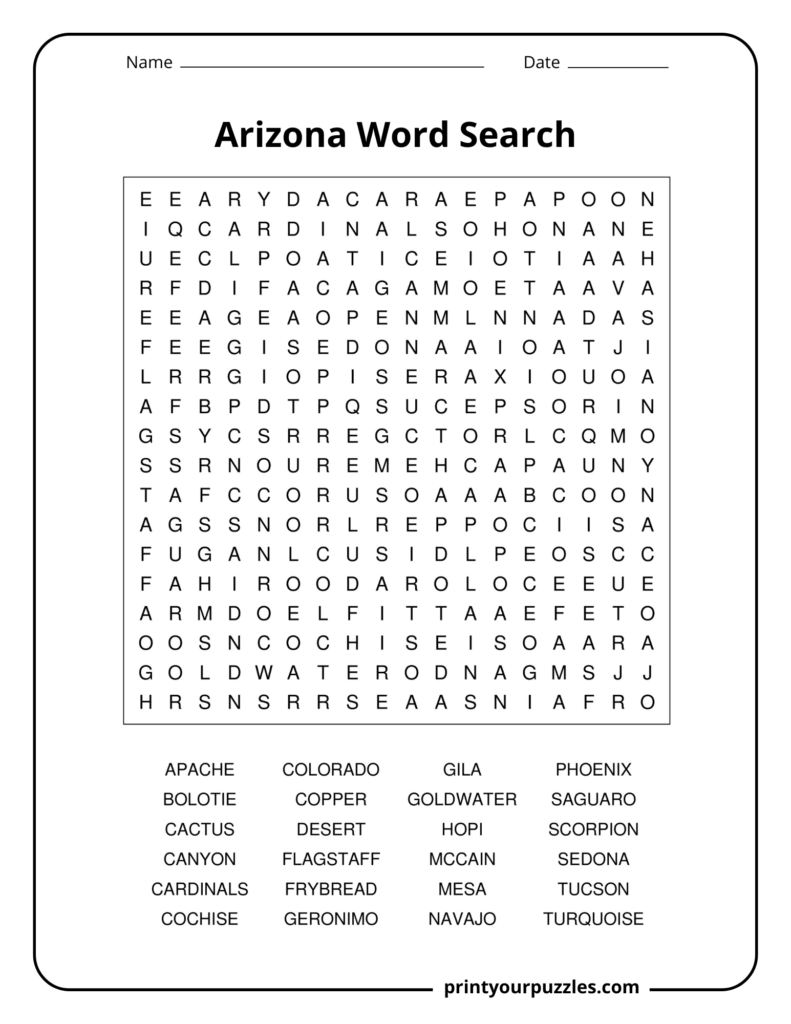
APACHE, BOLOTIE, CACTUS, CANYON, CARDINALS, COCHISE, COLORADO, COPPER, DESERT, FLAGSTAFF, FRYBREAD, GERONIMO, GILA, GOLDWATER, HOPI, MCCAIN, MESA, NAVAJO, PHOENIX, SAGUARO, SCORPION, SEDONA, TUCSON, TURQUOISE
APACHE – Indigenous Native American tribe that historically inhabited Arizona and the Southwest. Known for their fierce resistance against Mexican and American expansion during the 1800s.
BOLOTIE – Arizona’s official state neckwear since 1971. A braided leather cord with decorative clasp, often featuring turquoise or silver, worn as a Western-style tie alternative.
CACTUS – Spiny desert plant abundant throughout Arizona’s landscape. Adapted to store water in arid conditions, cacti are iconic symbols of the American Southwest and desert ecosystems.
CANYON – Deep gorge carved by river erosion over millions of years. Arizona is home to the Grand Canyon, one of Earth’s most spectacular natural wonders and geological marvels.
CARDINALS – Arizona’s professional NFL football team based in Glendale. Originally founded in Chicago, the franchise relocated to Arizona in 1988 and represents the state in sports.
COCHISE – Legendary Apache chief who led his people in resisting American encroachment during the 1860s. A county in southeastern Arizona bears his name honoring his legacy.
COLORADO – Major river flowing through Arizona, carving the Grand Canyon over millions of years. Provides crucial water resources for agriculture, cities, and hydroelectric power throughout the Southwest.
COPPER – Arizona’s most valuable mineral resource and official state metal. The state is America’s leading copper producer, with massive mining operations supporting the economy for generations.
DESERT – Arid landscape defining much of Arizona’s geography, including the Sonoran Desert. Characterized by extreme temperatures, sparse rainfall, and unique adapted plants and animals thriving there.
FLAGSTAFF – Northern Arizona city situated at 7,000 feet elevation near the San Francisco Peaks. Known for cooler climate, ponderosa pine forests, skiing, and being a gateway to Grand Canyon.
FRYBREAD – Traditional Native American food made from fried dough, popular throughout Arizona’s reservations. Often served as a base for Navajo tacos or topped with honey and powdered sugar.
GERONIMO – Famous Apache warrior and medicine man who resisted Mexican and American military forces until 1886. His name became synonymous with courage and defiance throughout American history.
GILA – Refers to the Gila monster, a venomous lizard native to Arizona’s deserts. Also names a river flowing through the state, important for irrigation and wildlife habitat.
GOLDWATER – Barry Goldwater, influential Arizona senator and 1964 Republican presidential candidate. Conservative icon who represented Arizona in Congress for decades, shaping American political conservatism significantly.
HOPI – Indigenous people residing primarily on mesas in northeastern Arizona for over a thousand years. Known for their pueblo villages, kachina dolls, pottery, and deeply spiritual agricultural traditions.
MCCAIN – John McCain, decorated Navy veteran and Arizona senator who served from 1987 until his death in 2018. Republican presidential nominee in 2008, known for maverick independence.
MESA – Arizona’s third-largest city in the Phoenix metropolitan area. The word also describes flat-topped elevated landforms common throughout Arizona’s desert landscape and plateau regions.
NAVAJO – Largest Native American tribe in the United States, with significant reservation lands spanning northeastern Arizona. Known for weaving, silversmithing, and their unbroken code in World War II.
PHOENIX – Arizona’s capital and largest city, rising from desert into a major metropolitan area. Named after the mythical bird, symbolizing growth from agricultural settlement to thriving modern metropolis.
SAGUARO – Iconic giant cactus native to Sonoran Desert, reaching heights over forty feet. Arizona’s state flower, these majestic plants live over 150 years and symbolize the Southwest landscape.
SCORPION – Venomous arachnid common in Arizona’s deserts, identified by curved tail and pincers. Arizona bark scorpions are the most dangerous species in North America, requiring caution outdoors.
SEDONA – Picturesque city in northern Arizona famous for stunning red rock formations and natural beauty. Popular destination for tourism, art galleries, hiking, spiritual retreats, and outdoor recreation activities.
TUCSON – Arizona’s second-largest city, located in the Sonoran Desert with rich Spanish and Mexican heritage. Home to University of Arizona, historic missions, and surrounded by dramatic mountain ranges.
TURQUOISE – Blue-green gemstone mined extensively in Arizona, prized for centuries by Native Americans. Used in traditional jewelry and artwork, the stone symbolizes protection, healing, and Southwestern artistic traditions.
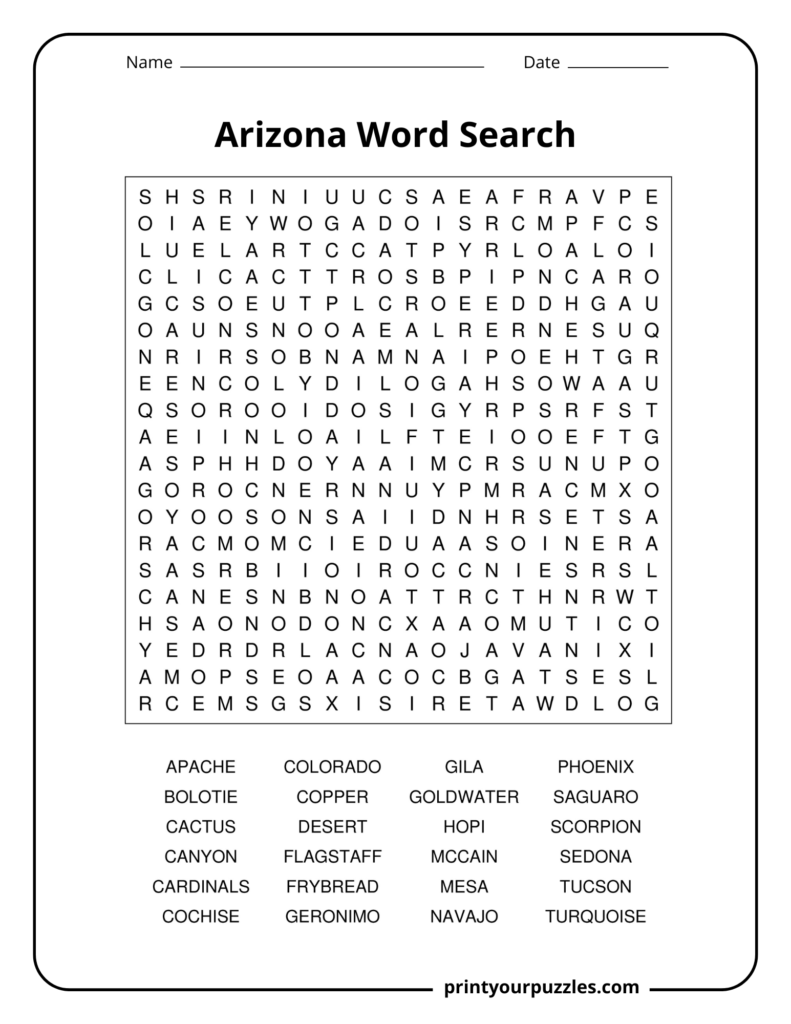
APACHE, BOLOTIE, CACTUS, CANYON, CARDINALS, COCHISE, COLORADO, COPPER, DESERT, FLAGSTAFF, FRYBREAD, GERONIMO, GILA, GOLDWATER, HOPI, MCCAIN, MESA, NAVAJO, PHOENIX, SAGUARO, SCORPION, SEDONA, TUCSON, TURQUOISE
Arizona is famous for the Grand Canyon, Sonoran Desert, saguaro cacti, Native American heritage, copper mining, hot summers, stunning sunsets, and diverse landscapes ranging from deserts to mountains.
Phoenix is Arizona’s capital and largest city. Located in the Valley of the Sun, Phoenix serves as the state’s economic, cultural, and governmental center with over 1.6 million residents.
Arizona features diverse climates: scorching desert summers exceeding 110°F in Phoenix, mild winters, monsoon season bringing dramatic thunderstorms, and cooler mountain regions with snow in Flagstaff and higher elevations.
Arizona became the 48th state on February 14, 1912, making it the last of the contiguous United States to join the Union. It’s nicknamed the Grand Canyon State.
Phoenix is the largest city, followed by Tucson, Mesa, Chandler, Scottsdale, Glendale, and Flagstaff. The Phoenix metropolitan area contains over half of Arizona’s total population, approximately 4.9 million people.
For official state records and government services, visit the Arizona State Portal. If you are planning a trip, check out Visit Arizona to find travel guides.
Arizona remains on Mountain Standard Time year-round, refusing to “spring forward” since 1968. The exception is the Navajo Nation, which does observe daylight saving time for tribal consistency.
The original London Bridge was purchased, dismantled, and rebuilt in Lake Havasu City in 1971. This authentic Victorian-era bridge now stands as Arizona’s second-most popular tourist attraction.
Astronomer Clyde Tombaugh discovered Pluto from Lowell Observatory in Flagstaff on February 18, 1930. Arizona’s clear skies and high elevation make it ideal for astronomical observations and research facilities.
Over 27% of Arizona is designated as Native American reservations, more than any other state. The Navajo Nation alone covers 27,000 square miles across Arizona, Utah, and New Mexico.
Meteor Crater near Winslow is nearly one mile wide and 550 feet deep, created 50,000 years ago. NASA astronauts trained there before Apollo missions because it resembles lunar landscape.
Purus ut praesent facilisi dictumst sollicitudin cubilia ridiculus.