
This Benjamin Harrison word search provides an engaging way to discover America’s twenty-third president, who served from 1889 to 1893. Benjamin Harrison, born in Ohio and raised in Indiana, was a distinguished lawyer, Civil War general, and United States senator before winning the presidency. His administration witnessed unprecedented growth, with six states joining the Union—more than any other single presidential term.
Harrison’s presidency was marked by significant achievements despite his often-overlooked legacy. He championed the Sherman Antitrust Act to combat monopolies, expanded veterans’ pensions, supported civil service reform, and modernized the White House with electric lighting. As the grandson of President William Henry Harrison, he became part of the only grandfather-grandson presidential pair in American history. His defeat of Grover Cleveland in 1888 despite losing the popular vote demonstrated the complexity of the Electoral College system.
This Benjamin Harrison word search printable goes beyond a simple puzzle by including comprehensive educational resources. Each of the twenty-four words comes with a detailed 20-30 word definition explaining its historical significance. The puzzle also features a FAQ section answering common questions about Harrison’s life and presidency, plus a fascinating Did You Know? section revealing surprising facts—including how Harrison was so terrified of the newly installed electric lights that his family left them burning all night.
This word search printable transforms learning about presidential history into an interactive, enjoyable experience perfect for students, educators, and history enthusiasts seeking to understand Benjamin Harrison’s important contributions to American democracy.
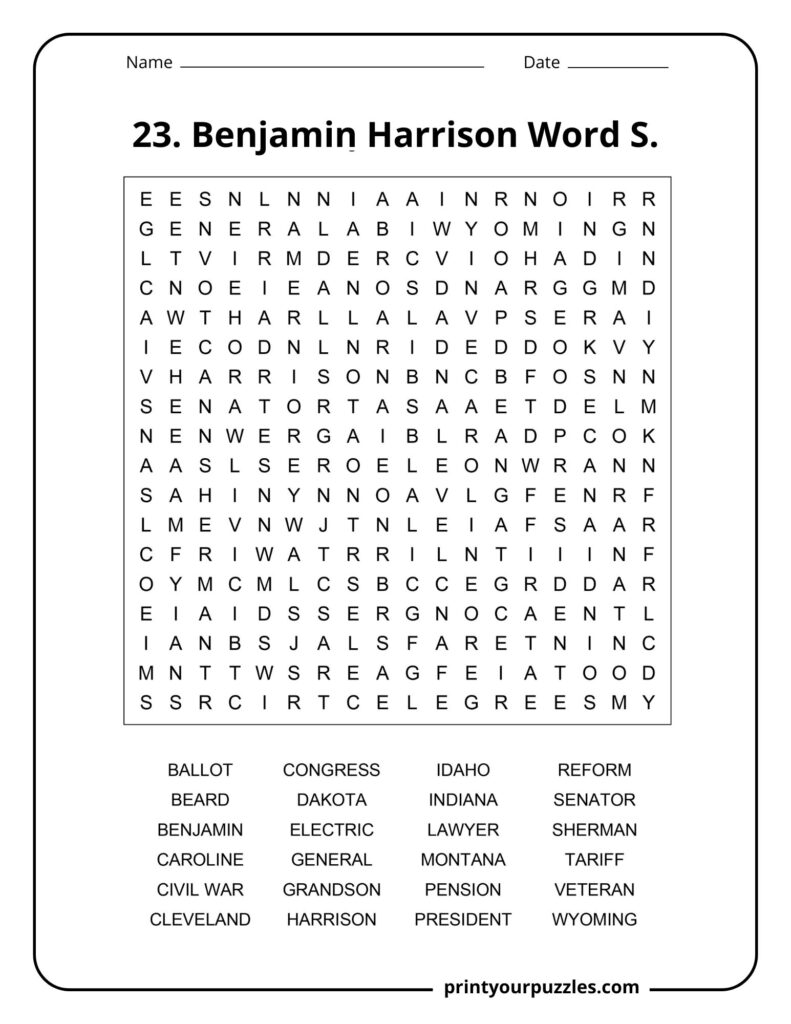
BALLOT, BEARD, BENJAMIN, CAROLINE, CIVIL WAR, CLEVELAND, CONGRESS, DAKOTA, ELECTRIC, GENERAL, GRANDSON, HARRISON, IDAHO, INDIANA, LAWYER, MONTANA, PENSION, PRESIDENT, REFORM, SENATOR, SHERMAN, TARIFF, VETERAN, WYOMING
BALLOT – Harrison won the presidency in 1888 despite losing the popular vote to Cleveland, demonstrating how the Electoral College system can override the general ballot count.
BEARD – Benjamin Harrison was known for his full, distinguished beard, which became one of his most recognizable physical features and contributed to his dignified presidential appearance.
BENJAMIN – Harrison’s first name, he was named after his great-grandfather Benjamin Harrison V, a signer of the Declaration of Independence and prominent Virginia political figure.
CAROLINE – Caroline Lavinia Scott Harrison was Benjamin’s first wife, First Lady from 1889-1892, who died of tuberculosis during his presidency, just before the 1892 election.
CIVIL WAR – Harrison served as a colonel and brigadier general in the Union Army during the Civil War, leading troops in the Atlanta Campaign under General Sherman.
CLEVELAND – Grover Cleveland was Harrison’s predecessor and successor, losing to Harrison in 1888 but defeating him in their 1892 rematch, serving non-consecutive presidential terms.
CONGRESS – Harrison worked with Congress to pass significant legislation including the Sherman Antitrust Act and the McKinley Tariff, though Republicans lost their majority in 1890.
DAKOTA – Both North Dakota and South Dakota were admitted to the Union in November 1889 during Harrison’s presidency, expanding the nation to forty-two states simultaneously.
ELECTRIC – Harrison had electric lights installed in the White House in 1891, though he and his family reportedly feared electrocution and often left them burning overnight.
GENERAL – Harrison achieved the rank of brevet brigadier general during the Civil War, commanding the 70th Indiana Infantry Regiment in Sherman’s march through Georgia and the Carolinas.
GRANDSON – Harrison was the grandson of William Henry Harrison, the ninth president, making them the only grandfather-grandson pair to both serve as President of the United States.
HARRISON – The family surname carried significant political weight in America, connecting Benjamin to both his presidential grandfather and his great-grandfather, a Declaration of Independence signer.
IDAHO – Idaho was admitted as the forty-third state on July 3, 1890, during Harrison’s administration, following its territorial status since 1863 and expanding representation westward.
INDIANA – Harrison’s home state where he practiced law and built his political career, serving as senator before his presidency and maintaining strong ties to Indianapolis.
LAWYER – Harrison was a prominent attorney in Indianapolis, specializing in business and civil cases, which established his reputation and financial stability before entering national politics.
MONTANA – Montana became the forty-first state on November 8, 1889, just one day before the Dakotas, part of Harrison’s remarkable year admitting six new states.
PENSION – Harrison signed the Dependent and Disability Pension Act of 1890, dramatically expanding benefits to Civil War veterans and their dependents, pleasing his Republican base significantly.
PRESIDENT – Harrison served as the twenty-third President of the United States from 1889 to 1893, focusing on tariff policy, civil service reform, and western expansion initiatives.
REFORM – Harrison supported civil service reform, expanding the classified civil service system and appointing qualified individuals based on merit rather than pure political patronage considerations.
SENATOR – Harrison represented Indiana in the United States Senate from 1881 to 1887, where he gained national prominence before winning the Republican presidential nomination in 1888.
SHERMAN – The Sherman Antitrust Act of 1890, signed by Harrison, was landmark legislation aimed at preventing monopolies and restraining anti-competitive business practices in interstate commerce.
TARIFF – The McKinley Tariff of 1890 raised import duties to protect American industries but became politically unpopular due to increased consumer prices, hurting Republican electoral prospects.
VETERAN – As a Civil War veteran himself, Harrison strongly supported veterans’ causes, expanding pensions and benefits, which strengthened his support among Union army veterans nationwide.
WYOMING – Wyoming was admitted as the forty-fourth state on July 10, 1890, notable as the first state granting women full voting rights before achieving statehood.
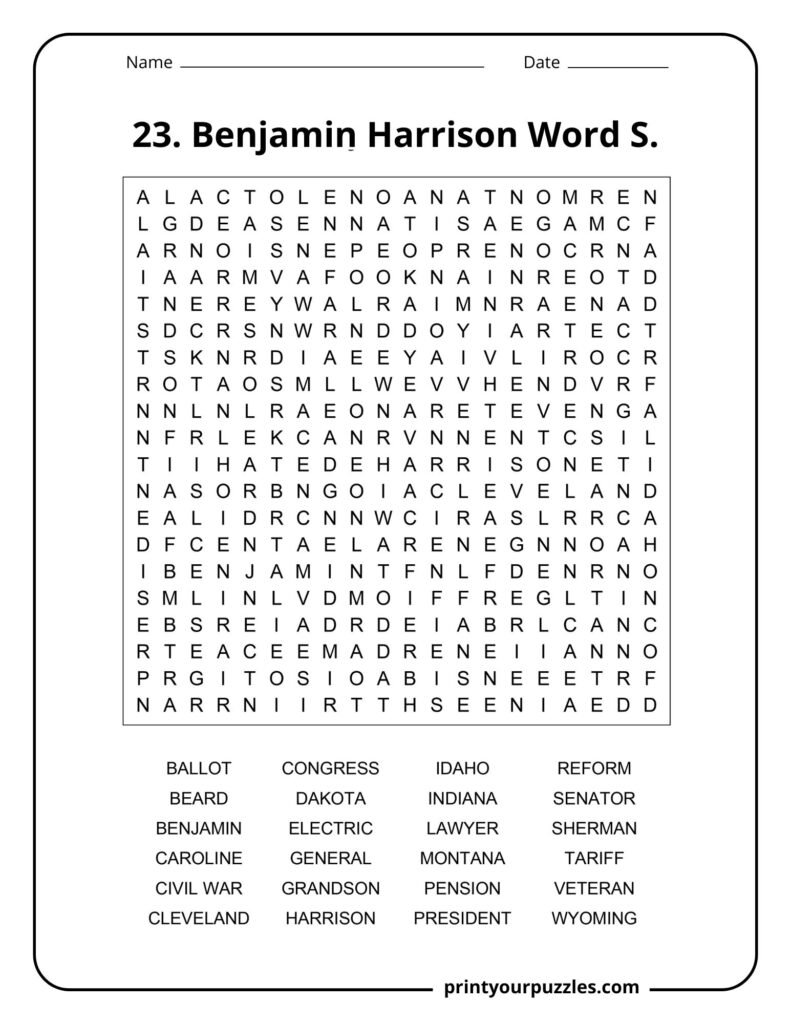
BALLOT, BEARD, BENJAMIN, CAROLINE, CIVIL WAR, CLEVELAND, CONGRESS, DAKOTA, ELECTRIC, GENERAL, GRANDSON, HARRISON, IDAHO, INDIANA, LAWYER, MONTANA, PENSION, PRESIDENT, REFORM, SENATOR, SHERMAN, TARIFF, VETERAN, WYOMING
Benjamin Harrison was the twenty-third President of the United States, serving from 1889 to 1893. He was a Civil War general, Indiana senator, and lawyer from Indianapolis.
Harrison was the grandson of William Henry Harrison, the ninth president. They remain the only grandfather-grandson pair to both serve as President of the United States.
Harrison signed the Sherman Antitrust Act, expanded veterans’ pensions, supported civil service reform, and oversaw the admission of six states: Montana, Idaho, Wyoming, North and South Dakota, and Washington.
Electoral College 233-168, despite receiving about 90,000 fewer popular votes, demonstrating how the electoral system can override popular majorities.
First Lady Caroline Harrison died of tuberculosis in October 1892, just two weeks before the presidential election. Harrison lost his reelection bid to Grover Cleveland while mourning his wife.
For official administration records and historical biography, visit the Benjamin Harrison page in the White House Archives. If you are planning a trip, visit the official Benjamin Harrison Presidential Site.
Benjamin Harrison: The American Presidents Series by Charles W. Calhoun. The best concise treatment of a cold but capable president sandwiched between Cleveland’s two terms, often overlooked by historians.
After electricity was installed in 1891, Harrison and his family were so afraid of electrocution they often left lights burning all night rather than risk touching the switches themselves.
In 1889, Harrison became the first sitting president recorded on Thomas Edison’s phonograph cylinder, though the recording quality was extremely poor and barely audible by modern standards.
Standing five feet six inches tall, Harrison earned the nickname “Little Ben” partially due to comparison with his grandfather, though his opponents used it mockingly during campaigns.
Despite being an excellent public speaker, Harrison’s aloof personality and formal manner earned him this unflattering nickname among politicians and the press who found him personally distant.
Six states joined the Union during Harrison’s single term—North Dakota, South Dakota, Montana, Washington, Idaho, and Wyoming—a record never matched by any other president in history.