
Biology word search puzzles offer an engaging and educational way to explore the fascinating world of life sciences. This Biology word search printable features 24 carefully selected terms that cover fundamental concepts every student should know, from microscopic organisms like bacteria and amoeba to complex processes such as mitosis and evolution. Each word has been chosen to represent key topics in biology, including cellular structures, genetics, ecology, and physiology.
What makes this word search printable especially valuable is that every term is accompanied by a clear, concise definition of 20-30 words. This means learners don’t just find words in the grid—they also understand what each term means and its significance in biological science. Whether you’re a student reviewing for an exam, a teacher looking for classroom activities, or simply someone interested in biology, this puzzle combines entertainment with education.
The challenge of locating hidden words helps reinforce spelling and recognition, while the definitions ensure comprehensive understanding of essential biological vocabulary that forms the foundation of life science knowledge.
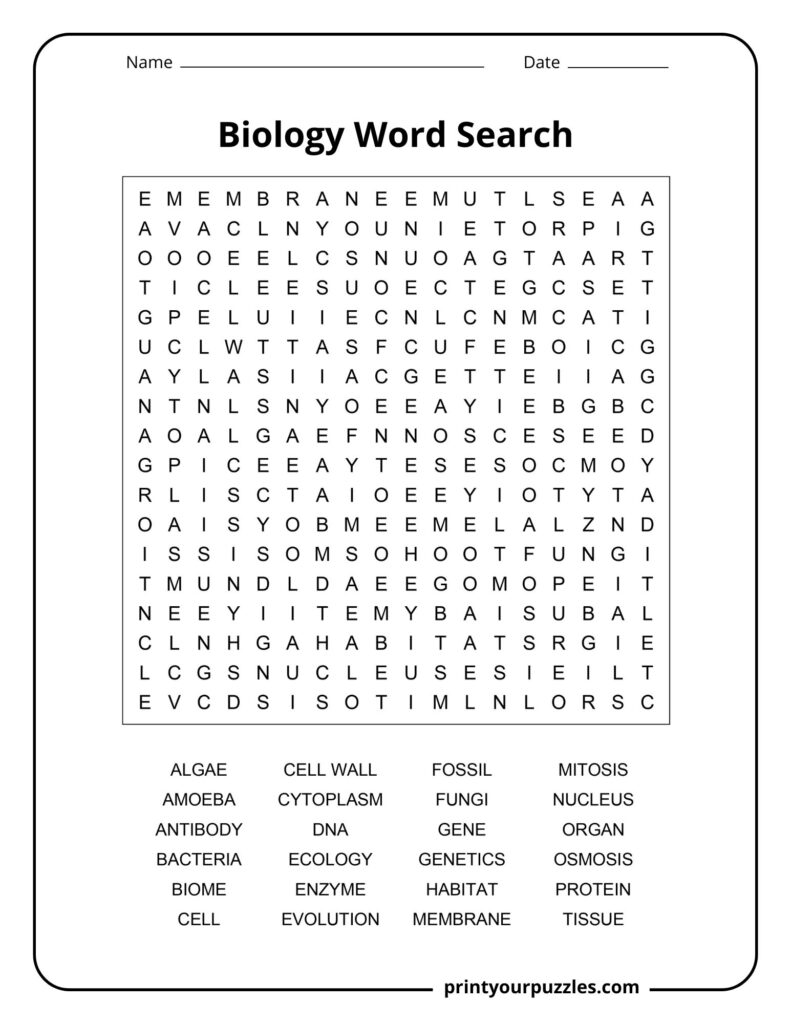
ALGAE, AMOEBA, ANTIBODY, BACTERIA, BIOME, CELL, CELL WALL, CYTOPLASM, DNA, ECOLOGY, ENZYME, EVOLUTION, FOSSIL, FUNGI, GENE, GENETICS, HABITAT, MEMBRANE, MITOSIS, NUCLEUS, ORGAN, OSMOSIS, PROTEIN, TISSUE
ALGAE – Simple aquatic organisms that perform photosynthesis, ranging from microscopic single cells to large seaweeds. They produce oxygen and form the base of many aquatic food chains.
AMOEBA – A single-celled organism that moves and feeds by extending finger-like projections called pseudopodia. It lacks a fixed shape and lives in water or soil environments.
ANTIBODY – A protective protein produced by the immune system that identifies and neutralizes foreign invaders like bacteria and viruses. Each antibody targets a specific antigen with remarkable precision.
BACTERIA – Microscopic single-celled organisms lacking a nucleus. They exist everywhere on Earth, performing essential roles in decomposition, digestion, and nutrient cycling. Some cause diseases while others are beneficial.
BIOME – A large geographical area characterized by specific climate conditions, plants, and animals. Examples include deserts, rainforests, tundra, and grasslands, each with distinct ecosystems and biodiversity patterns.
CELL – The smallest unit of life, containing genetic material and machinery for growth and reproduction. All living organisms are composed of one or more cells with specialized functions.
CELL WALL – A rigid protective layer surrounding plant, fungal, and bacterial cells, located outside the cell membrane. It provides structural support, maintains shape, and prevents excessive water uptake.
CYTOPLASM – The gel-like substance filling the cell between the membrane and nucleus. It contains organelles, nutrients, and enzymes where many metabolic reactions occur to sustain cellular life.
DNA – Deoxyribonucleic acid, the molecule carrying genetic instructions for development, functioning, and reproduction. Its double helix structure stores information in sequences of four chemical bases: adenine, thymine, guanine, cytosine.
ECOLOGY – The scientific study of interactions between organisms and their environment. It examines relationships among living things and how ecosystems function, including energy flow and nutrient cycling patterns.
ENZYME – A biological catalyst protein that speeds up chemical reactions in living organisms without being consumed. Each enzyme has a specific shape that binds to particular molecules called substrates.
EVOLUTION – The gradual process by which species change over generations through natural selection and genetic variation. Organisms better adapted to their environment survive and reproduce more successfully than others.
FOSSIL – Preserved remains or traces of ancient organisms found in sedimentary rock. Fossils provide evidence of past life forms and help scientists understand evolutionary history and Earth’s biological changes.
FUNGI – A kingdom of organisms including mushrooms, molds, and yeasts. They decompose organic matter, form symbiotic relationships with plants, and reproduce through spores rather than seeds or eggs.
GENE – A segment of DNA that contains instructions for making a specific protein or performing a particular function. Genes are inherited from parents and determine an organism’s traits and characteristics.
GENETICS – The branch of biology studying heredity and variation in living organisms. It examines how traits are passed from parents to offspring through genes and how DNA controls characteristics.
HABITAT – The natural environment where an organism lives, providing food, water, shelter, and space. Different species require specific habitat conditions including temperature, moisture, and available resources to survive.
MEMBRANE – A thin selective barrier surrounding cells and
organelles, controlling the passage of substances in and out. It consists of a lipid bilayer embedded with proteins for transport and communication.
MITOSIS – The process by which a cell divides to produce two identical daughter cells with the same genetic material. It involves chromosome replication and separation, enabling growth and tissue repair.
NUCLEUS – The control center of eukaryotic cells, containing chromosomes with DNA. It regulates gene expression and coordinates cellular activities including growth, metabolism, protein synthesis, and cell division through reproduction.
ORGAN – A collection of different tissues working together to perform specific functions within an organism. Examples include the heart, lungs, brain, and stomach, each with specialized roles in survival.
OSMOSIS – The movement of water molecules across a semipermeable membrane from areas of higher water concentration to lower concentration. This passive transport process is crucial for maintaining cellular water balance.
PROTEIN – Large complex molecules made of amino acids that perform most cellular functions. They act as enzymes, antibodies, structural components, and messengers, essential for body structure, function, and regulation.
TISSUE – A group of similar cells working together to perform a specific function in multicellular organisms. Four main types exist in animals: epithelial, connective, muscle, and nervous tissue.
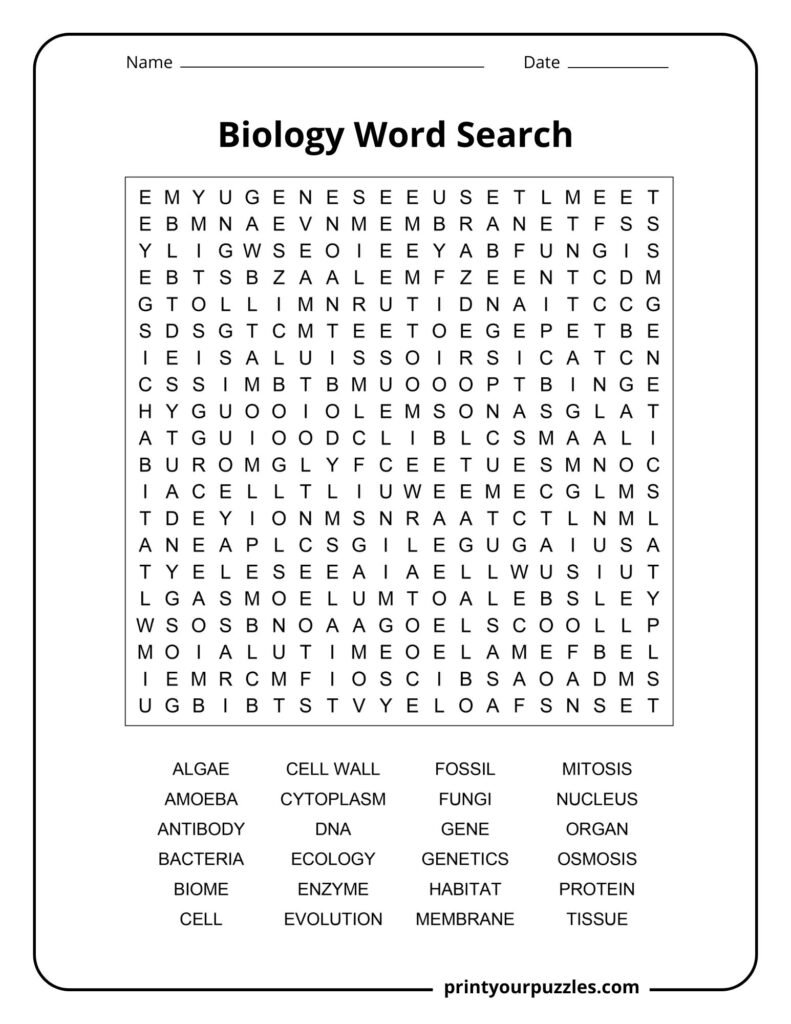
ALGAE, AMOEBA, ANTIBODY, BACTERIA, BIOME, CELL, CELL WALL, CYTOPLASM, DNA, ECOLOGY, ENZYME, EVOLUTION, FOSSIL, FUNGI, GENE, GENETICS, HABITAT, MEMBRANE, MITOSIS, NUCLEUS, ORGAN, OSMOSIS, PROTEIN, TISSUE
Biology is the scientific study of life and living organisms, including their structure, function, growth, evolution, distribution, and taxonomy. It encompasses everything from microscopic cells to entire ecosystems and biodiversity.
Biology helps us understand how living things work, develop medicines, protect ecosystems, improve agriculture, and solve health problems. It’s essential for addressing climate change, disease prevention, and food security challenges.
Major branches include zoology (animals), botany (plants), microbiology (microorganisms), genetics (heredity), ecology (environmental interactions), molecular biology (cellular processes), and anatomy (body structure). Each specializes in different life aspects.
Prokaryotic cells lack a nucleus and membrane-bound organelles, found in bacteria and archaea. Eukaryotic cells have a nucleus and organelles, characteristic of animals, plants, fungi, and protists.
Organisms with advantageous traits survive and reproduce more successfully, passing these traits to offspring. Over time, beneficial characteristics become more common in populations, driving evolutionary change and species adaptation.
Despite obvious differences, we share many basic cellular functions and genes with plants. This highlights our common evolutionary ancestry and the universal nature of genetic code across all life.
The human body contains approximately 39 trillion bacterial cells compared to 30 trillion human cells. These microorganisms play crucial roles in digestion, immunity, and overall health maintenance throughout life.
Two hearts pump blood to the gills while one pumps to the body. Their blood contains copper-based hemocyanin instead of iron-based hemoglobin, making it blue when oxygenated.
The brain’s billions of neurons require tremendous energy for thinking, processing information, and maintaining consciousness. This makes it the body’s most energy-demanding organ per unit mass.
Called the “wood wide web,” mycorrhizal fungi connect tree roots, allowing them to share nutrients, water, and chemical warning signals about pests or drought conditions with neighboring trees.

Purus ut praesent facilisi dictumst sollicitudin cubilia ridiculus.