
This Boston Tea Party word search offers an engaging way to explore one of America’s most pivotal historical events. The Boston Tea Party, which occurred on December 16, 1773, was a bold act of colonial defiance that helped spark the American Revolution. Patriots disguised as Mohawk Indians boarded British ships and dumped 342 chests of tea into Boston Harbor, protesting taxation without representation.
Our Boston Tea Party word search printable contains 24 carefully selected words, each directly connected to this historic protest. From key figures like Samuel Adams and John Hancock to important concepts like liberty, taxes, and patriots, every term helps tell the story of colonial resistance against British rule. The word search printable is designed for educational purposes, making it perfect for students, history enthusiasts, and anyone wanting to learn more about this revolutionary event.
What makes this puzzle especially valuable is that all words are thoroughly defined with 20-30 word explanations, providing historical context and deeper understanding. This combination of interactive learning and detailed definitions creates a comprehensive educational resource that brings the Boston Tea Party to life while challenging your puzzle-solving skills.
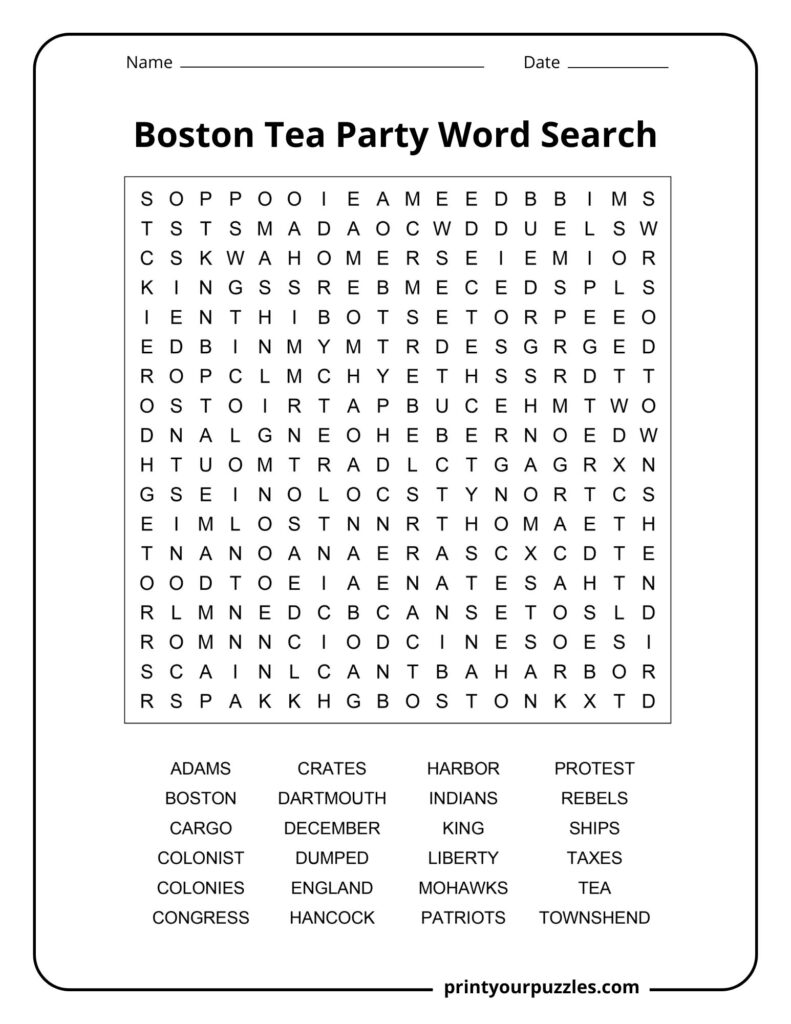
ADAMS, BOSTON, CARGO, COLONIST, COLONIES, CONGRESS, CRATES, DARTMOUTH, DECEMBER, DUMPED, ENGLAND, HANCOCK, HARBOR, INDIANS, KING, LIBERTY, MOHAWKS, PATRIOTS, PROTEST, REBELS, SHIPS, TAXES, TEA, TOWNSHEND
ADAMS – Samuel Adams was a prominent patriot leader and organizer who helped plan the Boston Tea Party protest against British taxation without colonial representation.
BOSTON – The colonial city in Massachusetts where patriots dumped tea into the harbor on December 16, 1773, protesting British taxation and control over commerce.
CARGO – The shipment of British East India Company tea aboard three vessels, valued at approximately 10,000 pounds sterling, that colonists destroyed during the protest.
COLONIST – A person living in one of Britain’s thirteen American colonies who faced taxation without parliamentary representation, fueling resentment toward British rule and policies.
COLONIES – The thirteen British territories along North America’s eastern coast that united in opposition to unfair taxation, eventually leading to the American Revolutionary War.
CONGRESS – Colonial assembly bodies that coordinated resistance against British policies, later forming the Continental Congress to govern and unite the rebelling American colonies together.
CRATES – Wooden containers holding approximately 342 chests of tea that patriots broke open and emptied into Boston Harbor during the midnight protest action.
DARTMOUTH – One of three British ships carrying East India Company tea that was boarded by disguised colonists who dumped its cargo into Boston Harbor.
DECEMBER – The month in 1773 when the Boston Tea Party occurred specifically on the night of December 16, marking a pivotal act of colonial defiance.
DUMPED – The action of throwing 342 chests containing over 92,000 pounds of British tea into Boston Harbor, destroying the valuable cargo as political protest.
ENGLAND – The ruling nation that imposed taxes and trade restrictions on American colonies, sparking resistance that culminated in events like the Boston Tea Party.
HANCOCK – John Hancock was a wealthy merchant and patriot leader who supported the tea protest and later became the first signer of the Declaration.
HARBOR – Boston Harbor was the waterfront location where tea-laden British ships docked and where patriots dumped the cargo during their nighttime protest raid.
INDIANS – The disguise worn by colonists who dressed as Mohawk Native Americans to conceal their identities while boarding ships and destroying the tea cargo.
KING – King George III ruled Britain during the colonial period, enforcing taxation policies that angered American colonists and provoked acts of rebellion and resistance.
LIBERTY – The freedom from British tyranny and taxation without representation that American colonists sought, making the tea party a symbolic fight for independence.
MOHAWKS – The Native American tribe whose appearance colonists imitated by wearing disguises, using war paint and feathers while conducting the tea party protest.
PATRIOTS – Colonists who opposed British rule and taxation, organizing resistance movements including the Boston Tea Party to protest unfair policies and defend colonial rights.
PROTEST – An act of organized resistance against the Tea Act and British taxation, demonstrating colonial unity and willingness to defy British authority through action.
REBELS – Colonists who actively defied British laws and authority, risking punishment by participating in acts like the Boston Tea Party to resist imperial control.
SHIPS – The three British vessels named Dartmouth, Eleanor, and Beaver that carried East India Company tea and were boarded during the Boston Tea Party.
TAXES – Duties imposed by Britain on colonial goods including tea, creating resentment over taxation without representation that sparked resistance movements and eventual revolution.
TEA – The British East India Company product taxed under the Tea Act, symbolizing colonial oppression and becoming the target of destruction during the protest.
TOWNSHEND – The Townshend Acts imposed duties on imported goods including tea, glass, and paper, angering colonists and contributing to revolutionary sentiment in America.
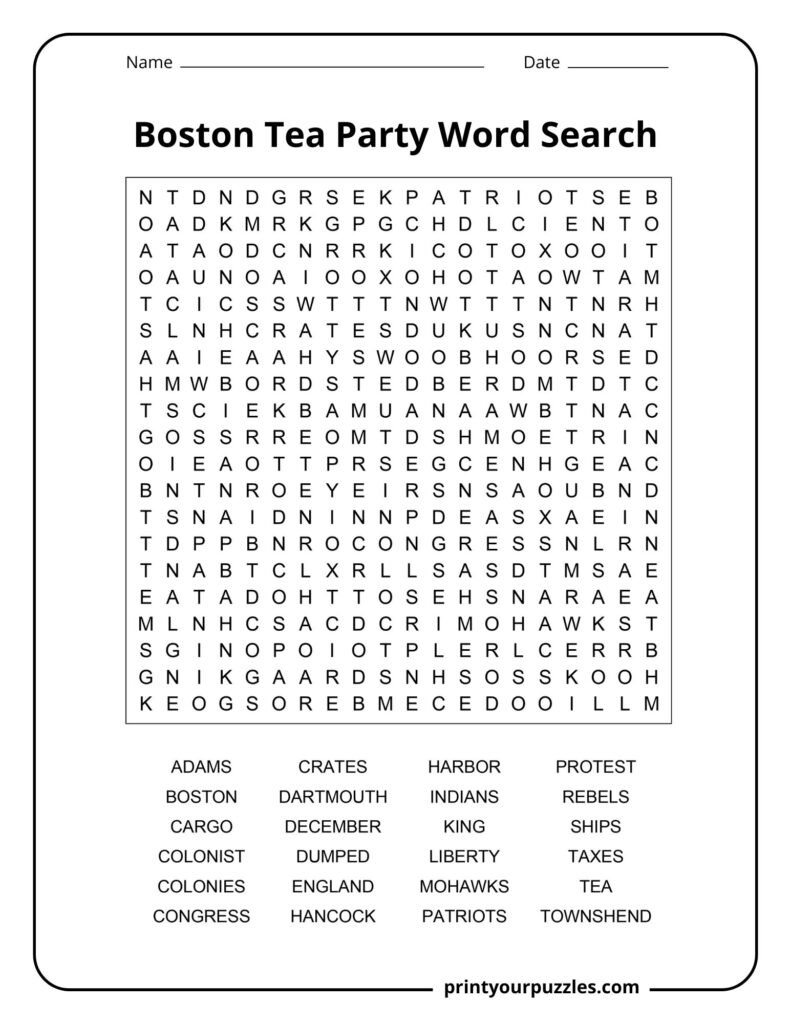
ADAMS, BOSTON, CARGO, COLONIST, COLONIES, CONGRESS, CRATES, DARTMOUTH, DECEMBER, DUMPED, ENGLAND, HANCOCK, HARBOR, INDIANS, KING, LIBERTY, MOHAWKS, PATRIOTS, PROTEST, REBELS, SHIPS, TAXES, TEA, TOWNSHEND
The Boston Tea Party was a political protest on December 16, 1773, where American colonists dumped 342 chests of British tea into Boston Harbor, opposing taxation without representation.
Colonists protested the Tea Act of 1773, which granted the British East India Company a monopoly on tea sales while imposing taxes without colonial consent or representation.
Approximately 100-150 colonists participated, including members of the Sons of Liberty. They disguised themselves as Mohawk Indians to conceal their identities during the nighttime raid.
Britain responded with the Coercive Acts, called Intolerable Acts by colonists, closing Boston Harbor and imposing military rule, which further united colonies toward revolution and independence.
Patriots destroyed approximately 342 chests containing over 92,000 pounds of tea, valued at roughly 10,000 pounds sterling, causing significant financial loss to Britain’s economy.
Colonists originally referred to it as “the destruction of the tea.” The famous name “Boston Tea Party” wasn’t popularized until decades later, during the 1820s.
After destroying the tea, patriots carefully swept the ship decks and even replaced a broken padlock, ensuring they only damaged the tea, nothing else.
Despite destroying valuable cargo worth thousands of pounds, the protest remained remarkably peaceful with no violence, injuries, or deaths reported during the entire event.
The dumped tea floated and washed ashore for weeks following the event. Some colonists reportedly collected tea leaves from the beaches despite the protest’s purpose.
Fearing British prosecution, most participants remained anonymous for years. Some never revealed their involvement, taking the secret to their graves to avoid potential punishment.
Purus ut praesent facilisi dictumst sollicitudin cubilia ridiculus.